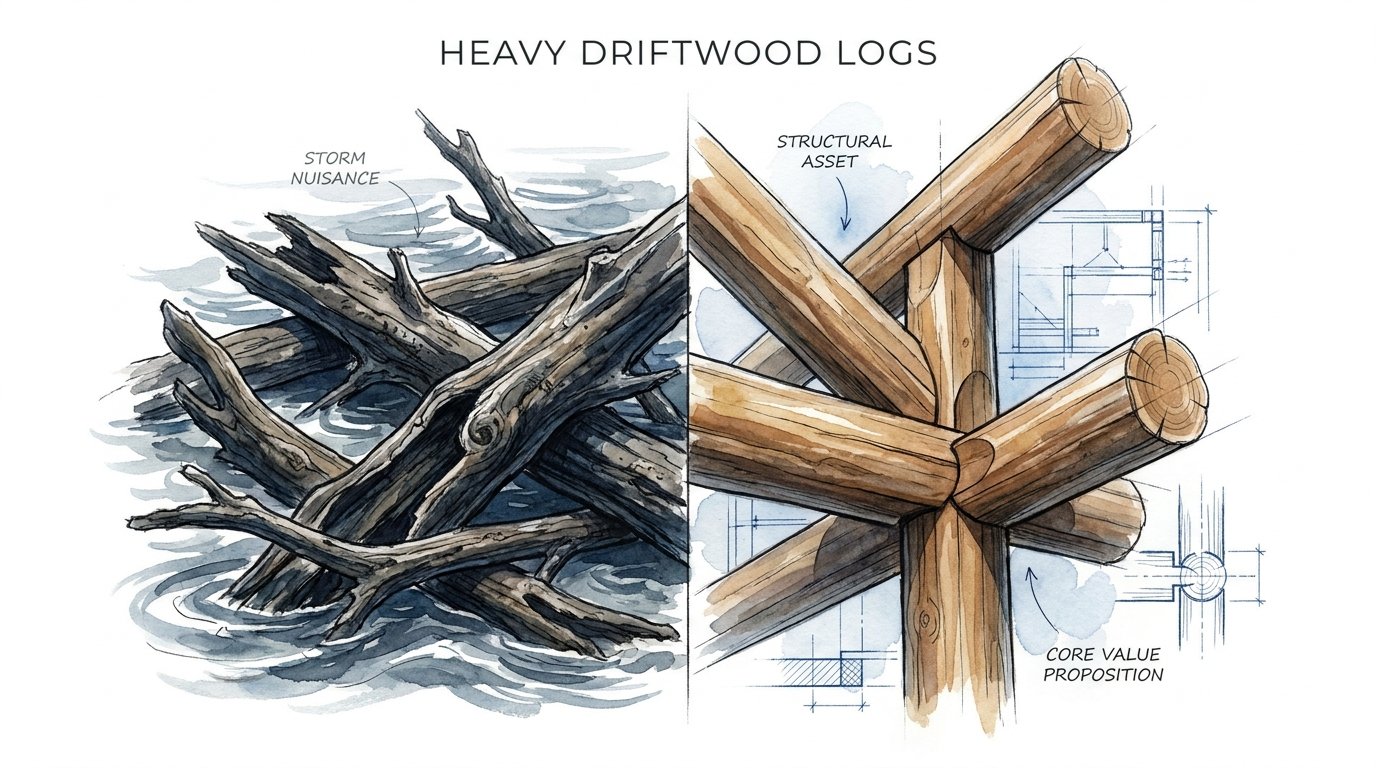
Building With Heavy Driftwood Logs
Stop seeing the storm’s wreckage and start seeing the bones of your next addition. Most cottage owners call the local council to remove heavy logs after a storm. The wise ones reach for their winches. Driftwood that survived a thousand miles of ocean travel isn’t trash; it is the most resilient, salt-tempered building material on earth. While your neighbors pay thousands for lumber, the tide is delivering industrial-grade pillars to your doorstep for free.
[affiai]Building with these giants requires a shift in perspective. You are no longer just a carpenter; you are a scavenger and a pioneer. This process demands respect for the raw power of the ocean and the physics of heavy timber. This guide will walk you through the grit and glory of turning tide-beaten timber into permanent structures.
Building With Heavy Driftwood Logs
Building with heavy driftwood logs refers to the practice of sourcing, preparing, and utilizing large-scale timber recovered from shorelines for structural or semi-structural construction. These logs are often massive trunks or limbs that have been uprooted by storms and transported by river or sea currents. Unlike standard lumber, these pieces have undergone a natural stress-test of crushing pressures, saltwater saturation, and intense UV exposure.
In the real world, this material serves as the foundation for coastal cabins, sturdy garden gazebos, or retaining walls that need to withstand harsh environments. The salt-tempering process that occurs during years at sea creates a wood that is remarkably resistant to typical rot and pest infestation. When you build with driftwood, you are using a material that has already proven its durability against the most aggressive elements on the planet.
Visualizing these logs as “industrial-grade pillars” is key. A single Douglas fir or Cedar log pulled from the surf can possess the structural integrity of a kiln-dried beam but with a density and weathered character that no sawmill can replicate. These logs are often used as vertical posts in post-and-beam construction or as lintels for doorways where a rustic, authoritative aesthetic is desired.
The Recovery and Preparation Process
Turning a massive, waterlogged trunk into a usable building component involves several critical stages. You cannot simply pull a log out of the sand and start notching it. The wood must be stabilized and cleaned to ensure it doesn’t destroy your tools or the integrity of your finished structure.
Recovery and Handling
Recovering these giants requires specialized equipment. Most logs are far too heavy for manual lifting, often weighing several tons when fully saturated. Use a heavy-duty winch or a 4×4 vehicle equipped with a snatch block to drag the timber above the high-tide line. Professional-grade log tongs are essential for a secure grip, especially when the wood is slick with algae or brine.
Cleaning and Desalination
Once the log is on dry ground, the first priority is removing sand and salt. High-pressure washing is the most effective method to blast away mud, sand, and loose organic matter that has wedged into the grain. Use a stiff-bristled brush to scrub deep into the cracks. Salt is a hygroscopic material, meaning it attracts moisture from the air, which can lead to internal rot if left trapped inside the fibers.
Soaking the wood in fresh water for several days can help “leach” the salt out of the outer layers. This desalination step is vital if you intend to use any metal fasteners later on, as salt will accelerate the corrosion of even high-quality steel.
Seasoning and Drying
Logs pulled from the ocean are often over 100% moisture content. Using them immediately will result in severe checking, warping, and shrinking as they dry in place. Stack the logs on skids at least 12 inches off the ground to allow for maximum airflow. Cover the top of the pile to protect them from rain, but keep the sides open.
Aim for a surface moisture level of 18% or less before beginning construction. Depending on the thickness of the log and your local climate, this seasoning process can take anywhere from six months to two years. Patience here ensures that your joints remain tight and your structure remains plumb for decades.
The Benefits of Using Salt-Tempered Timber
The primary advantage of driftwood is its inherent resilience. Years of exposure to saltwater act as a natural preservative. The salt inhibits the growth of many common fungi and discourages wood-boring insects like termites, which find the mineral-heavy wood unpalatable.
Durability and Strength
Research from organizations like the USDA Forest Service suggests that while salt-damaged wood may show a “stringy” surface texture, the actual reduction in structural strength is often less than 7%. This means a heavy driftwood log remains a formidable load-bearing asset. In many cases, the density of these logs has increased as minerals from the ocean fill the wood cells, creating a “petrified” effect that resists crushing better than fresh-cut timber.
Sustainability and Cost-Efficiency
Sourcing your own timber is the ultimate form of sustainable building. You are effectively recycling carbon that would otherwise rot or be burned. Beyond the environmental impact, the cost savings are astronomical. Large-diameter logs (12 inches or greater) are incredibly expensive at commercial lumber yards, but the ocean provides them at the cost of your labor and fuel.
Aesthetic Uniqueness
Every driftwood log is a one-of-a-kind sculpture. The silver-grey patina and naturally sculpted knots provide a “pioneer” look that is impossible to manufacture. Architects often pay a premium for “distressed” wood, yet the tide provides the genuine article for free.
Challenges and Common Pitfalls
Building with driftwood is not without its trials. The same properties that make it durable also make it difficult to work with. Ignoring the unique chemistry of sea-wood is the quickest way to a structural failure.
Fastener Corrosion
Standard galvanized nails and screws will fail within a few seasons when driven into salt-saturated wood. The residual salt acts as an electrolyte, creating a battery effect that eats through zinc coatings. This leads to “nail sickness,” where the wood around the fastener rots because of the metal’s oxidation.
Weight and Transport
Heavy logs require more than just muscle; they require engineering. A waterlogged log can weigh three times its dry weight. Attempting to move these without proper rigging leads to back injuries and damaged equipment. Always calculate the potential weight before committing to a recovery mission.
Tool Wear
Sand is often deeply embedded in the grain of driftwood. This silica acts like sandpaper on your chainsaw chains and chisels. You will find yourself sharpening tools ten times more often than when working with clean, store-bought lumber. Failing to keep tools sharp results in dangerous kickbacks and messy, inaccurate joinery.
Limitations of Driftwood Construction
While driftwood is excellent for many projects, it is not a universal solution. Certain constraints make it unsuitable for specific types of modern construction.
- Predictability: Driftwood lacks the uniform strength ratings of graded lumber. You cannot look up a “driftwood span table” in a building code book.
- Internal Rot: A log may look solid on the outside but be “punky” or rotten at the core. Inspecting the heartwood is difficult without cutting the log open.
- Legal Constraints: In many jurisdictions, such as Washington State or parts of the UK, collecting large driftwood is heavily regulated or prohibited to protect coastal ecosystems.
- Buoyancy: If used in shoreline structures like docks, driftwood requires massive amounts of ballast to prevent it from floating away during high water events.
Practical Tips for the Modern Scavenger
Success in this field comes down to the details. Apply these best practices to ensure your project stands the test of time.
Always use 316 Stainless Steel. This is the only grade of steel that can truly withstand the chloride-rich environment inside driftwood. While more expensive, it prevents the structural failure of your joints. Silicon bronze is a suitable alternative for high-end decorative work.
Seal the end grain immediately. Once you cut a log to length, the end grain will lose moisture much faster than the sides, leading to deep cracks (checking). Apply a heavy coat of wax-based end-sealer to slow the drying process and keep the log intact.
Use the “thump test.” Strike a log with a heavy mallet. A solid, healthy log will produce a clear, ringing tone. A dull, thudding sound indicates internal rot or excessive moisture. Leave the “thuds” on the beach.
Maintain a “pioneer” tool kit. Have extra chains, a high-quality drawknife for peeling bark, and a sturdy peavey for rolling logs. These traditional tools are often more effective than modern power tools when dealing with irregular, sand-covered surfaces.
Advanced Engineering with Irregular Shapes
Serious practitioners eventually move beyond simple stacking. Using the natural curves of driftwood allows for advanced “organic joinery.” For example, a log with a slight natural bend can be positioned with the curve facing upward in a roof structure. The weight of the roof will naturally push down on the “arch,” utilizing the wood’s own tension to increase load capacity.
In post-and-beam driftwood builds, the “scribed” joint is king. This involves mapping the exact contour of one irregular log onto another using a compass or scriber. You then carve a custom seat for the log to rest in, creating a joint that looks like the two pieces grew together. This is a time-consuming skill, but it results in a structure that can survive earthquakes and hurricanes where nail-reliant frames might buckle.
Example Scenario: The Shoreline Gazebo
Imagine a builder who recovers four 10-foot Cedar logs after a winter gale. These logs average 14 inches in diameter—massive enough to serve as corner posts.
First, the builder winches them to a drying shed, peels the bark to discourage beetles, and lets them season for 14 months. Once the moisture hits 15%, the builder uses a chainsaw to cut flat “sills” on the bottom of each post.
Instead of standard concrete anchors, the builder uses 316-grade stainless steel drift pins—long, thick rods—to secure the posts to a stone foundation. For the headers, the builder selects slightly thinner logs and uses a “saddle notch” to seat them atop the posts. The result is a gazebo that weighs several tons, naturally resists the salt air, and costs nothing in lumber.
Final Thoughts
Building with heavy driftwood logs is a return to a more deliberate, resourceful way of living. It forces you to work with the materials the earth provides rather than forcing the earth to provide what is convenient for you. While the labor is intensive and the learning curve is steep, the reward is a structure with a soul—a building that carries the history of the ocean in its grain.
Do not be discouraged by the grit and the sand. Every “trash” log on the beach is a potential pillar for your next great project. Start small, perhaps with a bench or a gate, and learn how the wood speaks. Once you master the art of the salt-tempered log, you will never look at a storm the same way again. Experiment with these methods, respect the legal boundaries of your coastline, and start building your legacy from the wreckage of the tide.
Sources
1 peartreehomes.net (https://peartreehomes.net/post/salt-air-impacts-building-materials/) | 2 airfixture.com (https://airfixture.com/resources/heavy-timber-construction) | 3 fairwindfasteners.com (https://fairwindfasteners.com/blogs/news/the-ultimate-guide-to-marine-fasteners) | 4 eagleclawco.com (https://www.eagleclawco.com/blogs/news/what-screws-are-best-for-salt-water)