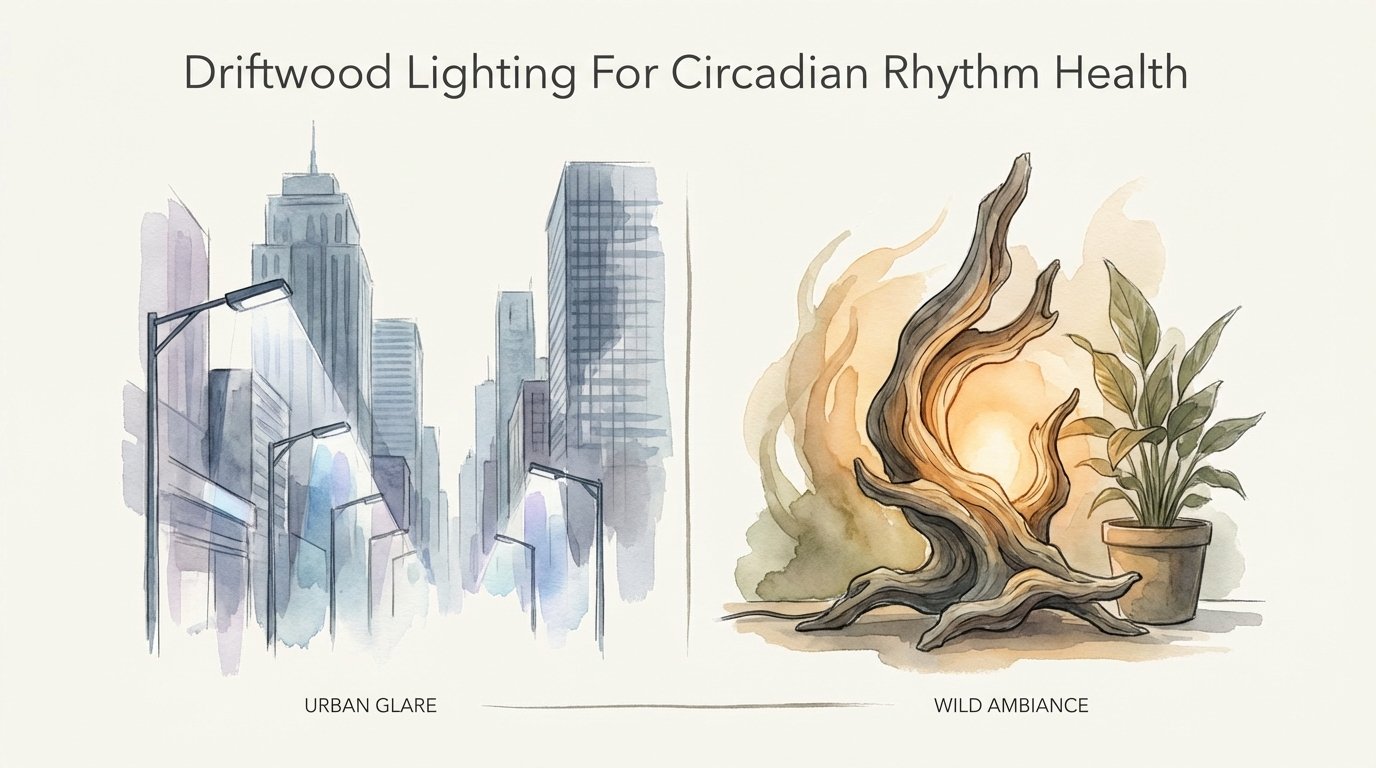
Driftwood Lighting For Circadian Rhythm Health
Your body knows the difference between a light bulb and a sunset. Urban lighting is designed for productivity, not peace. The flat, blue-tinted glare of modern bulbs disrupts our sleep and spikes our cortisol. Filtering light through the complex, organic textures of driftwood recreates the dappled sunlight of our natural habitat. It’s not just a lamp; it’s a nervous system reset.
Modern living has pushed us into concrete boxes under the constant hum of flickering LEDs. These artificial suns scream at our brains to stay alert long after the real sun has dipped below the horizon. This constant exposure to high-energy visible (HEV) blue light tells the pineal gland to hold back on melatonin, the hormone that governs our repair cycles. We end up wired, tired, and disconnected from the very rhythms that kept our ancestors resilient.
Choosing a driftwood lamp is an intentional act of rebellion against this sterile environment. It brings the unpredictable, weathered beauty of the coast into the bedroom or office. Beyond the aesthetics, the way light interacts with the grain, cracks, and salt-worn curves of the wood changes the quality of the illumination itself. This article explores how driftwood lighting serves as a functional tool for biological health.
Driftwood Lighting For Circadian Rhythm Health
Circadian rhythm health refers to the internal 24-hour clock that regulates everything from your body temperature to your immune response. This clock is primarily “set” by the light that enters your eyes. In the wild, humans were exposed to high-intensity, blue-rich light during the day and low-intensity, warm-colored light from fire at night. Driftwood lighting serves as a modern bridge back to this ancestral pattern.
Driftwood lamps function by providing a physical barrier and a natural diffuser for artificial light sources. Instead of a bare bulb casting a uniform, harsh shadow, the light must navigate the organic geometry of the wood. This creates a “dappled” effect, similar to sunlight filtering through a forest canopy. Research into biophilic design suggests that these natural patterns—often called fractals—have a measurably calming effect on the human brain.
In real-world terms, using driftwood lighting in the evening helps transition the body into a “rest and digest” state. The warm hues reflected off the wood grain emphasize the red and amber parts of the spectrum. These wavelengths do not suppress melatonin production as aggressively as the cool whites found in standard overhead lighting. A driftwood lamp in a dark corner isn’t just a decoration; it is a signal to your biology that the day is done.
The Role of Melanopsin
Melanopsin is a light-sensitive pigment in our eyes that is specifically tuned to detect blue light. When this pigment is activated, it sends a direct message to the suprachiasmatic nucleus (SCN) in the brain to keep us awake. Driftwood lamps, especially when paired with low-Kelvin bulbs, minimize this activation. They provide enough visibility for evening tasks without hitting the “wake up” switch in the brain.
Biophilia and Stress Reduction
The concept of biophilia suggests that humans possess an innate tendency to seek connections with nature and other forms of life. Bringing a piece of wood shaped by the ocean into a room satisfies this primal need. Touching the wood or even just observing its complex texture can lower heart rate and blood pressure. This sensory engagement acts as a grounding mechanism against the high-frequency stress of urban life.
How the Light Diffusion Process Works
Understanding how driftwood transforms light requires a look at the physics of reflection and scattering. Standard lamp shades often use plastic or fabric to create a uniform glow. Driftwood, however, is a non-uniform surface with varying densities and textures.
Light hitting a piece of salt-cured wood is reflected in a diffuse manner. The micro-textures of the wood fibers break up the light waves, preventing the “hot spots” of glare that cause eye strain. Deep fissures and curves in the wood create a play of light and shadow. This variation is what our eyes evolved to process over millions of years.
Refractive Scattering
Scattering occurs when light hits the irregular surfaces of the driftwood. Every curve and knot acts as a tiny redirecting tool. This reduces the overall intensity of the light reaching the eye without necessarily dimming the room into uselessness. It allows for a soft, ambient glow that feels “thick” or “rich” rather than the “thin” and “sharp” light of a naked LED.
Spectral Filtering
The natural color of driftwood—ranging from silvery greys to deep ochres—acts as a passive spectral filter. As light reflects off these surfaces, the wood absorbs some of the higher-frequency blue light and reflects the lower-frequency warm tones. This shift in the spectral power distribution makes the light feel more “natural” and less “electric.”
How to Construct a Circadian-Friendly Driftwood Lamp
Creating a light fixture that supports your health involves more than just gluing wood to a base. You must consider the placement of the bulb, the type of wood, and the wiring to ensure it is both safe and effective.
Selecting and Preparing the Wood
Choose pieces that have been thoroughly seasoned by the sun and salt. Freshwater driftwood is acceptable, but saltwater pieces often have a more interesting, “honeycombed” texture. Look for wood that has a stable base or a shape that can be easily balanced.
- Cleaning: Soak the wood in a solution of water and a small amount of bleach or white vinegar to kill any pests or mold.
- Drying: Let the wood air dry completely for at least a week. Trapped moisture can lead to rot or electrical issues later.
- Sanding: Lightly sand the sharp edges, but preserve the natural “weathered” look of the exterior.
The Wiring Process
Purchase a high-quality lamp kit with a UL-listed socket. Safety is paramount when working with organic materials. Use a drill with a long “spade” bit to create a channel through the center of the wood for the cord. If the wood is too hard or oddly shaped, consider “ghost wiring” where the cord is tucked into a natural groove on the back of the piece and secured with clear clips.
Choosing the Right Base
A heavy base prevents the lamp from tipping. Stone, slate, or even a thick cross-section of a fallen log works well. Drill a hole through the base to meet the channel in the driftwood. Secure the wood to the base using heavy-duty wood screws or epoxy resin. Ensure the socket is firmly mounted at the top so it doesn’t touch the wood directly.
Benefits of Driftwood Lighting for the Modern Home
The advantages of this approach extend beyond simple aesthetics. By integrating natural elements into your lighting scheme, you are actively managing your environment to favor your health.
Improved Sleep Onset
Switching to driftwood-diffused lighting two hours before bed significantly reduces the time it takes to fall asleep. This is because the softer light environment encourages the natural rise of melatonin. People who use these fixtures often report a “softer” transition into sleep, feeling naturally drowsy rather than suddenly exhausted.
Reduced Cortisol Spikes
Harsh, direct light is a known trigger for cortisol, the body’s primary stress hormone. In an office setting, this keeps you alert. At home, it keeps you on edge. The dappled patterns created by driftwood lighting have been shown to lower cortisol levels by providing a “non-threatening” visual environment.
Enhanced Visual Comfort
Standard bulbs often create high-contrast shadows that force the pupils to constantly dilate and constrict. Driftwood lamps create a more gradual gradient of light. This reduces digital eye strain and makes the room feel more expansive and comfortable for reading or conversation.
Common Mistakes to Avoid
Many beginners treat driftwood lighting as a purely decorative project and miss the functional health benefits. Avoiding these common pitfalls will ensure your lamp actually serves your circadian rhythm.
Using High-Kelvin Bulbs
Installing a “cool white” or “daylight” bulb (5000K+) in a driftwood lamp defeats the purpose. The blue light will still penetrate the room, and the reflection off the wood will look clinical rather than cozy. Always opt for bulbs in the 2000K to 2700K range for evening use.
Direct Bulb Visibility
A common error is placing the bulb in a way that it is visible from the seating area. If you can see the filament or the LED chip directly, you are still getting hit with raw, un-diffused light. Design the wood placement so that it shields the bulb from direct line-of-sight.
Neglecting the “Dust Factor”
Driftwood is porous and has many nooks and crannies. Over time, dust can accumulate and act as an insulator, potentially causing the bulb to overheat. It also dulls the light reflection. Use a can of compressed air or a soft brush to clean the wood every few months to maintain the light quality.
Limitations of Driftwood Lighting
While excellent for relaxation and health, driftwood lamps are not universal solutions for every lighting need. Recognizing their boundaries helps in creating a balanced lighting plan.
Not Ideal for Task Lighting
Precision work like sewing, detailed drawing, or surgery requires high-intensity, uniform light. The shadows and dappled effects of driftwood can be a hindrance here. These lamps should be considered supplemental or “mood” lighting rather than the primary source for high-detail tasks.
Environmental Sensitivity
Wood is a living material that reacts to humidity and temperature. In very damp environments, driftwood can swell or develop mold if not properly cured and sealed. It is generally not recommended for bathrooms or unconditioned outdoor spaces unless it has been treated with a marine-grade sealant.
Safety Clearances
Organic materials are combustible. You must ensure there is adequate space between the bulb and the wood. Heat-producing bulbs like old incandescents should be avoided in favor of LEDs, which remain cool to the touch and significantly reduce the risk of fire.
Comparing Lighting Environments
The difference between a standard modern apartment and a biophilic-focused space is measurable. The table below outlines how “Urban Glare” compares to the “Wild Ambiance” provided by driftwood lighting.
| Feature | Urban Glare (Standard LED) | Wild Ambiance (Driftwood) |
|---|---|---|
| Color Temp | 3000K – 5000K (Cool/Neutral) | 1800K – 2400K (Warm/Amber) |
| Light Pattern | Uniform, Flat, Harsh Shadows | Dappled, Textural, Gradient |
| Biological Impact | Melatonin Suppression, High Cortisol | Melatonin Support, Low Cortisol |
| Psychological Effect | Alertness, Clinical Feel, Fatigue | Calm, Grounding, Restorative |
| Maintenance | Low (Dust bulb only) | Moderate (Clean wood texture) |
Practical Tips for Implementation
Apply these best practices to get the most out of your driftwood lighting setup immediately. The goal is to create a “light hygiene” routine that supports your body’s natural clock.
- Layer Your Lighting: Use driftwood lamps at eye level or lower. Keep them on a separate circuit or switch from your bright overhead lights.
- Use a Dimmer: Being able to adjust the intensity of the light is crucial. As the night progresses, dim the driftwood lamp even further to mimic the dying embers of a fire.
- Pair with Amber Bulbs: Specifically look for “sunset” or “sleep” bulbs. These are designed to omit blue and green wavelengths entirely.
- Focus on Corners: Placing a driftwood lamp in a corner allows the light to bounce off two walls, maximizing the diffusion and filling the room with a soft glow.
Advanced Considerations for Practitioners
For those who want to take their circadian environment to the next level, consider integrating smart technology and architectural principles.
Smart Integration
Program your driftwood lamps to turn on automatically 20 minutes before sunset. Using smart bulbs allows you to set a “circadian ramp” where the brightness and color temperature slowly shift throughout the evening without any manual intervention. This creates a seamless transition that your brain will begin to anticipate.
Placement and Circadian Angle
The angle at which light hits the eye matters. High-angle light (from the ceiling) is more likely to trigger the “awake” response. Low-angle light (from a desk or floor lamp) mimics the sun when it is low on the horizon, which is a natural signal for the body to wind down. Position your driftwood lamps low in the room for the best biological effect.
Material Synergy
Combine driftwood lighting with other natural materials like wool, stone, or clay. These materials also have low light-reflectance values and contribute to a “quiet” visual environment. Avoiding shiny, plastic, or chrome surfaces in the bedroom helps maintain the soft-light sanctuary you are building.
Example Scenario: The Digital Nomad’s Bedroom
Imagine a professional who spends 10 hours a day staring at a high-definition monitor. By 7:00 PM, their eyes are strained, and their brain is stuck in a loop of high-frequency alertness. They enter their bedroom, where a large, vertical driftwood floor lamp stands in the corner.
The lamp is equipped with a 2200K amber LED. The light filters through a dense cluster of ocean-worn cedar. Instead of the sharp shadows of the hallway, the bedroom is filled with soft, shifting patterns of warm light. The nomad’s pupils relax. The visual complexity of the wood grain gives the eyes a “soft focus” place to rest. Within thirty minutes, the body begins the natural process of melatonin secretion. This isn’t magic; it’s the result of removing the biological stressors of the modern world.
Final Thoughts
Reclaiming your circadian health doesn’t require moving to a cabin in the woods. It requires being smart about how you bring the “wild” into your home. Driftwood lighting is a powerful tool because it addresses both the biological need for specific light spectrums and the psychological need for natural connection.
By replacing the flat glare of the city with the dappled, warm glow of the coast, you give your nervous system the permission it needs to rest. It is an investment in your sleep, your mood, and your long-term health. Experiment with different pieces of wood, different bulb temperatures, and different placements until you find the “reset” that works for you.
Lighting is the primary language our bodies use to understand time. When you speak that language with the organic textures of driftwood, you finally start telling your brain the truth about when it is time to sleep. Build your sanctuary, dim the lights, and let the natural world guide you back to balance.
Sources
1 instructables.com (https://www.instructables.com/Making-a-Driftwood-Lamp/) | 2 sleepandsinuscenters.com (https://sleepandsinuscenters.com/blog/emerging-indoor-lighting-technologies-and-their-impact-on-circadian-rhythms-and-ent-sleep-disorders) | 3 flexfireleds.com (https://www.flexfireleds.com/circadian-rhythm-lighting/) | 4 sleepfoundation.org (https://www.sleepfoundation.org/bedroom-environment/light-and-sleep) | 5 ox.ac.uk (https://www.ox.ac.uk/news/2016-06-09-lighting-colour-affects-sleep-and-wakefulness) | 6 myrostarhealth.com (https://www.myrostarhealth.com/post/the-effect-of-light-on-sleep-what-science-tells-us) | 7 integrishealth.org (https://integrishealth.org/resources/on-your-health/2024/january/biophilic-design) | 8 sustainability-directory.com (https://lifestyle.sustainability-directory.com/question/how-do-natural-textures-influence-psychological-well-being/) | 9 idlights.com (https://www.idlights.com/diy-how-make-driftwood-table-lamp/) | 10 youtube.com (https://www.youtube.com/watch?v=3MP3ygQuWWY) | 11 lightingdesignonline.com (https://www.lightingdesignonline.com/blogs/learn/lighting-and-texture-bringing-materials-to-life) | 12 rtmec.com (https://rtmec.com/human-centric-lighting-the-impact-of-light-on-health-wellbeing/) | 13 goayo.com (https://goayo.com/blogs/news/7-ways-circadian-light-transforms-your-body-rhythm-and-sleep) | 14 ies.org (https://ies.org/lda/biophilic-design-and-the-nature-of-light/) | 15 hmcarchitects.com (https://hmcarchitects.com/blog/2019/04/10/lighting-for-health-and-well-being-circadian-rhythm-benefits-2019-04-10/)