Dynamic Interior Lighting With Driftwood
Does your lighting just illuminate your room, or does it bring it to life with the movement of the ocean’s architecture? Why settle for a flat, hospital-grade glow when you can turn your walls into a living canvas? While standard LED panels provide utility, driftwood lamps provide a story. The ‘Static’ light kills the mood; the ‘Dynamic’ shadow-play of salt-cured timber invites the wild back into your home. It’s time to let the ocean’s bones sculpt your sanctuary.
Lighting is often the most overlooked element of interior design. Most people grab a standard floor lamp from a big-box store and call it a day. They ignore how the light interacts with the textures around it. They miss the opportunity to create a space that feels grounded and real.
Nature has already done the hard work of sculpting. Every piece of driftwood has been tumbled by the tide, bleached by the sun, and stripped of its softest parts until only the resilient heartwood remains. Using this material for lighting isn’t just a craft choice; it is a way to bring the raw energy of the coastline into a room that might otherwise feel sterile.
When you place a light source behind a gnarled piece of cedar or oak found on the shore, you are not just seeing a lamp. You are seeing the history of the water. You are watching shadows dance in a way that mimic the flickering of a campfire or the dappled sunlight of a forest floor.
Dynamic Interior Lighting With Driftwood
Dynamic interior lighting is the practice of using light to create depth, movement, and emotional resonance within a space. Unlike the flat, even distribution of standard overhead lights, dynamic lighting focuses on the interplay between brightness and darkness. Driftwood is the perfect medium for this because its irregular surfaces and hollowed-out sections act as natural filters for the light.
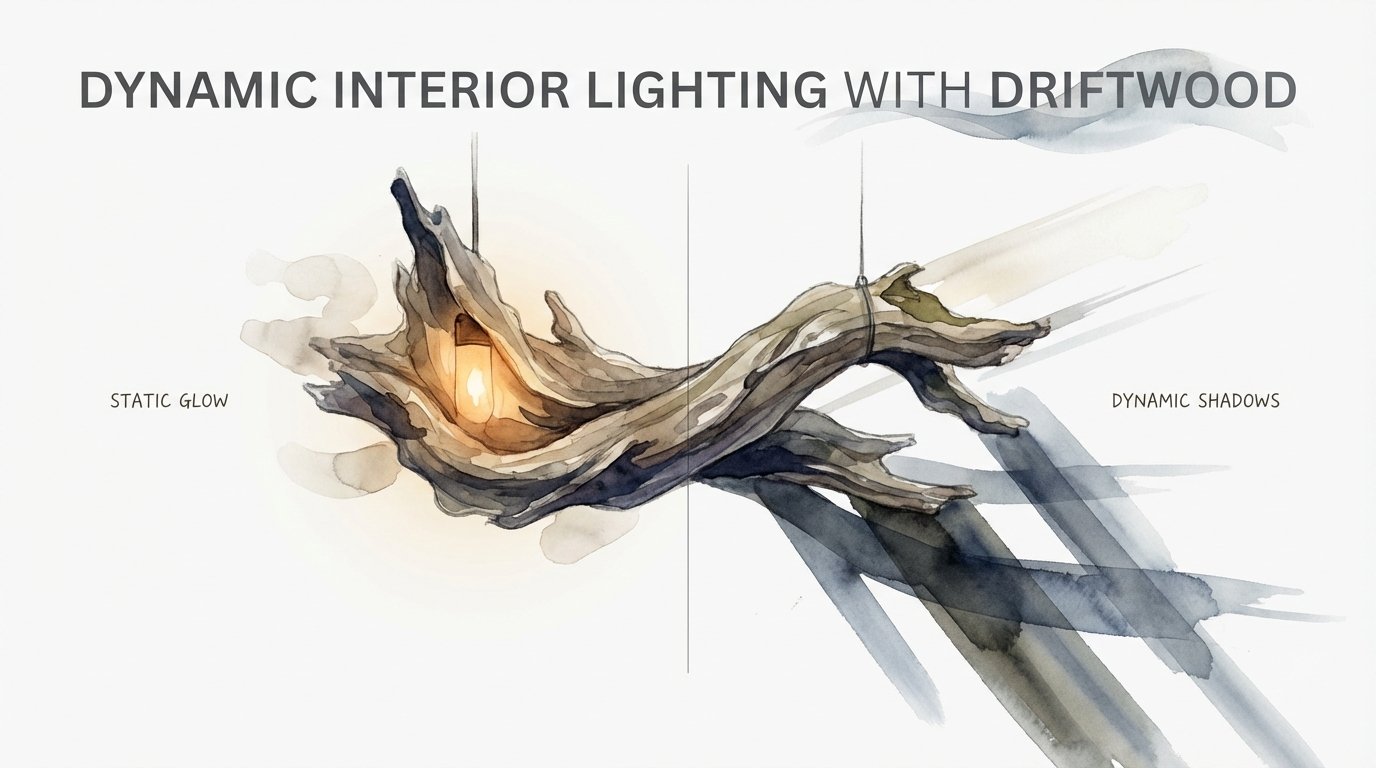
Standard “hospital-grade” lighting aims for total visibility, which often results in a washed-out, clinical atmosphere. This is what we call a STATIC GLOW. It reveals everything but highlights nothing. In contrast, driftwood lamps create DYNAMIC SHADOWS. The light hits the ridges and valleys of the wood, casting elongated shapes across your walls that change as you move through the room.
This approach to lighting exists because humans have a biological craving for organic shapes. Biophilic design suggests that we feel more relaxed and focused when our indoor environments mimic the patterns found in nature. Driftwood brings those patterns—circles, spirals, and rugged lines—directly into your line of sight.
Real-world applications of this lighting style range from high-end coastal resorts to rustic mountain cabins. It works best in areas where relaxation is the priority, such as bedrooms, reading nooks, or living rooms. It serves as a focal point that anchors the room’s aesthetic while providing a functional, warm ambiance.
How to Source and Prepare Driftwood for Lighting
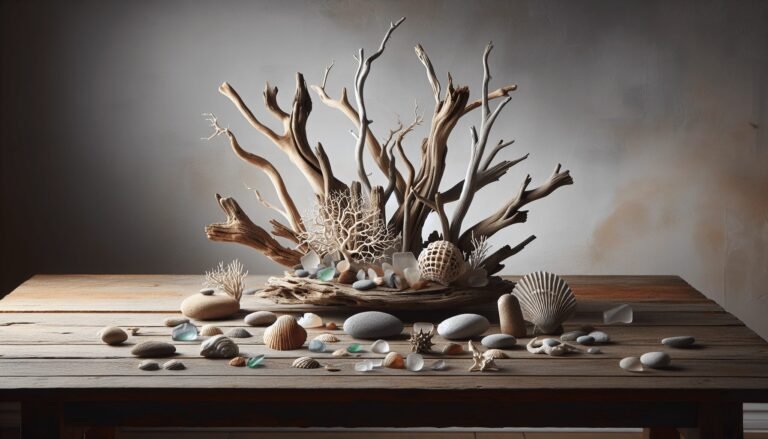
Building a lamp begins with the hunt. You cannot find the perfect piece of wood in a warehouse. You find it on the edges of the world where the water meets the land. Coastal beaches, riverbanks, and lake shores are the primary hunting grounds for these organic treasures.
Selecting the Right Timber
Look for wood that feels heavy and dense for its size. Avoid “punky” wood that crumbles when you press your thumbnail into it, as this indicates rot that will not hold a screw or a drill bit. Hardwoods like oak or cedar that have been stripped of their bark by the sea are the gold standard for lamp-making. They offer the structural integrity needed to support electrical hardware.
Pay attention to the natural “plumbing” of the wood. Some pieces have hollow centers or deep grooves where you can hide your wiring. If the wood is completely solid, you will need a long auger bit to create a path for the cord. Choose a piece with a stable base or one that can be easily mounted to a heavy stone or wooden plinth to prevent tipping.
Cleaning and Disinfecting the Wood
Ocean wood often carries hitchhikers like microscopic mites, bacteria, or salt deposits that can attract moisture. To make the wood safe for your home, you must treat it. A common method involves soaking the wood in a solution of one part bleach to nine parts water for at least six to twelve hours. This kills any organisms living deep within the grain.
After the soak, rinse the wood thoroughly with fresh water and let it sun-dry for several weeks. Rushing this process can lead to the wood warping or cracking once the heat from the lightbulb is introduced. For larger pieces that cannot fit in a tub, a garden sprayer filled with the bleach solution can be used to saturate every crevice, followed by a thorough drying period in a low-humidity environment.
Boring and Routing for Wires
Once the wood is cured, you must create a channel for the electrical cord. This is the most technical part of the process. A long-shaft spade bit or an auger bit is essential here. You may need to drill from both ends of the wood and meet in the middle, a task that requires a steady hand and a keen eye for alignment.
If the wood has a beautiful exterior that you do not want to puncture, consider routing a small channel along the back or underside. This channel can be filled with a mixture of sawdust and wood glue or epoxy once the wire is laid in, making the cord virtually invisible. Always ensure the hole is wide enough to accommodate the thickness of the lamp cord without stripping the insulation.
Benefits of Driftwood Lighting
The primary benefit of driftwood lighting is the immediate infusion of character. No two lamps are identical because no two pieces of wood have the same history. This uniqueness offers a level of bespoke luxury that mass-produced items cannot match.
From a psychological standpoint, the warm light filtered through wood grain reduces stress. Studies on interior environments show that sharp, cool-toned lights increase cortisol levels, while warmer, indirect lighting supports the body’s natural circadian rhythms. Driftwood lamps typically use warm Edison-style bulbs that emit a soft amber glow, perfect for winding down at the end of the day.
Texture is another significant advantage. In a modern home filled with flat drywall and smooth glass, the rugged, tactile surface of weathered wood provides a necessary counterpoint. It invites the eye to linger and the hand to touch, making the space feel more “lived-in” and less like a showroom.
Finally, there is the benefit of sustainability. Using driftwood is a form of upcycling. You are taking a piece of “debris” from a beach and giving it a new life as a functional piece of art. This reduces the demand for new timber and prevents the environmental cost associated with large-scale manufacturing and shipping.
Challenges and Common Mistakes
One of the biggest challenges is achieving balance. Driftwood is often asymmetrical and top-heavy. Many beginners build a beautiful lamp only to find that it topples over the moment someone walks past. Ensuring a low center of gravity is crucial. This often requires attaching the wood to a heavy base made of steel, slate, or a thick slab of finished hardwood.
Electrical safety is another area where mistakes happen frequently. Wood is flammable, and old, dry driftwood is especially prone to ignition if it gets too hot. Never let a high-wattage incandescent bulb touch the wood directly. Always use a threaded lamp pipe (a “nipple”) to keep the socket and bulb a safe distance from the timber.
Wiring through irregular shapes is a common frustration.  . If your drill hole isn’t perfectly straight, the wire can get snagged. Using a “fish tape” or a stiff piece of wire to lead the lamp cord through the channel can save hours of struggle. Avoid using too much force, as you can easily strip the plastic coating off the wire, creating a fire hazard.
Limitations of Natural Wood Lighting
While driftwood is beautiful, it has its limits. It is not ideal for high-moisture environments like small, poorly ventilated bathrooms. The wood can absorb steam, leading to mold growth or warping that might loosen the electrical fixtures. If you must use a driftwood lamp in a bathroom, ensure it is sealed with a high-quality marine-grade varnish.
Scale can also be a limitation. A massive piece of driftwood might look stunning on a beach, but in a small apartment, it can overwhelm the space and block traffic flow. You must consider the proportions of your furniture. A lamp that is too large for the table it sits on will look accidental rather than intentional.
Dusting and maintenance are more difficult with driftwood than with a smooth ceramic lamp. The intricate cracks and holes that make the wood look great also act as magnets for dust and spiderwebs. You will need a soft-bristled brush or compressed air to keep the lamp clean, as a standard cloth will snag on the rough grain.
Comparison: Standard Lighting vs. Driftwood Fixtures
To understand why driftwood is a superior choice for mood-setting, it helps to compare it to the most common alternatives found in modern homes.
| Feature | Standard LED Panel / Pot Light | Driftwood Lamp Fixture |
|---|---|---|
| Shadow Quality | Uniform, minimal shadows (Static) | High-contrast, complex patterns (Dynamic) |
| Atmosphere | Productive, clinical, bright | Nostalgic, warm, organic |
| Sustainability | Plastic and metal manufacturing | Upcycled natural materials |
| Installation | Simple, plug-and-play | Moderate DIY or custom fabrication |
| Maintenance | Wipe clean with a cloth | Requires brushing or compressed air |
While the LED panel wins on efficiency and ease of cleaning, it loses significantly when it comes to creating a sense of place. The driftwood lamp is a piece of sculpture first and a light source second. It is designed for those who value the “vibe” of a room over raw lumen output.
Practical Tips for Best Results
If you want to maximize the “Dynamic Shadow” effect, your choice of bulb is as important as the wood itself. Use a clear bulb with visible filaments, often called an Edison bulb. The clear glass allows the light to travel in straight lines, which creates much sharper, more dramatic shadows than a frosted bulb, which diffuses the light too early.
Position your lamp near a corner. When the light is close to two intersecting walls, the shadows of the driftwood will wrap around the corner, creating a 3D effect that makes the room feel larger and more mysterious. If you place the lamp in the middle of a large, flat wall, the shadows will be less defined.
Consider the height of the lamp in relation to your seating. For a reading nook, the bottom of the lampshade should be at roughly eye level when you are sitting down. This prevents the bulb from glaring in your eyes while still allowing the light to wash over your book and the surrounding wood structure.
Advanced Considerations for Practitioners
For those looking to take this craft further, consider integrating modern technology into the ancient wood. Smart bulbs allow you to change the color temperature and brightness via your phone.  . You can set your driftwood lamp to a bright, cool white in the morning to help you wake up, and a dim, flickering orange in the evening to mimic a sunset.
Scaling up to chandeliers requires a deep understanding of load-bearing structures. When hanging a heavy piece of driftwood from the ceiling, you must ensure the hooks are screwed directly into a ceiling joist, not just the drywall. Use high-quality manila rope or heavy-duty steel cables to complement the aesthetic while providing safety.
Combining driftwood with epoxy resin is another advanced technique. You can fill deep cracks or hollow sections with translucent resin, embedding small LED strips inside. This makes the wood appear to glow from within, as if it were holding a piece of the sun. This requires careful heat management, as LEDs can still generate warmth that needs to dissipate.
Example Scenario: The Pacific Coast Reading Nook
Imagine a small corner of a study with a leather armchair and a stack of old books. . A standard lamp would simply light the chair. However, a custom-built Pacific Cedar driftwood lamp changes the entire scene. The wood was found on a beach in Oregon, still smelling slightly of salt and pine.
The builder used a heavy piece of flagstone as the base, drilling a hole through the stone to anchor a central brass pipe. The cedar was then threaded onto this pipe, hiding the wiring completely. A burlap lampshade was chosen to keep the textures organic and muted.
When turned on, the lamp casts a series of long, rhythmic shadows across the ceiling that look like the ribs of an old ship. The light is warm—roughly 2200 Kelvin—which makes the leather of the chair look rich and deep. The room no longer feels like a box of drywall; it feels like a sanctuary protected by the elements.
Final Thoughts
Choosing driftwood for your interior lighting is a commitment to the organic and the authentic. It is a rejection of the flat, uninspired light that defines so much of our modern lives. By inviting the ocean’s architecture into your home, you are creating a space that breathes, shifts, and tells a story every time you flip the switch.
The process of finding, cleaning, and wiring your own lamp is a rewarding journey that connects you to the natural world. It requires patience and a bit of “pioneer grit,” but the result is a functional masterpiece that no factory could ever replicate. It is the difference between simply seeing your room and truly experiencing it.
Start small with a single table lamp and observe how the dynamic shadows transform your evening mood. Once you see the power of salt-cured timber to sculpt a sanctuary, you may find yourself looking at every beach and riverbank not just as a landscape, but as a source of light. Experiment with different species of wood and various bulb types to find the perfect balance for your home.
Sources
1 hubkafkas.com (https://www.hubkafkas.com/en/blog4-the-value-of-shadow/) | 2 chiaroscuro-lighting.com (https://www.chiaroscuro-lighting.com/knowledge-bank/dramatic-lighting-effects-for-a-bold-and-sophisticated-interior) | 3 yankodesign.com (https://www.yankodesign.com/2025/08/02/mastering-light-shadow-innovative-lighting-ideas-for-artistic-interiors/) | 4 simplydiscus.com (https://www.simplydiscus.com/library/biotopes/natural/driftwood_treatment.shtml) | 5 dksstores.com (https://vertexaisearch.cloud.google.com/grounding-api-redirect/AUZIYQHweB0e1hXEw8dsERrjqf0ngsU8j_JqFlo4KGExYMOpNYMsePsBoTv4ff_Cxcr8Ap2E1_pI1UcUMIm5uygMD8SDAhK0cGxtodpPI-tYMUTTigG_aPM3ong3nvcyfw==) | 6 instructables.com (https://www.instructables.com/Making-a-Driftwood-Lamp/) | 7 hometalk.com (https://www.hometalk.com/diy/upcycle/q-how-to-preserve-large-driftwood-piece-44401954) | 8 nirogranite.com (https://nirogranite.com/blog/how-to-use-light-and-shadow-in-interior-design) | 9 kaarwan.com (https://www.kaarwan.com/blog/architecture/achieving-drama-in-interiors-with-light-and-shadow?id=756)