Mechanical Gravity Lock Folding Desk Diy
Stop worrying about the motor burning out when gravity works for free every single day. Why add complexity with wires and sensors when a simple counterweight and a well-placed pivot can do the work? Build a desk that never needs an outlet.
Searching for a workspace solution often leads to expensive, motorized standing desks. These desks are great until a power outage hits or the cheap actuator decides to quit. A mechanical gravity lock folding desk diy project offers a more permanent, reliable alternative. It relies on the most consistent force in the universe to keep your workspace stable.
This guide will walk you through the logic, the build, and the optimization of a gravity-powered desk. You will learn how to harness simple physics to create a professional-grade workstation. Whether you are a weekend warrior or a serious woodworker, these principles will change how you think about furniture.
Mechanical Gravity Lock Folding Desk Diy
A mechanical gravity lock folding desk is a workspace designed to be stowed or adjusted using a physical locking mechanism that engages via its own weight. Unlike desks that use friction-based knobs or electric motors, a gravity lock system uses a falling pin, a sliding sleeve, or a weighted arm to secure the desk in its active position.
These systems are most common in industrial settings, high-end tiny homes, and efficient workshops. You might have seen similar mechanisms on professional folding ladders or heavy-duty scaffolding. The “lock” is typically a metal ring or a notched arm that slides into place the moment the desk reaches its intended height or angle.
In a DIY context, this means you are building a desk that “clicks” into place without you needing to tighten a single screw. It exists because human error and mechanical failure are the enemies of a productive workspace. If a desk relies on you tightening a knob, it can slip. If it relies on a motor, it can burn out. If it relies on gravity, it works as long as the Earth keeps spinning.
Imagine a wall-mounted surface. As you lift it, a support leg swings out. Once it reaches a 90-degree angle, a weighted sleeve drops over the hinge, preventing the leg from ever folding back until you manually lift that sleeve. That is the essence of a gravity lock. It is simple, elegant, and nearly impossible to break.
How the Gravity Lock Mechanism Works
The core of this project is the pivot-and-lock system. To build one, you must understand three specific mechanical components: the pivot point, the support arm, and the locking sleeve.
First, the pivot point is where the desktop attaches to the wall or frame. This needs to be a heavy-duty hinge, often a piano hinge or a set of robust gate hinges. The weight of the desktop creates a downward force that the support arm must counteract.
Second, the support arm (or “leg”) is what holds the desk up. In a gravity lock design, this arm is also hinged. When the desk is lifted, the arm swings into a vertical or diagonal position. The goal is to reach a state where the arm is under compression, meaning the weight of the desk is pushing directly through the length of the wood or metal arm.
Third, the gravity lock itself is usually a sleeve or a latch. For a sliding sleeve lock, a piece of metal tubing slightly larger than the support arm sits loosely on the arm. When the arm is folded, the sleeve stays at the base. When the arm is fully extended and straightens at its own hinge, the sleeve slides down over the joint by its own weight. This “sleeving” action prevents the hinge from bending, effectively turning a two-piece arm into a solid, unmoving pillar.
To build this yourself, you start with a rigid tabletop. Plywood is better than solid wood for this because it resists warping, which is crucial for mechanical alignment. You mount a ledger board to your wall studs and attach the tabletop. Then, you construct the support arms using the sliding sleeve method or a notched “drop-in” design where the arm falls into a pre-cut groove in the desktop’s underside.
Benefits of a Gravity-Powered Design
Choosing a mechanical gravity lock over an electric or friction-based system provides several measurable advantages in a workshop or home office.
Zero Maintenance and High Reliability
Electric desks have control boxes, wires, and motors. These components are prone to electronic failure, especially in dusty environments like a garage. A gravity lock has no electronics. There is nothing to “fry” or short circuit. As long as the hinges are lubricated once a year, the desk will function exactly the same in twenty years as it does today.
Instant Operation
Motorized desks move at a crawl, often taking 15 to 30 seconds to transition from sitting to standing. A gravity-assisted folding desk is manual and nearly instantaneous. You lift, the lock drops, and you are ready to work. This encourages more frequent movement because the transition is not a “process”—it is a single motion.
Cost Efficiency
A high-quality dual-motor frame can cost hundreds of dollars. The materials for a gravity lock desk—plywood, heavy-duty hinges, and a few pieces of steel pipe for sleeves—cost a fraction of that. You are investing in raw materials and your own labor rather than proprietary electronics that you cannot repair yourself.
Superior Stability
Friction-locks (the kind you tighten by hand) can vibrate loose over time. Gravity locks are binary; they are either locked or they are not. When the sleeve drops or the pin falls, the connection is solid. This eliminates the “wobble” often found in budget electric standing desks when they are at their maximum height.
Challenges and Common Mistakes
While the physics are simple, the execution requires precision. Small errors in alignment can lead to a desk that sticks or, worse, a lock that fails to engage.
One common mistake is neglecting the “clearance” for the gravity lock. If the sliding sleeve is too tight on the support arm, friction will prevent it from falling into place. You must use a sleeve with enough interior diameter to slide freely even if the arm gets a bit of dust or moisture on it. A gap of 1/8th of an inch is usually sufficient.
Another frequent error is poor wall anchoring. Because a folding desk acts as a large lever, it exerts significant “pull-out” force on the top mounting points. Using drywall anchors is a recipe for disaster. Every screw must go directly into a wall stud. If your studs do not align with your desk width, you must mount a horizontal “ledger board” to the studs first, then mount the desk to the ledger.
Alignment of the hinges is also a major pitfall. If the hinges on the wall and the hinges on the support arm are not perfectly parallel, the arm will bind. The desk might feel heavy or “crunchy” when you lift it. Using a long spirit level and pre-drilling your holes is mandatory for a smooth action.
Limitations of the Gravity Lock System
It is important to acknowledge where this system might not be the best fit. Understanding these constraints helps you decide if a mechanical gravity lock is right for your specific environment.
First, weight capacity is limited by your hardware and your wall. While the mechanism itself is strong, you are limited by what the hinges can carry. If you plan to put a 200-pound lathe on a folding desk, you will need industrial-grade steel brackets, not just standard gate hinges.
Second, there is a lack of “infinite” adjustability. Motorized desks can be set to the exact millimeter. A gravity lock desk is usually designed for one or two specific heights (sitting and standing). While you can design a system with multiple notches for the lock to fall into, it becomes significantly more complex to build and operate.
Third, the manual nature requires physical effort. While the desk can be counterweighted to make it feel light, you still have to physically move the surface. For users with limited mobility or strength, a motorized desk—despite the complexity—might be a safer and more practical choice.
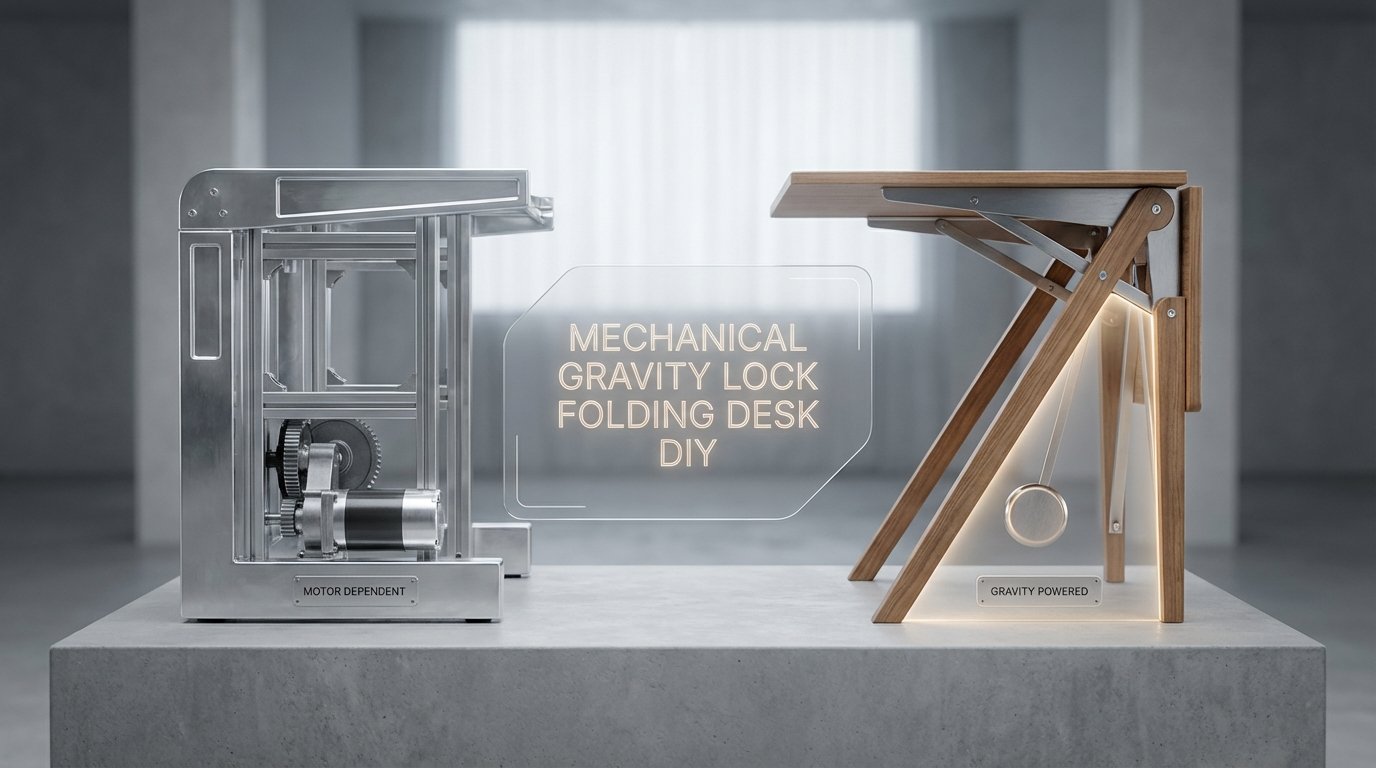
Comparing the Two Approaches
When deciding between a traditional motorized setup and a DIY gravity-powered desk, it helps to see the factors side-by-side.
| Feature | MOTOR DEPENDENT | GRAVITY POWERED |
|---|---|---|
| Power Source | AC Outlet Required | None (Human + Gravity) |
| Adjustment Speed | Slow (1-2 inches per second) | Instant |
| Build Complexity | Low (Assembly only) | Moderate to High (Fabrication) |
| Lifespan | 5-10 years (Motor life) | Lifetime (Steel/Wood) |
| Cost | $300 – $1,000+ | $50 – $150 |
The choice usually comes down to whether you value convenience or durability. The motorized desk is a luxury appliance; the gravity-powered desk is a lifetime tool.
Practical Tips for a Better Build
If you are ready to start your mechanical gravity lock folding desk diy project, these tips will ensure a professional result.
Choose the Right Materials
Avoid particle board or cheap MDF for the main surface. Under the stress of the hinge points, these materials can crumble. Use 3/4-inch Baltic Birch plywood. It has more layers and much higher screw-holding strength. For the locking mechanism, use galvanized steel pipe or structural aluminum. These won’t rust and provide a satisfying weight for the gravity lock.
Lubricate the Right Way
Do not use heavy grease on your gravity locks. Grease attracts sawdust and shop grime, which will eventually gum up the mechanism and stop the lock from falling. Instead, use a “dry” lubricant like PTFE spray or graphite. This provides a slick surface without the sticky residue.
Add a Safety Redundancy
Gravity is reliable, but a physical safety pin adds peace of mind. Drill a small hole through the locking sleeve and the support arm. If you are doing heavy work on the desk, you can slide a cotter pin or a bolt through the hole. This ensures that even if the desk is bumped from below, the lock cannot slide up.
Round Your Corners
Since a folding desk often sits in tight spaces, sharp corners are your shins’ worst enemy. Use a router or a simple sanding block to give all exposed edges a generous radius. This makes the desk safer and gives it a more “manufactured” look.
Advanced Considerations
For those who want to take this concept further, consider the “Counterweighted Elevator” design. This involves using a pulley system and a weight hidden inside the wall or a vertical frame.
The counterweight should be slightly less than the weight of your desktop. This makes the desk feel nearly weightless when you lift it. You can then use a “Gravity Pawl” (like the clicking mechanism on a ratchet) to allow the desk to rise freely and lock automatically at any height. To lower it, you simply disengage the pawl.
Another advanced technique is the use of gas struts as “assists.” While this moves away from pure gravity, a gas strut can provide a dampened, controlled motion that prevents the desk from slamming down if you lose your grip. This is particularly useful for very large, heavy workbenches.
Finally, consider the aesthetics of the “hidden lock.” You can use magnets to hold a gravity pin in a “retracted” state, releasing it only when the desk reaches the perfect angle. This allows for a clean, minimalist look where no mechanical parts are visible from the front.
Scenario: The Garage Workshop
Let’s look at how this works in a real-world setting. Imagine a 10-foot wide garage that needs to double as a parking space and a woodworking shop.
The user builds a 6-foot long folding desk using 1-inch thick plywood. Because the tools (a miter saw and a sander) are heavy, they use three support legs. Each leg has a “Gravity Sleeve” made from 1.25-inch PVC pipe filled with lead shot to give it extra falling force.
When the car is out, the user lifts the desk. The three legs swing down, and the weighted PVC sleeves “clunk” into place over the leg hinges. The desk is now a rock-solid workbench. When the project is done, the user slides the three sleeves up, folds the legs, and the desk hangs flat against the wall, leaving plenty of room to park the car.
This setup costs less than $100 and took one Saturday to build. It will never fail to “start,” and it provides more stability than any commercial folding table on the market.
Final Thoughts
Building a mechanical gravity lock folding desk is about reclaiming control over your environment. It is a rejection of the “planned obsolescence” that comes with cheap electronics and a return to the fundamentals of engineering. You are creating a tool that respects the laws of physics to provide a better user experience.
The beauty of this project lies in its scalability. You can build a small laptop nook for a studio apartment or a massive assembly table for a professional shop using the same core principles. The “clunk” of a gravity lock engaging is a sound of reliability that no electric hum can match.
As you move forward with your build, remember that simplicity is the ultimate sophistication. Don’t overcomplicate the design. Focus on strong hinges, clear paths for moving parts, and solid wall connections. Once you experience a desk that never needs an outlet, you may never go back to “motor dependent” furniture again.
Sources
1 youtube.com (https://www.youtube.com/watch?v=WaXTxx24Yco) | 2 reddit.com (https://www.reddit.com/r/DIY/comments/1gv2srn/hinging_desk/) | 3 instructables.com (https://www.instructables.com/Convertible-StandingSitting-Desk-for-200/) | 4 logicfox.net (https://www.logicfox.net/blogs/article/hand-crank-vs-electric) | 5 instructables.com (https://www.instructables.com/Study-Desk-Converted-to-Height-Adjustable-Standing/)