Modular Diy Balcony Seating
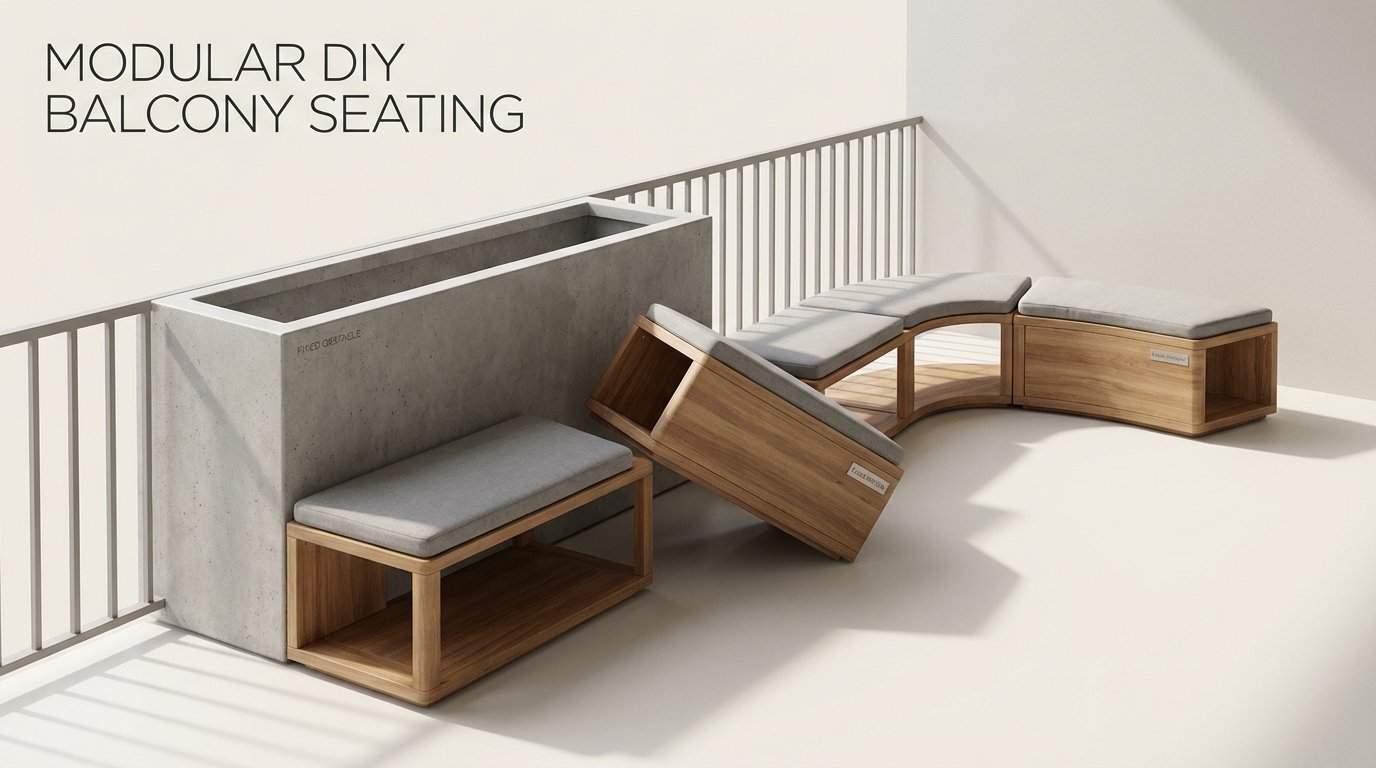
If your furniture can’t move, your lifestyle is stuck. Small balconies are dynamic environments—the sun moves, the wind shifts, and guests arrive. Why use static furniture? These modular DIY cubes are on wheels, allowing you to go from a sun-lounger to a dining set in 15 seconds. High-density storage and high-speed flexibility.

Whether you are sipping coffee in a tight corner or hosting a Friday night gathering, the environment changes fast. Most outdoor furniture is designed for sprawling lawns, not the surgical precision required for urban living. When you are working with fifty square feet, every inch must earn its keep. Modular DIY cubes are the ultimate hack for the modern balcony dweller because they solve the two biggest problems of small-space living: storage and configuration.
Imagine a furniture system that functions like a set of building blocks. You can stack them, line them up, or pull them apart. By adding heavy-duty casters to the base, you eliminate the friction of traditional heavy seating. You aren’t just building a chair; you are building a tool for total environmental control.
Modular Diy Balcony Seating
Modular DIY balcony seating refers to a system of individual, uniform units—typically shaped like cubes or rectangular boxes—that can be rearranged into various furniture types. Unlike a traditional “set” of furniture that has a fixed purpose, these cubes are designed for fluidity. One unit might be a stool; two units together create a bench; four units with a flat top become a coffee table or a dining surface.
This concept exists because urban outdoor spaces are notoriously difficult to furnish. Most commercial furniture is either too bulky to move or too flimsy to last. Modular cubes fill the gap by providing high-density structural support that is specifically tailored to your balcony’s dimensions. In a real-world scenario, you might use three cubes against a wall as a sofa during the day to maximize floor space. When a friend stops by for dinner, you simply unlock the wheels and roll two cubes into the center to act as seating, while the third becomes a bistro table.
Analogous to a Swiss Army knife, these cubes provide multiple “tools” in one footprint. They are often built with hollow interiors, allowing them to serve as storage bins for cushions, gardening tools, or outdoor blankets. This keeps your balcony clutter-free while ensuring your seating is always accessible. The “high-speed” nature of the design comes from the mobility; you can literally change your entire floor plan in seconds without lifting a single heavy object.
How to Build Your Modular Mobile Cubes
Building your own modular system requires basic woodworking skills and a focus on structural integrity. Since these pieces will be sat upon and moved frequently, the joinery must be robust.
Start with your framing. Use rot-resistant lumber like cedar or pressure-treated pine. A common dimension for a standard seat is roughly 16 to 18 inches in height, including the wheels and cushions. To build a standard 18×18-inch cube, you will need to construct a skeletal frame using 2×2 or 2×3 lumber. Secure the frame with exterior-rated pocket hole screws or galvanized wood screws and waterproof glue.
Once the frame is secure, add your “skin.” Cedar pickets are a favorite for this step because they are lightweight, affordable, and naturally weather-resistant. Attach the slats to the sides of the frame, leaving small gaps (about 1/8 to 1/4 inch) between each board. These gaps are critical; they allow air to circulate and water to drain, preventing the wood from rotting or warping over time.
The “motion” part of the build involves the casters. For a balcony environment, avoid cheap plastic wheels. Instead, opt for 3-inch rubberized casters with a high weight rating. You need at least two locking casters per cube to ensure the furniture doesn’t roll away during a windstorm or shift when someone sits down. Attach the casters to the four corners of the bottom frame using heavy-duty lag bolts or wood screws.
Finally, consider the top. If you want the cube to double as a table, use a solid wood top or tightly spaced slats. If it is purely for seating, you can leave the top open to drop in a storage lid. Sand every surface thoroughly to prevent splinters and apply a high-quality exterior sealant or outdoor oil to protect the wood from UV damage and moisture.
The Practical Benefits of Mobile Modular Systems
The primary advantage of this approach is the total elimination of “dead space.” In a traditional balcony setup, a large outdoor sofa takes up a fixed amount of room regardless of whether you are using it. Modular cubes allow you to “nest” pieces or move them into corners when the floor needs to be clear for activities like yoga or container gardening.
Another benefit is the long-term cost-effectiveness. High-end modular furniture from luxury retailers can cost thousands of dollars. By building your own, you are using standard lumber and hardware that can be easily repaired or replaced. If a single slat breaks, you swap it out for a few dollars rather than replacing an entire furniture set.
Furthermore, the storage potential is a game-changer for renters. Most balconies lack built-in storage. By making your seating cubes hollow, you create a protected environment for your soft goods. Keeping cushions inside the cubes when not in use protects them from the sun and rain, extending their lifespan and keeping your balcony looking sharp and ready for guests at a moment’s notice.
Common Challenges and How to Avoid Them
The most frequent mistake in DIY modular furniture is ignoring the “swivel radius” of the wheels. When you install casters, they need room to rotate 360 degrees. If you place them too close to the edges of a decorative skirt or trim, the wheels will jam against the wood. Always test the rotation of your casters before final assembly.
Another challenge is weight distribution. Because these cubes are relatively small, they can become “top-heavy” if you build them too tall or use extremely heavy materials for the lids. If a cube is too narrow and high, it may tip when being rolled over a door threshold. Stick to a square base (like 18×18 inches) to ensure a low center of gravity.
Lastly, many builders forget about “drift.” Even on a seemingly flat balcony, there is often a slight slope for water drainage. If you don’t use locking casters, your furniture will slowly migrate toward the railing. Ensure that at least two wheels on every unit have a robust locking mechanism that is easy to engage with your foot.
When Modular Cubes May Not Be Ideal
While highly versatile, mobile cubes aren’t the perfect solution for every environment. If your balcony is exposed to extreme, high-altitude winds, lightweight wooden cubes on wheels can become safety hazards. In these cases, you would need to weight the bottoms of the cubes or use a tethering system to keep them secure during storms.
Another limitation is the surface of your balcony. If your outdoor space is covered in thick, shaggy artificial turf or very uneven stone tiles, small casters will struggle to roll. You would need significantly larger wheels (4-5 inches) to navigate such terrain, which changes the aesthetic and height of the seating.
Finally, consider the “assembly fatigue.” If you need to seat ten people, building ten individual cubes is a lot of work. For very large balconies, a hybrid approach—one large fixed bench and a few mobile cubes—might be more practical than a 100% modular system.
Comparing Fixed Built-ins vs. Modular Cubes
Choosing between a permanent built-in bench and a modular system depends on your long-term goals and the nature of your space.
| Feature | Fixed Built-in Bench | Mobile Modular Cubes |
|---|---|---|
| Flexibility | Zero; stuck in one spot. | High; infinite layouts. |
| Storage | Massive, but hard to access. | Organized into smaller bins. |
| Moving/Relocation | Difficult; usually stays with the home. | Easy; rolls right into the elevator. |
| Cost | High; requires custom framing. | Moderate; scalable over time. |
| Maintenance | Hard to clean under/behind. | Easy; roll away to sweep the floor. |
Fixed benches provide a “cleaner” look and can often support more weight over a longer span. However, they trap dirt and debris behind them. Mobile cubes allow for a cleaner environment because you can move the furniture to wash the balcony floor.
Best Practices for Maintenance and Longevity
To keep your modular system in peak condition, you must treat the wood annually. Outdoor environments are brutal on natural fibers. Use a penetrating oil like Tung oil or a specialized deck sealer. These products soak into the wood rather than sitting on top, which prevents the “peeling” effect often seen with cheap paints.
Check your hardware twice a year. The vibrations from rolling the cubes and the expansion/contraction of the wood can loosen screws over time. Use a screwdriver to snug up the caster bolts and frame screws every spring and autumn.
For the wheels, a quick spray of silicone lubricant will prevent rust and keep the swivel action smooth. If you live near the ocean, salt air will corrode standard steel very quickly. In these environments, spend the extra money on stainless steel hardware and casters with nylon or high-density plastic components to prevent “seizing.”
Advanced Considerations for Serious Builders
If you want to take your modular project to the professional level, consider “nesting” designs. You can build your cubes in slightly different sizes so that the smaller ones can slide inside the larger ones when not in use. This “matryoshka” style of furniture is the ultimate space-saving technique for tiny balconies.
Another advanced move is integrating technology. You can install weather-resistant USB charging ports or LED strip lighting into the base of the cubes. By using a small, rechargeable battery pack hidden inside the storage compartment, you can have a “smart” seating area without needing to run extension cords across the balcony floor.
Finally, think about the “topography” of your seating. You don’t have to make every cube 18 inches tall. By building a few “half-cubes” (9 inches tall), you create footrests, steps for pets, or tiered plant stands that integrate perfectly with your seating modules.
Real-World Scenarios and Transformations
Let’s look at how a 4-cube system transforms a standard 5×10 balcony.
Scenario A: The Morning Zen (Solitary)
Place two cubes side-by-side against the short wall to create a wide lounge seat. Use the third cube as a side table for your coffee and book. The fourth cube stays tucked under a corner plant stand. Total floor space used: 15%.
Scenario B: The Bistro Date (Social)
Roll two cubes to the center of the balcony. Place a larger wooden board over the top of both to create a unified dining table. Use the remaining two cubes as individual chairs on either side. Total floor space used: 40%.
Scenario C: The Sun-Lounger (Relaxation)
Line up three cubes in a row to create a 4.5-foot long “chaise.” Add a long outdoor cushion. Roll the fourth cube to the end to act as an ottoman or a drink holder. You now have a full-length bed for sunbathing that can be dismantled in seconds when the rain starts.
Final Thoughts
Modular DIY balcony seating is more than just a woodworking project; it is a strategy for reclaiming your outdoor life. When you remove the “fixed obstacle” of heavy, static furniture, you open up possibilities for your space that didn’t exist before. You stop fighting your balcony and start flowing with it.
The beauty of the cube system lies in its simplicity. You don’t need to be a master carpenter to build a sturdy box on wheels. You just need a plan, some rot-resistant wood, and the desire for a more flexible lifestyle. Start with two cubes. See how they change your morning routine. You can always build more as your needs—and your guest list—grow.
Experiment with different wood stains, cushion patterns, and layouts. Your balcony is a dynamic environment, and your furniture should be just as adaptable. By investing a weekend into building these modular units, you are ensuring that your outdoor space remains functional, stylish, and ready for whatever the next season brings.
Sources
1 peradesign.com (https://peradesign.com/benefits-of-modular-outdoor-seating-for-flexible-layouts) | 2 creativ-space.com (https://creativ-space.com/your-guide-to-multifunctional-patio-furniture) | 3 homedit.com (https://www.homedit.com/outdoor-shelves/) | 4 bunnings.com.au (https://www.bunnings.com.au/diy-advice/outdoor-living/outdoor-furniture/how-to-make-diy-modular-outdoor-furniture) | 5 homebudgetfurniture.com (https://homebudgetfurniture.com/blogs/news/what-outdoor-furniture-works-best-for-small-outdoor-areas) | 6 chicoryhome.com (https://chicoryhome.com/blogs/guides/modular-furniture-solutions-for-urban-outdoor-spaces) | 7 shop4patio.com (https://shop4patio.com/blogs/news/maximize-your-outdoor-space-with-modular-and-multifunctional-patio-furniture) | 8 hisoliving.com (https://www.hisoliving.com/blogs/news/benefits-of-modular-outdoor-furniture) | 9 youtube.com (https://www.youtube.com/watch?v=8kmR7r9CGFQ) | 10 woodshopdiaries.com (https://www.woodshopdiaries.com/diy-outdoor-storage-box/) | 11 imeemade.com (https://imeemade.com/blog/planterbox) | 12 2thesunnyside.com (https://www.2thesunnyside.com/planter-box-on-wheels/) | 13 housedigest.com (https://www.housedigest.com/1694138/outdoor-storage-cabinet-diy/)