Multi-functional Driftwood Office Decor
Why clutter your workspace with single-purpose tools when the ocean offers a multi-dimensional architecture for your life? Your desk is prime real estate. Stop wasting it on a lamp that only does one thing. This driftwood ‘anchor’ provides light, storage, and organization in a single piece of storm-tossed art.


The modern office has become a sterile wasteland of plastic and cold glass. While these materials are functional, they lack the soul and grounding presence of the natural world. Bringing a piece of the shoreline into your workflow is not just about aesthetics; it is about reclaiming a sense of the wild in your everyday grind.
This guide explores the multi-functional driftwood anchor—a centerpiece that serves as a high-performance lamp, a resting place for your tech, and a vault for your essential tools. We will walk through the selection of materials, the grit of the cleaning process, and the precision of integrated electrical work. By the end, you will understand how to transform a piece of marine debris into the hardest-working asset on your desk.
Multi-functional Driftwood Office Decor
Multi-functional driftwood decor represents the intersection of rugged utility and biophilic design. This concept moves beyond the traditional “dust-gathering” knick-knack and into the realm of architectural furniture. These pieces are often referred to as “anchors” because they provide a heavy, stable foundation for a desktop while serving multiple needs simultaneously.
At its core, a driftwood anchor is a large, structurally sound piece of salvaged wood that has been modified to house modern technology. This might include recessed LED lighting, carved-out slots for smartphones, or integrated bowls for holding pens and paperclips. It exists to solve the problem of desk clutter by consolidating several separate tools into one organic form.
You will typically find these pieces in workspaces where the occupant values a connection to the environment. Research into biophilic design shows that incorporating natural wood textures and organic shapes can increase productivity by up to 6% and boost creativity by 15% (umn.edu, zapfloor.com). This is not just a trend for 2025; it is a biological necessity for those who spend 90% of their time indoors.
Visualize a weather-beaten branch of Pacific Cedar, salt-bleached and iron-strong. Instead of just sitting there, it arches over your laptop to provide task lighting while its hollowed-out knots hold your EDC (Everyday Carry) gear. It is a piece of the pioneer spirit adapted for the digital age.
Forging the Anchor: A Step-by-Step Build
Building a multi-functional anchor requires a blend of patience and precision. You cannot simply pull a log out of the surf and plug it in. The process begins with the hunt for a piece that has the “bones” for utility.
Phase 1: Sourcing and Structural Inspection
Look for hardwoods like Oak, Manzanita, or Ironwood. These species are dense and resistant to splintering, making them ideal for structural uses (alibaba.com). Avoid softwoods like Pine or Birch if you plan on drilling deep channels for wiring, as they are prone to cracking and rot over time. Ensure the piece has a “natural foot”—a flat or stable area that will rest on your desk without wobbling.
Phase 2: The Deep Clean
Raw driftwood is a haven for bacteria, salt, and pests. You must soak the wood in a 1:10 solution of bleach and water for at least 6 to 12 hours (wikihow.com, hawk-hill.com). This kills hidden sand gnats and their eggs while neutralizing odors. After the soak, scrub the wood with a stiff-bristled brush to remove any caked-on mud or “soft” layers that have begun to decay.
Phase 3: Curing and Drying
Never rush the drying process. A piece of wood that feels dry on the outside can still hold moisture deep in its marrow. Let the wood sit in direct sun for 15 to 30 days to fully cure (wikihow.com). If you are in a humid climate, a low-heat kiln or a few hours in an oven at its lowest setting (below 200°F) can finish the job. Use a moisture meter to ensure the internal moisture is below 10% before you begin any electrical work.
Phase 4: Carving and Wiring
Identify where your light source will sit. Many builders use a long 3/8-inch flexible drill bit to create a hidden channel through the center of the wood for the lamp cord (youtube.com). Use a Dremel or a chisel to carve out pockets for pens or a shallow “cradle” for your phone. When it comes to the light itself, use UL-listed lamp kits or 12V LED modules. LEDs are superior because they run cool and pose a significantly lower fire risk when embedded in dry wood (ambientwares.com, stackexchange.com).
The Raw Benefits of Biophilic Utility
The primary advantage of a driftwood anchor is its ability to reduce cognitive load. A cluttered desk leads to a cluttered mind. By integrating your lamp, phone stand, and tray into one piece, you clear the visual noise that distracts from deep work.
Biophilic elements have a measurable impact on the human nervous system. Studies suggest that looking at natural scenery or textures for as little as 40 seconds can trigger the brain into a more relaxed state (sbam.org). In an office environment, this translates to lower blood pressure and a 30% reduction in reported stress levels among employees (zapfloor.com).
Environmental sustainability is another significant factor. Using reclaimed marine debris means you are not contributing to the demand for new plastics or industrial lumber. Each piece of driftwood has a narrative—it has survived storms and tides to reach your desk. This “love of place” fosters a more restorative workspace than any mass-produced furniture ever could (gensler.com).
Finally, the durability of a well-treated hardwood piece is unmatched. Unlike plastic desk organizers that crack or go out of style, a driftwood anchor only gains character as it ages. It becomes a legacy piece of equipment that can serve a homestead for decades.
Common Pitfalls and Grit-Testing Challenges
The biggest mistake a beginner makes is failing to account for the center of gravity. Driftwood is often irregularly shaped. Once you add a heavy lamp harp or a large bulb, the piece may become top-heavy. Always test the stability of your anchor by placing it on a flat surface and applying pressure to the top. If it tips, you must add a counterweight or a hidden base plate made of heavy metal or stone.
Electrical safety is another area where shortcuts lead to disaster. Dry wood is a fuel source. Using high-wattage incandescent bulbs in a tight wooden cavity is a fire hazard. Always opt for LEDs and ensure that all wiring is properly insulated. Use “wall wart” style power supplies that convert the voltage to 12V DC before it even enters the wood (stackexchange.com). This ensures that if a short occurs, it is far less likely to cause a fire.
Cleanliness is a recurring challenge. If the wood is not properly bleached and sealed, it may shed sand or fine dust onto your keyboard and electronics. Applying a finish—such as linseed oil or a matte polyurethane—is essential to “lock in” the surface and prevent splintering (hawk-hill.com). Do not skip the sanding phase; start with a coarse 80-grit and work your way up to a smooth 220-grit for a professional feel.
When the Shoreline Meets Its Limits
Driftwood decor is not a universal solution. In ultra-minimalist workspaces with very shallow desks, a large organic anchor can feel intrusive. These pieces require room to “breathe” and may overwhelm a tiny standing desk setup. You must measure your available real estate before sourcing a piece.
Environmental limitations also play a role. Driftwood is sensitive to extreme fluctuations in humidity. If your office is in a basement with high moisture, the wood may begin to swell or develop mold even after treatment. Conversely, in desert environments, extremely dry air can cause old driftwood to develop deep cracks or “checks” over time.
Additionally, the uniqueness of driftwood makes it impossible to replicate. If you are trying to outfit a corporate office with ten identical desks, driftwood is not the right material. It is a choice for the individualist—the practitioner who wants a one-of-a-kind station that cannot be found in a catalog.
Comparing the Static vs. The Multi-Dimensional
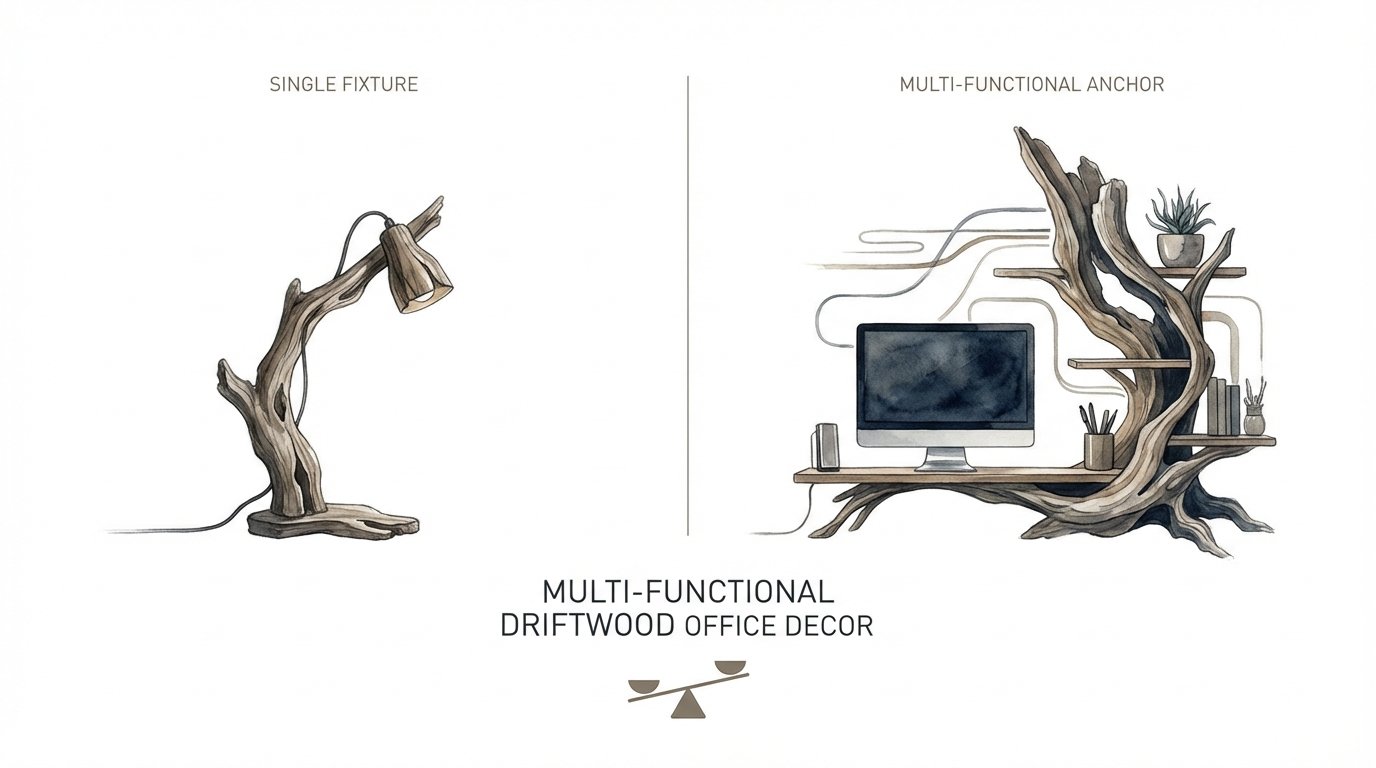
To understand the value of the driftwood anchor, it helps to compare it against the standard “single-fixture” office setup. Most people buy separate items that perform individual tasks.
| Factor | Single-Purpose Fixtures | Multi-Functional Anchor |
|---|---|---|
| Space Usage | High: Multiple bases for lamp, pens, and phone. | Low: One footprint for all utilities. |
| Mental Impact | Neutral: Standard industrial materials. | Positive: Biophilic connection reduces stress. |
| Durability | Medium: Plastic or thin metal parts. | High: Solid hardwood structure. |
| Customization | Low: Fixed designs from the factory. | Total: Carved to fit your specific tools. |
While the initial effort to build or source an anchor is higher, the long-term benefits of efficiency and focus are far greater than those of a modular, plastic-heavy setup.
Field-Tested Best Practices
If you want your piece to survive the test of time, you must focus on the “pioneer-grit” details. This starts with the base. If your driftwood is naturally uneven, do not just sand it flat—use small rubber feet or “buttons” on the bottom (diydriftwood.com). These provide airflow beneath the wood and prevent the piece from scratching your desk.
For the finish, avoid glossy varnishes that make the wood look like plastic. A hand-rubbed coat of beeswax or linseed oil preserves the natural, matte texture while providing a protective barrier (hawk-hill.com). This keeps the wood looking “raw” while ensuring it is smooth to the touch.
When wiring, always leave a “drip loop” or extra slack where the cord exits the wood. This prevents tension on the electrical connections if the piece is moved. If you are using a lamp kit, ensure the socket is firmly secured with a threaded rod and nut (diydriftwood.com). Glue alone is rarely enough to hold a light socket in place over years of use.
Advanced Engineering for the Modern Homestead
For the serious practitioner, a driftwood anchor can go beyond basic lighting. Consider integrating a Qi wireless charging pad into a carved-out recess. You can hide the charging coil just beneath a thin layer of wood, allowing your phone to charge simply by resting on the anchor.
Resin stabilization is another advanced technique. If you find a piece of driftwood that is visually stunning but structurally “soft” or full of holes, you can use a vacuum chamber to impregnate the wood with clear resin. This turns a fragile piece of debris into a rock-hard composite that can be drilled and carved with high precision (alibaba.com).
Touch-sensitive dimming is the final frontier. You can install a small metal sensor on a subtle part of the wood. When you touch a specific knot or grain line, the light turns on or dims. This maintains the “magic” of the natural form by hiding the industrial switches from view.
Case Study: The “Cascadia” Multi-Hub
Consider the build of a 24-inch piece of Red Cedar salvaged from the Oregon coast. The builder identified a natural hollow on the left side of the piece, which was widened to create a docking station for a tablet.
The central trunk was drilled using a long-reach 1/2-inch bit to accommodate a 12V LED strip recessed into an overhanging branch. This created a “floating” light effect that illuminated the desk without a visible bulb.
On the right side, three vertical holes were bored to serve as pen holders. To ensure stability, a 1-pound lead weight was epoxied into a hidden cavity at the base. The final piece occupied 40% less space than the separate lamp and organizers it replaced, while providing a focal point that sparked conversation with every visitor.
Final Thoughts
The multi-functional driftwood anchor is more than just a piece of furniture; it is a tool for mental clarity and environmental connection. By consolidating your essential desk utilities into one organic form, you create a workspace that works as hard as you do. The process of finding, cleaning, and forging these pieces requires grit, but the result is a legacy item that bridges the gap between the wild coast and the modern office.
Do not settle for a workspace that drains your energy. Take the time to build or source an anchor that grounds you. Experiment with different wood types, lighting temperatures, and integrated storage solutions to find the balance that suits your specific workflow.
As we move deeper into an era of digital saturation, these physical touchpoints with the natural world become our most valuable assets. Your desk is your frontier. Make sure your equipment is up to the task.
Sources
1 homedit.com (https://www.homedit.com/10-diy-driftwood-decoration-ideas/) | 2 marcusfishtanks.com (https://marcusfishtanks.com/blogs/news/caring-for-different-types-of-driftwood-tips-and-techniques) | 3 alibaba.com (https://smartbuy.alibaba.com/buyingguides/driftwood) | 4 stackexchange.com (https://diy.stackexchange.com/questions/179538/lamp-base-out-of-wood-containing-wires-is-there-a-safe-way) | 5 umn.edu (https://arb.umn.edu/blog/2024/05/07/biophilic-design-in-the-workplace-improves-creativity-wellbeing-and-productivity) | 6 eltru.com (https://eltru.com/blog/the-future-of-office-furniture-trends-to-watch-in-2025/) | 7 hawk-hill.com (https://www.hawk-hill.com/how-to-clean-driftwood/) | 8 mymumthedreamer.com (https://mymumthedreamer.com/how-to-clean-driftwood-for-crafting/) | 9 diydriftwood.com (https://diydriftwood.com/how-to-create-a-driftwood-lamp/)