Natural Light Diffusion With Driftwood
Why struggle with glitchy software to set the mood when the ocean has already carved the world’s most perfect light-sculptor for you? We spend a fortune on ‘smart’ bulbs and dimmers, yet they never quite capture the warmth we crave. The secret isn’t in the code; it’s in the structure. By using the natural, sea-honed architecture of driftwood, you can passively sculpt light into a biological masterpiece that feels like a permanent sunset.

This approach moves away from the sterile, flicker-prone world of digital automation and returns us to the tactile, reliable physics of the natural world. Driftwood is not merely a piece of debris; it is a skeleton of cellulose and lignin that has been pressurized by the depths, bleached by the sun, and sandblasted by the tides. These forces transform a standard branch into a complex optical instrument capable of scattering, refracting, and softening light in ways a plastic diffuser never could.
Embracing this method requires a shift in how we perceive interior illumination. Instead of viewing a lamp as a source of raw lumens, we should see it as an interaction between energy and matter. When light hits the weathered grain of a piece of cedar or cypress, it doesn’t just bounce off; it enters the porous structure of the wood, interacting with the hollow, spindle-shaped cells known as tracheids. This creates a soft, elliptical halo that follows the organic flow of the timber, grounding your living space in a sense of history and biological calm.
Natural Light Diffusion With Driftwood
Natural light diffusion with driftwood is the practice of utilizing the physical irregularities and internal cellular structure of water-weathered wood to manipulate artificial or natural light sources. Unlike a standard lampshade that provides a uniform, flat barrier, driftwood acts as a multi-dimensional baffle. It catches high-intensity light rays and breaks them apart, spreading the energy across its varied surface to create a “play of brilliance”—a term lighting designers use to describe a scene that evokes wonder through subtle sparkle and depth.
In the real world, this technique is employed by high-end architects and biophilic designers who understand that humans have an evolutionary affinity for the specific patterns found in nature. The random, yet non-chaotic, structures of driftwood provide what psychologists call “soft fascination.” This type of visual stimulus allows the brain to rest and recover from the “directed attention fatigue” caused by staring at screens and sharp, geometric urban environments.
Visualize a piece of sun-bleached manzanita mounted in front of a hidden LED strip. The light doesn’t hit the wall directly; it must first navigate the gnarled twists and salt-crusted hollows of the wood. Some rays are absorbed, warming the wood’s internal lignin and reflecting a rich, golden hue. Others are scattered by the surface roughness, filling the room with a glow that mimics the way sunlight filters through a forest canopy or reflects off a choppy sea at dusk.
The Mechanics of Organic Light Scattering
Understanding how wood manipulates light requires a look at its microscopic anatomy. Wood is essentially a composite of hollow tubes. In softwoods, these are tracheids, while hardwoods possess vessels. When light enters these tubes at an angle, they act as miniature optical waveguides. This phenomenon, often called the “tracheid effect,” causes light to spread further along the grain than across it.
When you place a light source behind a piece of driftwood, you are engaging with these three primary physical interactions:
Surface Refraction and Roughness
The abrasive action of sand and water creates a micro-textured surface on driftwood. This roughness ensures that light rays are reflected at many different angles rather than a single, harsh direction. This is known as diffuse reflection. A polished piece of wood might create a “hot spot” of glare, but the matte, weathered surface of a beach-find ensures a uniform, comfortable luminosity.
Subsurface Scattering
Light doesn’t just stop at the surface of the wood. It penetrates several microns deep into the cellulose fibers before being reflected back out. This “subsurface scattering” is the same reason human skin or wax looks “alive” rather than plastic. It gives the wood a glowing quality, making the fixture appear as if it is generating its own internal energy rather than simply being lit from the outside.
Shadow Geometry
The gnarled and twisted nature of driftwood creates a complex “shadow-scape.” As light passes through the gaps in the wood, it casts long, organic shadows that change shape as you move through the room. This adds a sense of dimensionality and motion to a static space, mirroring the shifting light of the natural world.
How to Select and Prepare Your Wood
The success of your light-sculpting project depends entirely on the quality of the timber you recover. Not every branch found on a riverbank is suitable for high-end light diffusion. You are looking for “ghost wood”—pieces that have been stripped of bark, sap, and soft tissue, leaving behind only the hard, mineralized core.
Sourcing the Right Species
Different woods offer different optical rewards. Cedar and Cypress are the gold standards for their rot resistance and beautiful, swirling grain patterns that catch light exceptionally well. Oak driftwood provides a more massive, architectural feel with a deep, rugged texture that creates dramatic, high-contrast shadows. If you are looking for a more delicate glow, Manzanita or “Spider Wood” offers fine, spindly branches that can create a web-like diffusion pattern across a large wall.
The Cleaning and Curing Process
Never bring raw driftwood directly into your home without proper treatment. It may harbor pests, fungal spores, or residual salts that can corrode electrical components.
- Initial Scrub: Use a stiff nylon brush and plain water to remove sand, loose fibers, and salt crust. Avoid wire brushes as they can leave metal fragments that will rust and stain the wood.
- Deep Sterilization: Submerge the wood in a large trough of water with a 10% bleach solution for 24 hours. This kills any hidden organisms and helps lighten the color of the wood, which improves its light-reflective properties.
- Boiling (Optional): For smaller pieces, boiling for two to three hours will release trapped tannins. Tannins are what give water a “tea” color; in a lighting fixture, excessive tannins can make the light look muddy or overly orange.
- The Drying Phase: Wood must be completely dry before you introduce electronics. Air-dry the wood in a low-humidity environment for at least two weeks. Use a moisture meter to ensure the internal content is below 10%.
Integrating the Light Source
Once your driftwood is cured, the goal is to integrate the light in a way that feels seamless and “grown-in.” Modern LED technology is the only safe and effective choice for this application due to its low heat output and slim profile.
Choosing Your Temperature
The color temperature of your light source is critical. Standard “cool white” LEDs (5000K) will make driftwood look grey and skeletal, often evoking a cold, sterile feeling. To achieve a biological, sunset-like warmth, you should opt for “extra warm” LEDs in the 2200K to 2700K range. This spectrum reinforces the natural reds and golds in the wood grain, creating a sense of coziness and security.
Placement and Mounting
The light source should almost always be hidden from direct view. Mounting an LED strip in a routed-out channel along the back of the driftwood allows the light to wash against the wall and the wood’s own texture simultaneously. This creates a “silhouette” effect where the wood remains a dark, interesting shape while the light “bleeds” out from its edges.
Benefits of Driftwood Light Diffusion
Choosing this organic approach offers several measurable advantages over traditional lighting fixtures or smart-app-controlled dimmers.
Biophilic Health Gains
Research into biophilic design shows that environments incorporating natural wood textures and non-uniform light patterns can significantly lower cortisol levels and reduce blood pressure. Unlike the steady, artificial pulse of some LED drivers, the scattered light from wood grain feels “predictably unpredictable,” which calms the human autonomic nervous system.
Superior Longevity
A smart bulb has a finite lifespan and a complex failure point (the software). A piece of well-cured driftwood is practically eternal. As the wood ages in your home, it will continue to “cure” and may even develop a deeper patina over decades, becoming a legacy piece rather than a disposable gadget.
Aesthetic Uniqueness
No two pieces of driftwood are identical. When you use this method, you are guaranteed a lighting signature that cannot be replicated. This “biological fingerprint” adds a level of luxury and soul to a home that cannot be purchased from a big-box retailer.
Challenges and Common Mistakes
While the process is rewarding, there are several pitfalls that can ruin the effect or even create a safety hazard.
The “Wet Wood” Darkening Effect
Many beginners are disappointed when their beautiful, light-grey driftwood turns dark brown once they apply a finish or if it remains damp. Wet wood has a different refractive index, which reduces light scattering and causes the wood to absorb more light. Always ensure the wood is bone-dry and avoid heavy oil finishes if you want to maintain that sun-bleached, high-diffusion look.
Heat Management
Even though LEDs run cool, they still generate heat at the diode level. Enclosing an LED strip too tightly inside a piece of wood without any airflow can lead to premature failure of the light or, in extreme cases, scorching of the wood. Always ensure there is a small gap for air to circulate around the light source.
Structural Integrity
Driftwood can be brittle. Over-drilling for wire management can cause a beautiful branch to snap. Always use sharp, high-quality bits and proceed slowly, reinforcing any soft areas with a clear, low-viscosity resin if necessary to stabilize the fibers.
Limitations of This Approach
As powerful as natural light diffusion is, it is not a universal solution for every room.
Not for Task Lighting
Driftwood is a master of ambient and accent lighting, but it is a poor choice for task lighting. If you need to chop vegetables or perform surgery, the high-scatter, low-focus light provided by wood will be frustrating. Use driftwood for the “mood” of the room and rely on dedicated, focused fixtures for specific tasks.
Scale and Weight
Large pieces of driftwood can be surprisingly heavy, especially if they are dense hardwoods like Oak. Mounting these to a standard drywall ceiling or wall requires significant structural reinforcement. You cannot simply use a “sticky tab” or a small nail; you must find the studs and use heavy-duty eye bolts or French cleats.
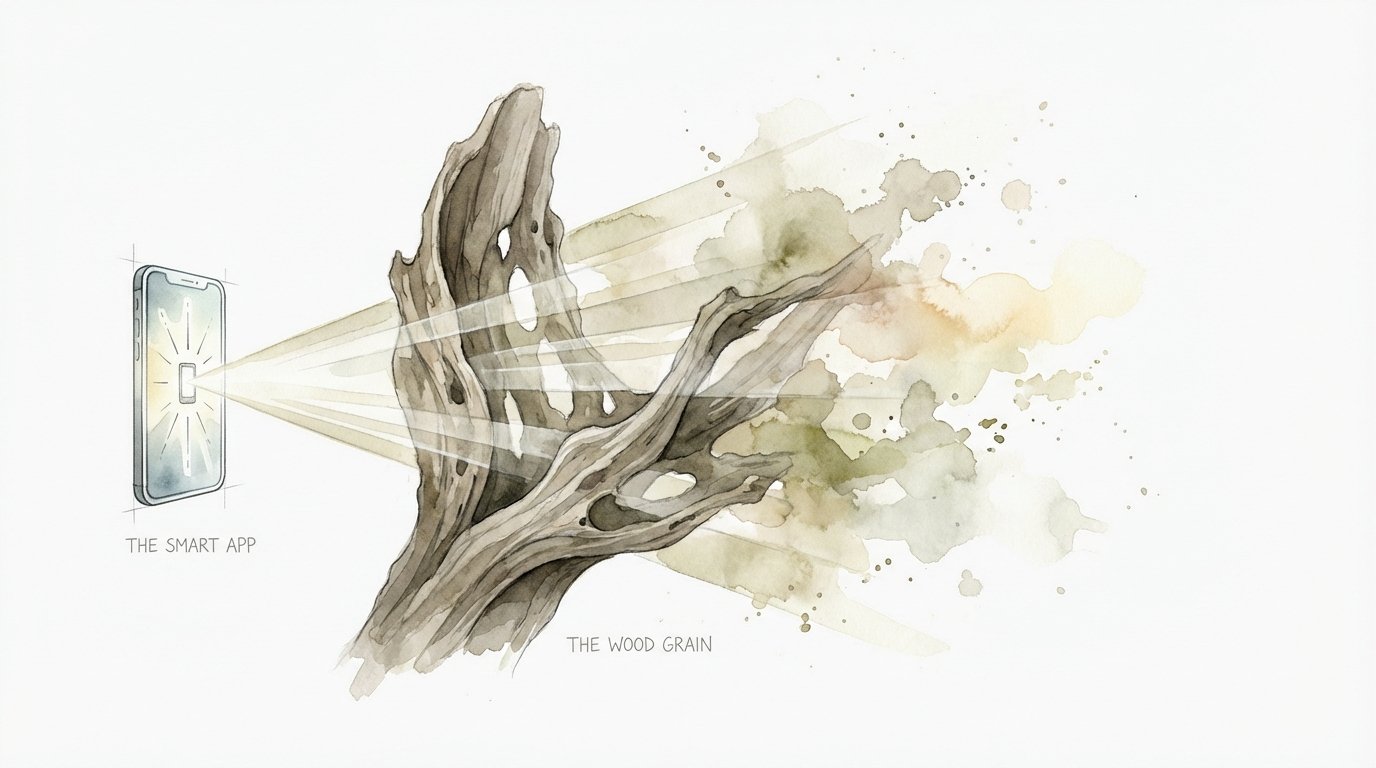
Comparison: THE SMART APP vs. THE WOOD GRAIN
| Factor | Digital Smart Apps | Driftwood Diffusion |
|---|---|---|
| Atmosphere | Clinical, adjustable, but often flat. | Warm, organic, and deeply textured. |
| Maintenance | Requires updates and Wi-Fi stability. | Occasional dusting; zero software. |
| Health Impact | Blue-light risks if not tuned. | Proven cortisol reduction (Biophilic). |
| Cost | Ongoing (subscription/replacement). | Initial labor; nearly zero material cost. |
| Lifespan | 3–5 years (tech obsolescence). | Lifetime (Natural durability). |
Practical Tips and Best Practices
If you are ready to start your first light-sculpting project, keep these veteran tips in mind to ensure a professional result.
- Hide the “Tail”: The biggest mistake in DIY lighting is visible wiring. Use a hollowed-out section of the wood or run the wire through a small copper tube that mimics a natural vine to keep the illusion intact.
- Test Before You Mount: Hold your light source at various angles against the driftwood in a dark room. Moving the light just an inch can completely change the shadow pattern on your wall.
- Use a Dimmer: Even though you are moving away from “smart” apps, a simple physical dimmer switch is vital. This allows you to tune the intensity of the light to the specific “glow point” where the wood grain is most visible.
- Consider the Wall Texture: The surface behind the driftwood acts as the secondary reflector. A matte, slightly off-white wall will provide the most natural “bounce,” while a dark or glossy wall will absorb or distort the diffused light.
Advanced Considerations: The Physics of Rayleigh Scattering
Serious practitioners should understand that the “haze” created by wood diffusion is a result of Rayleigh scattering—the same physics that makes the sky blue. The tiny cellulose fibers in the wood are smaller than the wavelength of visible light. When light hits these fibers, it scatters in all directions.
You can manipulate this by altering the thickness of the wood. A very thin “wafer” of driftwood can be made semi-translucent, allowing a soft, filtered light to pass through the wood itself. This requires precision resawing on a bandsaw and careful stabilization with a vacuum-chamber resin infusion. The result is a piece of wood that appears to be “glowing from within” like a piece of amber.
Furthermore, you can experiment with “anisotropic scattering” by orienting the wood grain vertically or horizontally. Vertical grain will tend to “stretch” the light toward the ceiling, making a room feel taller, while horizontal grain will widen the glow, making a space feel more expansive and grounded.
Scenario: The Coastal Sconce Build
Consider a project where a homeowner wants to light a dark hallway. They source a three-foot piece of Atlantic Cedar driftwood. After the sterilization and drying process, they use a router with a 1/2-inch bit to create a channel on the back of the wood.
They install a 2400K LED strip inside the channel and secure the wood to the wall using hidden French cleats. When the sun sets, the hallway is no longer a dark tunnel. Instead, the cedar sconce catches the light, casting a soft, golden aura that reveals the deep, weather-beaten ridges of the wood. The hallway feels wider, the light is never harsh on the eyes, and the organic form of the wood provides a focal point that changes as the viewer walks past.
This setup costs less than $50 in electronics and hardware, yet it provides a more compelling visual experience than a $500 designer fixture from a modern showroom.
Final Thoughts
The transition from digital complexity to organic simplicity is more than just a design trend; it is a return to a more human way of living. By harnessing the natural light-diffusing properties of driftwood, you are choosing a system that works with your biology rather than against it. You are replacing the flickering, blue-light-heavy world of modern tech with the steady, grounded warmth of the sea.
Experimenting with these natural structures allows you to become a pioneer of your own environment. You don’t need an engineer or a software developer to create a beautiful space; you only need the patience to find the right piece of wood and the willingness to let nature do the heavy lifting. The result is a home that feels less like a box of gadgets and more like a sanctuary anchored in the history of the earth.
Apply these principles slowly. Start with a single accent piece, observe how the light interacts with the grain at different times of day, and soon you will find that the “perfect” light isn’t something you download—it’s something you uncover.
Sources
1 aesdes.org (https://www.aesdes.org/2024/04/06/driftwood-light-specifications-and-constraints/)