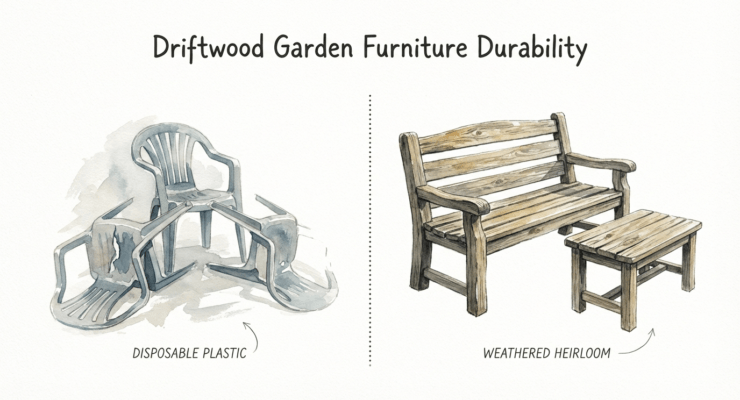
Some furniture dies in the sun; this furniture was born in it. Why buy a bench every three years when the ocean provides material that has already survived a thousand storms? Driftwood furniture doesn’t rot or fade—it gains character. It’s a legacy piece that connects your garden to the rhythm of the tides.
Most modern outdoor decor is built to fail. It is manufactured in a factory, dipped in chemical vats, and shipped across the world only to peel and crack after two seasons of real weather. Driftwood is different. It has already endured the most brutal conditions on the planet: abrasive sand, corrosive salt, and the relentless pounding of the surf. When you bring it into your garden, you aren’t just adding a seat; you are anchoring a piece of history.
This is a guide for the person who values grit over gloss. We will look at why driftwood stands the test of time, how to prepare it so it lasts for decades, and why it represents the ultimate “weathered heirloom” in an era of disposable plastic.
Driftwood Garden Furniture Durability
Driftwood garden furniture durability is a unique phenomenon where the environment that usually destroys wood—water and salt—actually serves to preserve it. In a standard forest, a fallen tree is quickly reclaimed by the earth through fungi, bacteria, and insects. In the ocean, a different process takes over.
Seawater acts as a natural pickling agent. As a log floats, the high salt concentration leaches out the natural sugars and starches that usually attract wood-boring insects and rot-causing fungi. This “curing” process can take years, effectively mummifying the wood from the inside out. By the time that piece of timber hits the shore, it has been stripped of its softest fibers, leaving behind only the most resilient heartwood.
In the real world, this means driftwood is inherently more stable than “green” lumber bought at a hardware store. It has already done its warping, shrinking, and cracking. When you build a chair out of a well-seasoned piece of coastal cedar or oak, that furniture will not change shape. It has reached a state of environmental equilibrium that modern kiln-drying processes try to mimic but rarely master.
Think of it like a seasoned cast iron skillet. New wood is raw and reactive. Driftwood is tempered. It exists in a “grey-state” where the outer layer has oxidized into a silver-gray patina. This layer is more than just an aesthetic choice; it acts as a reflective shield against UV rays, preventing the deeper internal fibers from breaking down under the summer sun.
How to Select and Prepare Driftwood for Furniture
Building with driftwood requires a different mindset than working with dimensional lumber. You cannot simply follow a blueprint; you must follow the grain. The process begins with selection and ends with a rigorous stabilization ritual.
First, you must evaluate the wood’s “inner soul.” Not all wood found on a beach is worth keeping. You are looking for pieces that feel surprisingly heavy for their size, which indicates a dense, rot-resistant heartwood. If a piece feels light or “punky”—meaning your thumb can press into the surface—it has already begun to decay from the inside and should be left for the tide to reclaim.
Once you have found your structural pieces, they must be cleaned and sanitized. Seawater is a preservative, but it also carries microscopic stowaways. A thorough scrubbing with a stiff-bristled brush is necessary to remove salt crust, sand, and loose bark.  . Many builders then soak or spray the wood with a mild bleach or white vinegar solution to ensure any remaining organisms are neutralized.
Curing is the next critical step. Even though the wood was “dried” by the sun on the beach, the core may still hold significant moisture. You should store your driftwood in a shaded, well-ventilated area for at least two to four weeks before construction. Drying it too quickly in direct heat can cause “checking,” or deep cracks, while drying it slowly allows the fibers to settle without internal stress.
Finally, the joinery must account for the wood’s irregular shapes. Traditional screws often fail in the porous ends of driftwood. Instead, use deep-set stainless steel bolts or traditional mortise-and-tenon joints. Because driftwood is rarely straight, you will spend more time with a drawknife and a chisel than a table saw, fitting each piece together like a three-dimensional puzzle.
The Benefits of Reclaiming the Tide’s Timber
Choosing driftwood over store-bought alternatives offers several practical and environmental advantages. The most immediate benefit is sustainability. Every piece of driftwood used is a piece of “found” material that required zero carbon footprint to grow, harvest, or process. You are practicing the ultimate form of recycling: taking what nature has discarded and giving it a second life.
Aesthetics play a massive role as well. No two pieces of driftwood are identical. While a plastic chair is a clone of a million others, a driftwood bench is a singular sculpture. It carries the “pioneer-grit” look—a sense of rugged endurance that complements a natural garden far better than the sterile lines of modern furniture.
From a maintenance perspective, driftwood is remarkably low-fuss. Because it has already been stripped of its sapwood and sugars, it does not require the constant staining or painting that pressure-treated lumber demands. 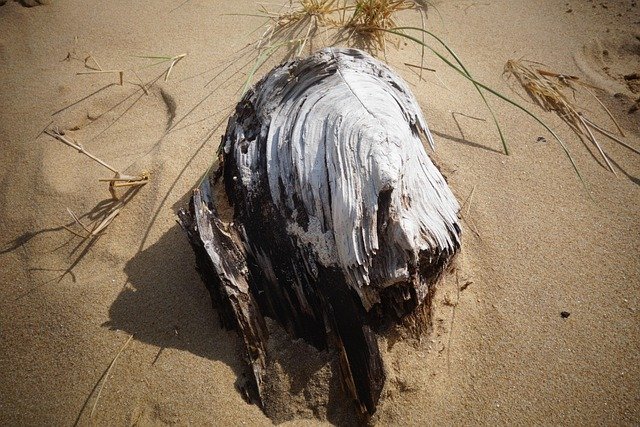 . In fact, many enthusiasts choose to leave it entirely unfinished, allowing the silver patina to deepen over the years.
There is also a tactile benefit. The ocean’s “sanding” process, involving years of agitation against sand and pebbles, creates a surface texture that is impossible to replicate with sandpaper. It is smooth but not slippery, weathered but not splintery. It feels “warm” to the touch because wood is a natural insulator, unlike metal or plastic which becomes either scalding or freezing depending on the temperature.
Challenges and Common Pitfalls
The primary challenge of working with driftwood is its unpredictability. Unlike a 2×4 from a lumber yard, driftwood has no “true” edge. This makes leveling a table or ensuring a chair doesn’t wobble a complex engineering task. If you are a beginner, you may find yourself frustrated by the lack of ninety-degree angles.
A frequent mistake is over-sanding. It is tempting to take a power sander to a piece of driftwood to “clean it up,” but doing so often removes the very patina that protects the wood. If you sand through the silver-grey layer, you expose the raw tan or brown wood underneath, which is more susceptible to UV damage and may look patchy as it tries to re-oxidize.
Another pitfall is ignoring the “ground-contact” rule. Even the toughest driftwood will eventually rot if it sits directly on damp soil or trapped in a puddle. The bottom of the furniture’s legs should always be slightly elevated. Using “feet” made of stone, or simply placing the furniture on a gravel or slate pad, will double its lifespan by allowing the wood to dry out between rainstorms.
Finally, builders often underestimate the weight. True structural driftwood—the kind that makes for a sturdy heirloom—is incredibly dense. A single log intended for a bench seat can easily weigh over a hundred pounds. This makes the furniture difficult to move once assembled, so it is wise to build the piece as close to its final destination as possible.
Limitations: When Driftwood May Not Be Ideal
Despite its rugged nature, driftwood is not a universal solution for every garden. If you live in a region with extreme, constant humidity and very little sunlight, driftwood may struggle. Without the sun to “bake” the wood and dry it out after a rain, it can develop moss or algae growth. While this adds a “forest” aesthetic, it can eventually lead to surface softening.
Furthermore, driftwood is generally unsuitable for high-load structural applications where safety is a factor, such as a multi-story deck or a heavy-duty children’s swing set. Because you cannot easily verify the internal integrity of a found log, you should never trust it to hold critical structural loads without significant reinforcement.
It is also important to consider the environmental impact of your sourcing. In some coastal regions, removing driftwood is illegal because it provides a vital habitat for local fauna and helps prevent beach erosion. Always check local regulations before hauling timber from the shore. A “weathered heirloom” is only valuable if it was acquired ethically.
Lastly, if you require a perfectly uniform look, driftwood will disappoint you. It is inherently “messy” and organic. It will have knots, old insect tracks (now empty), and irregular bumps. If your garden design leans toward a minimalist, “clean-line” aesthetic, the rugged grit of the tide might clash with your vision.
Comparison: Disposable Plastic vs. Weathered Heirloom
To understand the value of driftwood, one must compare it to the standard options available in today’s market.
| Feature | Disposable Plastic | Weathered Heirloom (Driftwood) |
|---|---|---|
| Longevity | 3–5 years (UV degradation) | 20–50+ years (Natural durability) |
| Maintenance | None, but impossible to repair | Occasional cleaning; easily repairable |
| Cost | Low upfront, high over time | Free (Sourced) or High (Artisan) |
| Environmental Impact | High (Petroleum-based, non-biodegradable) | Zero (Carbon-neutral, reclaimed) |
| Aesthetic | Uniform, sterile | Unique, soulful, rugged |
While plastic lumber is often marketed as “maintenance-free,” it has a definitive expiration date. UV rays eventually break down the chemical bonds in the plastic, leading to a chalky surface that can eventually shatter. Driftwood, conversely, has already survived the sun’s worst. Its maintenance is an choice, not a requirement for survival.
Practical Tips for Maintaining Driftwood Furniture
If you want to ensure your driftwood furniture lasts for a generation, a few simple best practices will go a long way.
- Keep the Air Moving: Ensure there is plenty of space around the furniture for airflow. This prevents the “micro-climate” of dampness that allows mold to take root.
- The Rock Trick: Never let wood touch the dirt. Use flat river stones or slate tiles as coasters under each leg. This breaks the “wicking” action where moisture travels from the ground into the wood grain.
- Annual Rinse: Once a year, give the furniture a firm hosing down to remove pollen, dust, and spider webs. If moss begins to grow, a stiff brush and a splash of vinegar will clear it right up.
- Check the Hardware: If you used metal fasteners, check them every spring. Salt in the wood can accelerate corrosion even in “galvanized” screws. Using stainless steel is the only way to truly prevent rust streaks.
- To Seal or Not to Seal: If you want to keep the “beach look,” do nothing. If you prefer a “wet” look, use a clear matte polyurethane or a natural tung oil. Avoid thick varnishes, as they will eventually peel and require a nightmare of sanding to fix.
Natural oils like linseed or tung oil are excellent for driftwood because they penetrate the porous surface rather than sitting on top of it. This allows the wood to “breathe” while providing a layer of water resistance. Just be aware that any oil will darken the wood significantly, shifting it from silver-grey to a deep driftwood brown.
Advanced Considerations for the Serious Practitioner
For those looking to build professional-grade driftwood furniture, the focus shifts to internal structural reinforcement. Because driftwood can be “punky” in spots, many advanced builders use a technique called “invisible bracing.” This involves drilling deep into a piece and inserting a threaded steel rod or a hardwood dowel, which is then epoxied into place. This provides the strength of a modern beam while maintaining the organic exterior.
Another advanced technique is the use of wood hardeners. These are thin resins that are brushed onto the wood; they soak into the fibers and then harden, effectively turning a soft piece of wood into a composite material. This is particularly useful for decorative pieces that need to withstand handling without flaking.
Serious practitioners also pay close attention to the species of wood they find. While “driftwood” is a catch-all term, its properties depend on the original tree. Coastal Cedar is the gold standard for durability. Oak is heavy and strong but can turn black if it reacts with iron fasteners. Pine is common but needs the most “pickling” time in the ocean to be truly durable. Knowing your species allows you to choose the right joinery and finish for the specific piece.
Finally, consider the concept of “compression fit.” As driftwood seasons in your garden, it will continue to lose the last few percentages of moisture. Advanced joinery like the “wedged mortise” actually gets tighter as the wood dries. This is the hallmark of pioneer-grit craftsmanship—building a piece that doesn’t just survive the years but uses them to become more solid.
Real-World Scenarios and Examples
Imagine a “Coastal Bandon Bench.” A massive cedar log, bleached white by the Oregon sun, forms the seat. It is supported by two thick stumps of salt-cured oak. Instead of using nails, the builder used hand-carved mortises. Ten years later, the bench is as sturdy as the day it was built. The moss growing in the crevices only adds to its beauty, and the silver patina has become so bright it almost glows in the moonlight.
Contrast this with a “Big Box Store Bench” made of thin slats of tropical hardwood. . After two years, the varnish has peeled. After four years, the screws have rusted, causing the wood around them to rot. By year six, the bench is in a landfill. The driftwood bench, however, has only just begun its life. It has become a permanent part of the landscape, a landmark in the garden.
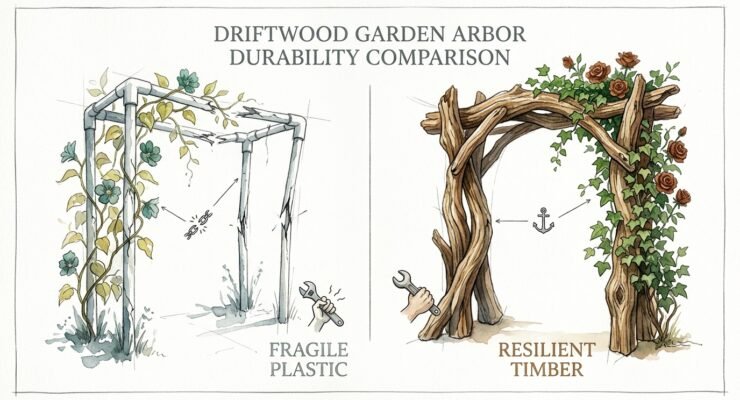
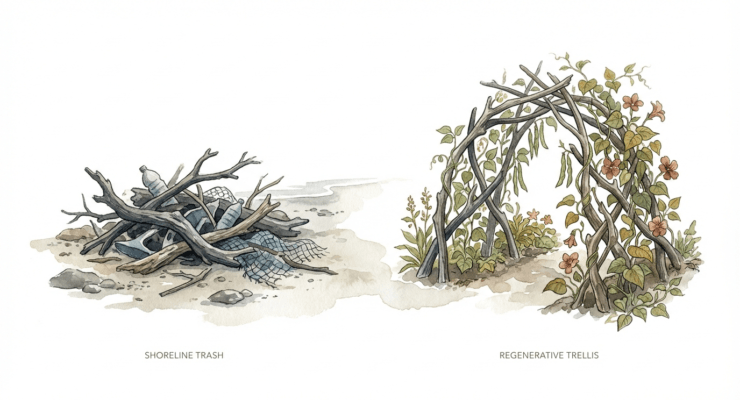
Another scenario is the “Driftwood Arbor.” By using long, curved branches of tide-washed fir, a gardener creates an entrance to their vegetable patch. The salt-cured wood is naturally resistant to the climbing vines that would rot a standard pine lattice. The irregular shapes of the wood provide perfect handholds for the plants to grip, creating a living sculpture that changes with every season.
Final Thoughts
Driftwood furniture is a rebellion against the temporary. It is a commitment to a material that has already proven its worth in the harshest arena on earth. When you choose to work with the ocean’s timber, you are choosing a path of patience, grit, and respect for the natural world.
The durability of these pieces isn’t just measured in years, but in the stories they tell. Every knot and silver fiber is a testament to survival. Whether you are building a simple stool or a complex garden arbor, you are creating something that will likely outlast the person who built it.
Go to the shore, find a piece of wood that the sun has born and the sea has cured, and bring it home. Don’t be afraid of the rough edges or the grey patina. That isn’t decay; it’s armor. In a world of disposable plastic, be the person who builds a weathered heirloom. Your garden—and the generations who sit in it—will thank you.
Sources
1 quora.com (https://www.quora.com/How-is-furniture-made-from-driftwood-different-from-other-wooden-furniture) | 2 reddit.com (https://www.reddit.com/r/DIY/comments/18gub7/request_driftwood_as_decor_or_building_material/) | 3 dtwooddecor.com (https://www.dtwooddecor.com/driftwood-coffee-table-care-and-maintenance/) | 4 researchgate.net (https://www.researchgate.net/publication/399045870_Driftwood_as_a_Material_for_Making_Unique_Furniture) | 5 coastalcottagebyceleste.com (https://www.coastalcottagebyceleste.com/diy/lr0iwt1wrtsiz0a4dzvpbq3m5awhyk) | 6 youtube.com (https://www.youtube.com/watch?v=c7C4FjX1xls) | 7 wikihow.com (https://www.wikihow.com/Preserve-Driftwood) | 8 southernpine.com (https://www.southernpine.com/real-wood-vs-composite-or-plastic-decking/) | 9 kedel.co.uk (https://www.kedel.co.uk/blog/how-strong-is-recycled-plastic-lumber-compared-to-timber.html) | 10 woodgraingirls.com (https://www.woodgraingirls.com/avoid-these-common-mistakes-when-building-diy-outdoor-furniture) | 11 simexa.com (https://www.simexa.com/revitalize-and-preserve-wooden-outdoor-furniture/) | 12 stackexchange.com (https://woodworking.stackexchange.com/questions/2654/techniques-for-working-with-driftwood)
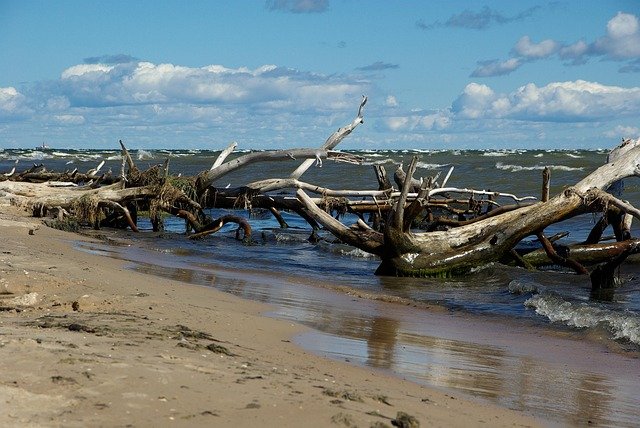 . If the wood gives way easily or feels like a sponge, the rot has moved past the surface and into the core. You want pieces that feel surprisingly heavy for their size, as this indicates high density and low internal rot.
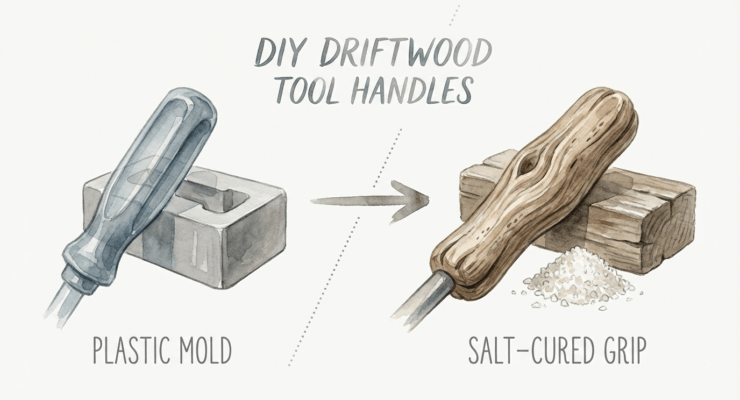
 . The silvered patina and intricate grain patterns of driftwood give your tools a “legacy” feel, making them look like heirlooms from day one.
 . The natural curve of the wood provides better leverage for digging in hard clay, turning a broken piece of trash into a superior gardening tool that will last for decades.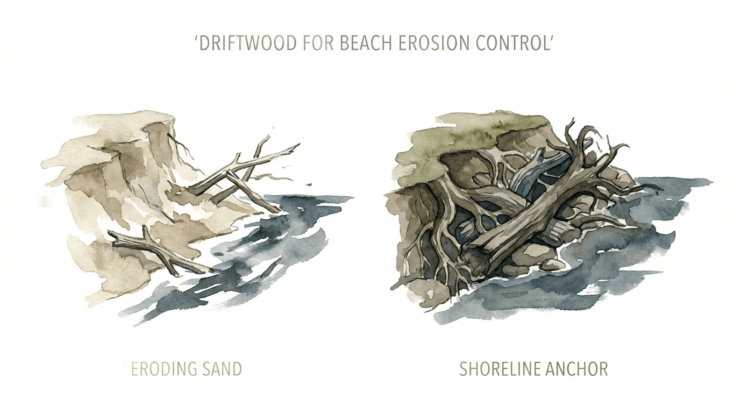
 .
. . This structure is incredibly effective at breaking wave energy.
 .
.
 . Use a stiff wire brush to scrub away sand and any lingering organic matter. This reveals the beautiful gray patina and ensures a clean surface for your plants to grip.
 . At the top where the poles meet, they use heavy-duty jute twine to lash the pieces together. A long, thinner piece of driftwood is then laid across the tops of both tripods, creating a “bridge” between them. This entire structure is stable enough to support 50+ pounds of fruit and foliage.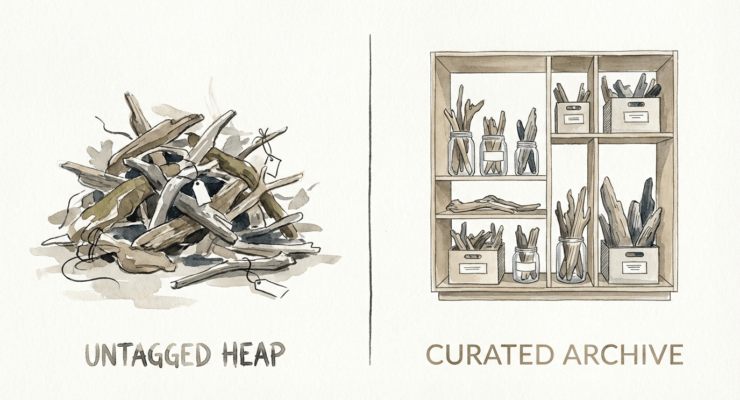
 . Submerging the wood in a solution of one part bleach to ten parts water for twenty minutes kills most surface organisms. For smaller pieces, baking them in an oven at 200°F (93°C) for two to four hours provides a deeper thermal kill that ensures no larvae survive to infest your home.
 . Driftwood is rarely uniform, making it difficult to stack efficiently. Large root balls or sprawling branches require significant square footage that cannot be easily condensed. This often forces crafters to be highly selective about what they keep, leading to the difficult task of discarding “good” wood to make room for “great” wood.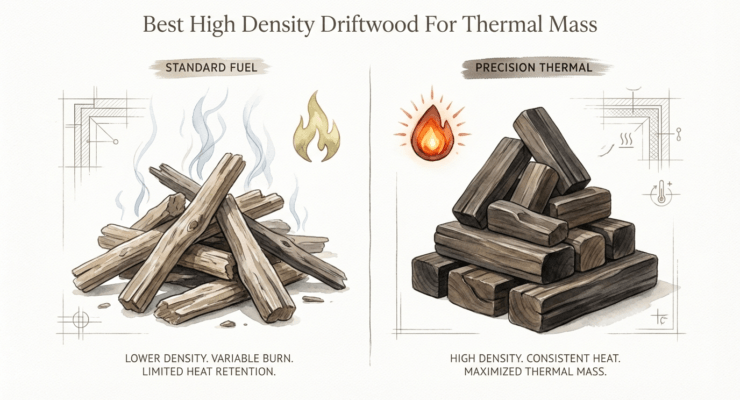
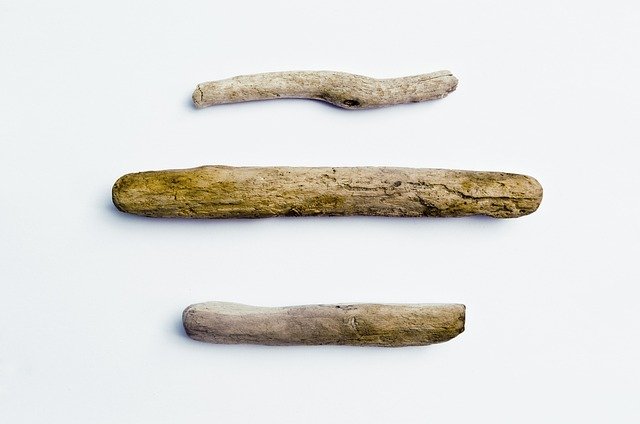 . It breaks down the hemicellulose that makes wood light and fast-burning, leaving behind the denser lignin and a lattice of salt crystals. In the world of homesteading, this is as close to “free coal” as you can get, provided you have the right machine to process it.
 . Standard red clay bricks can eventually crumble under the chemical stress of high-temperature salt combustion. High-alumina firebricks, however, are essentially immune to the chloride ions.