Primal Driftwood Lighting Vs Modern Minimalist Lamps
Your brain was evolved to recognize the curves of the forest, not the straight lines of a factory floor. We’ve traded the primal comfort of the hearth for the sterile glow of a warehouse. While modern lamps focus on ‘function,’ they forget our ancestral need for organic forms. Driftwood lighting doesn’t just illuminate a room; it reconnects us to the patterns of the wild that we’ve been missing for a century.
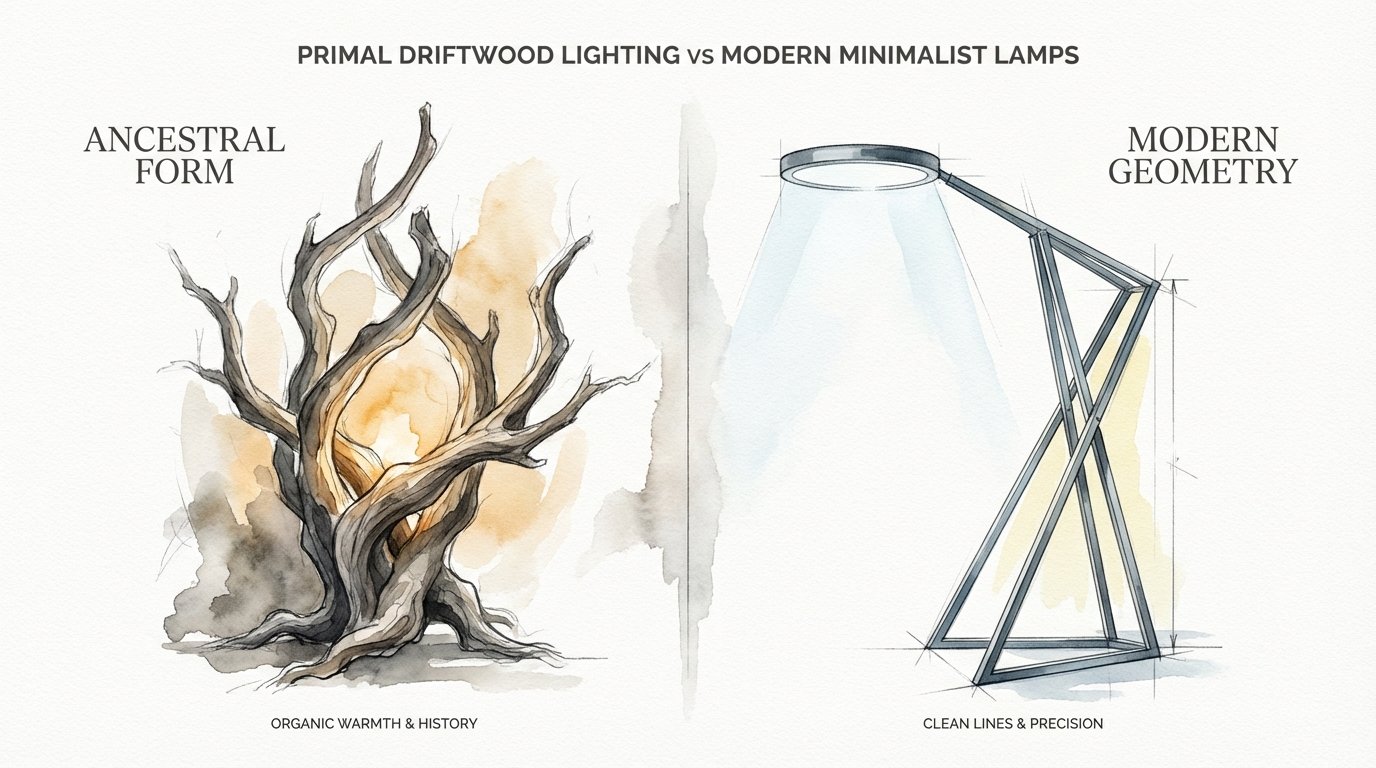
For decades, interior design has leaned toward the sharp, the clinical, and the predictable. We surround ourselves with right angles and flat surfaces, wondering why our homes feel like waiting rooms rather than sanctuaries. The solution isn’t more technology; it is the reintroduction of the natural world. Driftwood lighting bridges the gap between MODERN GEOMETRY and ANCESTRAL FORM, providing a functional light source that carries the weight of history and the rhythm of the tides.
Every piece of driftwood is a story told by the water. It has been tumbled by river rapids or scoured by salt and sand for years until only the strongest heartwood remains. When you turn a piece of that weathered timber into a lamp, you aren’t just buying furniture. You are inviting a survivor of the elements into your living space to cast shadows that remind your nervous system of the safety of the woods.
Primal Driftwood Lighting Vs Modern Minimalist Lamps
Primal driftwood lighting is the antithesis of the mass-produced plastic and metal fixtures found in big-box stores. While a modern minimalist lamp seeks to disappear into the background with its thin lines and neutral colors, a driftwood piece demands attention. It represents a return to biophilic design, which suggests that humans possess an innate tendency to seek connections with nature and other forms of life.
Modern lamps are often built with planned obsolescence in mind. They use thin-gauge metals and cheap polymers that lack soul. In contrast, driftwood lighting utilizes materials that have already proven their durability by surviving the harshest environments on Earth. These fixtures exist at the intersection of art and utility, serving as a functional sculpture during the day and a source of warm, atmospheric light at night.
In real-world applications, driftwood lighting works in almost any setting where warmth is needed. In a sleek, modern apartment, a gnarled cedar root lamp provides a necessary “organic break” from the surrounding glass and steel. In a rustic cabin, it reinforces the connection to the land. This style of lighting isn’t just for coastal homes; it is for anyone who feels the “sterile glow” of modern life is becoming too much to bear.
The Alchemy of the Shore: How Driftwood Lighting Works
Creating a piece of driftwood lighting is a process of curation and preservation rather than manufacturing. It starts with the hunt. You look for wood that has been stripped of its bark and soft outer layers by the abrasive action of water and sand. This natural “sandblasting” reveals the dense, twisting grain and unique knots that make each piece a one-of-a-kind specimen.
The mechanical function of a driftwood lamp is identical to a standard fixture, but the structural integration is far more complex. Instead of a hollow metal tube, the “body” is a solid, irregular piece of timber. This requires the craftsman to navigate the internal geometry of the wood, drilling long, precise holes or carving hidden channels to house the electrical components without compromising the exterior’s raw beauty.
Preservation is the second half of the equation. Raw wood from the wild can carry moisture, salt, and unwanted organisms. The wood must be meticulously cleaned and seasoned before it ever sees a light bulb. Once stabilized, it can be left raw for a tactile, matte finish, or sealed with oils and waxes to deepen the color and protect it from the dry air of a climate-controlled home.
Forging the Form: A Step-by-Step Guide to Crafting Your Own
Building your own driftwood lamp is a satisfying way to claim a piece of the wild for your home. You don’t need a master’s degree in electrical engineering, but you do need patience and a respect for the material. Follow these steps to ensure your project is both beautiful and safe.
Step 1: The Collection and Selection. Wander the shorelines or riverbanks after a heavy storm. Look for hardwoods like oak, cedar, or cypress, as these resist rot better than softwoods. Choose a piece that has a stable base or can be easily mounted to one. Ensure the wood is “sound”—if you can poke a screwdriver deep into the grain with little resistance, the wood is too decayed to hold a heavy fixture.
Step 2: Purification. Natural wood is often home to tiny hitchhikers. Submerge your find in a solution of one part bleach to nine parts water for at least 24 hours. This kills bacteria, mold spores, and insects. After the soak, rinse it thoroughly with fresh water and let it dry in a sunny, well-ventilated area. Depending on the thickness of the wood, this drying process can take anywhere from two weeks to a full month.
Step 3: Structural Prep. Once the wood is bone-dry, use a wire brush or sandpaper to remove any remaining loose debris or sharp splinters. Use 180-grit to 300-grit sandpaper if you want a smooth, touchable surface, or keep it rough for a more primitive look. Determine where the wire will enter and exit. You will likely need a long “spade bit” or an aircraft drill bit to create a central channel for the lamp rod.
Step 4: Wiring and Assembly. Purchase a UL-listed lamp kit. This includes the socket, cord, and threaded rod (often called a nipple). Thread the rod through your drilled hole and secure it with washers and nuts. Pull the electrical cord through the rod and wire the socket according to the manufacturer’s instructions. Ensure the base is heavy enough to prevent tipping; if the driftwood is top-heavy, consider mounting it to a stone or heavy wooden plinth.
Step 5: Finishing. Apply a coat of finishing oil, such as Danish oil or beeswax, to protect the wood. This will bring out the rich textures of the grain. Avoid high-gloss polyurethane unless you want a very “wet” look; usually, a matte or satin finish feels more authentic to the wood’s journey.
The Gifts of the Wild: Benefits of Organic Lighting
The primary benefit of driftwood lighting is its impact on the psychological atmosphere of a room. Natural textures have been shown to lower cortisol levels and improve mood. This isn’t just “design talk”—it’s a biological response to the presence of fractal patterns found in nature. A driftwood lamp provides a focal point that calms the eye and invites touch, making a room feel inhabited and warm.
Durability is another unsung advantage. Because the wood has already survived years of exposure to water and sun, it is remarkably stable. It won’t warp or crack like fresh “green” wood might. If you care for it properly, a driftwood fixture can last for generations, becoming a family heirloom that only looks better as it develops a deeper patina over time.
Versatility in design is a major draw for professional decorators. Driftwood is neutral in color but rich in texture, allowing it to complement a wide range of palettes. It can be used as a floor lamp, a table fixture, or even a massive ceiling chandelier. Because no two pieces are the same, you are guaranteed to have a lighting solution that is entirely unique to your home.
Common Pitfalls and Hidden Dangers
Ignoring the cleaning process is the most frequent mistake beginners make. Taking a “cool log” straight from the beach and putting it on your nightstand is an invitation for termites, wood-boring beetles, or mold to enter your home. The bleach soak is non-negotiable. If the wood is too large to soak, you must at least treat it with a borate-based wood preservative to ensure it is sterile.
Electrical safety is the second major concern. Many DIYers try to “hack” a lamp using old cords or unlisted parts. Always use new, UL-listed components. The wood itself is flammable, so ensuring your wiring is tight and your socket is secure is vital. Never allow a high-heat incandescent bulb to touch the wood directly. Stick to LED bulbs, which remain cool to the touch and significantly reduce the risk of fire.
Poor balance is a physical hazard that is often overlooked. Driftwood is inherently irregular. A piece that looks beautiful might be prone to tipping over at the slightest bump. Always test the center of gravity. If the piece is unstable, do not hesitate to bolt it to a wider, heavier base. Safety must always come before the “pure” aesthetic of the wood.
Limitations: When the Wild Isn’t the Right Fit
Driftwood lighting is not a universal solution for every space. In environments that require clinical precision and maximum brightness—such as a high-tech laboratory or a surgery-style kitchen—the shadows cast by gnarled wood can be a hindrance. Driftwood creates “moody” light, often resulting in complex shadow patterns that might interfere with tasks requiring clear, even illumination.
Space constraints also play a role. Because driftwood is organic and sprawling, it often has a larger footprint than a minimalist metal lamp. In a tiny apartment where every square inch matters, a large, twisting branch might feel cluttered rather than cozy. You must consider the “air” around the lamp; it needs room to breathe so the viewer can appreciate its form.
Environmental factors like extreme humidity or direct, harsh sunlight can also take a toll. While driftwood is tough, prolonged exposure to high moisture can eventually lead to rot if the wood wasn’t sealed correctly. Conversely, placing a gnarled piece in a window with ten hours of direct, baking sun can cause the fibers to become brittle and bleached over several years.
Comparison: Hand-Crafted Driftwood vs. Factory-Made Minimalist Lamps
| Feature | Driftwood Lighting | Modern Minimalist Lamps |
|---|---|---|
| Material Origin | Natural, reclaimed, weathered timber. | Extruded aluminum, plastic, or steel. |
| Visual Impact | High-texture, organic focal point. | Low-profile, blends into surroundings. |
| Customization | Each piece is entirely unique. | Standardized, mass-produced. |
| Psychological Effect | Calming, biophilic, nostalgic. | Clean, efficient, modern. |
| Maintenance | Occasional dusting and oiling. | Simple wiping with a damp cloth. |
| Complexity | Moderate (requires selection & prep). | Low (ready to use out of the box). |
Expert Maneuvers: Best Practices for Longevity
To keep your driftwood lighting in peak condition, you must treat it like a living piece of art. Dust tends to settle in the deep crevices and knots of the wood. Using a soft-bristled paintbrush or compressed air is much more effective than a standard rag. Keeping the wood clean prevents oils from building up and dulling the natural silver or tan patina.
Maintain the moisture balance of the wood if you live in an extremely dry climate. Wood is a porous material that can “shrink” if the air is too arid, which might loosen the mounting hardware or the lamp rod. Rubbing the wood with a high-quality furniture wax once a year creates a barrier that slows down moisture exchange and keeps the fibers supple.
Upgrade your electrical components over time. If you built your lamp years ago with an older kit, consider swapping in a high-quality “touch-dimmer” socket or a cloth-covered cord. These small details elevate the primitive look of the wood, making it feel like a high-end designer piece rather than a simple DIY project. Smart bulbs are also an excellent addition, allowing you to change the color temperature to match the time of day.
Advanced Considerations: Scaling and Structural Integrity
Serious practitioners often want to move beyond simple table lamps into larger architectural pieces. Creating a driftwood chandelier requires a deep understanding of weight distribution and ceiling joist support. A large branch can weigh fifty pounds or more; you cannot simply hang this from a standard electrical box. You must use heavy-duty eye bolts anchored directly into the structural timber of your home.
Wiring for large-scale pieces often involves multiple bulbs. This requires “daisy-chaining” the sockets or using a central hub hidden within the wood. If the branch is particularly thin in some areas, you may need to use copper tubing to protect the wires and provide extra structural rigidity. This is where the craft moves from woodworking into true engineering.
Consider the scale of the wood in relation to the lumens produced. A massive, dark-toned cedar root will absorb more light than a pale, sand-bleached oak branch. For larger installations, you may need higher-output LED “filaments” to ensure the piece actually provides enough light for the room. Balancing the “shadow play” of the wood with the need for actual illumination is the mark of a master craftsman.
Real-World Scenarios: From Coastal Cottages to Urban Lofts
Imagine a modern loft in a converted warehouse. The walls are exposed brick, the floors are polished concrete, and the furniture is mostly metal and glass. It’s a cold space. Now, place a six-foot-tall driftwood floor lamp in the corner. Suddenly, the room has a soul. The shadows cast by the gnarled wood break up the harsh lines of the brickwork, making the industrial space feel like a home.
In a coastal bedroom, the use of driftwood lighting is more literal but no less powerful. A pair of matching bedside lamps made from salt-crusted cypress brings the spirit of the ocean indoors. Because the wood is reclaimed from the very beach visible through the window, it creates a seamless transition between the exterior environment and the interior sanctuary.
Even in a corporate office, a small driftwood desk lamp can make a difference. It serves as a “tactile reset” for an employee who has spent eight hours staring at a digital screen. Running a hand over the smooth, water-worn grain of the wood provides a momentary connection to the physical world, reducing stress and increasing focus in a way that a plastic office lamp never could.
Final Thoughts
Driftwood lighting is more than a design trend; it is a rejection of the “sterile glow” of the modern factory. It honors the slow, patient work of nature and brings a sense of history and grit into our homes. By choosing organic forms over rigid geometry, we satisfy a primal need for connection that mass production has ignored for too long.
Whether you find a piece on a local riverbank and build it yourself or invest in a professionally crafted chandelier, you are making a statement about the world you want to inhabit. You are choosing the curves of the forest. You are choosing a material that has already survived the storm. And in doing so, you turn a simple light source into a beacon of the wild.
Experiment with different species of wood and various lighting kits. The beauty of this craft is that there are no mistakes, only unique variations. Take the time to clean your wood, wire it safely, and watch as your living space transforms from a warehouse of objects into a sanctuary of form and light.
Sources
1 scavengerchic.com (https://scavengerchic.com/2018/07/25/maine-driftwood-lamp-diy/) | 2 ies.org (https://ies.org/lda/biophilic-design-and-the-nature-of-light/) | 3 homify.co.uk (https://www.homify.co.uk/diy/12998/5-things-used-to-preserve-driftwood-and-make-it-home-decor) | 4 diydriftwood.com (https://diydriftwood.com/how-to-clean-driftwood/) | 5 dksstores.com (https://vertexaisearch.cloud.google.com/grounding-api-redirect/AUZIYQFEBWhDNcyzsrjROnkryVuXxB-crbqYtpMxp40m16XCt75xIQueDPNI4_h-4HdGX8CGq2m9OOh3Spm2tqOdF1_ZGVEAhf-dEZr9bbVRKJJwKcjnOb5qhsX0PncvefE=) | 6 diydriftwood.com (https://diydriftwood.com/how-to-create-a-driftwood-lamp/) | 7 simplydiscus.com (https://www.simplydiscus.com/library/biotopes/natural/driftwood_treatment.shtml)