Rust-proof Coastal Garden Lighting Ideas
Why fight the salt-saturated air with metals that crumble when the ocean has already provided a shield that never rusts? Every year, coastal homeowners replace ‘weatherproof’ metal lights that have turned to orange dust. Meanwhile, the wood that spent a decade in the Atlantic is just getting started. Learn why your garden infrastructure should come from the tide, not the hardware store.


Living within the reach of the sea spray is a privilege that comes with a high maintenance tax. Standard outdoor lighting, even those labeled as “weather-resistant,” often fails within two seasons. The salt-laden air acts as a relentless abrasive, finding microscopic pits in powder coating and turning aluminum into white powder and steel into flakes of rust. This guide explores a more resilient path: utilizing natural, salt-hardened materials and marine-grade components to create a lighting system that thrives where others fail.
Rust-proof Coastal Garden Lighting Ideas
Rust-proof coastal lighting focuses on materials that the ocean cannot digest. This means moving away from mass-produced “contractor grade” metal fixtures and toward materials with inherent biological or chemical resistance to salt.
Natural driftwood is perhaps the ultimate coastal lighting material. Having survived years of submersion in saltwater, driftwood is effectively “cured.” The salt has replaced much of the organic moisture in the wood fibers, making it extremely resistant to rot and further salt damage. Using these pieces as bollards or pedestals for lights creates a fixture that looks at home on the dunes and will outlast any painted metal post.
Another idea involves reclaimed pier timber. These heavy beams, often made of Greenheart or tropical hardwoods like Ipe and Teak, were designed to stand in the surf for half a century. Sliced into smaller sections, they make rugged, immovable path lights. For those who prefer a modern look, high-grade 316 stainless steel or solid brass are the only metal exceptions. Brass does not rust; it develops a dark, protective patina known as “verdigris,” which actually seals the metal from further decay.
Composite fixtures and high-density polycarbonates are also emerging as practical, budget-friendly options. Unlike metal, these polymers are chemically inert to salt spray and can be molded into various shapes that mimic traditional lanterns without the risk of peeling or pitting.
How to Build and Install Coastal-Grade Wood Lighting
Building a lighting system that survives the coast requires a different mindset than inland landscaping. You are not just installing a light; you are building a marine-grade electrical enclosure.
Start by selecting your timber. If using driftwood, ensure it is thoroughly dried and cleaned of sand. For new timber, choose species high in natural oils like Teak, Western Red Cedar, or Ipe. These woods contain natural preservatives that repel moisture and insects.
The process of converting a piece of wood into a light fixture involves “internalizing” the vulnerabilities. Instead of mounting a metal box on the outside of the wood, use a long-reach drill bit to create an internal channel for the wiring. This keeps the electrical heart of the fixture shielded from direct salt spray.
For the electrical components, never use standard household copper wire. Always opt for “marine-grade” tinned copper wire. Each strand in marine wire is coated in tin, preventing the “black wire disease” where salt air travels up the insulation and oxidizes the copper, leading to high resistance and fire risks. All connections should be made inside a junction box rated IP67 or higher, meaning it is dust-tight and can survive temporary immersion.
Benefits of Timber and Natural Materials in Coastal Lighting
The most immediate advantage of using timber and marine metals is longevity. While a cheap aluminum light might last 18 months near the surf, a solid brass or teak fixture can easily last 20 years with minimal care.
Aesthetically, wood and patinated metals blend into the coastal landscape. Shiny metal often looks out of place against the muted grays and tans of the beach. Weathered wood, on the other hand, mirrors the environment. As the wood grays and the brass darkens, the lighting system becomes part of the scenery rather than a jarring addition.
There is also a significant cost benefit over the long term. Frequent replacement of “disposable” fixtures adds up. Investing in high-quality materials upfront means fewer trips to the hardware store and less time spent troubleshooting flickering lights. Furthermore, wood is a poor conductor of heat and electricity, which reduces the thermal stress on LED components compared to metal housings that can bake in the summer sun.
Challenges and Common Mistakes in Coastal Environments
The most frequent mistake homeowners make is trusting the “outdoor rated” label on big-box store products. In a coastal environment, “outdoor rated” usually means it can handle a rainy day in the suburbs, not a salt-fog morning on the coast.
Another challenge is galvanic corrosion. This happens when two different types of metal touch each other in the presence of saltwater. For example, if you use a zinc-plated screw to mount a stainless steel bracket, the salt air will act as an electrolyte, causing the zinc screw to dissolve rapidly. Always match your metals; if the fixture is 316 stainless, every screw, washer, and nut must also be 316 stainless.
Electrical sealing is the third major hurdle. Many people believe that wrapping a wire connection in electrical tape is enough. It is not. Salt air is microscopic and will find its way under the tape. Proper coastal installations require heat-shrink tubing with an internal adhesive lining that melts and creates a permanent, airtight seal around the connection.
Limitations: When Natural Materials May Not Be Ideal
While wood is superior for resisting salt, it has structural limitations. You cannot easily create the thin, delicate shapes possible with metal. If your garden design requires ultra-modern, slim-profile fixtures, you will have to rely on expensive marine-grade 316 stainless steel rather than timber.
Environment also plays a role. In areas with high humidity but low salt (like a rainforest or deep inland swamp), wood may be more prone to fungal rot than in a high-salt coastal zone. The salt in coastal areas actually acts as a preservative. If your garden is inland, standard powder-coated aluminum might actually be more maintenance-free than wood.
Lastly, the weight of reclaimed timbers or large driftwood can make installation a two-person job. These fixtures require deep footings and more physical effort to set in place compared to a light metal spike that you simply push into the ground.
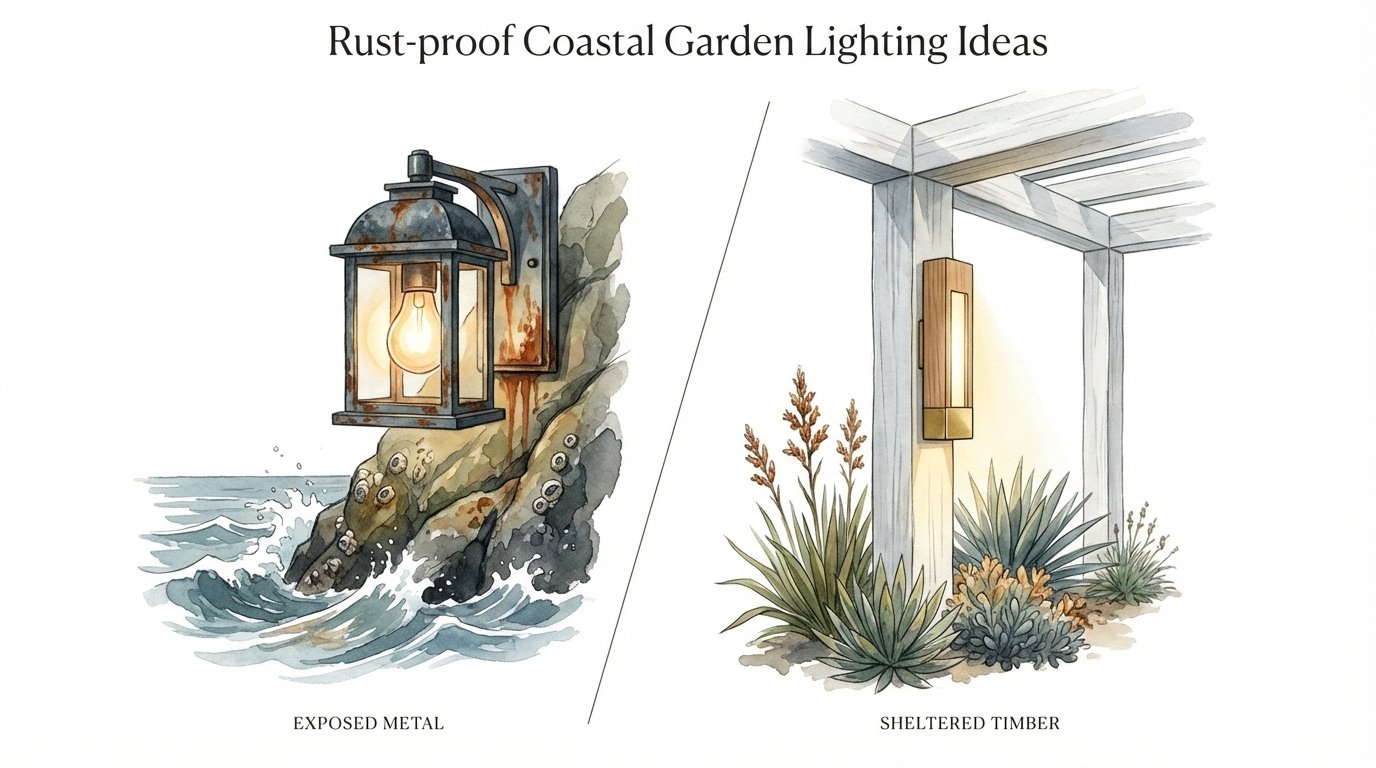
Comparison: EXPOSED METAL vs. SHELTERED TIMBER
Choosing between traditional metal fixtures and timber-based systems often comes down to a choice between frequent maintenance and initial labor.
| Feature | Exposed Metal (Standard) | Sheltered Timber / Marine Grade |
|---|---|---|
| Lifespan (Coastal) | 1–3 Years | 15–25 Years |
| Maintenance | High (Cleaning, Painting) | Low (Natural Weathering) |
| Corrosion Risk | Severe (Pitting, Rust) | Negligible |
| Electrical Safety | Moderate (Socket Oxidation) | High (Sealed Internal Wiring) |
| Initial Cost | Low to Moderate | High |
Practical Tips for Coastal Lighting Maintenance
Even the best-built system needs a little help to face the Atlantic or Pacific. One of the most effective tools in your kit should be dielectric grease. Apply a small dab of this non-conductive, waterproof silicone grease to every light bulb base and electrical socket. It creates a physical barrier that prevents salt from reaching the metal contacts, stopping corrosion before it starts.
Wash your fixtures occasionally with fresh water. It sounds counterintuitive for “weatherproof” items, but a quick rinse with a garden hose removes the salt crystals that accumulate on the surface. These crystals attract moisture from the air, creating a constant corrosive bath. By rinsing them off, you give the material a break from the chemical attack.
Inspect your seals every spring. UV rays from the sun are just as damaging as salt air; they can make rubber gaskets brittle. If a gasket feels hard or shows cracks, replace it immediately. A tiny drop of silicone lubricant on these gaskets will help them stay supple and maintain a watertight seal.
Advanced Considerations for Salt-Air Environments
For those looking to build a truly professional-grade system, consider the “voltage drop” over long coastal runs. Coastal properties are often sprawling, and low-voltage (12V) systems can lose power over distance. Using a 10-gauge or 8-gauge marine wire (which is thicker) ensures that the light furthest from the transformer is just as bright as the one closest to it.
Integration with solar power is another advanced route. Since many coastal areas are wide open to the sun, solar-powered timber bollards can eliminate the need for trenching wires through sand and salt-grass. However, ensure the solar panel itself is protected by a glass cover rather than cheap plastic, which will cloud up from sand abrasion and UV exposure within a year.
Think about “light pollution” and local wildlife. Many coastal areas have strict regulations regarding sea turtle nesting seasons. Lighting should be “shielded” and use amber-colored LEDs (long wavelength) which are less disruptive to nesting turtles than bright white or blue lights. Designing your timber fixtures to point light downward not only protects wildlife but also creates a more sophisticated, high-end look for your garden.
Scenario: Building a Reclaimed Timber Path Light
Imagine you have a winding path leading to a private beach. You want light that feels like it has always been there. You source four-foot sections of 6×6 Ipe timber.
First, you use a router to cut a 1/2-inch deep groove down the back of the post for the wire. You drill a hole through the center of the post about three feet up, connecting to that groove. This hole is where your LED puck light will sit.
You mount a solid brass “hood” over the hole to direct light downward. Instead of using standard screws, you use 316 stainless steel square-drive screws. You fill the wiring groove with a marine-grade sealant (like 3M 5200) after the wire is laid, effectively turning the timber post into a solid, waterproof unit. The result is a path light that can be hit by a rogue wave and keep right on shining.
Final Thoughts
Building a coastal garden that stands the test of time requires moving beyond the temporary solutions sold at most retailers. By embracing the materials that have already proven their worth in the ocean—driftwood, dense hardwoods, and marine metals—you create a landscape that ages with grace rather than decaying with rust.
The secret lies in the details: the tinned wire, the dielectric grease, and the rejection of mismatched metals. It takes more effort to drill a channel through a piece of salt-cured oak than it does to stick a plastic light in the ground, but the reward is a system that remains reliable while your neighbors are on their third set of replacements.
Experiment with the natural shapes the sea provides. A garden lit by the warm glow of timber and brass feels permanent and connected to the horizon. It is a testament to the idea that if you want to beat the ocean, you have to start thinking like it. Reach for the materials that the tide has already tested and found worthy. Rust is a choice, not an inevitability.
Sources
1 delmarfans.com (https://www.delmarfans.com/educate/learn/coastal-lighting-material) | 2 illuminationfl.com (https://illuminationfl.com/2025/05/08/how-to-choose-the-right-outdoor-lighting-fixtures-for-coastal-climates/) | 3 k2lighting.com (https://k2lighting.com/blogs/news/comparing-marine-grade-led-lighting-vs-traditional-lighting-systems-which-is-better) | 4 oclights.com (https://oclights.com/prevent-coastal-corrosion-protect-landscape-lighting/) | 5 longhousecedar.com (https://www.longhousecedar.com/the-best-types-of-water-and-rot-resistant-timber-species/) | 6 thestewartlumberco.com (https://thestewartlumberco.com/blog/what-are-the-best-water-resistant-woods/) | 7 nhregister.com (https://www.nhregister.com/homeandgarden/article/DIY-driftwood-sconce-6471444.php) | 8 brazilianlumber.com (https://brazilianlumber.com/the-8-most-weather-resistant-woods/) | 9 fencearmor.com (https://fencearmor.com/blogs/news/rot-resistant-wood-what-wood-is-best-for-long-lasting-projects) | 10 orlandomistersparky.com (https://orlandomistersparky.com/protect-outdoor-lights-salt-air-humidity/) | 11 agcled.com (https://www.agcled.com/blog/4-little-known-secrets-about-outdoor-coastal-lighting.html) | 12 youtube.com (https://www.youtube.com/watch?v=8cHYfIrY_xQ)