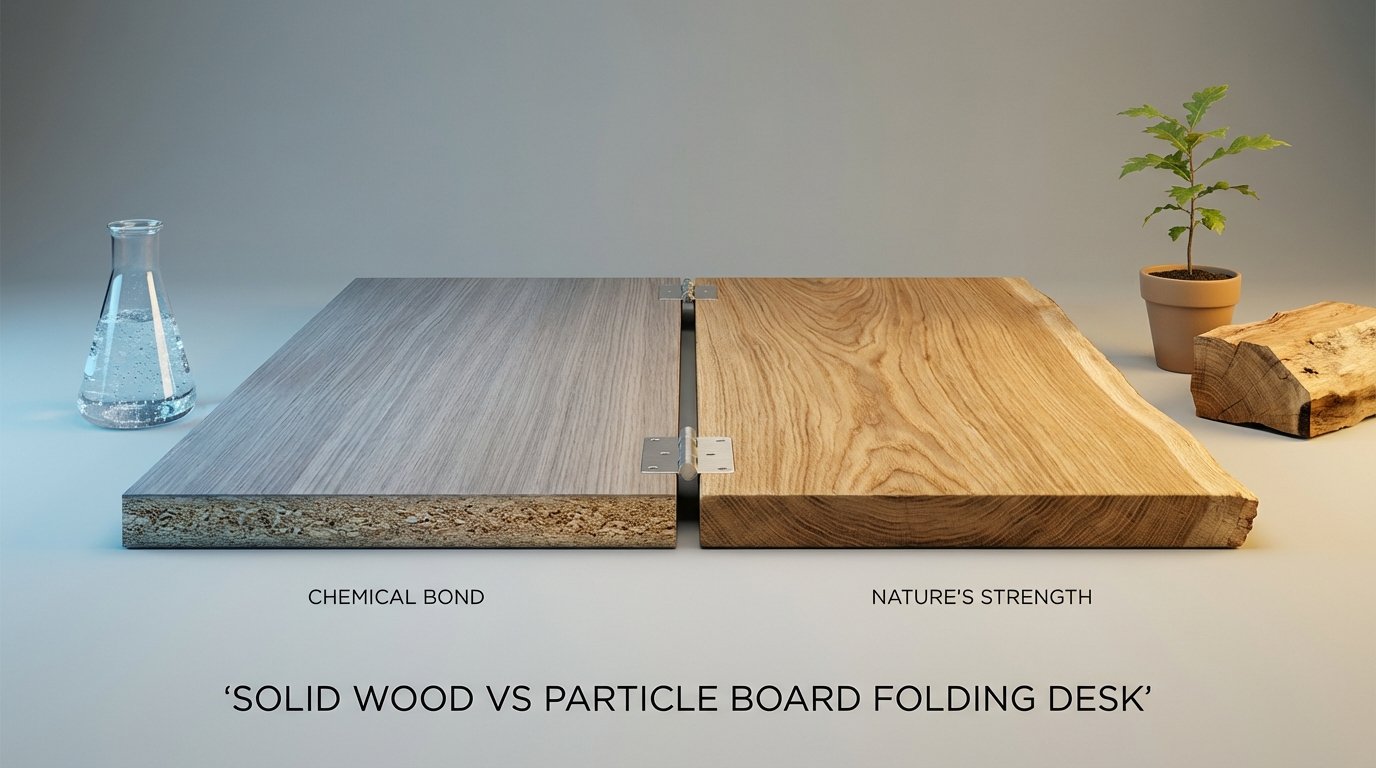
Solid Wood Vs Particle Board Folding Desk
One is held together by industrial chemicals, the other by the strength of the grain. We’ve traded longevity for convenience. Most ‘DIY’ desks are just sawdust and glue disguised as furniture. It’s time to return to real timber that breathes with your home.
Modern workspaces demand flexibility. A folding desk serves as the ultimate chameleon, appearing when duty calls and vanishing when the day ends. However, the material you choose determines whether that desk is a lifelong partner or a temporary resident destined for a landfill.
Understanding the fundamental battle between Nature’s Strength and Chemical Bonds is the first step toward a smarter home office. This guide dives deep into the structural, environmental, and practical realities of furniture materials.
Solid Wood Vs Particle Board Folding Desk
A solid wood folding desk is a piece of furniture crafted from single planks of natural timber. Every inch of the surface is a direct slice of a tree, showcasing the unique cellular structure that grew over decades. This natural architecture provides inherent tension and strength that synthetic materials try to mimic but rarely achieve.
Particle board, often labeled as chipboard or MDF, is an engineered product. It consists of wood chips, sawmill shavings, and sawdust pulverized into a fine mesh. Manufacturers then drench these particles in synthetic resins—typically urea-formaldehyde—and compress them under high heat into flat panels.
Real-world usage exposes the massive gap between these two. A solid wood desk handles the repeated stress of folding and unfolding with ease because the wood fibers are continuous and interconnected. Particle board lacks this internal network. It relies on the “glue bond” to hold everything together, which often fails at the exact points where hinges and screws are attached.
Think of solid wood like a woven fabric where every thread supports the next. Particle board is more like a pile of sand held together by hairspray. It looks solid until you apply pressure to a specific point, at which time the structure crumbles into its original components.
How the Construction Dictates Performance
The physics of a folding desk centers on the pivot point. Most designs use heavy-duty hinges to transition the desk from a flat profile to a horizontal workspace. This creates a leverage effect that exerts significant force on the screws holding the hardware in place.
Solid wood excels here because the screw threads bite into long, resilient cellulose fibers. These fibers wrap around the metal, creating a mechanical lock. If the desk is bumped or overloaded, the wood yields slightly and then holds its ground. This resilience is what allows solid wood furniture to survive multiple moves and decades of daily use.
Particle board construction takes a different path. Because it is essentially compressed dust, there are no long fibers for a screw to grab. The hardware stays in place solely because the resin is stiff. Over time, the vibrations of typing or the weight of a monitor cause the resin to micro-fracture. Eventually, the screw hole “blows out,” leaving a crater of sawdust that is nearly impossible to repair effectively.
Moisture plays another critical role in how these desks function. Real timber is hygroscopic, meaning it absorbs and releases moisture as the seasons change. It expands and contracts as a single, cohesive unit. High-quality solid wood desks are engineered with “breadboard ends” or slotted screw holes to allow for this natural movement without cracking.
Engineered boards react to moisture like a sponge. If a coffee spill or high humidity reaches the raw core of a particle board desk, the wood particles swell. Unlike real wood, this swelling is permanent and non-uniform. The internal glue bonds break, the surface bubbles, and the structural integrity vanishes. This “swelling death” is the primary reason why budget folding desks rarely last more than a few years in humid climates.
Benefits of Choosing Real Timber
Longevity stands as the most obvious advantage of solid wood. A well-made oak or walnut folding desk can easily last 50 years. This isn’t just a marketing claim; it is a mechanical reality. The material’s density and grain structure allow it to absorb impacts that would shatter a synthetic alternative.
Repairability is a hidden superpower of natural wood. Life happens. Scratches, coffee rings, and dents are inevitable in a busy workspace. With solid timber, a simple afternoon of light sanding and a fresh coat of oil or wax returns the desk to its original glory. You are essentially working with a “self-healing” material that can be refreshed as many times as needed.
Structural integrity for heavy equipment is another win. If you use a dual-monitor setup or a heavy desktop PC, the “sag” factor becomes a real concern. Solid wood has a much higher modulus of elasticity than particle board. It can span longer distances without bowing under the weight of your tech stack.
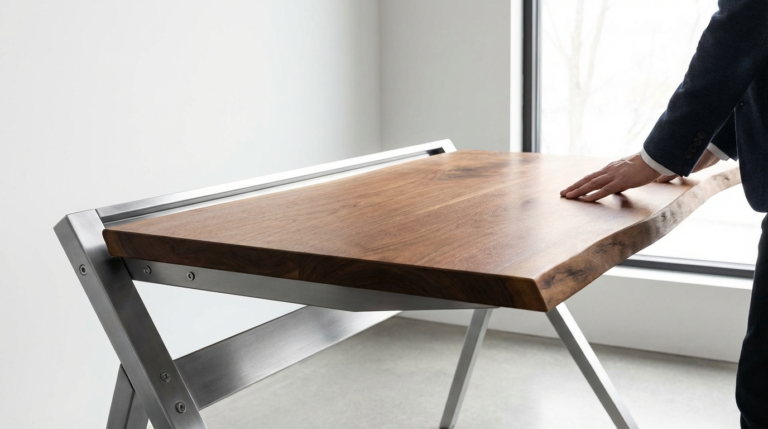
Aesthetic soul cannot be manufactured in a factory. No two pieces of real wood are identical. The grain tells a story of the tree’s life, from rainy seasons to dry spells. This visual depth creates a sense of warmth and permanence in a home office that a printed laminate pattern simply cannot replicate. Every time you fold down your desk, you are interacting with a unique piece of nature.
Challenges and Common Mistakes
Buying the cheapest “wood” desk online is the most frequent error. Many listings use deceptive language like “wood finish” or “espresso wood” to hide a particle board core. Always look for the specific term “Solid Wood.” If the price seems too good to be true for a solid oak desk, it probably isn’t solid oak.
Neglecting the hardware is another pitfall. A solid wood desktop is useless if it is attached with flimsy, thin-gauge hinges. The weight of real timber is significantly higher than sawdust boards, meaning the folding mechanism must be robust. High-quality desks often use piano hinges or recessed heavy-duty steel brackets to ensure the transition is smooth and secure.
Ignoring wood movement causes long-term issues. Beginner woodworkers or low-end manufacturers sometimes glue solid wood tops directly to rigid frames. As the humidity changes, the wood tries to expand, but the frame holds it back. This tension leads to the wood splitting down the center. Professional-grade solid wood desks always include a “floating” mount system to prevent this.
Forgetting to seal the grain is a common maintenance mistake. While solid wood is durable, it still needs a barrier against the elements. If you buy an unfinished “live edge” folding desk, failing to apply a protective oil or polyurethane will leave it vulnerable to stains and drying out. A quick application once every year or two keeps the fibers hydrated and resilient.
Limitations of Both Approaches
Weight is the primary constraint of solid wood. A 48-inch folding desk made of solid maple can be surprisingly heavy. If you plan to move the desk frequently or mount it to a wall, you must ensure the wall studs or support legs are capable of handling the load. This is not a “toss it in the trunk” piece of furniture; it is a substantial investment in mass.
Cost remains the biggest hurdle for many. Harvesting, drying, and milling real timber takes time and skilled labor. A solid wood folding desk will almost always cost 3x to 5x more than a mass-produced flat-pack version. You are paying for a lifetime of use upfront, which can be a difficult pill to swallow for those on a tight budget.
Environmental trade-offs exist on both sides. Solid wood requires the felling of mature trees, though sustainable forestry (FSC certification) mitigates this. Particle board uses sawmill waste, which sounds eco-friendly on paper. However, the high concentration of synthetic resins makes particle board nearly impossible to recycle. When it breaks, it goes to the landfill, where it may release chemicals for decades.
Precision and uniformity are the few areas where particle board wins. Because it is an engineered product, every sheet is perfectly flat and consistent. There are no knots to work around and no grain directions to consider. This makes it ideal for ultra-minimalist designs that require razor-thin profiles which would be too fragile in natural wood.
Solid Wood vs Particle Board Comparison
| Feature | Solid Wood | Particle Board |
|---|---|---|
| Average Lifespan | 20 – 50+ Years | 3 – 7 Years |
| Repairability | High (Sanding/Refinishing) | None (Replacement only) |
| Moisture Resistance | Moderate (Can be sealed) | Low (Permanent swelling) |
| Screw Holding Power | Excellent (Fiber-lock) | Poor (Resin-only) |
| Chemical Off-gassing | None (Natural) | High (Formaldehyde/VOCs) |
| Weight Capacity | Superior | Limited / Prone to sag |
Practical Tips for a Better Workspace
Check the underside of the desk for the most honest look at the material. Manufacturers often apply a beautiful veneer to the top but leave the bottom raw or covered in a cheap paper backing. If you see a consistent, grainy texture underneath that matches the top, you are likely looking at solid timber.
Inspect the edges for “edge banding.” Particle board requires a thin plastic or wood strip to hide the ugly sawdust core. If you see a faint line where the top meets the side, it’s a sign of a composite material. Solid wood will show the “end grain”—the rings of the tree—on the edges, which is impossible to fake perfectly.
Invest in a high-quality desk pad if you choose solid wood. While the wood is tough, the finishes can be sensitive to the heat from a laptop or the friction of a mouse. A leather or felt pad protects your investment and adds a layer of comfort to your typing experience.
Test the folding mechanism before committing. Open and close the desk several times. Listen for creaks or “crunching” sounds in the wood. A well-engineered solid wood desk should feel silent and weighty. If the hinges feel loose or the material feels “crunchy” around the screws, walk away.
Advanced Considerations: The Health Factor
Indoor air quality is a growing concern for home office workers. Particle board is a major source of Volatile Organic Compounds (VOCs). The urea-formaldehyde glues used to bond the wood chips can “off-gas” for years, especially in small, poorly ventilated rooms. This can lead to respiratory irritation, headaches, and long-term health risks.
Choosing solid wood eliminates this risk entirely. Natural timber is inert and “clean.” When you sit at a solid wood desk, the only thing you are breathing in is the faint, natural scent of the wood itself. For anyone with allergies or chemical sensitivities, this is often the deciding factor.
Thermal stability is another advanced point to consider. Wood is a natural insulator. If your office is in a cold basement or a drafty attic, a solid wood surface will feel warmer to the touch than a plastic-laminated particle board desk. This might seem minor, but over an 8-hour workday, it significantly impacts your comfort levels.
Sustainable sourcing is the final frontier. Look for species like White Oak, Maple, or Walnut. These are “hardwoods” that offer the best density for furniture. Avoid “softwoods” like cheap Pine for folding desks, as they are too soft to hold hinges securely over long periods. Hardwoods grow slower, making them more expensive but infinitely more durable for mechanical furniture.
Real-World Scenarios
Imagine a freelance graphic designer living in a studio apartment. Space is at a premium. They buy a $90 particle board folding desk. Within six months, the humidity from the nearby kitchen causes the hinges to sag. One day, while moving the desk to clean, a screw rips out of the softened core. The desk is now trash, and the designer is out $90 and a workspace.
Contrast this with a remote software engineer who invests in a solid cherry wood wall-mounted folding desk. The initial cost is $450. Three years later, they move to a new house. They unbolt the desk, sand out a small scratch from the move, and re-install it. Ten years later, the wood has darkened into a rich, beautiful patina. The desk has cost them roughly $45 per year and will likely be passed down to their children.
Construction workers and hobbyists often choose solid wood for a different reason: the ability to customize. If you need a specific cable management hole or want to mount a power strip underneath, you can simply drill into solid wood. Doing this with particle board often compromises the entire panel’s strength, leading to cracks that spiderweb across the surface.
Final Thoughts
The choice between solid wood and particle board is a choice between an heirloom and a disposable commodity. While the lower price point of engineered wood is tempting, the hidden costs of replacement, health risks, and environmental impact tell a different story. Real timber offers a level of structural security and aesthetic beauty that transforms a temporary workspace into a permanent part of your home.
Investing in quality means buying something once. When you choose Nature’s strength over industrial chemicals, you aren’t just buying a desk; you are reclaiming a piece of craftsmanship. You deserve a workspace that is as resilient and authentic as the work you do.
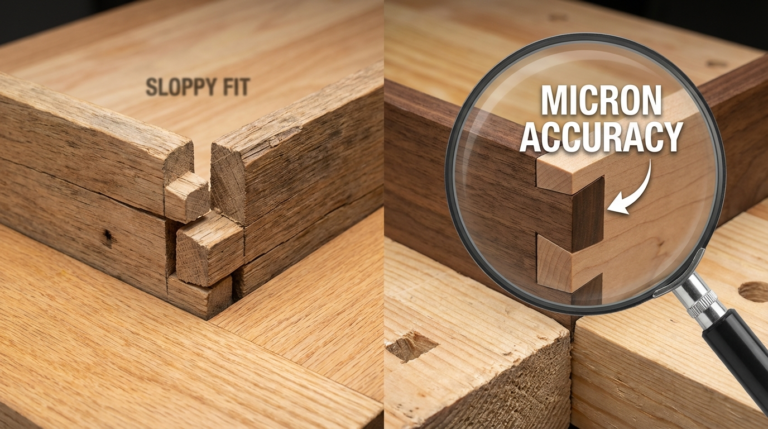
Take the time to research local makers or high-end retailers who specialize in solid timber. Feel the weight, smell the wood, and look closely at the joinery. Your home office is your sanctuary. Fill it with materials that are built to last a lifetime, not just a season.
Sources
1 trandesk.com (https://www.trandesk.com/blog/particleboard-vs-mdf-comprehensive-comparison-for-buyers/) | 2 jamesandjamesfurniture.com (https://jamesandjamesfurniture.com/blogs/news/why-solid-wood-outperforms-particle-board-the-smart-investment-guide) | 3 vinsonfinefurniture.com (https://vinsonfinefurniture.com/engineered-wood-vs-particle-board/) | 4 forestplywood.com (https://forestplywood.com/blog/composite/mdf-vs-particle-board/) | 5 tyfinefurniture.com (https://www.tyfinefurniture.com/blogs/blog/solid-wood-furniture-vs-particle-board-which-is-better) | 6 oakfurniturestore.co.nz (https://oakfurniturestore.co.nz/blogs/our-stories/understanding-the-difference-between-particle-board-and-solid-wood-furniture) | 7 amishoakintexas.com (https://amishoakintexas.com/solid-wood-furniture-vs-particle-board-what-texans-need-to-know-before-buying/) | 8 lukesfurniturecompany.com (https://www.lukesfurniturecompany.com/articles/5-reasons-to-choose-solid-wood-over-particle-board-for-your-furniture) | 9 smart-living.asia (https://smart-living.asia/blogs/the-importance-of-high-quality-furniture-for-enhancing-your-living-space/solid-wood-vs-particleboard-environmental-impact-scorecard-for-conscious-consumers) | 10 btod.com (https://www.btod.com/blog/reasons-particle-board-desk-good/) | 11 reddit.com (https://www.reddit.com/r/IKEA/comments/1p56cxe/has_anyone_noticed_a_real_difference_between/) | 12 buildinggreen.com (https://www.buildinggreen.com/explainer/particleboard-deadly-formaldehyde-emissions-explained) | 13 lumi.cn (https://www.lumi.cn/en/news&blog-detail/10-differences-you-must-know-about-particleboard-and-mdf) | 14 okstate.edu (https://extension.okstate.edu/fact-sheets/basics-of-formaldehyde-emission-from-wood-composite-panels)