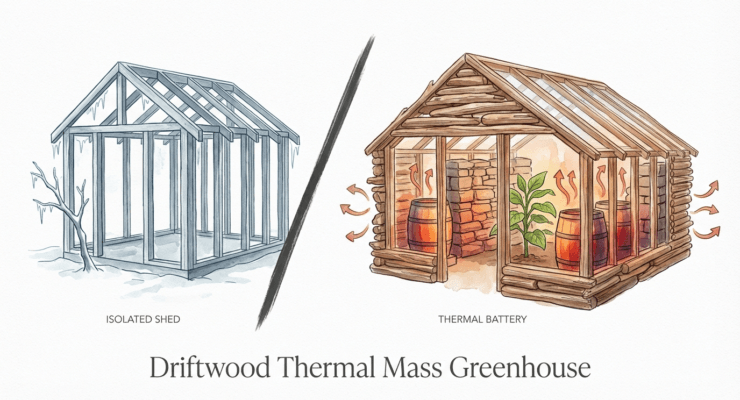
What if your driftwood stash could keep your winter garden alive for free? Isolated storage is a missed opportunity. Driftwood, with its high density and salt-hardened fibers, is a fantastic thermal battery. By integrating your storage wall directly into your greenhouse or garden microclimate, you create a heat-sink that stabilizes temperatures for your seedlings. It’s time your storage became a biological engine.
Most gardeners treat their wood storage as a separate entity, tucked away in a dark corner of the yard. This approach ignores the laws of thermodynamics. A massive stack of dense wood is a battery waiting to be charged by the sun. When you bring that stack inside the greenhouse, you are no longer just storing fuel or craft supplies. You are building a climate-control system that requires zero electricity.
Driftwood offers a unique advantage over standard kiln-dried lumber. Years of exposure to saltwater and the relentless pounding of the tide create a material that is structurally dense and chemically altered. These salt-impregnated fibers hold onto heat with a stubbornness that standard pine simply cannot match. This is the essence of the pioneer-grit approach to gardening: using what the environment provides to solve the problems the environment creates.
Driftwood Thermal Mass Greenhouse
A Driftwood Thermal Mass Greenhouse is a passive solar structure that uses large quantities of scavenged wood to regulate its internal temperature. In a traditional greenhouse, the sun heats the air, which then escapes through the glass or plastic the moment the sun goes down. This leads to massive temperature swings that can shock or kill sensitive winter crops. Adding thermal mass changes the equation by absorbing that excess daytime heat and holding it for the night.
Think of the driftwood as a sponge. During a clear winter day, solar radiation passes through the greenhouse glazing and hits the dark, dense surfaces of the wood. The wood soak up this energy, raising its internal temperature. When the sun sets and the air temperature begins to plummet, the driftwood starts to “leak” that heat back into the room. This process is known as thermal lag, and it is the key to preventing frost damage without a heater.
This system exists because traditional thermal mass materials like water barrels or concrete slabs are often expensive, heavy, and difficult to move. Driftwood is a free, renewable resource for anyone near a coastline or river system. It allows a gardener to build a functional heat-sink that is also a storage solution for future projects. It turns a “pile of wood” into a functional piece of greenhouse infrastructure.
How the System Works Step-by-Step
The first step is the collection of high-density driftwood. Look for pieces that feel unusually heavy for their size, as this indicates a tight grain and high mineral content. Avoid wood that is “punky” or rotting, as air pockets in the rot act as insulation rather than mass. You want solid, salt-cured logs and branches that ring when you tap them with a hammer.
Strategic placement is the second crucial phase. The driftwood must be stacked against the north wall of the greenhouse. This allows the low winter sun to hit the stack directly for as many hours as possible. If the wood is shaded by the plants themselves, it won’t charge properly. You are essentially building a “living wall” of fuel and heat storage.
Airflow management is the third component. You must leave small gaps between the logs to allow air to circulate around the entire surface area of the stack. If the stack is too tight, only the outer layer will exchange heat with the room. A loose, stable “crib” style stack ensures that the core of the thermal battery is utilized. This prevents the center of the pile from staying cold while the greenhouse air is warm.
Moisture control is the final part of the process. While driftwood is naturally resilient, a greenhouse is a high-humidity environment. Elevate the base of your stack on stones or bricks to prevent ground moisture from wicking into the bottom logs.  . This also allows for better air draw from the floor, which is usually the coldest part of the structure. Keeping the wood dry ensures it remains a heat-sink rather than a source of mold.
Benefits of Driftwood as a Thermal Battery
One of the most immediate benefits is the cost. In an era of rising energy prices, the ability to heat a space for free is invaluable. Driftwood is a “gleaned” resource, meaning the only investment required is your time and the physical effort of hauling it. This makes it accessible to homesteaders and hobbyists who may not have the budget for high-tech climate batteries.
The salt content in driftwood provides a secondary benefit. Salt is a natural desiccant and preservative. It helps prevent the wood from rotting in the damp greenhouse environment and can even help regulate humidity levels. Furthermore, the high mineral density makes the wood less flammable than kiln-dried lumber, providing a safer storage environment within the structure.
The dual-purpose nature of the stack is another major advantage. Most greenhouses have “dead space” along the north wall where light levels are too low for most plants. By filling this space with a driftwood thermal battery, you are turning a liability into an asset. You get a stabilized growing environment and a beautiful, organized storage area for your woodworking or landscaping materials.
Finally, the “pioneer-grit” aesthetic cannot be ignored. A wall of silvered, salt-cured driftwood creates a natural, rugged atmosphere that no plastic water barrel can replicate. It connects the garden to the surrounding landscape and serves as a constant reminder of the cycles of the earth and sea. It is a functional piece of art that works for you every single night.
Challenges and Common Mistakes
A common mistake is using wood that is too small or thin. Twigs and small branches have a high surface-area-to-volume ratio, meaning they lose their heat almost as fast as they gain it. For a thermal battery to be effective, you need “thick” mass. Logs with a diameter of at least four to six inches are necessary to provide the thermal lag required to last through a long winter night.
Neglecting the “charge” time is another pitfall. A massive stack of wood takes time to heat up. If you build your stack in the middle of a week-long cold snap with no sun, the wood will actually act as a “cold-sink,” pulling warmth away from your plants. You must time your setup for a period of sunny weather so the battery can reach its baseline operating temperature before the extreme cold arrives.
Salt leaching is a legitimate concern for plant health.  . If raw driftwood is placed directly on the soil or allowed to drip onto foliage, the salt can cause chemical burns or “physiological drought” in your plants. Always ensure the wood is separated from the growing medium by a physical barrier like stones, a wooden pallet, or a vapor barrier. Protect your soil from the very minerals that make the driftwood such a good battery.
Limitations of the Method
Climate is the biggest limiting factor. In regions with extremely long, sunless winters (like the Pacific Northwest or parts of Northern Europe), there may not be enough solar gain to charge the battery. Thermal mass only works if there is an excess of heat during the day to store for the night. Without sun, the wood simply stays at the ambient temperature of the room.
Space is another constraint. To provide enough heat to keep a large greenhouse above freezing, you need a significant volume of wood. As a general rule, you need about 2 to 3 cubic feet of wood for every 10 square feet of glazing. In a small 8×10 greenhouse, this can take up a large portion of your floor space. This method is best suited for those who have the room to accommodate the mass.
The weight of the material must also be considered. A full wall of driftwood can weigh several tons. If your greenhouse is built on a deck or a thin concrete pad, it may not be able to support the load. Always ensure your foundation is rated for the weight of your thermal battery before you start stacking. Safety should never be sacrificed for thermal efficiency.
Isolated Shed vs. Thermal Battery
| Feature | Isolated Storage Shed | Integrated Thermal Battery |
|---|---|---|
| Energy Use | Passive (Waste Heat) | Active (Heat Sink) |
| Microclimate Impact | None | Stabilizes Temp Swings |
| Maintenance | Low (Dry Storage) | Medium (Humidity Control) |
| Cost | High (Separate Structure) | Low (Existing Space) |
| Efficiency | Zero Thermal Value | High Thermal Lag |
When comparing these two approaches, the choice comes down to efficiency. An isolated shed is a static structure that protects the wood but does nothing for the garden. An integrated battery turns that same wood into a dynamic part of the ecosystem. While the shed might keep the wood slightly drier, the thermal battery saves money on heating and extends the growing season, providing a much higher return on investment.
Practical Tips for Success
Paint the back of your greenhouse wall black behind the wood stack. This helps absorb any solar radiation that passes through the gaps in the wood, turning the entire wall into a giant solar collector. The heat is trapped against the wood, forcing the “charge” deeper into the logs and increasing the overall efficiency of the system.
Layer your wood by density. . Place the largest, heaviest logs at the bottom and center of the stack. These will be your “long-term” storage units. Surround them with smaller branches and textured driftwood. This creates a tiered release of heat: the smaller pieces provide warmth in the early evening, while the large logs continue to radiate heat in the pre-dawn hours when it is coldest.
Monitor your temperatures with a dual-probe thermometer. Place one probe in the air and one deep inside a gap in the wood stack. This allows you to see exactly how much heat the wood is holding and when it begins to release it. Understanding the “pulse” of your battery will help you decide when you might need to supplement with a small backup heater on the most extreme nights.
Use “sacrificial” pieces of wood on the very top of the stack. These pieces will be most exposed to the fluctuating humidity and UV rays. If you are storing high-quality driftwood for future carving or furniture projects, keep them in the middle of the stack where they are protected by the surrounding mass. This preserves your “good” wood while still letting it work for the garden.
Advanced Considerations for Serious Practitioners
For those who want to push the system further, consider adding an active airflow component. By using a small solar-powered fan to blow warm air from the peak of the greenhouse through a pipe that ends at the base of the driftwood stack, you can “force-charge” the battery. This pulls the hottest air in the room down to the coldest part of the wood, significantly increasing the amount of energy stored.
Another advanced technique is the inclusion of “wet mass” within the wood stack. Interspersing several dark-colored water jugs inside the driftwood pile creates a hybrid battery. Water has a higher specific heat than wood, but wood has a slower release rate. Combining the two allows for a rapid charge and a very long, sustained release, giving you the best of both worlds.
Consider the chemical interaction between the salt in the wood and the greenhouse atmosphere. Over time, the salt can help keep the air “crisp” and reduce fungal spores, but it can also be corrosive to metal greenhouse frames. If you have an aluminum or steel structure, ensure that the driftwood is not in direct contact with the metal. A simple layer of thick plastic or a wooden spacer will prevent galvanic corrosion.
Example: The February Frost Scenario
Imagine it is mid-February in a coastal zone. Daytime temperatures reach a balmy 60°F inside the greenhouse thanks to the sun, but the forecast calls for a hard freeze of 25°F at night. Without thermal mass, the internal temperature would drop to 25°F within three hours of sunset, likely killing your tomato starts and tender herbs.
With a 40-cubic-foot stack of driftwood (roughly the size of a large dresser), the story is different. During the 8 hours of sunlight, the stack absorbs roughly 15,000 BTUs of energy. As the sun sets, the air temperature begins to drop, but the wood stays at 55°F. It begins radiating heat immediately. By midnight, the air is 30°F outside, but the greenhouse is still at 48°F.
By 5:00 AM, the coldest part of the night, the wood has finally cooled to 40°F, but it is still releasing just enough warmth to keep the greenhouse at a safe 34°F. Your plants survived the frost without a single watt of electricity. When the sun rises the next morning, the cycle begins again, “recharging” the wood for the next night. This is the power of a well-designed thermal battery.
Final Thoughts
Using driftwood as a thermal mass is more than just a clever gardening trick. It is a fundamental shift in how we view “waste” and “storage.” By bringing your materials into the active zone of your garden, you create a symbiotic relationship between your hobbies and your food production. It requires no complex machinery—just a respect for the weight of the material and the warmth of the sun.
This approach rewards the patient observer. It asks you to learn the rhythms of your specific microclimate and to adjust your stacks accordingly. Over time, you will find the perfect balance between storage volume and growing space. You will see your plants grow stronger and your winter seasons grow longer, all while your driftwood stash waits for its eventual purpose in the workshop.
Don’t let your wood sit idle in a cold shed. Let it work for you. Build a battery that breathes with the sea and the sun. Your garden will thank you with every green leaf that survives the winter chill. It’s time to stop fighting the cold and start storing the light.
Sources
1 motherearthnews.com (https://www.motherearthnews.com/diy/thermal-mass-materials-zm0z18fmzsor/) | 2 mdpi.com (https://www.mdpi.com/2076-3417/14/19/8640) | 3 thinkwood.com (https://www.thinkwood.com/wp-content/uploads/2019/08/Think-Wood-CEU-Exceeding-Thermal-Performance-Goals.pdf) | 4 reddit.com (https://www.reddit.com/r/gardening/comments/o2emi8/can_you_use_the_thermal_mass_of_wood_to_protect/)