Why fight for floor space when the railing is your best friend?
Are you wasting your tiny balcony on heavy, immovable furniture? Switch from manual labor to strategic design. This railing-mounted desk takes 15 minutes to build and saves 100% of your floor space.
Most urban dwellers treat their balcony like a storage unit for dead plants and rusted chairs. It is time to stop thinking horizontally and start thinking vertically. Your railing is a structural goldmine waiting to hold your coffee, your laptop, and your weekend cocktails.
Strategic design is about reclaiming every square inch. When you move your surfaces off the ground and onto the railing, the floor suddenly opens up, making even a four-foot-wide space feel like a sprawling terrace. This guide will show you how to execute this transformation with minimal tools and maximum impact.
Diy Balcony Furniture Ideas For Small Spaces
Diy balcony furniture ideas for small spaces represent the ultimate hack for modern apartment living. These projects focus on “air space”—the volume of your balcony that usually goes unused. Instead of placing a four-legged table that blocks your walking path, you utilize the perimeter of the structure to create utility.
Think of your balcony like a ship’s cabin. On a ship, everything is built-in, foldable, or multi-functional. This approach exists because small spaces cannot afford the luxury of “single-use” furniture. Real-world applications of these ideas range from hanging herb gardens to bar-top ledges that clamp directly onto the metal or wood balusters.
Imagine a “floating” aesthetic. By using hooks, clips, and brackets, your furniture appears to hover. This does not just look cool; it creates a psychological sense of openness. When you can see the entire floor of your balcony, your brain registers the space as larger and less cluttered.
Common examples include the folding bistro set, the pallet sectional with hidden storage, and the superstar of small spaces: the railing-mounted bar. These solutions are used globally in dense cities like New York, Tokyo, and London, where every square foot is a premium asset.
The “Railing Bar” Concept
A railing bar is essentially a slim shelf that attaches to the top of your balcony guardrail.  . It serves as a workspace during the day and a dining area at night. Because it has no legs, it provides a zero-footprint solution for anyone needing a surface area without the bulk.
Vertical Greenery and Seating
Vertical gardening isn’t just for plants. You can use the same wall-mounted grids to hold folding stools or clip-on trays. This modularity allows you to “deploy” your furniture only when you need it, keeping the balcony clear for morning yoga or evening stretches.
How to Build the 15-Minute Railing Desk
Speed meets functionality in this build. You do not need a full workshop to create a professional-grade workspace. The key is selecting the right mounting hardware and a pre-cut piece of weather-resistant lumber.
Step one involves measuring your railing depth. Most apartment railings are either flat-top metal or 2×4 wood. For flat-top metal railings, you will want “C-clamp” style brackets. For wood railings, simple “L-brackets” or “French cleats” work wonders to secure your surface without drilling permanent holes into the building’s structure.
Step two is the material prep. Buy a pre-cut 12-inch by 36-inch plank of cedar or acacia. These woods are naturally oily and resist rot. Sand the edges with 120-grit sandpaper to prevent splinters. If you want a high-end look, apply a single coat of outdoor-rated teak oil to bring out the grain.
Step three is the assembly. Attach two heavy-duty folding shelf brackets to the underside of the wood plank. These brackets allow the desk to collapse flush against the railing when not in use. Align the brackets so they rest securely against the vertical balusters of your railing. Tighten your clamps or zip-tie the bracket arms for a non-permanent, renter-friendly installation.
Underlying principles here focus on the “lever arm.” Ensure your desk does not extend too far out from the railing. A 12-inch depth is the sweet spot; it is deep enough for a 15-inch laptop but shallow enough that it won’t put excessive torque on your railing. Common pitfalls include using cheap plastic brackets that warp in the sun. Stick to powder-coated steel or stainless steel hardware to ensure longevity.
Benefits of Railing-Mounted Furniture
Practical benefits start with the total reclamation of floor space. On a standard 4×10 balcony, a traditional table and two chairs can consume nearly 40% of the walkable area. A railing-mounted desk consumes 0% of the floor, leaving room for a comfortable rug or a lounge chair.
Flexibility is the second major advantage. Most DIY railing projects are modular. You can slide the desk to the left for better shade or remove it entirely in minutes if a storm is approaching. This adaptability is something heavy, “Bulky Builds” simply cannot offer.
Cost efficiency makes these projects accessible to everyone. While a high-end outdoor furniture set can cost upwards of $500, a DIY railing desk can be completed for under $60. You are paying for raw materials rather than retail markups and shipping for oversized boxes.
Customization is the final win. You choose the height that fits your body. If you prefer a standing desk, mount the ledge higher. If you want a cozy coffee nook, mount it at standard table height. This ergonomic freedom ensures your balcony is tailored to your specific lifestyle.
Challenges and Common Mistakes
Warning: weight distribution is the most frequent error. Beginners often place all the weight on the outer edge of the desk, which can pull at the railing or cause the wood to bow. Always ensure your brackets are rated for at least twice the weight you plan to put on the surface.
Poor hardware selection leads to “rust streaks” on your balcony floor. Using standard zinc-plated screws in an outdoor environment is a recipe for disaster. Within one season, rain will cause these screws to oxidize, leaving permanent orange stains on your concrete or decking. Always opt for 304 or 316-grade stainless steel fasteners.
Neglecting wind load is a dangerous misunderstanding. A flat board acts like a sail during high winds. If your desk is not securely fastened or if it doesn’t have a “fold-down” mechanism, a strong gust could flip the board or, worse, pull it off the railing entirely. Secure your desk with safety cables or heavy-duty industrial zip-ties as a secondary backup.
Mistakes also happen with wood choice. Using untreated pine or “whitewood” from the hardware store might save you $10 today, but the wood will warp, crack, and grow mold within six months of exposure. Investing in cedar, redwood, or pressure-treated lumber is mandatory for outdoor success.
Limitations and Constraints
Realistic constraints include building codes and landlord restrictions. Many modern apartment complexes have strict “nothing over the railing” policies. These rules exist to prevent items from falling onto people below. Always check your lease agreement before mounting anything that extends past the perimeter of your balcony.
Environmental limitations play a role in material choice. If you live in a coastal area, salt spray will corrode even “weather-resistant” metals. In these cases, you must use marine-grade hardware and apply protective coatings more frequently. Similarly, extreme heat can cause wood to shrink and hardware to loosen, requiring monthly “tune-ups” of your screws and bolts.
Juliet balconies present a unique boundary. These “fake” balconies have no floor at all. While you can still mount a very slim shelf for plants or a single drink, you cannot use any furniture that requires floor support. Understanding the structural limits of your specific railing is vital; thin aluminum balusters cannot support the same weight as a masonry or thick steel railing.
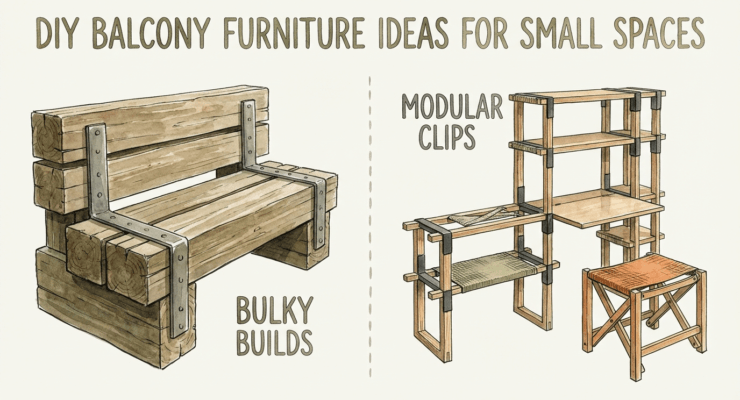
Bulky Builds vs. Modular Clips
Comparing traditional “Bulky Builds” to modern “Modular Clips” reveals a massive shift in urban design. Bulky builds prioritize permanence and “living room comfort” but fail in small, high-exposure environments. Modular clips focus on agility and space-saving.
| Factor | Bulky Builds (Traditional) | Modular Clips (Modern) |
|---|---|---|
| Floor Space Saved | 0% – 10% | 90% – 100% |
| Portability | Very Low | Very High |
| Build Complexity | High (Heavy Tools) | Low (Basic Hand Tools) |
| Cost | $200 – $800 | $30 – $100 |
| Maintenance | Moderate (Covers needed) | Low (Easy storage) |
Measurable factors like efficiency show that modular systems win for anyone in a space under 50 square feet. Efficiency is calculated by the ratio of surface area provided to floor area consumed. Modular clips reach near-infinite efficiency because they consume no floor area while providing significant utility.
Practical Tips and Best Practices
Actionable advice for your next build starts with the “Two-Point Anchor” rule. Never rely on a single bracket to hold a desk. Using two anchor points spaced at least 24 inches apart prevents the board from wobbling or tipping sideways when you lean on it.
Optimization techniques include adding a “pencil ledge” to your railing desk. A simple 1/2-inch strip of wood glued to the front edge prevents your phone or pens from sliding off the desk and falling several stories. It is a small addition that prevents major heartaches.
- Use a level during installation to ensure your coffee doesn’t slide toward the street.
- Apply a UV-resistant clear coat every spring to prevent the sun from bleaching your wood gray.
- Install “rubber bumpers” on the back of your brackets to protect the railing’s paint and prevent metal-on-metal rattling.
- Check the tightness of your bolts once a month, as temperature fluctuations can cause hardware to expand and contract.
Efficiency improvements can be found by adding a “magnetic strip” to the underside of the desk. This allows you to snap on small metal tins for herbs or attach a magnetic LED light for working at night. This keeps the top surface completely clear for your primary tasks.
Advanced Considerations for Serious Builders
Deeper insights involve the physics of the “Cantilever.” When you mount a desk to a railing, you are creating a cantilevered load. The further the desk extends, the more pressure is applied to the top of the railing. If you want a deeper desk (e.g., 18-20 inches), you must add support legs that angle back toward the base of the railing balusters to distribute the load.
Scaling considerations apply if you want to turn your entire railing into a continuous bar. In this scenario, do not use one long board. Instead, use several smaller modules. This allows for wood expansion and makes it much easier to remove sections for cleaning or maintenance. It also allows you to mix and match modules—one for a desk, one for a planter, and one for a grill station.
Advanced techniques include integrating solar-powered charging ports. You can embed a small solar panel into the corner of your desk and run the wiring to a USB port mounted underneath.  . This turns your DIY furniture into a fully off-grid workstation, perfect for long afternoons of remote work without needing to run extension cords through your patio door.
Real-World Example: The 4×10 Studio Balcony
Let’s look at a realistic scenario. Sarah lives in a 400-square-foot studio with a 4×10 balcony. . Initially, she bought a standard bistro set. The table was 24 inches wide, and the chairs required another 24 inches of clearance. Her walking path was reduced to a mere 12 inches, making the balcony feel cramped and stressful.
Sarah switched to a railing-mounted bar system. She built a 6-foot long, 10-inch deep ledge using cedar planks and three folding brackets. She replaced her heavy chairs with two lightweight, stackable bar stools. The result? She gained 20 square feet of “usable” floor space.
Step-by-step reasoning shows why this worked. By moving the “table” to the perimeter, she opened the center of the balcony. She now uses the floor for a large outdoor rug and several floor cushions. When she has guests, she unfolds the bar. When she is alone, she stacks the stools and has enough room to do a full workout on her balcony. Total cost of the upgrade: $85.
Final Thoughts
Reclaiming your balcony is not about buying more things; it is about building smarter things. Moving your furniture from the floor to the railing is the single most effective way to double your usable outdoor space. These projects require minimal skills but offer a massive return on investment in terms of lifestyle and comfort.
Practical value lies in the simplicity of the design. A 15-minute build can change how you use your home for years. Whether you are a renter looking for a non-permanent solution or a homeowner wanting a sleek, modern look, the railing-mounted desk is your entry point into the world of strategic small-space design.
Encourage yourself to experiment with different wood types and bracket configurations. Your balcony has the potential to be a lush garden, a productive office, or a private bistro. Stop fighting for floor space and start utilizing the structural potential of your railing today. Once you experience the freedom of a zero-footprint balcony, you will never go back to bulky, ground-based furniture again.
Sources
1 jcdesignbuild.com (https://jcdesignbuild.com/blog/balcony-decor-ideas/) | 2 homedepot.com (https://www.homedepot.com/c/ai/balcony-ideas/9ba683603be9fa5395fab90ea2b3051) | 3 youtube.com (https://www.youtube.com/watch?v=ruxKS1XK1wY) | 4 youtube.com (https://www.youtube.com/watch?v=qj4tSSZTE8s) | 5 cedarcreekfurniture.com (https://www.cedarcreekfurniture.com/blogs/news/best-material-for-outdoor-furniture) | 6 farrellslandscaping.com (https://farrellslandscaping.com/what-wood-is-best-for-outdoor-furniture/) | 7 decoroutdoor.com (https://decoroutdoor.com/blog/outdoor-furniture-materials-guide-frames-tabletops-wood/) | 8 forestplywood.com (https://forestplywood.com/blog/lumber/the-best-types-of-wood-for-outdoor-furniture/) | 9 simplifiedbuilding.com (https://www.simplifiedbuilding.com/projects/wall-mounted-desk-plans) | 10 prettyhandygirl.com (https://prettyhandygirl.com/wall-mounted-desk-tutorial/) | 11 weinsteinconstruction.com (https://weinsteinconstruction.com/apartment-and-condo-balcony-safety-5-steps-to-take/) | 12 instructables.com (https://www.instructables.com/15-Minute-Hanging-Desk/) | 13 youtube.com (https://www.youtube.com/watch?v=ySMq5qv8kdg) | 14 expandfurniture.com (https://expandfurniture.com/blogs/inspire/modular-furniture-vs-bulky-furniture-which-best-maximizes-your-living-space)