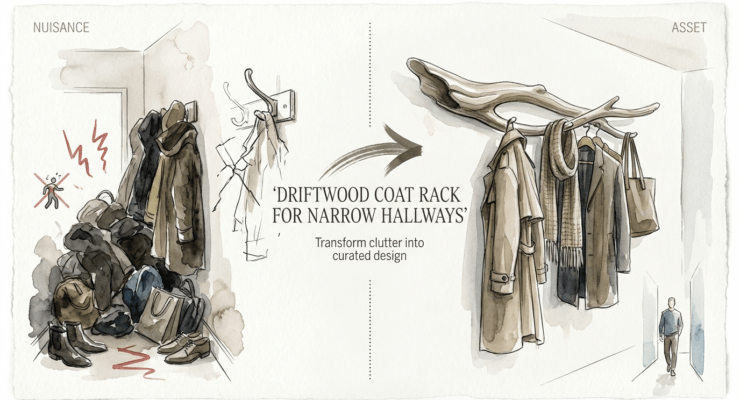
Your tiny hallway isn’t too small; your furniture just doesn’t understand verticality. Most modern homes treat the entryway like a secondary thought, a transition zone where floor space goes to die under a mountain of polyester and leather. An entryway pile is a daily stressor. But that same ‘mess’ hung on a vertical driftwood ladder becomes a functional art piece. Use the natural hooks created by years of tide and current to hold your life together.
A home’s entrance is its handshake.  . It is the first thing you see when you return from the world and the last thing you touch before you face it. If that handshake is weak and cluttered, your mindset follows suit. Transitioning from a state of chaos to one of order requires a shift in how we view our walls.
Narrow hallways present a unique architectural challenge. You cannot simply throw a chunky mahogany bench into a thirty-six-inch wide corridor and expect to keep your shins intact. You need something that hugs the wall, something that breathes with the space rather than suffocating it.
Driftwood offers a solution that no factory-pressed particle board can replicate. It brings the outside in, grounding your living space in a biophilic reality that reduces cortisol and improves focus. Every piece of timber reclaimed from the shore carries a history of survival, and that resilience is exactly what a high-traffic hallway needs.
Driftwood Coat Rack For Narrow Hallways
A driftwood coat rack is a wall-mounted organizational system crafted from timber that has been weathered by natural water sources. Unlike standard hardware store rails, these pieces utilize the organic geometry of the wood—its knots, bends, and forks—to provide unique hanging points. In the context of a narrow hallway, this is a strategic choice designed to maximize vertical utility while minimizing the physical footprint on the floor.
These racks exist because traditional furniture is often too deep for modern apartment corridors or older home foyers. A standard console table might be eighteen inches deep, effectively cutting a narrow hallway in half. A driftwood rack, however, rarely exceeds six inches in depth, preserving the “Negative Space” that makes a home feel expansive and expensive.
Real-world applications for these pieces range from coastal cottages to brutalist urban lofts. In a coastal setting, the silvered patina of salt-cured wood complements the natural light and sea-air aesthetic. In an urban environment, the raw, unrefined texture of the wood provides a necessary “soft fascination” that breaks up the monotony of drywall and concrete.
Imagine a forty-eight-inch length of sun-bleached oak. It sits flush against your wall, held by hidden anchors. It doesn’t just hold your winter parka; it acts as a sculptural anchor for the entire room. By moving the “visual load” from the floor to the wall, you deceive the eye into seeing more square footage than actually exists.
How to Source and Prepare Your Timber
Building a rack that lasts a lifetime starts with the hunt. You aren’t just looking for any stick; you are looking for a piece of heartwood that has survived the grinding of sand and the bleaching of the sun. Hardwoods like oak, maple, or walnut are the gold standard for durability, while softwoods like pine or cedar offer a lighter weight and a different aromatic profile.
Understanding the Legality of the Hunt
Before you set foot on the sand, you must understand the laws of the land. In the United Kingdom, the Coast Protection Act of 1949 generally allows for the collection of small amounts of driftwood, as it is considered “washed up” material rather than part of the beach’s structural integrity. However, taking pebbles or sand is strictly prohibited and can result in heavy fines.
In the United States, rules vary by state and agency. For example, California allows for the collection of up to fifty pounds of driftwood per day for personal use. Conversely, states like Georgia and Michigan often classify the removal of natural features from public lands as illegal. Always check with local wildlife agencies or environmental authorities to ensure your sourcing is ethical and legal.
The Cleaning and Curing Process
Raw driftwood is a biological mystery box. It may contain salt, sand, tannins, or unwanted organisms like algae and insects. To make it safe for indoor use, you must follow a rigorous sterilization protocol. Start by power washing the timber to remove loose debris, being careful not to strip away the weathered patina you worked so hard to find.
Soaking is the next critical step. A solution of two cups of bleach per four gallons of water is a common standard for killing fungal spores and bacteria. Submerge the wood for at least twenty-four hours, using heavy stones to keep it from floating. If you prefer a more natural approach, a concentrated vinegar and water mixture can work, though it is less effective against deep-seated pests.
Once cleaned, the wood must dry completely. This is not a process to be rushed. Storing the wood in a low-humidity environment for two to four weeks ensures that the internal moisture levels stabilize. If you mount a piece of wood that is still “green” or water-logged, it will warp, crack, or even rot against your drywall, turning your asset back into a nuisance.
Engineering a Secure Mount
The greatest mistake a beginner makes is underestimating the leverage of a heavy winter coat. A five-pound piece of wood plus twenty pounds of damp wool exerts a significant “pull-out” force on your wall. You cannot rely on a simple nail or a plastic expansion anchor. You need an engineering mindset.
Whenever possible, you must drive your mounting screws directly into wall studs. A single #10 wood screw sunk an inch and a half into a wooden stud can hold over one hundred pounds of shear force. Use a stud finder to locate the vertical framing members in your wall and mark them clearly before you begin drilling your timber.
If your hallway layout makes hitting a stud impossible, you must use toggle bolts. These are spring-loaded “wings” that fold flat for insertion and then snap open behind the drywall. They distribute the weight across a larger area of the gypsum board, preventing the rack from tearing a hole in the wall. Avoid the cheap ribbed plastic anchors; they are designed for picture frames, not functional furniture.
Benefits of the Vertical Approach
Choosing a vertical driftwood rack over a traditional hall tree is a decision rooted in both aesthetics and psychology. The most immediate benefit is the reclamation of floor space. When the floor is clear, the “traffic flow” of the house improves, and the daily friction of tripping over shoes and bags disappears.
Biophilic design principles suggest that incorporating natural elements into the home reduces stress and lowers blood pressure. Wood grain is a “natural fractal,” a complex, non-repeating pattern that the human brain is wired to find relaxing. Looking at the swirls and knots of a handcrafted rack triggers a “soft fascination” that rests the eyes after a day of staring at digital screens.
Nuisance vs Asset
Consider the difference between a cluttered entryway and a curated one. A “nuisance” is a pile of gear that demands your attention and energy every time you walk through the door. It is a visual tax you pay daily. An “asset” is a system that works for you, holding your belongings in a way that feels intentional and artistic.
| Feature | The Nuisance (Floor Pile) | The Asset (Driftwood Rack) |
|---|---|---|
| Space Usage | Consumes 4-6 sq. ft. of floor | Consumes 0 sq. ft. of floor |
| Visual Load | High; creates mental clutter | Low; acts as a focal point |
| Maintenance | Constant re-stacking | One-time installation |
| Longevity | Temporary and chaotic | Permanent and structural |
Common Mistakes to Avoid
Installing a driftwood rack seems simple, but several pitfalls can ruin the project. The first is poor hook placement.  . Many DIYers space their hooks evenly along the wood without considering the irregular shape of the timber. This often leads to coats overlapping and becoming a tangled mess.
Another frequent error is failing to pre-drill. Hardwood driftwood is incredibly dense and brittle. If you try to drive a screw directly into a piece of salt-cured oak, the wood will likely split, destroying the structural integrity of your piece. Always use a drill bit slightly smaller than the diameter of your screw to create a pilot hole first.
Neglecting the “12-Inch Rule” is also common. . In a narrow hallway, any object deeper than twelve inches—including the items hanging on it—will choke the space visually and physically. If your driftwood piece is exceptionally thick, or your hooks are too long, you might find yourself bumping into your coats every time you walk past.
Limitations and Trade-offs
While beautiful, a driftwood rack is not a universal solution. It has realistic constraints that you must respect. For example, driftwood pieces are inherently irregular. This means you will likely get fewer usable hanging points than you would on a mass-produced, flat board. If you have a family of six, a single driftwood branch may not provide enough storage.
Environmental limitations also play a role. Driftwood is porous. If you live in an exceptionally humid climate and did not seal the wood properly, it can absorb moisture from wet raincoats and develop mold over time. For high-humidity areas, a light coating of clear matte polyurethane or beeswax is essential to protect the timber.
Weight distribution is another factor. Unlike a uniform piece of lumber, driftwood has thin spots and thick spots. If you mount a heavy bag on a thin, weathered branch-end, it might snap. You must assess the structural “meat” of the wood and place your primary hooks where the timber is strongest.
Practical Tips and Best Practices
For a professional-looking result, focus on the details of the hardware. Never buy cheap, shiny zinc hooks. They look like an afterthought. Instead, seek out vintage brass, wrought iron, or matte black steel. These materials feel substantial and age beautifully alongside the wood.
Stagger the heights of your hooks if your piece of wood allows for it. This creates a more organic look and prevents the “bulge” effect where all the coats sit at the same level. You can also mix types of hooks—using larger ones for heavy coats and smaller, more delicate ones for keys or dog leashes.
If your piece of driftwood is long and thin, consider a “hidden mount” technique. Drill a hole through the wood, countersink the screw, and then fill the hole with a plug of the same wood or a bit of sawdust mixed with glue. This makes the rack appear as if it is floating on the wall, emphasizing its sculptural qualities.
Advanced Considerations for the Serious Builder
For those looking to elevate the project, consider integrated lighting. A slim LED strip hidden behind the top edge of the wood can cast a soft glow down the wall, highlighting the texture of the grain and making the hallway feel warmer at night. This turns a simple utility item into a high-end architectural feature.
Another advanced technique is the “multi-tiered forest” layout. Instead of one large piece, use three or four smaller, vertically aligned pieces of driftwood. This allows for dedicated zones: one for adults, one for children, and one for smaller accessories. It maximizes the use of vertical wall height and creates a more dynamic visual experience.
Think about the interplay between the wood and your wall color. A light, sun-bleached piece of cedar pops beautifully against a dark navy or charcoal wall. Conversely, a dark, water-stained piece of walnut looks sophisticated against a crisp gallery-white backdrop. Use the wood to create contrast and define the boundaries of the entryway.
Example Scenario: The 36-Inch Hallway
Let’s look at a practical application. Suppose you have a hallway that is exactly thirty-six inches wide—a common measurement in urban apartments. A traditional coat rack with four-inch hooks would leave only thirty-two inches of walking space. Once you hang a puffer jacket, that space shrinks to twenty-four inches.
To solve this, you select a piece of oak driftwood that is four feet long but only two inches thick. You mount it at eye level (sixty inches from the floor) using three toggle bolts. Instead of using long, protruding hooks, you choose low-profile “knob” style hooks that only stick out two inches.
By using this setup, even with coats hanging, you preserve nearly thirty inches of clear walkway. The visual texture of the oak draws the eye upward, making the ceiling feel higher. The “nuisance” of the floor pile is gone, replaced by an “asset” that functions as art.
Final Thoughts
Transforming a narrow hallway is not about adding more stuff; it is about choosing the right stuff. A driftwood coat rack represents a marriage of necessity and nature. It solves the physical problem of storage while addressing the psychological need for a peaceful, grounded home environment.
Reclaiming your entryway from chaos is a weekend project that pays dividends every time you cross the threshold. By thinking vertically and choosing materials with character, you turn a forgotten corridor into a statement of intent. You aren’t just hanging up a coat; you are setting the tone for your entire living space.
Experiment with the shapes you find. Every beach and riverbank holds a different story in its timber. Find a piece that speaks to your grit and your history, and let it hold your life together. When you stop fighting your space and start working with its natural constraints, your home finally becomes the sanctuary it was meant to be.
Sources
1 decorindimes.com (https://decorindimes.com/5-vertical-storage-hacks-for-tiny-entryways-get-luxury-tips/) | 2 beerusty.com (https://www.beerusty.com/blogs/news/biophilic-design-wood-decor-benefits) | 3 groupenovatech.com (https://www.groupenovatech.com/en_canada_quebec/blog/post/mazimize-storage-entryway.html) | 4 bellasystems.com (https://bellasystems.com/how-to-organize-the-entryway-small-space-big-impact/) | 5 discovertheoutdoors.co.uk (https://discovertheoutdoors.co.uk/beachcombing-uk-law/) | 6 driftwoodacademy.com (https://driftwoodacademy.com/is-it-legal-to-collect-driftwood/) | 7 wikihow.com (https://www.wikihow.com/Clean-Driftwood) | 8 furnituremargate.co.za (https://furnituremargate.co.za/how-to-clean-driftwood/) | 9 dgfloors.com (https://dgfloors.com/how-to-hang-heavy-items-on-drywall/) | 10 youtube.com (https://www.youtube.com/watch?v=zXRXeBJdLYw) | 11 stugastudio.com (https://stugastudio.com/blogs/inspiration/wood-wellbeing-biophilic-design) | 12 inspolivingspaces.com (https://inspolivingspaces.com/how-to-maximize-entryway-storage-in-small-spaces/) | 13 ashdeco.com (https://ashdeco.com/blogs/room-ideas/wood-coat-rack-styles-tree-driftwood-modern) | 14 aosom.ca (https://www.aosom.ca/blog-how-to-decorate-a-coat-rack-stylish-ideas-for-any-entryway.html)