Turning Beach Trash Into High-end Light Diffusers
The ‘trash’ you’re stepping over on your morning walk is actually a masterclass in light diffusion. What most people call a ‘mess’ on the beach is actually the world’s most durable light-shaping material. Thousands of years of salt and sun create a texture that scatters light in ways glass and plastic simply can’t replicate. Stop looking for a lamp and start looking for the asset the ocean just delivered for free.
Most modern lighting solutions rely on factory-made plastics that age poorly and yellow under heat. You see them in every office and big-box store—uniform, sterile, and ultimately disposable. Nature offers a different path for those willing to get their boots wet. The constant mechanical abrasion of sand combined with the chemical etching of salt creates a surface area so complex it breaks up harsh beams into a soft, wrap-around glow that professional cinematographers would pay thousands to recreate.
Finding value in the discarded is the hallmark of a true pioneer. Whether you are a photographer looking for the ultimate softbox material or a homeowner aiming for a custom architectural look, the shoreline is your warehouse. This guide will show you how to identify, harvest, and deploy these weathered wonders to transform your lighting from clinical to coastal.
Turning Beach Trash Into High-end Light Diffusers
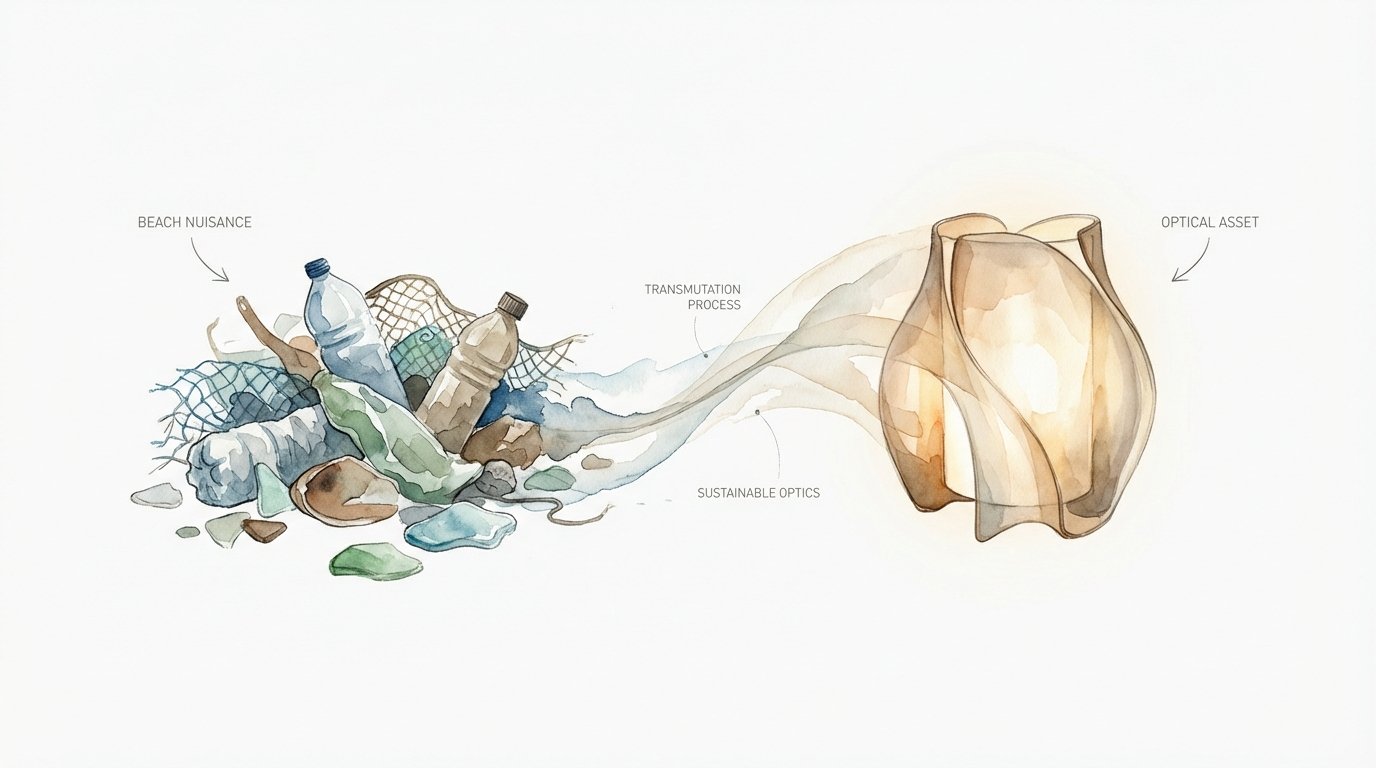
Light diffusion is the process of scattering direct light rays to reduce harsh shadows and hot spots. In the professional world, we use “tuffak” or sandblasted acrylic to achieve this, but these materials are often expensive and environmentally taxing to produce. Turning beach trash into high-end light diffusers involves reclaiming weathered glass and plastics—what many call a beach nuisance—and utilizing their unique surface geometry to manage photons.
Ocean-weathered materials exist in a state of “perfect imperfection.” When a plastic bottle or a shard of glass spends decades in the surf, it undergoes a process called micro-pitting. This is not just a surface-level scratch; it is a profound structural change where the material’s surface is bombarded by sand particles and eroded by saline. This creates a Lambertian surface—a surface that appears equally bright from all viewing angles because it scatters light so efficiently.
You find these assets everywhere from the high-tide line to the rocky crevices of the intertidal zone. A weathered piece of high-density polyethylene (HDPE), like a fragment from an old maritime buoy, possesses a dense, milky quality that is superior to many commercial LED diffusion sheets. It handles heat better, offers a more natural spectral roll-off, and carries a story that no factory-pressed sheet can match.
The Physics of the Surf: How Nature Shapes Light
Scattering occurs when light waves encounter obstacles or irregularities that are roughly the size of the light’s wavelength. On the beach, the primary drivers of this are UV radiation and mechanical abrasion. Understanding these two forces helps you choose the right material for your specific lighting needs.
UV rays from the sun initiate photo-oxidation in plastics. This breaks the molecular chains at the surface, leading to brittleness and a “frosty” appearance. This chemical breakdown creates a layer of haze that is essential for diffusion. Meanwhile, the ocean acts as a giant rock tumbler. Every wave pushes sand against the material, creating millions of microscopic divots. These divots act as tiny lenses, refracting light in a thousand different directions simultaneously.
Scientists distinguish between Rayleigh scattering (small particles) and Mie scattering (larger particles). The micro-pitting on sea glass often falls into the Mie scattering category, which is why it produces such a dense, white glow. When you place a high-output LED behind a piece of well-weathered sea glass, the light doesn’t just pass through; it becomes the glass. The entire object radiates light, turning a point source into an area source. This is the secret to high-end lighting: increasing the surface area of the emitter to soften the shadows.
How to Identify and Prepare Your Optical Assets
Harvesting light-shaping materials requires a keen eye for texture over color. While many people hunt for rare blue or red sea glass, the light-smith looks for the white, the frosted, and the thick-walled. These provide the most neutral and efficient diffusion.
Foraging for the Right Texture
Find materials that have a uniform, matte finish. If the piece is still transparent in the center, it hasn’t spent enough time in the “tumbler.” You want pieces that look like frozen fog. High-density plastics, often found as white or off-white fragments from containers or maritime gear, are the gold standard. They provide the highest “haze” value, which is a technical measurement of how much light is scattered more than 2.5 degrees from the incident beam.
The Cleaning Process
Salt and biological films are your enemies. Sea-found materials are often coated in a fine layer of dried salt or biofilm that can smell or even scorch if placed near a hot light source. Soak your finds in a solution of warm water and white vinegar for at least twelve hours. This breaks down the calcium deposits and salt crystals trapped in the micro-pits. Use a soft-bristled brush to scrub the surface, ensuring you don’t use anything abrasive enough to create deep, directional scratches that would ruin the omnidirectional scattering.
Sorting by Opacity
Organize your materials into three categories: high-transmission (lightly frosted), medium-diffusion (heavily pitted), and high-opacity (thick, weathered plastic). This allows you to “tune” your light. If you need a bright, punchy light with just a bit of softness, you go for the high-transmission glass. If you are building a bedside lamp that needs to be completely glare-free, the high-opacity plastic is your best bet.
The Benefits of Weathered Materials for Modern Lighting
Choosing ocean-weathered assets over store-bought diffusers offers practical advantages that go beyond simple aesthetics. These materials have survived one of the harshest environments on Earth, making them incredibly resilient.
Reliability is a major factor. Commercial plastic diffusers often yellow and become brittle over time when exposed to the heat of light bulbs. Materials found on the beach have already undergone their most significant UV degradation. They are stable. They have been “pre-stressed” by the environment, meaning their optical properties won’t shift significantly over the next few decades.
Customization is the second major benefit. You cannot easily “tune” a commercial light fixture without buying new parts. With beach-found diffusers, you can layer pieces to achieve the exact level of light fall-off you desire. This “stacking” technique allows for a depth of light that feels organic and three-dimensional. The slight variations in thickness and pitting create a “living” light—a glow that has character and micro-variations that prevent the flat, “dead” look of cheap LED panels.
Challenges and Common Pitfalls
Success in this field requires more than just picking up trash. Several common errors can lead to poor lighting or even safety hazards. Understanding these pitfalls will save you hours of frustration.
Heat management is the primary concern. Even though many people use LEDs today, high-wattage bulbs still generate significant heat. Placing plastic beach debris directly against a bulb can cause melting or the release of toxic fumes. Always maintain a “dead air” space of at least two inches between the light source and your salvaged diffuser. This allows for convection currents to carry heat away without compromising the diffusion.
Contamination is another issue. Microplastics and residual chemicals can be trapped in the porous surface of weathered debris. If you are using these materials in a home environment, they must be thoroughly sealed or cleaned. Some foragers use a light coat of clear, matte spray fixative to “lock in” the texture and prevent any fine plastic dust from shedding. However, be careful—too much sealant can fill in the micro-pits and turn your beautiful matte diffuser back into a shiny, useless piece of plastic.
Limitations: When the Ocean Isn’t Enough
Acknowledge that while these materials are excellent, they have their limits. They are not a universal replacement for precision-engineered optics in every scenario.
Color accuracy can be a struggle. Weathered plastics often have a slight “patina”—a yellow or grey tint caused by decades of sun exposure. In professional photography, this can throw off your white balance. If you are doing color-critical work, you must either use highly neutral white plastics or be prepared to use “gels” (color correction filters) to compensate for the warmth of the salvaged material.
Weight and mounting also present challenges. Sea glass is heavy. Creating a large-scale architectural diffuser from thousands of shards requires a robust structural frame, often involving steel mesh or heavy-duty epoxy. This isn’t a “set it and forget it” solution like a lightweight paper lantern. It requires real “pioneer grit” to engineer a mounting system that is safe, stable, and easy to clean.
Beach Nuisance vs. Optical Asset: A Comparison
| Material Source | Diffusion Quality | Durability | Light Loss (%) |
|---|---|---|---|
| Commercial Frosted Acrylic | High/Uniform | Moderate (Yellows) | 10-15% |
| Weathered Sea Glass | Superior/Organic | Permanent | 20-30% |
| Aged Maritime HDPE Plastic | Maximum/Soft | High (Impact Resistant) | 35-50% |
| Standard Tracing Paper | Moderate/Flat | Low (Tears easily) | 5-8% |
Focusing on the numbers reveals that while beach-found materials have a higher “light loss” (meaning they block more light), they provide a much higher quality of scattering. This is the trade-off. You might need a slightly more powerful bulb, but the light that reaches your subject will be infinitely more pleasing.
Practical Tips for the Modern Light-Smith
Applying these concepts in your home or studio doesn’t have to be complicated. Start small and build your understanding of how different textures react to different light temperatures.
- Use “Cold” LEDs: Weathered plastics often have a natural warmth. Using a “cool white” LED (5000K-6000K) can help neutralize the yellowing of the material, resulting in a clean, daylight-balanced glow.
- The Mosaic Technique: Instead of searching for one large piece, create a mosaic of smaller sea glass shards. Use a clear, heat-resistant silicone to bond them to a flat glass pane. The gaps between the shards create “micro-shadows” that add incredible texture to the light.
- Backlighting is Key: These materials shine—literally—when backlit. Do not try to reflect light off them. Their power lies in their transmissive properties. Position your light source directly behind the weathered surface for the best effect.
- Mechanical Fasteners: Avoid hot glue for long-term projects. The heat from the light will eventually cause it to fail. Use mechanical clips or high-temperature epoxies to ensure your diffusers stay where you put them.
Advanced Considerations: Tuning the Beam
Professional users will want to go beyond simple “glow.” You can actually shape the directionality of your light by paying attention to the “grain” of the weathered material.
Some plastics found on the beach have been “stretched” or extruded during their original manufacturing. After decades of weathering, these stress lines become visible as microscopic ridges. Placing these ridges horizontally will spread your light vertically, and vice versa. This is essentially a “found” version of an anamorphic lens or a professional “spread lens.”
Scaling is another advanced consideration. For large architectural installations, the weight of sea glass becomes a primary engineering constraint. Serious practitioners often use a “sandwich” method: two layers of thin, clear acrylic with a layer of sea glass or plastic fragments in the middle. This protects the delicate weathered surfaces from dust and fingerprints while providing a structurally sound panel that can be mounted in standard lighting tracks.
Realistic Scenarios: Theory into Practice
Imagine you are setting up a home office and the overhead light is casting a harsh, unflattering glare on your computer screen and your face during video calls. You could buy a plastic ring light, or you could use a single, large fragment of a weathered white plastic drum found on a local beach.
Mount the plastic fragment six inches in front of a standard 100-watt equivalent LED bulb. Because the plastic is curved from its original drum shape, it naturally wraps the light around your face. The micro-pitting from years of sand-blasting in the surf eliminates the “hot spot” of the bulb, creating a soft, even light that looks like professional studio equipment.
In another scenario, a photographer is struggling with the “clinical” look of modern LED panels. By taping a layer of thin, frosted beach glass shards over the LEDs, they introduce “organic noise” into the light. This breaks up the digital perfection of the sensor and creates shadows that feel “soft-edged” and natural, reminiscent of light filtered through a coastal mist.
Final Thoughts
The ocean is the world’s most efficient recycling center, but it doesn’t just break things down—it refines them. Every shard of sea glass and every fragment of weathered plastic is a testament to the power of time and the elements. By looking at these items as optical assets rather than beach nuisances, you tap into a source of high-end material that is both sustainable and aesthetically superior to mass-produced alternatives.
Mastering the use of these materials requires a shift in perspective. It asks you to value the rough over the smooth, the weathered over the new, and the found over the bought. This is more than just a DIY project; it is an exercise in environmental stewardship and creative engineering. It is about taking the “grit” of the pioneer and applying it to the modern world’s waste.
Experiment with your finds. Hold them up to the sun, place them over your phone’s flashlight, and see how the light changes. You’ll soon realize that the best light-shaping tool you’ll ever own wasn’t bought in a store—it was washed up at your feet, waiting for someone with the vision to pick it up. Don’t be afraid to get your hands dirty in the pursuit of the perfect glow. The ocean has done the hard work; you just have to give its delivery a purpose.
Sources
1 diycraftsgroup.com (http://diycraftsgroup.com/how-to-make-sea-glass-light-fixtures/) | 2 gamma-sci.com (https://gamma-sci.com/2021/08/16/light-transmission-in-the-ocean-and-other-bodies-of-water/) | 3 youtube.com (https://www.youtube.com/watch?v=CpZ4likv8qQ) | 4 aisglass.com (https://www.aisglass.com/blog/clear-glass-vs-frosted-glass-pros-and-cons/) | 5 kunxinplastics.com (https://www.kunxinplastics.com/news/68/) | 6 luck-glass.com (https://www.luck-glass.com/info/the-difference-between-frosted-glass-and-obscu-101162116.html)