Warm Organic Lighting For Wellbeing
Is your home lighting designed for a high-tech factory or for the biological needs of a human soul? Modern lighting has become sterile, efficient, and utterly dead. We’ve traded the warmth of the hearth for the buzz of the circuit board. Integrating driftwood lighting doesn’t just add a fixture; you’re re-introducing a biological warmth that echoes our ancestral connection to wood and fire. Turn off the ‘Dead’ overheads and wake up your ‘Living’ space.


Warm Organic Lighting For Wellbeing
Driftwood lighting is the practice of using water-sculpted timber—harvested from shorelines, riverbeds, or swamps—to house electrical illumination. This design philosophy bridges the gap between raw nature and modern utility. It exists because human beings have an innate affinity for living things, a concept known as biophilia. When we surround ourselves with organic shapes and natural textures, our nervous systems recognize a familiar, safe environment.
In a real-world setting, a driftwood lamp serves as more than a light source; it is a piece of functional sculpture. These fixtures are used in bedrooms to signal the end of the day or in living rooms to create a focal point that demands a slower pace of life. Think of a standard plastic lamp as a sterile tool, whereas a driftwood fixture is a companion. It carries the history of the tides and the sun within its grain.
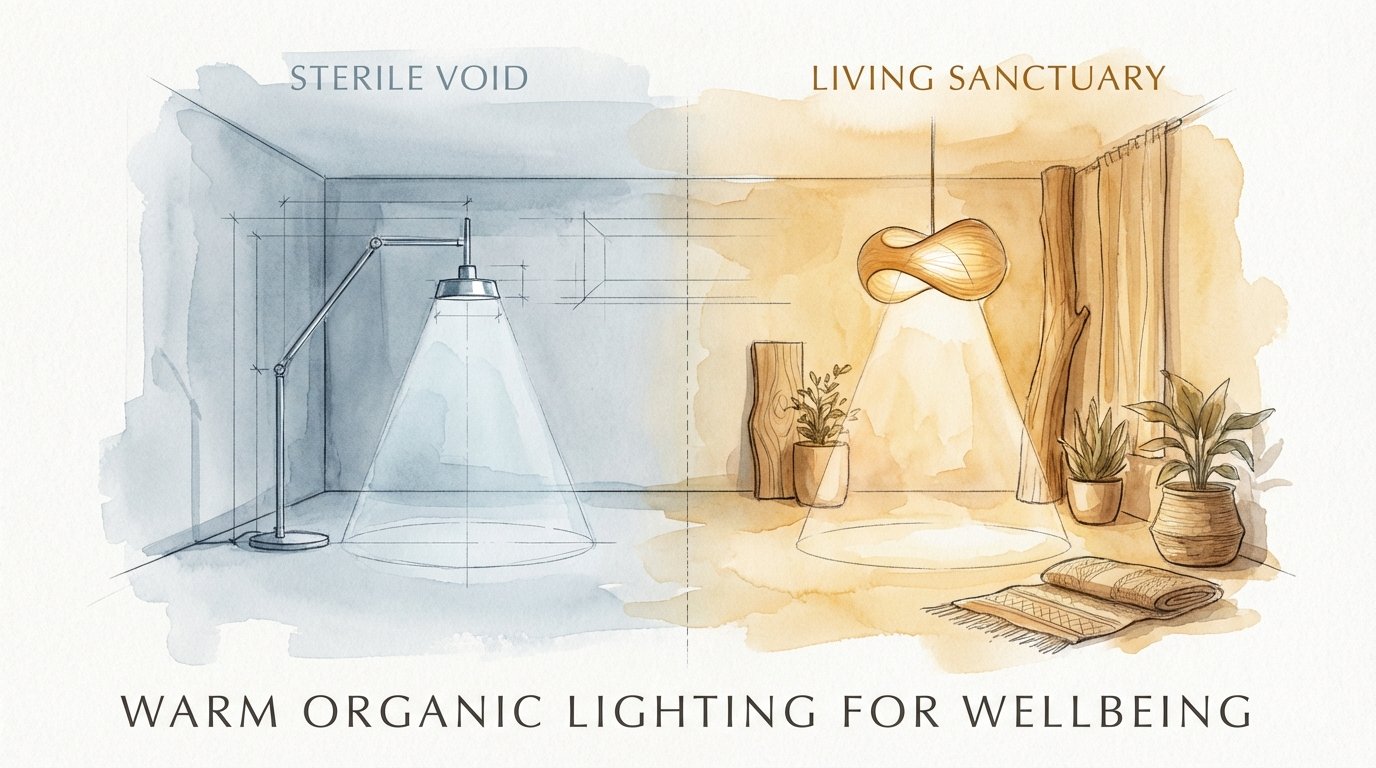
Visualizing this concept is simple. Imagine the difference between a cold, blue-tinted LED panel in a hospital hallway and the dappled, golden light filtering through a forest canopy. Driftwood lighting aims to replicate that forest canopy indoors. The irregular, twisted branches of the wood create complex shadows that the human eye finds soothing rather than distracting. This is lighting for the “Living Sanctuary” rather than the “Sterile Void.”
How to Source and Prepare Your Wood
The journey begins on the shoreline. Ancient civilizations once viewed driftwood as a gift from sea gods, using it for everything from tools to shelter. Today, we look for “character wood”—pieces with interesting twists, deep fissures, or a silvery patina earned through years of saltwater exposure. Hardwoods like oak, cedar, or tropical species like Mopani are ideal because they resist rot and provide a sturdy base for electrical components.
Preparation is the most critical step for any pioneer of this craft. Raw wood from the beach is often home to microscopic mites, bacteria, or salt deposits. You must rinse the wood in fresh water and then soak it in a solution of one part bleach to ten parts water for at least 24 hours. This process neutralizes organic threats and ensures the wood won’t bring unwanted guests into your home.
Once the wood is soaked, it requires a slow, natural drying period. Place the pieces in direct sunlight for several days until they are bone-dry to the touch. If the wood is still damp when you begin drilling, you risk trapping moisture inside the fixture, which can lead to mold or structural failure. Patience is a requirement here; rushing the drying process is the quickest way to ruin a high-potential piece.
Sand the surface to remove sharp splinters while preserving the natural texture. Using 120-grit sandpaper followed by a 220-grit pass allows you to smooth the wood without stripping away its weathered appearance. Some practitioners prefer to leave the wood completely raw, while others apply a light matte varnish to seal the grain. Avoid high-gloss finishes, as they create a plastic look that contradicts the organic mission of the piece.
The Engineering: Wiring the Living Light
Transforming a branch into a lamp requires a basic understanding of electrical circuits. A standard lamp kit usually includes a socket, a threaded nipple, a cord, and a plug. To begin, you must determine the “path of least resistance” for your wiring. This often involves drilling a vertical hole through the center of the wood or routing a channel along a natural groove in the branch.
Drilling through driftwood requires a steady hand and a sharp auger bit. Since the wood is irregular, you may need to drill from both ends and meet in the middle. If the wood is too twisted for a straight drill path, you can use a small router to create a “wire trench” on the back of the wood. You can later hide this wire by filling the trench with a mixture of wood glue and sawdust from the same piece.
Wiring the socket is where safety becomes paramount. Most lamp sockets have two distinct screws: a gold-colored screw for the “hot” wire and a silver-colored screw for the “neutral” wire. On a standard lamp cord, the neutral wire is usually marked with small ridges on the insulation. Wrap the bare wire ends clockwise around the screws before tightening to ensure a secure connection. Never allow the insulation to be pinched under the screw head.
Stability is the final engineering hurdle. A tall piece of driftwood can be top-heavy once a socket and shade are attached. Secure the wood to a heavy base—such as a slab of slate, a cross-section of a larger log, or even a steel plate. Pre-drilling holes is essential to avoid splitting the driftwood, especially if the piece is old and brittle. Use epoxy resin for additional bonding strength at the junction between the wood and the base.
Benefits of Organic Lighting Systems
The primary advantage of driftwood lighting is its impact on the human circadian rhythm. Standard overhead LEDs often emit a high concentration of blue light, which suppresses melatonin and keeps the brain in a state of high alert. In contrast, warm-toned bulbs housed in wood fixtures create a spectral environment that mimics the setting sun. This shift in color temperature signals to the brain that it is time to wind down and recover.
Natural materials also provide a tactile benefit. Touching wood has been shown in various studies to lower heart rates and reduce stress levels. Unlike the cold touch of metal or glass, wood maintains a neutral temperature and a soft texture. Incorporating these elements into your workspace or bedroom creates a sensory anchor that grounds you in the physical world, away from digital screens.
Sustainability is another measurable benefit. Utilizing reclaimed wood reduces the demand for new timber and prevents natural resources from being wasted. Each lamp is a unique, one-of-a-kind artifact that cannot be mass-produced in a factory. This uniqueness adds value to your home and ensures that your lighting solution is as individual as your own personality.
Common Pitfalls and How to Avoid Them
Many beginners make the mistake of using “punky” wood. Punky wood is timber that has begun to rot and feels soft or spongy to the touch. While it may look interesting, it will eventually crumble under the weight of the lighting hardware. Always test the structural integrity of your wood by trying to indent it with a fingernail; if it gives easily, the wood is too far gone for a safe lamp project.
Ignoring the “Hot and Neutral” polarity is a dangerous electrical error. If you reverse the wires at the socket, the outer shell of the lightbulb base can become electrified. This creates a significant shock hazard for anyone changing the bulb. Always double-check that your ribbed (neutral) wire is connected to the silver screw. Using a simple multimeter to test continuity can save you from a major safety oversight.
Failure to properly clean the wood is a long-term mistake. If you skip the bleaching process, you may find yourself dealing with an infestation of wood-boring insects months after the lamp is finished. These pests can spread to your other furniture and the structural timber of your home. The 24-hour soak is non-negotiable for anyone who values their living space.
Limitations and Environmental Constraints
Driftwood lighting is not a universal solution for every room. Because of its irregular shape, it often takes up more physical space than a streamlined modern lamp. In a very small apartment, a large driftwood floor lamp might feel cluttered rather than cozy. You must balance the scale of the wood with the dimensions of the room to avoid overwhelming the space.
Maintenance is slightly more complex than with standard fixtures. The deep crevices and natural textures of driftwood are magnets for dust. You cannot simply wipe it down with a damp cloth; you often need a soft-bristled brush or compressed air to keep the wood clean. Furthermore, wood is a reactive material. If you place a driftwood lamp in a room with extreme humidity fluctuations, the wood may expand or contract, potentially loosening the hardware over time.
Light output is another trade-off. Driftwood lamps are designed for ambient, atmospheric lighting. They are rarely the best choice for “task lighting,” such as reading small print or performing detailed craft work. The shadows cast by the branches, while beautiful, can be distracting if you need a perfectly even field of light. Use these fixtures as a supplement to your lighting plan, not the sole source of illumination.
Living Sanctuary vs. Sterile Void
| Feature | Living Sanctuary (Organic) | Sterile Void (Industrial) |
|---|---|---|
| Materials | Reclaimed wood, stone, linen | Plastic, chrome, brushed nickel |
| Biological Impact | Reduces cortisol, supports sleep | Increases alertness, disrupts sleep |
| Light Quality | Warm, dappled, complex shadows | Cool, flat, uniform illumination |
| Lifespan | Decades (Heirloom quality) | Short-term (Disposable design) |
Practical Tips for Best Results
Choosing the right lightbulb is as important as choosing the wood. To maximize the biological benefits, use “warm white” LEDs with a color temperature between 2200K and 2700K. These bulbs emit a golden glow that complements the natural tones of the wood. If you want to go a step further, consider Edison-style filament bulbs, which add a nostalgic, industrial-pioneer aesthetic to the organic frame.
Placement determines the “vibe” of the room. Position your driftwood lamp near a corner or a flat wall to allow the shadows of the wood to “paint” the surface. This creates a sense of depth and movement in the room that static lighting cannot match. If the lamp is a floor model, ensure it is out of the main traffic path, as the irregular branches can easily snag clothing or be knocked over.
Stabilize soft wood with resin if you find a piece that is visually stunning but structurally weak. You can inject clear epoxy into cracks or “punky” areas to harden them. This allows you to use wood that would otherwise be unsuitable for a lamp. This technique is often used by advanced practitioners to create “river” effects within the wood grain, combining modern chemistry with ancient timber.
Advanced Considerations for Serious Practitioners
Scaling up to a driftwood chandelier requires a mastery of weight distribution and balance. Suspending a multi-branch fixture from the ceiling involves calculating the “center of gravity” for the entire assembly. You must use heavy-duty eye bolts and safety chains that are rated for at least twice the weight of the fixture. Never rely on the electrical cord itself to hold the weight of a suspended piece of wood.
Integrating “Smart” technology can modernize an organic fixture without ruining its soul. Using dimmable smart bulbs allows you to program your lighting to match the natural daylight cycle. For example, the lamp can be programmed to gradually dim and shift to a warmer hue as your bedtime approaches. This combination of ancient material and modern logic provides the ultimate wellness environment.
Advanced finishers may want to explore the use of fire to seal the wood, a technique known as Shou Sugi Ban. Charring the surface of the wood creates a deep, blackened texture that is incredibly resistant to insects and decay. When combined with a warm light source, the contrast between the dark, scorched wood and the golden light is visually arresting and fits perfectly in a “modern pioneer” home.
Example Scenario: The Shoreline Reading Nook
Imagine a small corner of a study or bedroom. You have a comfortable leather chair and a small side table. Instead of a standard desk lamp, you’ve installed a five-foot driftwood floor lamp. The wood is a piece of weathered cedar found on the coast of the Pacific Northwest, featuring a deep, natural twist that spirals upward toward the socket.
The lamp is fitted with a linen shade in an oatmeal color. When the 2200K bulb is turned on, the light passes through the linen and catches the edges of the cedar. The shadows on the wall aren’t sharp or harsh; they look like the silhouette of a tree against the setting sun. In this space, the act of reading a book feels less like a task and more like a retreat.
Measurements for such a project might include a 12-inch heavy steel base to provide a low center of gravity. The electrical cord is wrapped in a jute sleeve to hide the plastic and maintain the natural theme. This setup demonstrates how theory translates into a physical space that nourishes the mind and body simultaneously.
Final Thoughts
Choosing driftwood lighting is a rejection of the “dead” efficiency of modern manufacturing. It is a conscious decision to bring the unpredictable, beautiful complexity of nature into your private sanctuary. By following the proper steps for preparation and safety, you can transform a discarded piece of timber into a functional heirloom that serves your biological needs.
The transition from a sterile environment to a living one does not happen overnight. It starts with a single choice—a single light source that honors your connection to the natural world. Whether you source your wood from a local beach or purchase a handcrafted piece from an artisan, the result is the same: a home that feels more human.
Encourage yourself to experiment with different wood types and lighting layers. The principles of biophilic design are flexible, allowing you to create a space that reflects your specific environment and history. Turn off the sterile overheads, embrace the warmth of the wood, and let your living space finally come alive.
Sources
1 limbicmedia.ca (https://limbicmedia.ca/blog/biophilic-lighting-design/) | 2 driftedtreasures.co.uk (https://driftedtreasures.co.uk/the-allure-of-driftwood/) | 3 sunmory.com (https://www.sunmory.com/blogs/resources/how-to-make-driftwood-floor-lamp) | 4 youtube.com (https://www.youtube.com/watch?v=hYChsveTXgs) | 5 dtwooddecor.com (https://www.dtwooddecor.com/what-is-driftwood-decor/) | 6 youtube.com (https://www.youtube.com/watch?v=d_aGVl7YpGs) | 7 wayfair.com (https://www.wayfair.com/keyword.php?keyword=driftwood+lighting) | 8 frontiersin.org (https://www.frontiersin.org/journals/neuroscience/articles/10.3389/fnins.2021.637221/full) | 9 instructables.com (https://www.instructables.com/Making-a-Driftwood-Lamp/) | 10 youtube.com (https://www.youtube.com/watch?v=bibML6DW_7Y) | 11 woodart.studio (https://woodart.studio/2021/01/05/what-is-driftwood-art/)