Why Driftwood Lights Outlast Modern Outdoor Fixtures
Metal fights the ocean and loses; driftwood survived the ocean and won. Most outdoor lighting is designed for a showroom, not the reality of coastal salt and humidity. While metal fixtures start their path to the landfill the moment they’re installed, driftwood lighting is already ‘cured’ by the elements. It doesn’t just survive the storm—it was created by it. Build for the next generation, not just next season.
Living near the coast requires a different kind of grit. The air is thick with salt, a invisible chemical force that eats through powder-coated aluminum and turns “stainless” steel into a pitted, rusted mess within a few seasons. If you have spent any time replacing outdoor sconces every three years, you know the frustration of TEMPORARY METAL. It is a cycle of waste that serves the manufacturer, not the homeowner. There is a better way to illuminate a shoreline property, and it involves looking at what the ocean leaves behind.
Driftwood is more than just debris. It is timber that has undergone a brutal, natural processing. The ocean scours away the soft, vulnerable fibers, leaving behind the dense, salt-saturated heartwood. This material has already faced the worst the planet can throw at it. When you transform this wood into a lighting fixture, you aren’t just making a piece of decor; you are repurposing a survivor. This guide will walk you through why this approach is the ultimate solution for coastal longevity and how to build a lighting system that outlasts the house itself.
Why Driftwood Lights Outlast Modern Outdoor Fixtures
Coastal environments are high-salinity zones where moisture and salt act as a catalyst for rapid oxidation. Standard outdoor lights, often made from thin-walled aluminum or low-grade 304 stainless steel, fail because they rely on a superficial coating to keep the elements out. Once a single grain of sand chips that coating, the metal begins to corrode from the inside. Salt air can corrode metal up to 40 miles inland, and in direct coastal zones, this process is accelerated by high humidity and UV exposure.
Driftwood operates on a completely different physical principle. Unlike metal, which reacts chemically with salt, wood that has spent years in the ocean has been “salt-cured.” The cellular structure of the wood has been permeated by minerals and salt, which naturally inhibits the growth of rot-inducing fungi. Furthermore, the ocean’s mechanical action acts as a natural sandblaster, removing any parts of the wood that were prone to decay. What remains is a skeletal structure of cellulose and lignin that is remarkably stable and resistant to the very environment that destroys man-made alloys.
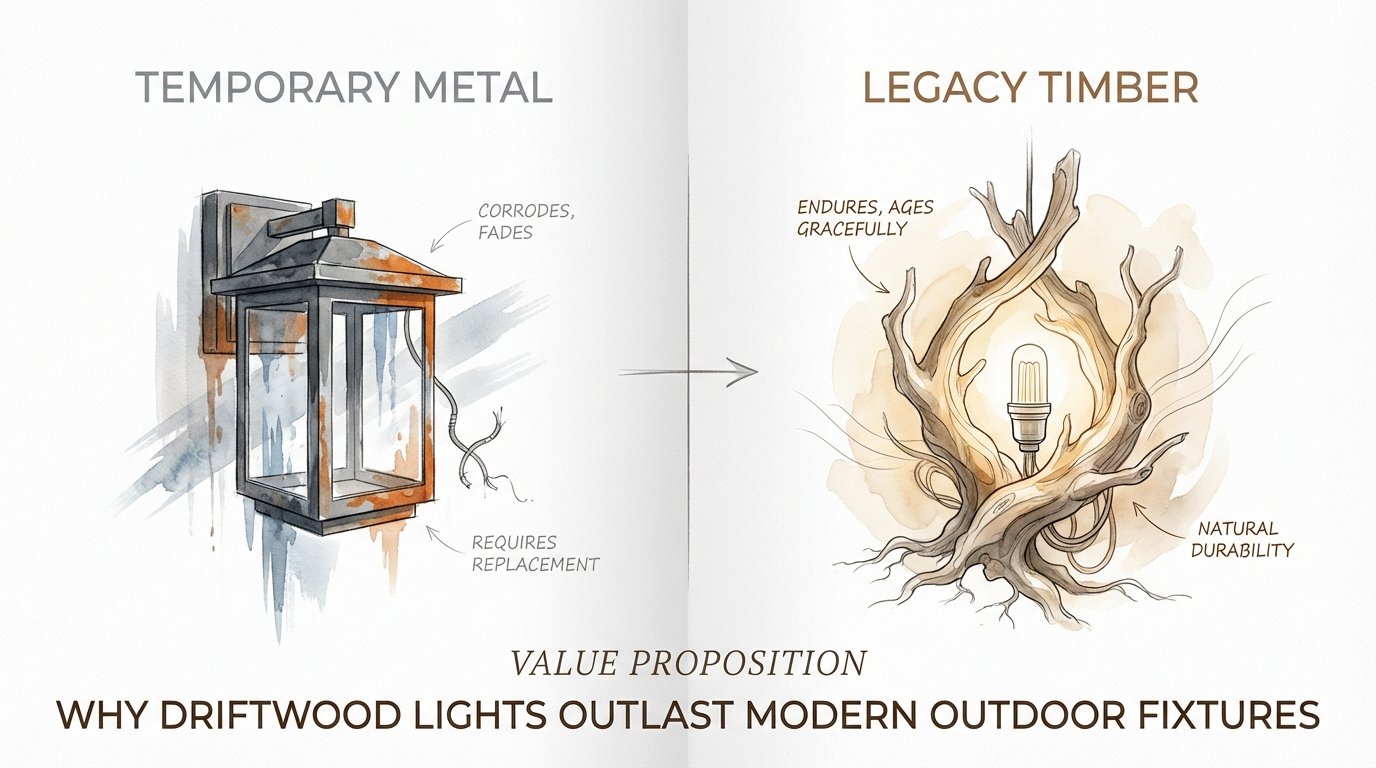
In real-world terms, a driftwood light does not have a finish that can “fail.” There is no paint to peel and no chrome to pit. As the years pass, the wood continues to weather into a silver-gray patina that only increases its structural integrity and aesthetic value. While a metal fixture looks its best on day one and declines thereafter, a driftwood fixture matures. It is an investment in LEGACY TIMBER rather than a subscription to disposable hardware.
Engineering the Internal Skeleton: How to Build It Right
Building a driftwood light is not simply about sticking a bulb into a piece of wood. It requires a sophisticated internal “nervous system” that protects the electrical components from the same salt air that ruins metal housings. The process starts with selecting a piece of wood that is structurally sound. You want wood that feels heavy for its size—an indicator of density—and shows no signs of active soft rot or boring-insect damage.
The first step is a deep cleaning and desalination. Even though salt helps preserve wood, an excess of surface salt can attract moisture. Scrub the wood with a stiff brush and fresh water, then allow it to dry in a shaded, well-ventilated area for several weeks. Rushing this process leads to trapped moisture, which can cause internal cracking once the light’s heat source is activated. Once dry, use a long-ship auger bit to create a central wire chase. This is the “spine” of your fixture.
For the electrical components, you must use marine-grade materials. Standard copper wire will turn green and brittle in coastal air. Instead, use tinned copper wire, which is coated in a thin layer of tin to prevent oxidation. This wire should be housed inside a flexible non-metallic conduit or a rigid brass tube within the wood. The goal is to ensure that the salt-laden air never touches the actual conductors. Seal all entry and exit points with high-grade silicone or marine epoxy to maintain an airtight environment for the wiring.
The Structural Benefits of Natural Resilience
The practical advantages of driftwood lighting go beyond simple aesthetics. One of the most significant benefits is wind resistance. Coastal storms can easily rip lightweight aluminum sconces off a wall. Driftwood, particularly larger bollard-style lights, has significant mass. When properly anchored with 316 stainless steel lag bolts into the building’s framing, these fixtures become a permanent part of the structure. They don’t rattle in the wind; they stand firm.
Another advantage is the thermal management of LED technology. Modern LEDs are sensitive to heat. Metal housings in direct sunlight can reach temperatures that significantly shorten the life of the LED driver. Wood is a natural insulator. A driftwood housing protects the internal electronics from the brutal afternoon sun, keeping the operating temperature stable and extending the life of the light source. This thermal stability is a key reason why these fixtures can operate for decades without maintenance.
Repairability is the third major benefit. When a modern integrated LED metal fixture fails, you usually have to throw the whole unit away. With a driftwood light, the wood is a permanent chassis. If the LED bulb or driver eventually fails after 50,000 hours, you simply unscrew the access plate—made of marine brass—and replace the component. This is a circular design philosophy that respects both the environment and the owner’s wallet.
Challenges and Common Pitfalls to Avoid
One of the most common mistakes is using the wrong fasteners. Many builders use standard zinc-plated or even galvanized screws. In a coastal environment, these will fail within two years. Even worse, the chemical reaction between the salt in the wood and the zinc will cause “nail sickness,” where the wood around the screw begins to rot and turn black. You must use 316-grade stainless steel or silicon bronze fasteners. These are the only metals that can survive long-term contact with salt-saturated wood.
Another frequent error is “over-sealing” the wood. Beginners often try to coat driftwood in thick layers of polyurethane or varnish to make it look shiny. This is a mistake. These coatings will eventually crack under UV exposure, trapping moisture underneath and causing the wood to rot from the inside out. Driftwood needs to breathe. If you want to enhance the color, use a penetrating natural oil like tung oil or a specialized marine-grade timber oil. These soak into the fibers rather than sitting on top, allowing the wood to expand and contract naturally.
Poor drainage is the final major pitfall. If you are building a vertical bollard light, you must ensure that water cannot pool at the base or inside the wire chase. Always drill a small “weep hole” at the lowest point of any internal cavity. This allows condensation and any wind-driven rain to exit the fixture immediately. Without drainage, the internal wiring will eventually sit in a bath of saltwater, leading to a short circuit regardless of how well you think you’ve sealed it.
Limitations: When Driftwood May Not Be Ideal
Driftwood lighting is not a universal solution. The primary limitation is the lack of uniformity. If you are designing a commercial space that requires twelve identical lights, driftwood will not work. Each piece is a unique sculpture created by the sea. You can find pieces with similar “personalities,” but they will never be twins. For some, this organic variation is the draw; for others, it is a deal-breaker.
Weight is another practical boundary. A six-foot driftwood bollard can weigh 80 to 100 pounds. This requires substantial mounting hardware and a solid foundation, usually a concrete footer or a reinforced deck joist. You cannot simply screw these into a thin piece of vinyl siding. The installation requires more skill and physical labor than a standard five-pound light fixture from a big-box store.
Finally, there are regulatory considerations. In some strictly controlled HOAs or historical districts, the “raw” look of driftwood may not meet the architectural guidelines. While you are building for the next generation, you still have to live with the neighbors of this generation. Always check local codes regarding “dark sky” compliance as well; because driftwood lights are custom-made, you must ensure your design directs light downward to prevent light pollution.
Comparing the Two Philosophies: Metal vs. Timber
To understand the value proposition of driftwood, it helps to see how it compares to the standard industry offerings. Most people choose metal because it is familiar and easy to buy, but the long-term costs often tell a different story.
| Feature | TEMPORARY METAL (Aluminum/Steel) | LEGACY TIMBER (Salt-Cured Driftwood) |
|---|---|---|
| Expected Lifespan | 3–7 Years (Coastal) | 25–50+ Years |
| Maintenance | Repainting, cleaning salt pits | Occasional oiling (optional) |
| Failure Mode | Corrosion, peeling, wiring decay | Electronic component aging only |
| Wind Resistance | Low (Lightweight) | High (Heavy Mass) |
| Environmental Impact | High (Mining, Smelting, Landfill) | Low (Reclaimed, Carbon Storage) |
| Repairability | Often Non-Repairable | Fully Modular/Repairable |
Practical Tips for the Modern Pioneer
If you are ready to begin your first project, start small. A wall-mounted sconce is a perfect entry point. Look for “hard” driftwood like cedar, juniper, or oak. Avoid softwoods that feel “spongy” to the touch, as these have already begun the process of decomposition and won’t hold up to the heat of a lamp. When you find a piece, drop it on a hard surface; it should “ring” or sound solid, not thud.
- Use only IP65 or IP67 rated LED modules. These are dust-tight and can withstand jets of water, ensuring the electronics are as tough as the wood.
- Install a low-voltage transformer (12V or 24V) in a sheltered location. Running low voltage to the driftwood fixtures is significantly safer and more durable than running 120V line voltage through a natural material.
- Opt for brass or copper accents for your mounting plates and screws. These metals develop a green patina that complements the silver wood and never rusts.
- Consider the “Light Temperature.” Coastal environments look best with warm light (2700K). This mimics the glow of a sunset and brings out the amber tones in the wood grain.
Advanced Considerations for Serious Practitioners
For those looking to push the boundaries of driftwood lighting, consider integrating smart controls. Since you are already building a custom internal chase, you can easily include a small Zigbee or Z-Wave controller. This allows the lights to dim automatically as the moon rises or change intensity based on motion, which is particularly useful for beachfront security without creating constant glare.
Scaling is another consideration. If you are lighting a large coastal estate, you can use driftwood as the “thematic anchor” for the entire landscape. This involves using large vertical trunks for path lighting and smaller, more intricate branches for accent lighting in the gardens. The key to scaling is consistency in the electrical system—use the same high-quality marine wire and the same waterproof connectors throughout the entire property to simplify future maintenance.
Think about the “Glow Factor.” Instead of having a bulb visible, use a router to create a recessed channel on the back or underside of the wood. Lay in a waterproof LED strip and cover it with an opal acrylic lens. This creates an indirect glow that highlights the texture of the wood without the harshness of a direct light source. It turns the entire piece of driftwood into a glowing lantern, which is much more visually striking than a standard “bulb on a stick.”
Example Scenario: The Sentinel Bollard
Imagine a property on the rugged coast of Maine. A traditional metal path light would be battered by Atlantic salt spray and buried in snow every winter. Within four years, the stems would be bent and the finish would be bubbling. The homeowner decides to install “The Sentinel”—a series of 4-foot tall cedar driftwood bollards.
Each Sentinel is anchored 18 inches deep into a concrete base with a 316 stainless steel threaded rod. The internal wire is a 14/2 tinned marine cable, and the light source is a 5-watt Cree LED module housed in a custom brass “hat” that directs all light downward. During a Nor’easter with 60 mph winds, the metal lights on the neighbor’s property are vibrating and flickering. The Sentinels don’t budge. Ten years later, the neighbor is on their third set of lights. The Sentinels have turned a beautiful, uniform silver-gray and look more like a part of the landscape than ever before. They have cost the homeowner exactly zero dollars in repairs.
Final Thoughts
Choosing driftwood lighting is a rejection of the “disposable” culture that has infected the home improvement industry. It is an acknowledgment that the ocean is the ultimate engineer. By using materials that have already been tested by the tide, you are creating a system that values durability over flashiness and legacy over convenience.
This approach requires more thought, better materials, and a bit of pioneer grit. However, the result is a lighting system that tells a story. Every time the sun goes down and those fixtures glow, they remind you that while metal fights the ocean and loses, your lights survived the ocean and won. Experiment with different shapes, invest in marine-grade internals, and build something that your grandchildren will still see standing on the porch, weathered and bright, long after the storms have passed.
Sources
1 urbanambiance.com (https://www.urbanambiance.com/blogs/ideas-and-inspiration/12-sustainable-reclaimed-materials-changing-the-way-we-think-about-lighting) | 2 coohom.com (https://www.coohom.com/article/common-problems-with-outdoor-lighting-in-coastal-cape-cod-homes) | 3 agcled.com (https://www.agcled.com/blog/4-little-known-secrets-about-outdoor-coastal-lighting.html) | 4 illuminationfl.com (https://illuminationfl.com/2025/05/08/how-to-choose-the-right-outdoor-lighting-fixtures-for-coastal-climates/) | 5 youtube.com (https://www.youtube.com/watch?v=lg_pSFeMBjY) | 6 dmflighting.com (https://www.dmflighting.com/marine-grade-lighting/)