Driftwood Vs Cedar For Garden Soil Health
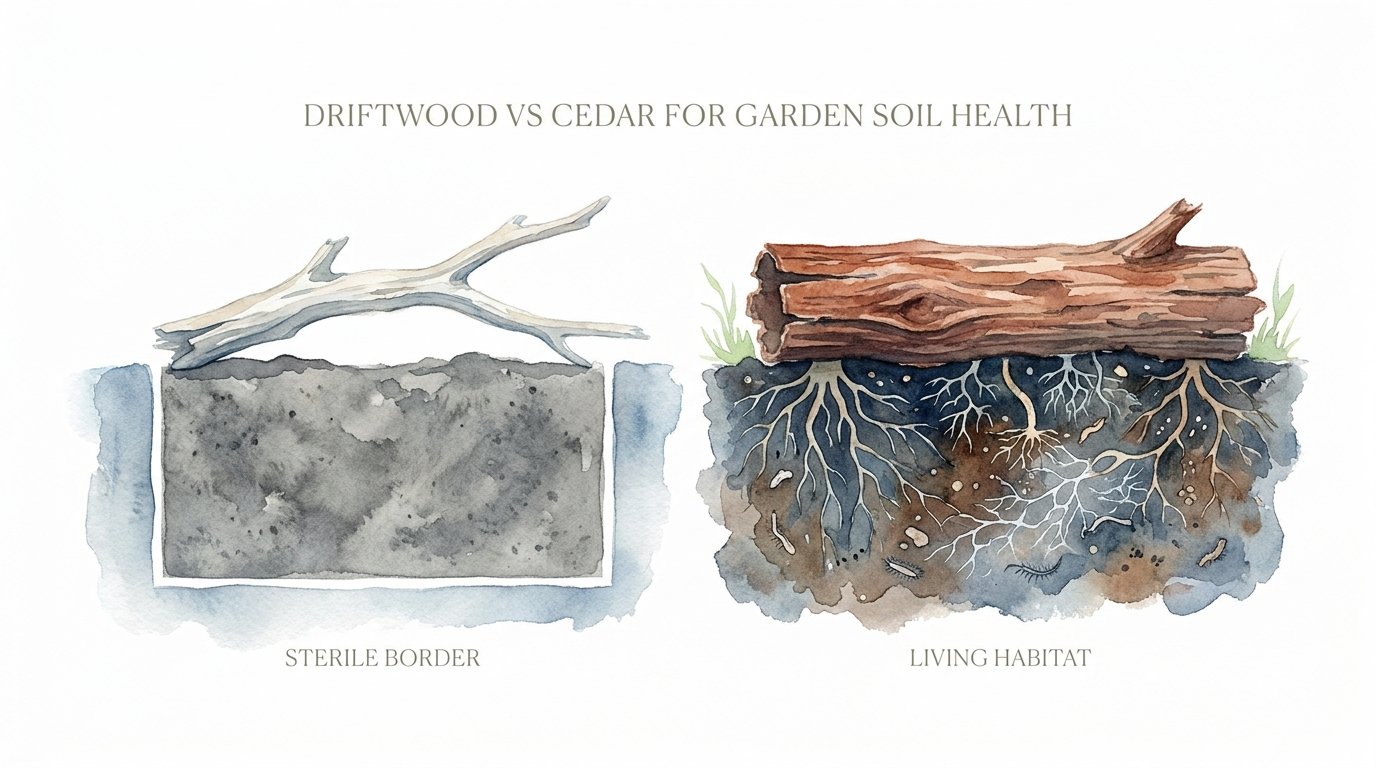
One is a sterile barrier; the other is the motherboard of your garden’s biology. Standard garden lumber is treated with chemicals to stay dead for as long as possible. Driftwood, seasoned by the sea and sun, acts as a biological sponge. It doesn’t just mark a boundary; it hosts the beneficial fungi and moisture-rich micro-habitats your soil is starving for. Stop building with ‘dead’ wood and start importing the living architecture of the coast.
[affiai]Most gardeners head to the local lumber yard when they want to build a raised bed or a property border. They look for the straightest, cleanest boards of cedar or pressure-treated pine they can find. These materials are chosen for their ability to resist life—specifically, the fungi and insects that naturally break down organic matter. While this preserves the structure of the box, it does nothing for the vitality of the earth inside it.
Pioneer-grit gardening isn’t about building pretty boxes that look like they belong in a suburban showroom. It is about understanding the raw mechanics of the land. When you place a piece of sea-weathered driftwood against your soil, you aren’t just placing a border. You are installing a seasoned reservoir that has spent years absorbing minerals and being scoured by the elements. It carries a history of resilience that your garden can tap into.
Every crack and silvered grain in a piece of driftwood is a potential home for the mycelial networks that drive nutrient exchange. Modern agriculture treats wood as a structural necessity, but the old ways see it as a biological catalyst. Transitioning from a sterile border to a living habitat requires a shift in how you view the “waste” of the ocean.
Driftwood Vs Cedar For Garden Soil Health
Choosing between driftwood and cedar is a choice between two very different philosophies of land management. Cedar is the “gold standard” of the modern garden for its natural rot resistance. It contains tannins and oils that are toxic to many insects and fungi. This makes it an excellent defensive material, keeping the wood intact for fifteen to twenty years while the soil remains contained.
Driftwood, on the other hand, is an offensive material. It has already been stripped of its softest tissues and most volatile oils by the relentless action of salt water and sun. What remains is a dense, lignin-rich skeleton. This skeleton is remarkably porous, having been “cured” in a way that allows it to hold onto moisture like a subterranean sponge. While cedar repels the very organisms that create healthy soil, driftwood invites them to set up shop.
In a real-world garden setting, driftwood acts as a bridge between the wild ecosystem and your cultivated plants. In coastal regions, foraged wood has been used for centuries to trap blowing sand and organic detritus, slowly building up rich pockets of soil where nothing would otherwise grow. Using it in your garden replicates this natural process, creating a high-carbon environment where the “wood-wide web” of fungi can thrive.
Cedar is reliable, but it is a closed system. It sits there, slowly graying, largely uninvolved in the biology of the bed. Driftwood is an active participant. As it slowly breaks down over decades, it releases trace minerals gathered from the sea—iodine, magnesium, and potassium—directly into the root zone. It doesn’t just hold the dirt; it feeds the dirt.
How to Prepare and Use Driftwood in the Garden
You cannot simply drag a log off the beach and bury it next to your prize tomatoes without some preparation. The primary concern with sea-sourced wood is salinity. While many plants appreciate trace amounts of sea salt, a concentrated dose can cause osmotic stress, effectively pulling moisture out of your plant roots and “burning” the soil.
Preparing driftwood starts with a deep leaching process. If you live in an area with heavy rainfall, the easiest method is to stack your foraged wood in an open area for a full season. Let the rains wash away the surface salts and penetrate the grain. For those in a hurry, soaking the wood in a large trough of fresh water, changed every few days for a week, will pull the majority of the salt out of the fibers.
Integration is the next step. Large, heavy logs make incredible anchors for the corners of a garden. They don’t need to be square or perfect. In fact, the irregular shapes of driftwood create micro-climates. A curve in a log can trap heat on its southern face while providing a cool, moist “toad house” on its northern side. This physical complexity is something a flat 2×6 cedar board can never provide.
Avoid the pitfall of thinking you need to “seal” the wood. Applying chemical sealants or stains to driftwood defeats the entire purpose. You want the wood to interact with the soil. You want the moisture to move in and out of the timber. The goal is to create a porous, breathing architecture that supports life from the inside out.
Benefits of Living Wood Architecture
The measurable benefits of using seasoned driftwood go far beyond aesthetics. The most immediate advantage is moisture management. Because driftwood is highly porous, it acts as a battery for water. During a heavy rain, it absorbs moisture; during a drought, the soil directly adjacent to the wood remains damp for days longer than the rest of the bed.
Biological diversity is another massive win. Driftwood provides a variety of textures—deep grooves, soft punky areas, and hard knots. This attracts a wide range of beneficial organisms. You will find centipedes, ground beetles, and spiders taking up residence in the wood. These are the “security guards” of your garden, preying on slugs and pests before they ever reach your crops.
There is also the cost factor. If you live near a coastline or a large river, driftwood is a free resource. While a single 8-foot cedar board can cost upwards of thirty dollars, a beach after a storm is a literal gold mine of structural material. Using foraged wood is the ultimate expression of the pioneer-grit mindset: using what the land provides to build something that lasts.
Finally, the trace minerals found in sea-seasoned wood are rare in inland soils. The ocean is a soup of every element known to man. When wood soaks in that soup for years, it becomes impregnated with these elements. As the wood decays, it acts as a slow-release fertilizer that provides the “micro-nutrients” often missing from bagged compost and synthetic fertilizers.
Challenges and Common Mistakes
The most common mistake gardeners make is ignoring the legalities of foraging. In many coastal regions, driftwood is considered part of the public trust or essential habitat for nesting birds. Always check your local regulations before loading up the truck. Taking wood from a protected beach can result in heavy fines and does more harm to the environment than your garden can offset.
Another pitfall is using “green” wood that has recently washed up. If the wood still has bark or hasn’t been properly seasoned by the sun, it may still contain high levels of sap or tannins that could inhibit plant growth. Look for wood that is silvered, smooth, and relatively lightweight for its size. This indicates that the volatile organics have leached out and the wood is ready to become a biological sponge.
Salt toxicity is a real threat if you skip the leaching phase. Signs of salt damage include brown, “burnt” edges on leaves and stunted growth. If you notice these symptoms near your driftwood borders, heavy irrigation with fresh water can help wash the excess salt deeper into the subsoil, away from the root zone. However, prevention is much easier than the cure.
Structural stability can also be a challenge. Unlike milled lumber, driftwood is rarely straight. Building a perfectly level, rectangular bed with it is nearly impossible. If you require absolute precision for things like greenhouse footings or automated irrigation mounts, driftwood might not be the right choice. It requires a more fluid, “organic” approach to garden design.
Limitations and Environmental Constraints
Driftwood is not a universal solution. In extremely arid, desert environments, the salt content in foraged sea wood can accumulate in the soil rather than leaching away. Without regular rainfall to move the minerals through the soil profile, you risk creating a saline environment that will kill most garden vegetables. In these areas, cedar or locally sourced, untreated hardwoods are safer bets.
Longevity is also a trade-off. While the hard “skeleton” of a driftwood log will last a very long time, it does not have the uniform decay resistance of cedar. Some pieces may rot away in five years, while others remain for fifty. This variability means you have to be okay with a garden that is constantly evolving. You aren’t building a monument; you are tending a cycle.
Weight and transport are practical boundaries. A large, water-logged piece of driftwood is incredibly heavy. Moving these pieces requires significant physical labor or equipment. For the older gardener or those with limited access to the shoreline, the convenience of home-delivered cedar boards often outweighs the biological benefits of foraged timber.
Comparison of Garden Boundary Materials
When deciding how to frame your soil, it helps to see the measurable differences in how these materials perform over time. The following table breaks down the three most common choices for “grit” gardening.
| Factor | Driftwood (Seasoned) | Cedar (Untreated) | Pressure-Treated Pine |
|---|---|---|---|
| Primary Use | Living Habitat/Sponge | Durable Border | Structural Support |
| Soil Impact | Adds minerals/fungi | Neutral/Repellent | Leaches chemical copper |
| Lifespan | 10–40+ years | 15–20 years | 20–30 years |
| Moisture Retention | Excellent (Sponge-like) | Poor (Repels water) | Moderate |
| Cost | Free (Foraged) | High | Medium |
This comparison shows that while pressure-treated wood wins on pure longevity, it fails on biological integration. Cedar is a safe, middle-ground choice for those who want a clean look, but driftwood is the only option that actively improves the health and hydration of the soil it touches.
Practical Tips and Best Practices
If you want to maximize the impact of your driftwood boundaries, try “wedging” the logs. Instead of just laying them on top of the grass, dig a shallow trench about two inches deep and set the wood into it. This creates direct contact between the wood’s biological sponge and the soil’s fungal networks. It also prevents the log from rolling or shifting during heavy storms.
Combine your driftwood with seaweed. If you are already at the beach, grab a few bags of washed-up kelp or eelgrass. Lay the seaweed down as a mulch against the driftwood. The wood will help hold the moisture in the seaweed, and as the seaweed breaks down, it will “charge” the wood with even more minerals. It is a coastal nutrient cycle brought directly to your backyard.
Use the wood as a trellis for climbing plants. The rough, silvered surface of driftwood is perfect for the tendrils of peas, beans, and cucumbers to grip. Unlike smooth metal or plastic trellises, the wood doesn’t get hot in the sun, which prevents the delicate vine tips from scorching. It provides a natural, sturdy ladder for your vertical crops.
Plant “salt-tolerant” companions near new driftwood. Even with leaching, a little residual salt is likely. Planting things like asparagus, beets, or kale—which are naturally more tolerant of salinity—near the logs for the first year is a smart move. By the second or third year, the salt will be gone, and you can rotate in more sensitive crops like strawberries or peppers.
Advanced Considerations for the Soil Motherboard
Serious practitioners can take this a step further by using driftwood in a modified Hügelkultur system. Hügelkultur involves burying wood under mounds of soil to create a self-watering garden. While usually done with fresh-cut logs, using sea-seasoned driftwood in the base of a mound creates a mineral-dense core that won’t rob the soil of nitrogen as aggressively as “green” wood might.
You can also inoculate your driftwood with specific gourmet or medicinal mushrooms. Because the wood is already seasoned and lacks the defensive oils of fresh cedar, it is a prime candidate for mushroom plugs. Oyster mushrooms and Wine Cap mushrooms (Stropharia rugosoannulata) are particularly aggressive and can thrive on the lignin in weathered logs, providing you with a secondary harvest while they break down the wood into rich humus.
Think about the “thermal mass” of larger logs. A thick driftwood log can absorb a significant amount of solar energy during the day and radiate it back out at night. Placing these logs on the north side of a bed can create a warmer micro-climate that allows you to plant earlier in the spring or harvest later into the fall. It is a passive heating system that requires zero electricity.
Example: The Coastal Boundary Bed
Imagine a garden plot located 10 miles inland. The soil is heavy clay, prone to cracking in the summer and waterlogging in the winter. The gardener decides to eschew the hardware store and spends three weekends hauling silvered logs of Douglas fir and hemlock driftwood from a nearby estuary.
These logs are placed as the primary boundary for a 20-foot long perennial border. Before planting, the gardener leaves the logs through a wet winter to leach. In the spring, they tuck native ferns and blueberries right against the wood. By mid-summer, the clay soil near the logs is noticeably more friable and darker than the soil in the center of the yard.
When the gardener pulls back a bit of mulch, they see white, thread-like mycelium fanning out from the log into the root zone of the blueberries. Despite a three-week dry spell, the blueberry bushes show no signs of wilt, as the driftwood logs have stayed cool and damp under their silvered skins. This is a functional, living habitat at work.
Final Thoughts
The choice between building a sterile box and a living habitat is one of the most important decisions you can make for your land. Cedar and treated lumber have their place in construction, but the garden is not a construction site. It is a biological engine. Using seasoned driftwood recognizes that the best materials are often those that have been shaped and refined by the very forces of nature we are trying to harness.
Embrace the irregularities, the salt-cured grains, and the weathered history of sea-wood. You will find that your garden becomes more than just a place where plants grow; it becomes a sanctuary for the complex web of life that turns dirt into “living soil.” It requires more effort and a keener eye for the land, but the rewards are measured in the resilience of your harvests and the vitality of your earth.
Start small if you must. Find one beautiful, silvered log and place it where it can do the most good. Watch how the life around it changes over the seasons. Once you see the difference between a dead barrier and a living motherboard, you will never look at a “perfect” cedar board the same way again.
Sources
1 kellogggarden.com (https://kellogggarden.com/blog/soil/why-wood-soil-is-the-better-choice/) | 2 avofenceandsupply.com (https://marketing.avofenceandsupply.com/blog/cedar-lumber-for-landscaping) | 3 thrivegarden.com (https://thrivegarden.com/pages/lifespan-analysis-fabric-raised-beds-vs-wooden-raised-beds) | 4 reddit.com (https://www.reddit.com/r/mycology/comments/u0lz40/can_driftwood_be_inoculated_with_mushroom_spawn/) | 5 youtube.com (https://www.youtube.com/watch?v=IdUMy3NZg5s) | 6 richsoil.com (https://richsoil.com/hugelkultur/) | 7 youtube.com (https://www.youtube.com/watch?v=MPSx6buv3N8) | 8 permacultureapprentice.com (https://permacultureapprentice.com/food-forest-fungi/) | 9 arboristnow.com (https://arboristnow.com/news/understanding-treated-lumber-what-you-need-to-know/) | 10 gardenary.com (https://www.gardenary.com/blog/the-best-type-of-wood-to-use-for-a-raised-garden-bed) | 11 glplanters.com (https://glplanters.com/blog/best-wood-for-raised-garden-beds/) | 12 thrivegarden.com (https://thrivegarden.com/pages/fabric-vs-wooden-raised-beds-lifespan-comparison) | 13 anleolifeshop.com (https://www.anleolifeshop.com/blogs/garden-center/best-long-lasting-materials-review) | 14 tnnursery.net (https://tnnursery.net/blogs/garden-blog/driftwood-has-many-uses)