How To Harvest Driftwood For Furniture
The ocean is currently washing up the $500 designer furniture you think you can’t afford. You can either wait 3-5 business days for a box of glue and sawdust, or you can walk down to the tide line and harvest a masterpiece. The transition from consumer to producer starts with realizing that the best architecture in the world is currently floating in the surf for free. Stop shopping the catalog and start reading the coastline.
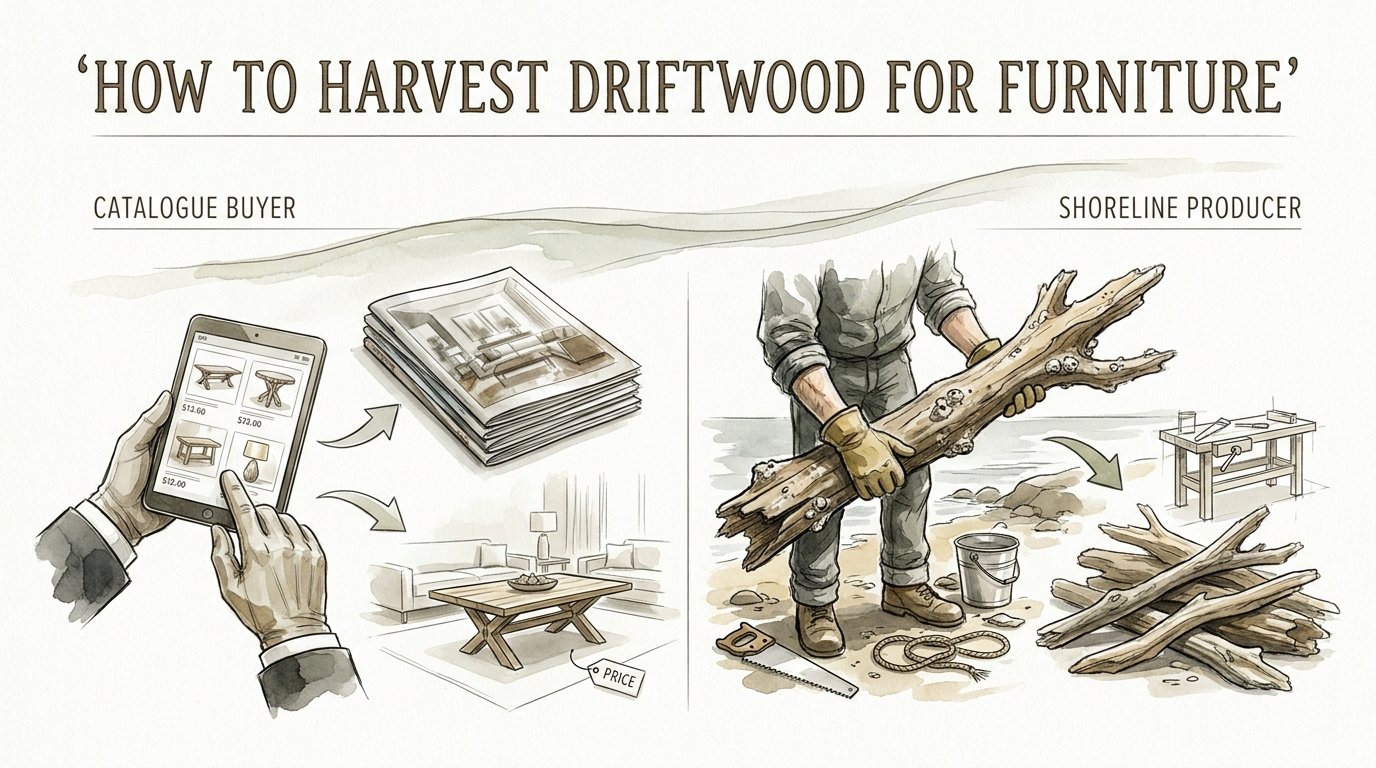
[affiai]Every storm that batters the coast acts as a logistics manager for the Shoreline Producer. While the Catalogue Buyer waits for a delivery truck, the producer is out in the salt air, identifying timber that has been cured by the sea and sculpted by the current. This isn’t just about finding free wood; it is about recognizing the inherent value in materials that have already survived the ultimate stress test.
Driftwood is more than just debris. It is a renewable, carbon-neutral resource that carries a history written in salt and sun. Whether you are looking to build a rugged dining table or a minimalist light fixture, the beach is providing the raw inventory. You just need to know how to claim it.
How To Harvest Driftwood For Furniture
Harvesting driftwood is the act of collecting wood that has been washed onto the shores of oceans, rivers, or lakes. This material exists because trees fall into waterways, ships lose cargo, or old structures are reclaimed by the rising tides. Over months or years, the water strips away the bark, rounds off the sharp edges, and leaches out the natural sugars, leaving behind a dense, weathered skeleton.
In the real world, this wood is highly prized for its unique textures and silver-grey patina. It is used in everything from high-end interior design to structural garden elements. Because no two pieces are identical, driftwood furniture possesses a level of character that mass-produced items cannot replicate. It represents a “natural recycling” process where the elements do the heavy lifting of shaping and curing the wood for you.
Think of the ocean as a giant, slow-motion wood shop. It uses sand as sandpaper and salt as a preservative. When you find a piece that has been properly weathered, you are looking at a material that is often more stable than fresh “green” lumber because the internal stresses of the wood have been neutralized by the constant movement of the tides.
Sourcing and Identifying Your Timber
Finding the right piece requires understanding coastal geography. Driftwood tends to accumulate in sheltered bays, on the leeward side of points, and in the estuaries of large rivers. After a major storm, these areas become “inventory warehouses” for the shoreline producer.
Identifying the species of wood is the first skill you must master. Even without bark, you can use grain patterns, weight, and smell to determine what you’ve found. Oak is heavy with bold, open pores, while Cedar is lighter, often redder in the center, and carries a distinct aromatic scent even after years in the water. Pine will often still smell resinous if you chip away a small piece of the surface.
Avoid “punky” wood. If you can press your thumbnail deep into the surface or if the wood feels spongy, it has begun to rot from the inside out. You are looking for pieces that feel “ringing” hard when tapped with a stone. These are the survivors, the pieces that have the structural integrity to hold a screw or support a glass tabletop.
Legal Considerations for the Modern Pioneer
Before you load your truck, you must understand the local laws. In the United Kingdom, the Coastal Protection Act of 1949 generally allows for the collection of small amounts of driftwood and shells for personal use, though taking sand or pebbles can lead to fines. In the United States, regulations vary wildly by state. For instance, Florida often prohibits harvesting from state parks, viewing driftwood as “park property”.
Always check with local wildlife agencies or environmental authorities. National parks and wildlife refuges often have strict “leave no trace” policies. On private land, you must obtain the owner’s consent to avoid trespassing charges. Being a producer means being a steward of the land, not a looter.
The Restoration Process: From Tide to Table
Once you bring your harvest home, the real work begins. You cannot simply move a piece of raw beach wood into your living room without preparation. Salt, sand, and pests are part of the package deal, and they must be dealt with before the wood becomes furniture.
- Step 1: Deep Cleaning. Start by using a stiff-bristled brush to remove surface sand and dried salt. For deep crevices, a water flossing tool or a blast of compressed air can dislodge hidden debris.
- Step 2: Sanitization. To kill bacteria and mold, soak the wood in a solution of one part bleach to ten parts water for 4 to 12 hours. If you want to preserve the dark tannins, use a vinegar solution instead, as bleach will whiten the wood significantly.
- Step 3: Pest Removal. This is the most critical step. Driftwood often houses sand gnats, borers, or even termites. If the piece is small enough, you can dry it in an oven at 200°F (93°C) for several hours to kill organisms. For larger pieces, a thorough soak in a borate-based wood preservative is necessary.
- Step 4: Desalination. If the wood was harvested from the ocean, it is saturated with salt. Salt is hygroscopic, meaning it will pull moisture from the air and cause your wood to “sweat” or rot in humid environments. Repeatedly soaking the piece in fresh water and allowing it to dry helps leach out the salt.
- Step 5: Final Drying. The wood must be completely dry before you apply any finish. Use a moisture meter to ensure the internal moisture content is below 10%. This may take weeks of air-drying in a shaded, well-ventilated area.
The Benefits of Shoreline Production
Choosing to harvest your own furniture materials offers practical and aesthetic advantages that no retail store can match. The primary benefit is sustainability. By upcycling weathered timber, you are preventing the need for new logging and reducing the carbon footprint associated with manufacturing and shipping.
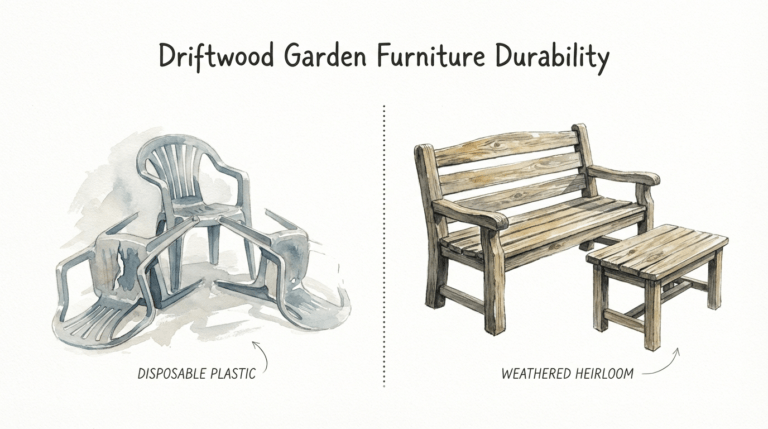
Beyond ethics, there is the durability of the survivors. Driftwood that has survived years in the ocean has already been through more stress than any furniture in your home will ever face. It has been sun-bleached, salt-cured, and tumbled. If it is still solid, it is likely to stay that way for decades.
Finally, there is the biophilic design aspect. Research indicates that incorporating natural, raw elements into a living space can improve mood, productivity, and general well-being. A driftwood coffee table provides a tactile connection to the wild that polished, factory-edged lumber lacks.
Challenges and Common Mistakes
The most common mistake beginners make is rushing the drying process. Wood that feels dry on the surface can still be damp in the core. If you seal a piece that still has high moisture content, you are essentially trapping rot inside, which will cause the wood to crack or grow mold within months.
Another pitfall is ignoring the salt content. If you ignore desalination, the salt in the wood can react with metal fasteners, causing screws and brackets to corrode and fail prematurely. Always use stainless steel or galvanized hardware when working with coastal timber.
Lastly, many new producers fail to inspect for rot properly. Just because a piece looks beautiful doesn’t mean it’s structurally sound. Always test the “heart” of the wood. If the center is soft, the piece is a decorative element at best, not a structural component.
Limitations of Driftwood
Driftwood is not a universal substitute for structural lumber. Because it has been weathered, its compressive strength and bending modulus are often lower than those of fresh, kiln-dried timber. It is not recommended for use in load-bearing walls or as primary structural beams in a home.
There are also environmental limitations. In certain ecosystems, driftwood plays a vital role in coastal defense, trapping sand and helping to build dunes. Removing too much wood from a sensitive area can accelerate coastal erosion. A responsible producer knows when to walk away from a piece to let it do its job for the coastline.
Comparison: Catalogue Buyer vs. Shoreline Producer
| Factor | Catalogue Buyer | Shoreline Producer |
|---|---|---|
| Cost | $500 – $2,000 per piece | Free (plus labor and tools) |
| Material Quality | Veneer, MDF, or “faked” aging | Solid, element-cured hardwood |
| Customization | Zero (Mass produced) | Infinite (One-of-a-kind) |
| Lead Time | 3-5 business days | One storm + 2 weeks curing |
| Durability | High (initially), prone to chipping | Extreme (proven by the elements) |
Practical Tips for Best Results
To move from hobbyist to serious practitioner, you need the right kit. Invest in a moisture meter; it is the only way to know if your wood is truly ready for a finish. Without it, you are just guessing.
When it comes to finishing, less is often more. To maintain the “beach” look, use a matte water-based polyurethane. This protects the wood without giving it the “plastic” look of high-gloss finishes. If you want to enrich the color, Tung oil or Linseed oil will penetrate deep into the fibers and bring out the hidden grain patterns of cedar or oak.
Use epoxy resin to stabilize small cracks or voids. Instead of hiding the imperfections, you can fill them with clear or tinted resin to create a “river” effect that highlights the wood’s history while adding structural integrity.
Advanced Considerations: Resin Impregnation
For pieces that are “punky” or slightly soft but possess an incredible shape, serious practitioners use resin impregnation. This involves placing the wood in a vacuum chamber with a stabilizing resin. The vacuum pulls the air out of the wood’s cells, and the resin is then forced in to fill the gaps.
Once the resin is cured, even wood that was once soft enough to crumble becomes as hard as rock. This technique allows you to use pieces that would otherwise be destined for the burn pile. It is an advanced move, but it expands your available inventory significantly.
Example Scenario: The Anchor Base Coffee Table
Imagine finding a massive, gnarled root system of a downed cedar tree on the beach. It’s too big to be a lamp, but it has three distinct “arms” that could serve as a base. After cleaning, sanitizing, and drying the piece for three weeks, you find it has a moisture content of 8%.
You use a chainsaw to level the three arms so they sit perfectly flat on the floor. You then sand the top contact points until they are level enough to support a sheet of tempered glass. Instead of using screws, you use clear adhesive bumpers. The result is a table that looks like it grew out of the floor, costing you nothing but the price of the glass and a few hours of grit.
Final Thoughts
The transition from a Catalogue Buyer to a Shoreline Producer is a shift in perspective. It requires moving away from the convenience of a “buy now” button and toward the patient, observant rhythm of the coastline. The rewards, however, are measurable: furniture that carries the weight of the sea and the satisfaction of a master’s craft.
Start small. Go to the beach after the next high tide. Look for a piece of wood that has been stripped of its bark and rounded by the surf. Take it home, clean it, and let it dry. You will find that the ocean is the most generous supplier you have ever worked with.
By learning to read the coastline, you aren’t just saving money—you are reclaiming a connection to the natural world. Experiment with different species, master the curing process, and stop settling for glue and sawdust. The masterpiece you’ve been looking for is currently floating in the surf, waiting for you to walk down and claim it.
Sources
1 aprettyfix.com (https://aprettyfix.com/disinfect-driftwood/) | 2 parklanejewelry.com (https://www2.parklanejewelry.com/how-to-clean-driftwood/) | 3 homify.com.my (https://www.homify.com.my/diy/52765/preserve-driftwood-with-5-things-and-make-a-decorative-object-out-of-it) | 4 hawk-hill.com (https://www.hawk-hill.com/how-to-clean-driftwood/) | 5 youtube.com (https://www.youtube.com/watch?v=aFWLyAPowMA) | 6 elevatedmagazines.com (https://www.elevatedmagazines.com/single-post/discovering-the-perfect-driftwood-coffee-table-for-your-home) | 7 dksstores.com (https://dksstores.com/blog-post6) | 8 homestyler.com (https://www.homestyler.com/article/driftwood-decor-redefined?lang=ar_SA) | 9 youtube.com (https://www.youtube.com/watch?v=mVZIJy5mecU) | 10 stackexchange.com (https://woodworking.stackexchange.com/questions/2654/techniques-for-working-with-driftwood) | 11 darhlene.com (https://darhlene.com/2017/02/20/harvesting-driftwood-101/) | 12 discovertheoutdoors.co.uk (https://discovertheoutdoors.co.uk/beachcombing-uk-law/)