Drfitwood Shelf Vs Mdf Durability
Why does a piece of wood that spent 40 years underwater hold more weight than the shelf you bought yesterday? Why are we spending hundreds on ‘wood-look’ furniture that dissolves in the first humid summer? The ocean has been curing the real thing for decades, just waiting for you to bring it home. This isn’t just a shelf; it’s a legacy that survived the Atlantic before it ever met your living room. Switch from disposable decor to coastal history.
[affiai]True driftwood isn’t just “wet wood” found on a beach. It is timber that has undergone a brutal, chemical transformation. While factory-made boards are engineered to look perfect on a showroom floor, driftwood has already survived the worst conditions on Earth. Bringing a piece of this marine-grade timber into your home offers a level of character and structural integrity that modern DISPOSABLE MDF simply cannot replicate.
Choosing HEIRLOOM TIMBER over engineered composites is a decision to stop participating in the cycle of “fast furniture.” This guide will walk you through the science of why saltwater-cured wood is superior, how to source and prepare it yourself, and the advanced carpentry techniques required to mount a rugged, irregular piece of history to your wall.
Drfitwood Shelf Vs Mdf Durability
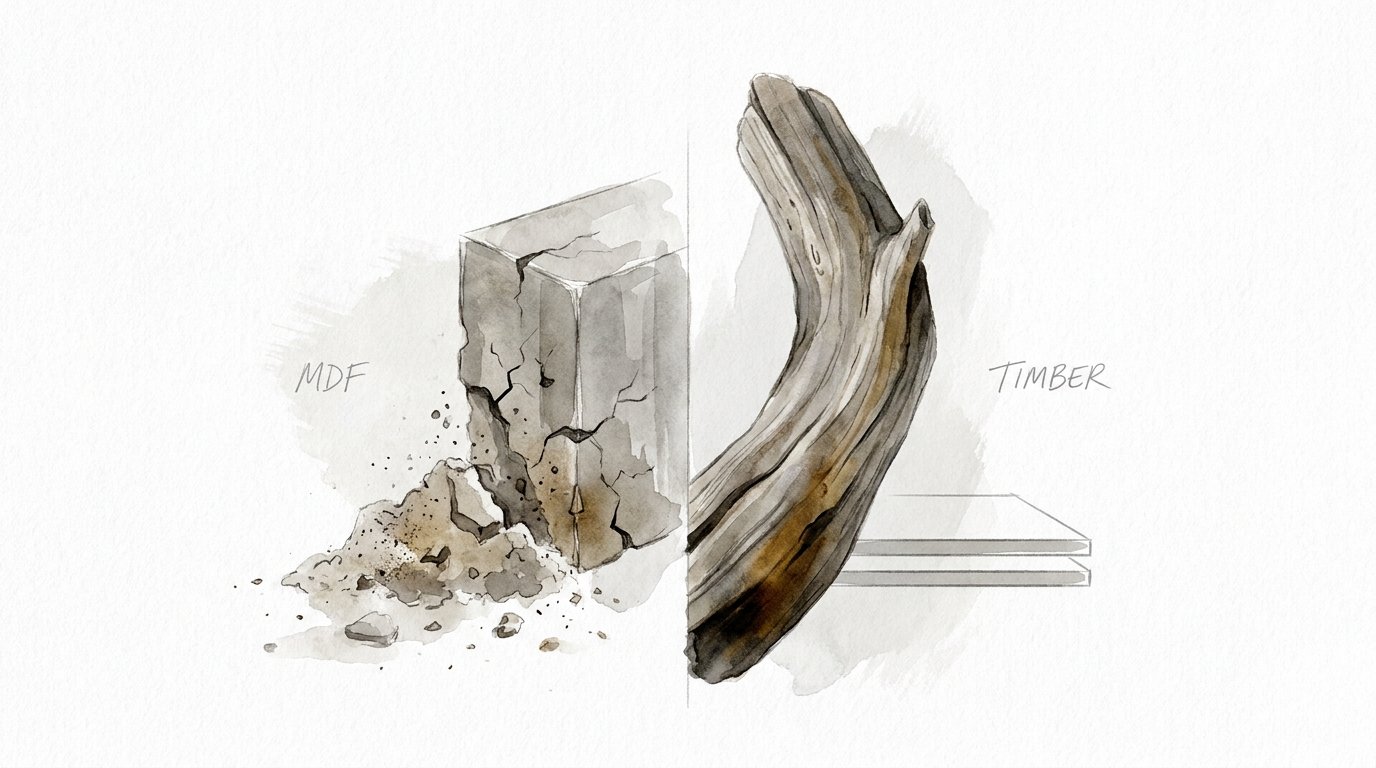
Durability in furniture is often misunderstood as simple hardness. In reality, durability is the ability of a material to withstand environmental stress, weight loads over time, and moisture. When we compare a driftwood shelf to Medium-Density Fiberboard (MDF), we are comparing a biological survivor to a chemical sponge.
MDF is an engineered product made by breaking down hardwood or softwood residuals into wood fibers. These fibers are then combined with wax and a resin binder—usually formaldehyde—and formed into panels under high heat and pressure. While MDF is uniform and easy to paint, it has no internal grain structure. Without grain to provide tension and compression strength, MDF is highly susceptible to “creep.” This is a phenomenon where the material slowly and permanently deforms under its own weight or the weight of books.
Driftwood, particularly pieces that have spent years submerged in saltwater, possesses a fundamentally different cellular structure. As wood floats in the ocean, the high concentration of salt outside the wood creates an osmotic pressure. This process draws out the natural sugars, starches, and sap from the wood cells. These organic materials are the primary food sources for rot-inducing fungi and wood-boring insects.
The ocean replaces these sugars with sodium chloride and trace minerals. This “salt-curing” acts as a natural preservative, essentially petrifying the wood from the inside out. While a cheap MDF shelf will swell and delaminate the moment it encounters a humid summer or a spilled drink, salt-cured driftwood is nearly indifferent to moisture. It has already been saturated to the limit and dried under the sun, making it one of the most stable materials a woodworker can handle.
The Science of Salt-Cured Timber
Understanding why a piece of marine timber is so resilient requires a look at the “Viking Secret” of wood curing. Ancient shipbuilders often submerged green timber in the sea for months before using it. They knew that the saltwater exchange flushes out the “biological food supply” of the wood. Modern research from the Viking Ship Museum in Roskilde confirms that salt ions migrate deep into the cell walls, regulating moisture loss and preventing the internal stresses that cause modern lumber to cup, twist, or check.
Saltwater immersion also increases the relative lignin content of the wood. Lignin is the “glue” that holds wood cells together. Studies on waterlogged wood show that as hemicellulose and sugars leach out, the remaining lignin structure becomes more concentrated and robust. This makes the wood harder and more resistant to the decay that typically claims fallen timber in a forest.
How to Process Driftwood for Home Use
Bringing a piece of the ocean indoors requires a specific cleaning and stabilization process. You cannot simply pull a log from the surf and bolt it to your drywall. Residual salt, sand, and potential marine hitchhikers must be dealt with first.
Step 1: The Initial Scrub
Begin by using a stiff nylon brush and fresh water to remove loose sand, dried salt crusts, and any clinging barnacles. Avoid using a pressure washer on a high setting, as this can shred the beautiful “fuzzy” or “stringy” surface texture created by years of wave action. If the wood is particularly grimy, a mild solution of dish soap and warm water is sufficient.
Step 2: Disinfection and Pest Control
The biggest concern with reclaimed wood is the presence of pests. To ensure your shelf doesn’t introduce wood-boring insects into your home, you must treat the timber. A common method is a 24-hour soak in a solution of one part bleach to nine parts water. This kills mold spores and bacteria. For a more natural approach, a concentrated vinegar soak or heat-treating the wood in a low-temperature kiln (about 150°F) for several hours will suffice.
Step 3: The Desalination or Stabilization Phase
Depending on your finish, you may want to leave the salt in or leach it out. If you plan to leave the wood raw for a rustic look, the embedded salt will help prevent rot. However, if you intend to use metal brackets or clear-coat finishes, you must be careful. Salt is hydroscopic, meaning it attracts moisture from the air. In very humid environments, this can lead to “weeping” or the corrosion of metal hardware.
Step 4: Proper Drying
Patience is the most important tool here. Driftwood must be bone-dry before it is mounted. Large pieces should be kept in a dry, shaded area with plenty of airflow for 2–4 weeks. Using a moisture meter is highly recommended; you are looking for a reading below 10% before you begin any fine woodworking or finishing.
Benefits of Reclaimed Marine Wood
The advantages of using driftwood go beyond its unique aesthetic. It offers practical benefits that engineered wood and even fresh-cut lumber cannot match.
- Structural Stability: Because the wood has already “done its moving,” it is much less likely to warp or crack once installed in a climate-controlled home.
- Natural Decay Resistance: The mineral deposits left behind by the sea make the wood naturally inhospitable to the fungi that cause dry rot.
- Environmental Sustainability: Using driftwood is the ultimate form of recycling. It requires zero carbon footprint for harvesting (compared to logging) and diverts waste from shorelines.
- Non-Toxic Composition: Unlike MDF, which can off-gas formaldehyde for years, natural driftwood is free of industrial glues and VOCs.
Challenges and Common Mistakes
Working with driftwood is not as straightforward as working with dimensional lumber. Beginners often fall into traps that can ruin a project or damage their walls.
One frequent error is failing to identify “punky” wood. Punky wood is timber that has begun to rot internally before the salt-curing process could save it. If you can press your thumb into the wood and it feels soft or spongy, it lacks the structural integrity to hold weight as a shelf. Always perform a “thump test” or use a small awl to check for density throughout the piece.
Another common pitfall is ignoring the corrosive nature of salt. If you use standard zinc-plated screws to mount a salt-heavy piece of driftwood, the hardware will rust and fail within a few years. Always use stainless steel fasteners or high-quality coated exterior screws when dealing with marine-reclaimed materials.
Limitations of Driftwood Shelving
While driftwood is incredibly durable, it is not the ideal choice for every scenario. There are realistic constraints you must consider before committing to this material.
Driftwood is rarely flat. If you need a perfectly level surface for a precision tool rack or a series of identical spice jars, the natural undulations of a sea-worn log will be a hindrance. You may need to use a planer or a sander to create a flat top surface, which can strip away the weathered patina that makes the wood desirable in the first place.
Furthermore, weight is a significant factor. Driftwood can be surprisingly heavy due to the mineral deposits within the cells. Mounting a 50-pound irregular log as a “floating” shelf requires advanced anchoring techniques that may be beyond the skill level of a casual DIYer.
Comparison Table: Material Performance
| Feature | Driftwood (Marine) | Standard MDF | New Pine Planks |
|---|---|---|---|
| Longevity | Decades (Heirloom) | 5-10 Years | 15-20 Years |
| Moisture Resistance | Exceptional | Very Low (Swells) | Moderate |
| Weight Capacity | High (Dense) | Low (Creeps) | Medium |
| Chemical Off-gassing | None | Formaldehyde/VOCs | None |
Practical Tips and Best Practices
If you are ready to mount your first coastal shelf, follow these optimization techniques to ensure it stays on the wall forever.
- Use a “Blind” Shelf Support: For a clean look, use heavy-duty steel rods that insert directly into the back of the wood. Because driftwood is irregular, you will likely need to custom-weld or adjust these brackets to fit the natural curves of the timber.
- Scribe to the Wall: Very few walls are perfectly flat. Use a compass to scribe the back of your driftwood to the exact contour of your drywall. This eliminates gaps and prevents the shelf from wobbling.
- Seal with Tung Oil or Beeswax: To preserve the natural, silvery-gray patina of the wood, use a matte finish like pure Tung oil or a homemade beeswax paste. These finishes protect the wood from dust and oils without giving it a plastic, “store-bought” sheen.
- Locate Every Stud: Never trust wall anchors alone for a heavy wood shelf. Use a high-quality stud finder and ensure every primary bracket is driven at least 2 inches into a solid wood stud.
Advanced Considerations: The Physics of the Cantilever
For serious practitioners, the mounting of an irregular driftwood shelf is a problem of physics. A floating shelf is essentially a cantilever—a beam supported only at one end. The weight of the shelf and the objects on it create a massive amount of “downward torque” on the wall anchors.
With a standard 12-inch deep shelf, every pound of weight on the outer edge exerts significantly more force on the mounting hardware than a pound placed near the wall. When working with driftwood, the center of gravity is often offset because the wood might be thicker on one side than the other.
To combat this, professional installers often use a “French Cleat” system if the back of the wood is flat enough. If not, they may use a custom-fabricated steel backplate that spans multiple studs, distributing the load across a larger surface area. This prevents the “lever effect” from pulling the screws right out of the wood grain or the wall.
Example Scenario: The 48-Inch Atlantic Oak Shelf
Imagine you have found a 4-foot length of salt-cured oak on the coast of Maine. It is 3 inches thick and weighs roughly 40 pounds.
In a standard MDF installation, a shelf of this size would require a bracket every 16 inches and would still likely bow in the center within six months. Using the “pioneer-grit” approach, you would instead drill three 9/16-inch holes into the dense heartwood of the oak. Using 12-inch heavy-duty steel mounting rods anchored directly into three separate wall studs, you create a shelf capable of holding over 150 pounds.
Because the oak has been salt-cured, it won’t react to the humidity of a kitchen or bathroom. The natural minerals in the wood have replaced the sap, creating a rigid, stone-like internal structure that resists sagging for decades.
Final Thoughts
The difference between a driftwood shelf and a store-bought alternative isn’t just aesthetic—it is a matter of geological time and chemical transformation. One is a product of a factory assembly line, designed for a short lifespan and eventual landfill disposal. The other is a piece of the earth that has been tempered by salt, sun, and tide.
Building with marine timber requires more effort, more patience, and a deeper understanding of woodcraft. However, the result is a piece of furniture that tells a story. It is a functional heirloom that brings the raw power of the coast into your home, standing as a testament to the durability of natural materials over engineered convenience.
Do not be afraid to experiment with the treasures you find on the shore. As long as you clean, dry, and mount them with the respect they deserve, these pieces of coastal history will hold your weight—and your memories—for a lifetime.
Sources
1 kovascapehomedecor.com (https://www.kovascapehomedecor.com/post/mdf-vs-solid-wood-floating-shelves-which-is-the-better-choice) | 2 ashdeco.com (https://ashdeco.com/blogs/buying-guides/floating-shelf-weight-limit-guide) | 3 citainterior.com (https://citainterior.com/blogs/news/how-much-weight-can-floating-shelves-hold) | 4 youtube.com (https://www.youtube.com/watch?v=9u-lrUTm9-4) | 5 dtwooddecor.com (https://www.dtwooddecor.com/driftwood-coffee-table-care-and-maintenance/) | 6 woodywalls.com (https://woodywalls.com/blog/mdf-vs-wood/)