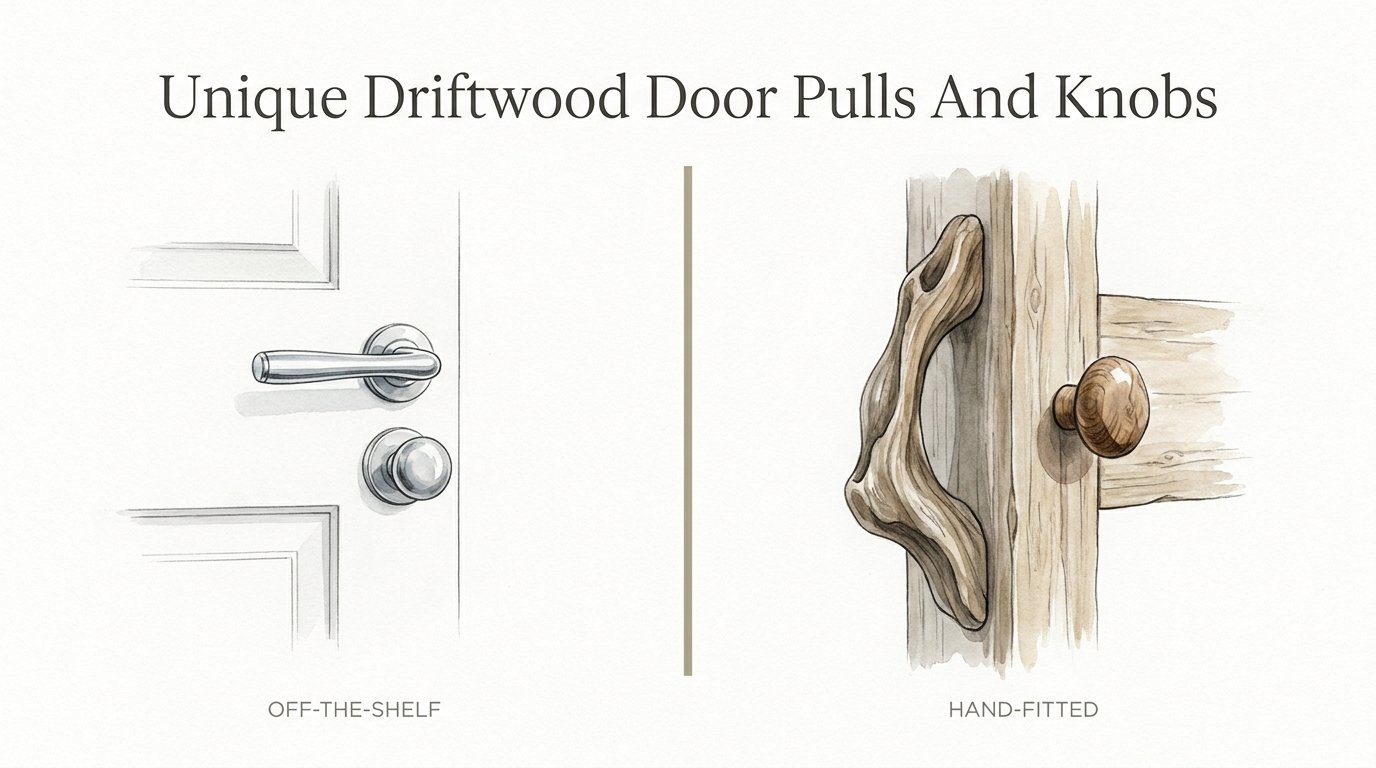
Unique Driftwood Door Pulls And Knobs
Stop living in a house designed by a committee and start building a home that responds to the touch of your own hand. We touch our door handles dozens of times a day, yet we settle for cold, industrial metal. By producing your own hardware from the ocean’s bones, you turn a mundane action into a connection with the wild. You aren’t just a consumer; you are the architect of your own experience.
[affiai]Creating custom hardware from natural driftwood is a practice in patience and vision. It requires looking at a weathered branch and seeing the grip of a front door handle or the delicate curve of a kitchen cabinet pull. This process moves beyond simple home improvement. It is an act of reclaiming your living space from the mass-produced and the unremarkable. Choosing hand-fitted elements over off-the-shelf alternatives changes the very texture of your daily life.
Every piece of wood you find on a shoreline has a history written in its grain. Saltwater, sun, and sand have stripped away the weak outer layers, leaving behind a core that is often as hard as stone. When you bring these pieces into your home, you are bringing in a sculpture shaped by the elements. This guide will walk you through the grit and grace of transforming raw driftwood into functional, beautiful door pulls and knobs that will last a lifetime.
Unique Driftwood Door Pulls And Knobs
Unique driftwood door pulls and knobs are functional pieces of hardware crafted from wood that has been washed ashore by oceans, rivers, or lakes. These items serve as the tactile interface between you and your home’s doors, drawers, and cabinets. Unlike standard metal or plastic handles, driftwood pulls offer an organic, irregular shape that fits the natural contour of a human hand. They exist because homeowners desire a connection to the natural world that industrial manufacturing cannot provide.
In real-world applications, these pulls appear in coastal cottages, rustic mountain cabins, and even modern minimalist apartments where they provide a warm, textured counterpoint to clean lines. A large, barn-door style pull might be used on a heavy entry door to make a bold statement. Smaller, smoother pieces often find their home on kitchen cabinetry or bedroom dressers. These handles are not merely decorative; they are rugged tools built to withstand the torque and tension of daily use.
Visualizing these pulls requires thinking about the environment they come from. Imagine a piece of oak or cedar that has spent years tumbling in the surf. The sharp edges are gone. The grain is raised and silvered. When you mount such a piece to a door, you aren’t just adding a handle; you are installing a piece of the horizon. It is an architectural choice that favors the hand-fitted over the mass-manufactured, ensuring that no two handles in the world are exactly alike.
How to Select and Prepare Driftwood Hardware
The process begins long before you pick up a drill. Finding the right wood is a hunt for structural integrity and ergonomic potential. You must look for wood that feels heavy and solid for its size. Avoid anything that feels “punky” or soft, as this indicates internal rot that will fail under the stress of being pulled.
Searching the Shoreline
Walk the high-tide line or riverbanks after a heavy storm. Rivers often yield the best hardwood specimens like oak, ash, or maple that have fallen from nearby forests. Oceans provide the most dramatic weathering, but the salt content requires more intensive cleaning. Look for “bolts” or branches that already have a natural “D” shape or a straight section that can be easily mounted.
Test the strength of a potential handle by applying pressure across your knee. If it has any give or makes a cracking sound, leave it for the elements. You want wood with high lignin content, which acts as a natural plastic that keeps the fibers together. Dense hardwoods like Mopani or Malaysian driftwood are legendary for their rot resistance, often used in aquariums because they effectively “fossilize” rather than decay [1.17, 1.23].
Cleaning and Disinfection
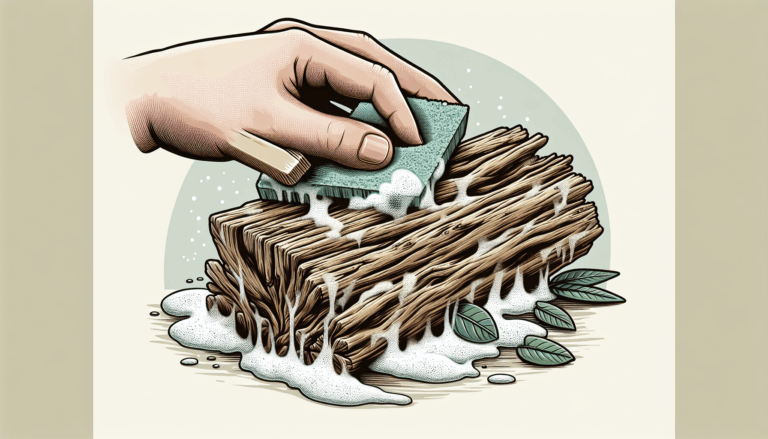
Raw driftwood is a haven for salt, sand, bacteria, and sometimes tiny wood-boring insects. Bringing it indoors without treatment is a recipe for disaster. Start by dry-brushing the wood with a stiff nylon brush to remove loose debris [1.2]. Follow this with a thorough freshwater soak for at least 24 to 48 hours. This soaking dissolves the salt crystals trapped in the pores, which would otherwise attract moisture and cause the wood to weep or rot over time [1.1, 1.3].
Disinfecting is the next critical step. A solution of one part bleach to ten parts water is the standard for killing mold and larvae [1.1, 1.4]. Submerge the wood for 30 to 60 minutes. If you are concerned about the bleach changing the wood’s color, use a heavy concentration of washing soda instead. This will draw out tannins—the dark, tea-like liquids in the wood—and brighten the silver-gray patina that many collectors prize [1.2, 1.5].
Drying and Seasoning
Moisture is the enemy of stable hardware. After cleaning, the wood must dry completely to prevent it from warping or cracking once it is screwed to a door. Air drying in a well-ventilated, shaded area is best. This can take anywhere from two weeks to two months depending on the thickness of the branch [1.12]. Avoid placing it in direct, scorching sun immediately, as rapid moisture loss causes deep “checking” or cracks.
If you are in a hurry, a low-temperature oven set to 200°F (93°C) can speed up the process. Keep the wood on a parchment-lined tray and monitor it closely for several hours. Professional-grade results come from using a moisture meter to ensure the internal humidity of the wood is below 10%. This level of dryness ensures that the wood won’t shrink and loosen your mounting hardware later.
The Mechanics of Mounting Driftwood Handles
Transforming a branch into a handle requires a solid mechanical connection. Because driftwood is irregular, you cannot rely on standard flat-surface mounting techniques. You must create a stable “bridge” between the organic shape of the wood and the flat surface of the door.
The Thrifty Screw Method
For lightweight applications like cabinet drawers or shed doors, a direct screw method works well. Position the wood against the door and find the flattest contact points. Drill a pilot hole through the back of the door and into the driftwood. Use heavy-duty wood screws that are long enough to bite deep into the handle without piercing the front surface [1.7, 1.15]. This method is simple but offers limited strength for heavy doors.
The Dowel and Epoxy System
For a more organic, “floating” look, use timber dowels as stand-offs. Drill two holes into the back of your driftwood handle and two corresponding holes into the door. Cut short lengths of 16mm or 20mm oak dowel to act as the bridge. Use a high-strength, two-part epoxy to bond the dowels into the handle first [1.16]. Once cured, the handle can be bolted through the door and into the dowels, or the dowels themselves can be glued into the door for a permanent, hardware-free appearance.
Pro-Grade Threaded Inserts
Serious practitioners use threaded inserts for entry doors or heavy barn doors. These are metal sleeves with external wood threads and internal machine threads. You drill a hole into the driftwood and drive the insert home using a hex key or a specialized driver [1.24, 1.27]. This creates a permanent, metal-lined hole. You can then use standard machine bolts to secure the handle from the other side of the door. This method allows for repeated removal and reinstallation without ever stripping the wood fibers [1.28, 1.29].
Benefits of Custom Driftwood Hardware
Choosing to build your own hardware offers practical advantages that go beyond aesthetics. It allows for complete ergonomic customization. You can choose a piece of wood that fits the specific grip of your hand, making the act of opening a heavy door feel effortless. This level of hand-fitting is something industrial designers try to mimic, but can never truly achieve for every individual user.
The durability of seasoned driftwood is another major factor. Wood that has survived years of pounding surf is incredibly resilient. Once cleaned and sealed, these handles are resistant to the oils on your skin and the humidity in your home. They don’t show fingerprints like polished brass or stainless steel, and they develop a rich, dark patina over years of use that only adds to their character.
Sustainability is the silent benefit of this approach. Instead of consuming new metal that requires mining and smelting, you are upcycling a waste product of the natural world. Driftwood is a carbon-neutral material that requires very little energy to process. By choosing found objects, you reduce the environmental footprint of your home renovation while creating something of higher quality than what is found in a big-box store.
Challenges and Common Mistakes
Working with natural materials presents unique obstacles that don’t exist with factory-made parts. The most frequent error is failing to account for the “flatness” of the mounting surface. If the contact points of your driftwood aren’t perfectly level with each other, the handle will wobble or put uneven stress on the screws, eventually pulling them out of the door. Use a rasp or sandpaper to flatten the contact points until the handle sits rock-solid against a flat tabletop.
Another pitfall is the use of chemically treated wood. Sometimes, what looks like driftwood is actually old pier pilings or railroad ties that have been treated with creosote or CCA (Chromated Copper Arsenate). These chemicals are toxic and can cause skin irritation. If the wood has a chemical smell, a waxy/sticky texture, or a greenish tint, discard it immediately. It is intended for outdoor industrial use only and should never be handled daily [1.4].
Splintering is a common complaint from those who rush the finishing process. Driftwood fibers can become brittle after years of salt exposure. If you don’t sand the wood properly or seal it with a penetrating finish, the handle will eventually start to shed small, sharp slivers. This is especially dangerous on high-traffic doors. Always sand through the grits, starting at 80 and ending at 320, to ensure the surface is as smooth as sea glass.
Limitations of Natural Wood Hardware
While driftwood handles are exceptionally beautiful, they are not ideal for every situation. They are thick and irregular by nature. In tight spaces where a door must swing close to a wall, a bulky driftwood pull might prevent the door from opening fully. You must measure the “projection” of the handle—the distance it sticks out from the door—to ensure it doesn’t become an obstruction.
Environmental constraints also play a role. If you live in an extremely dry climate, driftwood that was found in a damp riverbed may continue to shrink over the first year. This can cause the mounting hardware to loosen. Conversely, in very humid bathrooms, poorly sealed driftwood can absorb moisture and grow surface mold. These handles require more initial preparation and occasional maintenance than a simple chrome pull.
Strength is relative to the species of wood. A handle made from a piece of weathered pine or balsa will not survive the torque required to open a heavy, weather-sealed exterior door. You must match the wood’s density to the door’s weight. For heavy lifting, stick to hardwoods like oak, mahogany, or dense tropical driftwoods. Save the lighter, more decorative pieces for jewelry boxes or light cabinet doors.
Comparison of Mounting Methods
Selecting the right way to attach your handle depends on the weight of the door and your skill level. The table below compares the three most common methods used by modern pioneers.
| Method | Best Use Case | Difficulty | Strength |
|---|---|---|---|
| Wood Screws | Light Cabinets/Drawers | Beginner | Low |
| Dowel & Epoxy | Interior Passage Doors | Intermediate | Medium |
| Threaded Inserts | Entry Doors/Heavy Barn Doors | Advanced | Very High |
Practical Tips and Best Practices
Getting a professional finish on a DIY handle requires a few tricks of the trade. First, always use a drilling jig when preparing your doors. Because driftwood is irregular, it is very difficult to hold it in place while drilling. Tape a piece of cardboard to the door and mark the handle’s holes on the cardboard first. This ensures that the holes in the door align perfectly with the holes you’ve drilled into the back of the wood [1.30].
When it comes to finishing, less is often more. The goal is to protect the wood without losing the “sun-bleached” look. A high-quality beeswax or a matte water-based polycrylic will seal the fibers without turning the wood yellow or making it look like plastic [1.18, 1.19]. Apply the finish in thin coats and buff it out with a lint-free cloth. This maintains the tactile, dry feel of the driftwood while providing a barrier against skin oils and dirt.
If you are mounting handles on a pair of double doors, try to find a single piece of driftwood that can be split down the middle. This creates a “book-matched” pair of handles that mirror each other’s curves and knots [1.10]. This technique is used by high-end architectural designers to create a sense of symmetry and intention in an otherwise wild and organic space.
Advanced Considerations for Serious Builders
For those looking to push the boundaries of driftwood hardware, consider the “back-to-back” mounting system. This is common for glass entry doors or heavy commercial-style doors. It involves a single threaded rod that passes through the door, connecting a handle on the outside to a handle on the inside. This creates a sandwich effect that is incredibly strong because the handles pull against each other rather than pulling against the door material itself.
Internal stabilization is another advanced technique. If you find a piece of driftwood that is visually stunning but feels a bit lightweight, you can “petrify” it using thin-viscosity CA glue or a vacuum-chamber epoxy infusion. This process sucks all the air out of the wood cells and replaces it with resin, turning a fragile branch into a rock-hard composite. It preserves the look of the wood while giving it the structural strength of metal.
Think about the metal accents you pair with your wood. Using blackened steel bolts or hand-forged copper washers can elevate the look from “beach craft” to “architectural feature.” The contrast between the cold, dark metal and the warm, silvered wood creates a sophisticated aesthetic that works in both modern and traditional settings.
Real-World Examples and Scenarios
Consider a heavy sliding barn door made of reclaimed oak. A standard iron handle feels expected. However, mounting a 24-inch piece of sun-bleached cedar driftwood—one that still bears the deep grooves of its journey down a river—changes the entire character of the room. The handle becomes a conversation piece. It requires a different type of grip, forcing the user to engage with the door in a more conscious, physical way.
In a kitchen setting, imagine replacing boring stainless steel pulls with small, thumb-sized knobs made from river-tumbled pebbles or short sections of driftwood roots. These small touchpoints provide a burst of texture every time you reach for a glass or a plate. Because they are smaller, you can use a simple wood screw mounting method, making this a perfect weekend project for a beginner looking to add personality to a rental property or a new build.
For a front entry door, a vertical driftwood pull can be paired with a modern deadbolt for a “high-low” design. This combination of high-tech security and ancient, weathered wood tells everyone who enters that this home is a place of both protection and connection. It signals that the inhabitants value the hand-made and the enduring over the temporary and the mass-produced.
Final Thoughts
Building your own driftwood hardware is about more than just saving money or being different. It is an exercise in seeing the potential in what others have discarded. It requires you to step out of the store and onto the shore, engaging with the world in a way that is both creative and physical. Every time you open your door, you are reminded of the wind, the water, and the work of your own hands.
The process of finding, cleaning, and mounting these handles connects you to a tradition of craftsmanship that predates the industrial revolution. It is pioneer-grit at its finest. Whether you are installing a single knob on a jewelry box or a massive pull on your front door, you are making a choice to live in a home that is truly your own.
Take the time to find the right piece of wood. Treat it with the respect its history deserves. When you finally turn that handle and feel the smooth, silvered grain under your palm, you will realize that you haven’t just built a handle. You have built a bridge between your home and the wild world outside. Apply what you have learned here, experiment with different species, and never settle for hardware that doesn’t have a soul.
Sources
1 homediyer.com (https://homediyer.com/blogs/diy-tutorials/are-threaded-inserts-stronger-than-screws) | 2 philipwattsdesign.com (https://www.philipwattsdesign.com/products/driftwood) | 3 arnoldwood.com (https://www.arnoldwood.com/blog/wood-tool-handles-choosing-a-species/) | 4 ezlok.com (https://www.ezlok.com/how-to-install-threaded-inserts-in-wood) | 5 snazzylittlethings.com (https://www.snazzylittlethings.com/3-step-durable-driftwood-finish/) | 6 youtube.com (https://www.youtube.com/watch?v=ovLKphz6A3g) | 7 hawk-hill.com (https://www.hawk-hill.com/how-to-clean-driftwood/) | 8 parklanejewelry.com (https://www2.parklanejewelry.com/how-to-wash-driftwood/) | 9 youtube.com (https://www.youtube.com/watch?v=i0XORaw8pqM) | 10 mymumthedreamer.com (https://mymumthedreamer.com/how-to-clean-driftwood-for-crafting/) | 11 kyalandkara.com (https://www.kyalandkara.com/inspiration/how-to-install-a-driftwood-door-handle/) | 12 entrysystems.com (https://entrysystems.com/new-garage-doors/driftwood-faux-wood/) | 13 youtube.com (https://www.youtube.com/watch?v=kmF7X0GSd4s)