Durable Driftwood Stair Railing Ideas
Why trust your safety to a material the ocean eats in a year when the waves already delivered a permanent solution to your doorstep? Most homeowners in coastal zones spend their weekends fighting a losing battle against rust and rot. But the elite coastal designer knows a secret: if the wood survived forty years in the Pacific, it won’t even notice a little sea spray on your porch. Swap your fragile metal for the resilient bones of the ocean.
[affiai]Coastal living demands a certain level of grit. You need materials that don’t just tolerate the salt air but thrive in it. Driftwood represents the ultimate survivor, stripped of its softest fibers and hardened by sun, salt, and tide. When you integrate these elements into your home, you aren’t just building a staircase; you are anchoring your living space to the raw history of the coastline.
Durable Driftwood Stair Railing Ideas
Durable driftwood stair railings are structural safety systems built from naturally reclaimed timber that has been weathered by water exposure. These aren’t fragile decorative pieces. Instead, they are the dense heartwood remnants of sturdy species like cedar, oak, and juniper that have undergone a natural stress test in the wild. In the real world, these railings serve as the focal point for oceanfront decks, rugged beach cabins, and high-end coastal estates where standard lumber would warp or peel within two seasons.
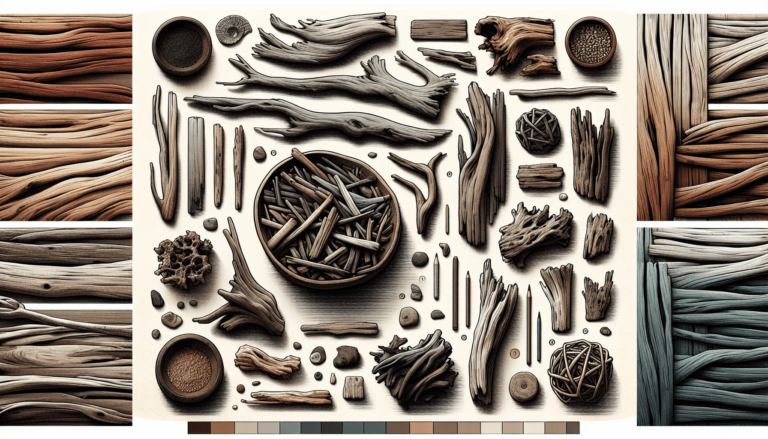
Designers use these “ocean bones” because they offer a texture and silver patina that factory-made materials simply cannot replicate. You might see a thick, sun-bleached branch serving as a continuous handrail on a spiral staircase, or massive, twisted roots used as newel posts for a grand entryway. The goal is to blend the organic, chaotic beauty of the shoreline with the rigid requirements of modern building codes.
Creative applications often involve mixing these natural timbers with contemporary elements. For instance, a heavy driftwood top rail paired with thin stainless steel cable infill creates a “warm industrial” look that preserves your ocean view. Alternatively, fitting driftwood branches between tempered glass panels offers a minimalist aesthetic that feels both modern and deeply rooted in nature.
The Anatomy of Ocean Bones: How to Build It Right
Building with driftwood is not as simple as picking up a stick and nailing it to a post. The process requires a pioneer’s patience and a craftsman’s eye for structural integrity. You must first ensure the wood you’ve harvested is actually durable heartwood and not just a waterlogged piece of rot.
Start by sourcing dense species. Cedar, Redwood, and Cypress are the gold standards for outdoor durability because their natural oils repel insects and decay. If you find a piece of White Oak or Teak that has been tumbled by the waves, you have found a treasure. These woods are naturally “closed-cell,” meaning they resist the deep penetration of moisture better than softer pines.
Preparation is the next critical phase. You must treat the wood to remove salt, microorganisms, and potential pests. A common technique involves a bleach bath—typically a 1-to-9 ratio of bleach to water—where the wood is submerged for several days. After the bath, the wood needs to dry completely. Professionals often use a low-heat kiln or a sunny, well-ventilated area for several weeks. Only when the internal moisture content drops below 12% is the wood stable enough for construction.
Refining the surface is where the character emerges. Use 180-grit to 300-grit sandpaper to remove loose fibers and splinters without erasing the natural bumps and “story” of the wood. For a handrail, the surface must be silky smooth to the touch. Once sanded, apply a high-quality finish. Marine-grade spar varnish is the best choice for exterior railings as it contains UV inhibitors that prevent the sun from turning your silver wood into brittle dust. Indoors, penetrating oils like Odie’s Oil or Linseed oil provide a rich, matte finish that highlights the grain.
Benefits of Choosing Driftwood Over Conventional Materials
The primary advantage of using driftwood is its proven resilience. Unlike kiln-dried lumber that meets the elements for the first time on your job site, driftwood has already survived the harshest environment on earth. The salt has naturally “cured” the fibers, and the sun has already done its worst to the exterior. What remains is the toughest part of the tree.
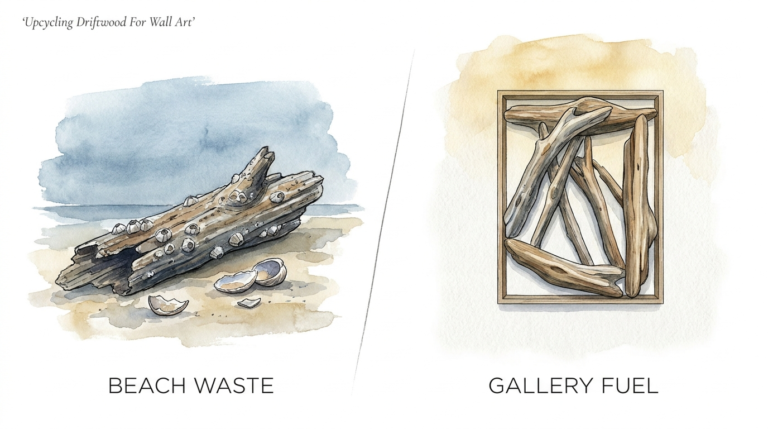
Sustainability is another measurable benefit. Utilizing driftwood is a form of radical upcycling. You are taking a “waste” product delivered by the tide and giving it a secondary life that can last for decades. This reduces the demand for newly harvested timber and eliminates the carbon footprint associated with manufacturing synthetic railing systems or smelting metal.
From an aesthetic standpoint, no two driftwood railings are identical. Every curve, knot, and silver-gray hue is a result of a unique journey across the water. This provides a level of custom luxury that “off-the-shelf” railing kits cannot match. Furthermore, the maintenance cycle for driftwood is often simpler. While painted metal requires sanding and repainting when it inevitably chips and rusts, a well-sealed driftwood rail only needs a light cleaning and an occasional fresh coat of oil to maintain its integrity.
Challenges and Common Pitfalls to Avoid
The most frequent mistake beginners make is ignoring the building code. A handrail is a safety device first and an art piece second. Most residential codes require a handrail to be between 34 and 38 inches high and have a “graspable” diameter of 1.25 to 2 inches. Because driftwood is irregular, finding a piece that meets these dimensions over its entire length can be difficult. If your wood is too thick or too thin, it may look beautiful but fail a safety inspection.
Another challenge is structural attachment. Standard railing brackets are designed for flat, square lumber. When you try to mount a twisted, round branch to a wall, the contact points are minimal. This creates leverage that can rip a bracket out of the stud if not handled correctly. Professionals solve this by “shimming” the back of the wood or using custom-fabricated 316 stainless steel brackets that can accommodate irregular shapes.
Failing to pre-drill is a recipe for disaster. Driftwood is often extremely dry and brittle on the surface. If you drive a screw directly into it, the wood will almost certainly split along the grain lines created by its time at sea. Always use a drill bit slightly smaller than your screw diameter to create a pilot hole, ensuring the screw “bites” into the dense heartwood without fracturing the piece.
Limitations: When Driftwood May Not Be the Best Choice
While driftwood is a hero in coastal environments, it does have constraints. In extremely high-traffic commercial areas, the natural irregularities of the wood can be a liability. People with mobility issues or visual impairments rely on a consistent, predictable handrail. If your driftwood has significant “knuckles” or dramatic bends, it might not provide the continuous support required by the Americans with Disabilities Act (ADA).
Environmental trade-offs also exist. If you live in an area with extreme humidity and zero salt (like a deep forest or swamp), found driftwood may actually be more prone to mold than pressure-treated lumber. The salt in beach-found wood acts as a natural preservative; without it, the porous nature of the wood can soak up fresh water and rot from the inside out.
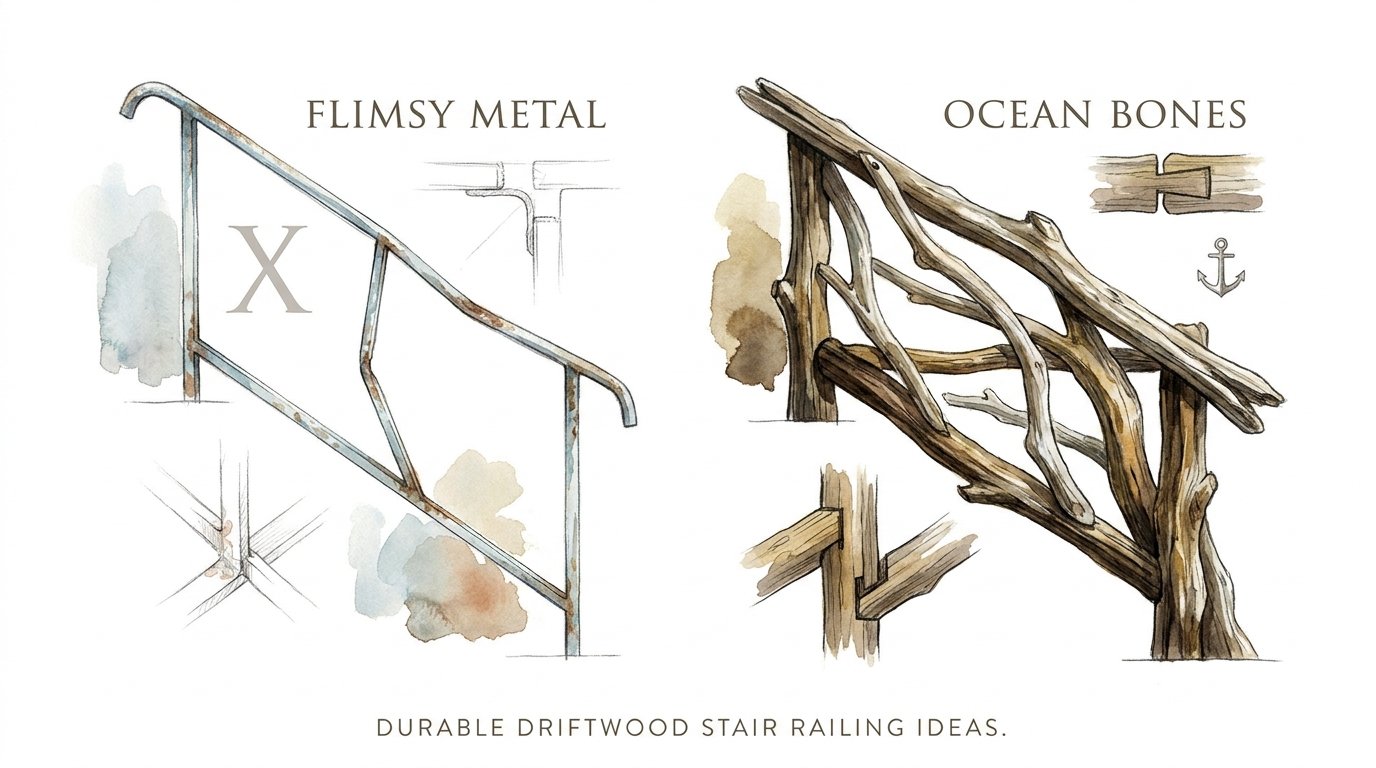
FLIMSY METAL vs. OCEAN BONES
Understanding the measurable differences between standard metal railings and driftwood helps in making a long-term investment.
| Feature | Flimsy Metal (Steel/Iron) | Ocean Bones (Driftwood) |
|---|---|---|
| Coastal Longevity | 3–7 years before visible rust. | 20–40+ years with proper species. |
| Maintenance | Scraping, priming, painting. | Occasional oiling or washing. |
| Installation Difficulty | Low (Modular kits). | High (Custom fitting required). |
| Aesthetic Value | Industrial/Standard. | High-end Sculptural/Unique. |
| Tactile Feel | Cold, gets hot in sun. | Warm, organic, textured. |
Practical Tips for a Successful Driftwood Project
Achieving a professional result requires attention to the small details that big-box stores ignore. Follow these best practices to ensure your railing stands the test of time and tide.
- Use 316 Grade Stainless Steel: Standard screws and brackets will rust in months near the ocean. Only 316 grade (marine grade) stainless steel can withstand the salt air without bleeding “rust tears” down your beautiful silver wood.
- Select “Graspable” Sections: When choosing a branch for a handrail, test the grip with your own hand. It should feel secure and comfortable. If you find a perfect piece that is too thick, consider “thinning” the back side with a drawknife where it meets the wall brackets.
- Anchor Into Solid Blocking: Because driftwood is heavy and the mounting points are specific to the wood’s shape, you cannot rely on simple drywall anchors. You must have solid wood blocking behind the wall or use heavy-duty lag bolts into the framing.
- Seal the Ends: The end grain of the wood is like a bundle of straws. It sucks up moisture faster than any other part. Always apply extra coats of sealer or even a bit of clear epoxy to the cut ends of your driftwood to prevent “end rot.”
Advanced Considerations for Serious Practitioners
For those looking to scale this concept or build for a high-value client, consider the structural engineering of organic shapes. When you use a curved piece of wood as a load-bearing guardrail, you are introducing “eccentric loading.” This means the weight isn’t traveling in a straight line to the floor.
To counter this, practitioners often use hidden steel “spines.” This involves routing a channel into the underside of a large driftwood log and inlaying a flat bar of steel or aluminum. This adds immense rigidity without compromising the natural look. It allows you to use more dramatic, “wibbly-wobbly” pieces of wood while still meeting the 200-pound concentrated load requirement required by the International Building Code (IBC).
Another advanced technique is the “concrete root anchor.” For outdoor garden stairs, some designers use the stump and root system of a weathered tree as the base newel post. They dig a hole below the frost line, treat the underground portion of the wood with a high-build bitumen coating (to prevent rot), and pour a concrete footing around it. This creates an incredibly stable anchor that looks like the railing is growing directly out of the earth.
Real-World Examples and Scenarios
To visualize how these concepts translate into reality, let’s look at a few common scenarios where driftwood outperforms every other material.
Scenario 1: The Storm-Prone Beach Deck
In a location where hurricanes or “King Tides” are common, a standard wood railing is often ripped apart by the force of the water. A homeowner in the Outer Banks replaced their traditional balusters with “woven” driftwood branches, anchored with heavy spikes and marine epoxy. During the next surge, the irregular shapes and gaps allowed the water to flow *through* the railing rather than acting like a sail. The railing remained standing while the neighbors’ solid-panel systems were destroyed.
Scenario 2: The Modern Minimalist Interior
In a San Francisco loft, a designer wanted to soften the “cold” feeling of concrete floors and glass walls. They installed a single 12-foot piece of sun-bleached ghost cedar as a floating handrail, mounted on hidden black steel brackets. The silver-gray wood provided a tactile, warm element that contrasted perfectly with the glass, proving that driftwood can be just as sophisticated as it is rustic.
Final Thoughts
Building with driftwood is a commitment to the long game. It requires you to step away from the convenience of pre-packaged lumber and enter into a partnership with the elements. By choosing “ocean bones” over flimsy metal, you are investing in a material that has already proven its worth in the most unforgiving conditions on the planet.
These railings do more than just prevent a fall; they tell a story of resilience and survival. Whether you are building a simple handrail for a garden path or a complex guardrail for a coastal balcony, remember that the most durable solutions are often those that have already been tested by the sea.
As you begin your project, don’t be afraid of the knots, the bends, or the scars in the wood. Those are the marks of a survivor. Experiment with different species and hardware combinations, but always keep safety and code compliance at the forefront. With the right preparation and a bit of pioneer grit, your driftwood railing will serve as a permanent, beautiful anchor for your home for generations to come.
Sources
1 oceanstairrails.com (https://www.oceanstairrails.com/post/discovering-the-best-stair-railing-for-your-beach-house) | 2 trendir.com (https://www.trendir.com/driftwood-in-home-decor-ideas/) | 3 growcycle.com (https://growcycle.com/learn/stylish-stair-railing-ideas-to-upgrade-your-homes-look-and-safety) | 4 specializedstairs.com (https://specializedstairs.com/top-10-modern-glass-railing-inspirations/) | 5 coco-papaya.com (https://www.coco-papaya.com/en/blog/ethnic-decoration-handicrafts-from-around-the-world/driftwood-decoration-a-unique-and-natural-choice-to-beautify-your-interior) | 6 decks-docks.com (https://www.decks-docks.com/deck-railing-ideas) | 7 decks.com (https://www.decks.com/resource-index/railing/cable-deck-railing-ideas/) | 8 villohome.com (https://villohome.com/products/driftwood-handrail-9-16-ft-stair-rail) | 9 etsy.com (https://www.etsy.com/nz/listing/666920616/rustic-driftwood-stair-rail-branch) | 10 freerangingdesigns.com (https://freerangingdesigns.com/products/driftwood-handrail-banister) | 11 stubbseng.com (https://www.stubbseng.com/articles/guardrail-handrail-design-ibc-2021)