Driftwood Corner Decor Ideas
Your room feels small because it is full of fragments; one massive piece of the ocean’s architecture can turn visual noise into a sanctuary. Stop trying to ‘decorate’ your beach house with ten tiny things from a big-box store. One strategic, massive piece of driftwood can replace your coat rack, hide your cables, and ground your entire room’s energy. It’s not just wood; it’s the architecture of order.
[affiai]When you walk into a room, your eyes search for a place to land. If you have filled your corners with small frames, plastic shells, and flickering candles, your eyes never rest. You are creating a nervous environment that lacks the weight of the natural world. A single, weathered beam of cedar or a gnarled root of manzanita provides the visual gravity needed to transform a house into a home.
This guide is for those who are tired of the flimsy and the temporary. We are going to look at how to source, treat, and install massive driftwood anchors that serve as the structural backbone of your interior design. Whether you are living in a coastal cottage or a city apartment, the principles of pioneer grit apply: find what is solid, treat it with respect, and let it stand as a witness to the passage of time.
Driftwood Corner Decor Ideas
Driftwood corner decor ideas often fail because people think too small. A corner is not just a gap between two walls; it is a structural opportunity to create height and depth. Instead of a standard floor lamp, imagine a seven-foot vertical branch of ghostwood that has been wired internally to glow from within its own hollow core.
In real-world situations, corners are often dead zones where dust and cables accumulate. A massive piece of driftwood can act as a natural conduit, hiding the ugly necessities of modern life behind the silver-grey patina of sea-worn timber. You can use these pieces as corner-spanning shelves, vertical plant stands, or even as a singular, floor-to-ceiling sculptural column.
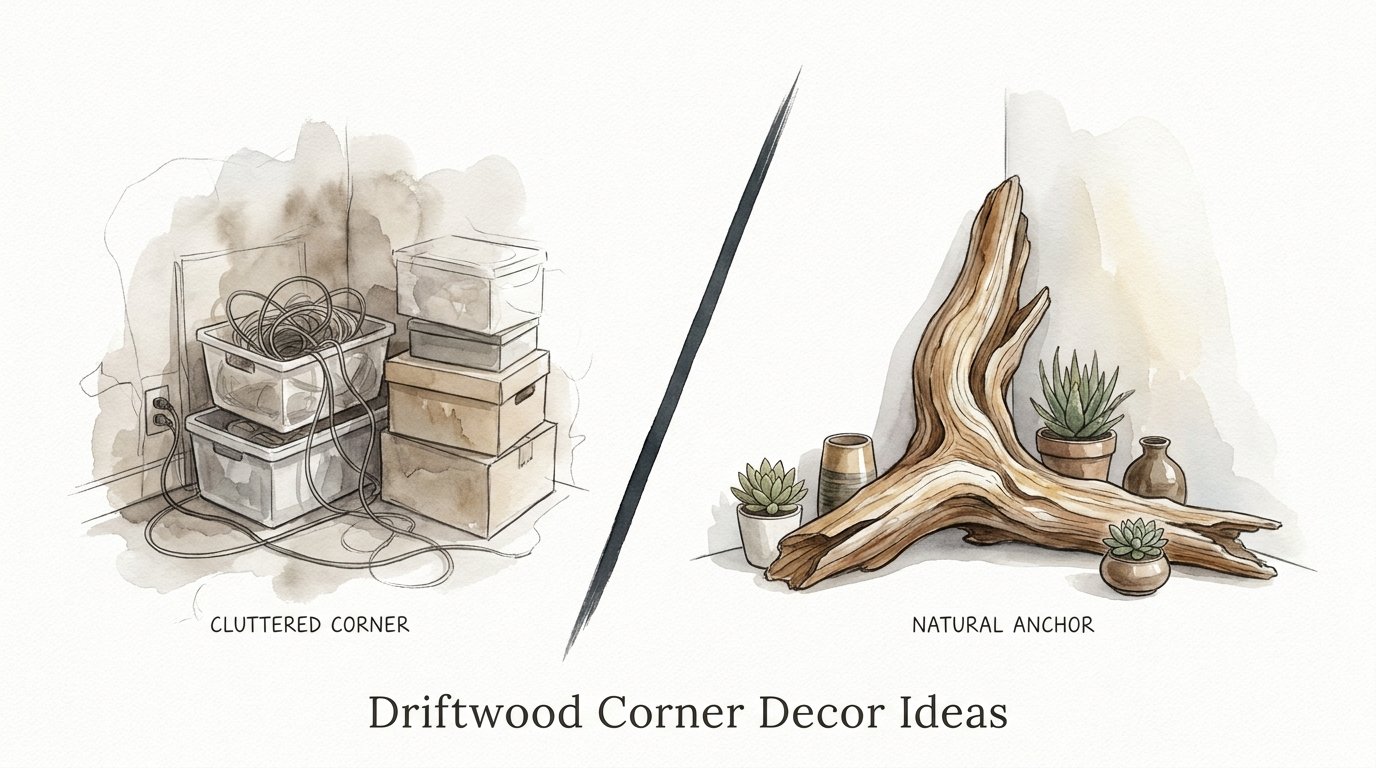
The goal is to replace the “Cluttered Corner” with a “Natural Anchor.” This transition moves your home away from a “beach-themed” look and toward a “coastal-inspired” architecture. One large, authentic piece of wood from the Pacific or the Atlantic tells a story of survival and resilience that a mass-produced resin sculpture simply cannot match.
The Process of Preparing Massive Driftwood
You cannot simply drag a log off the beach and lean it against your white drywall. Raw driftwood is a living ecosystem of salt, sand, and microorganisms that will eventually damage your home if not properly cured. The first step in any serious driftwood project is the cleaning and preservation phase.
Start by scrubbing the piece with a stiff-bristled brush to remove loose bark, dried mud, and salt crust. For large pieces that won’t fit in a bathtub, you will need a garden pump sprayer and a solution of one part bleach to ten parts water. Spray the wood thoroughly and let it sit for at least thirty minutes to kill any bacteria or wood-boring insects.
Rinse the wood with fresh water and move it to a shaded, well-ventilated area to dry. Patience is the hallmark of the pioneer spirit; a massive log can take weeks or even months to dry completely to the core. Rushing this process leads to internal rot and future cracking, so let the air do the work it was meant to do.
How to Install Heavy Driftwood Safely
Mounting a twenty-pound or fifty-pound piece of wood to a vertical surface requires more than just a nail and a prayer. You must find the studs in your wall using a reliable stud finder. Screwing directly into the studs ensures that your driftwood remains a permanent fixture of the room rather than a falling hazard.
For pieces that are relatively flat on one side, a French cleat system is the most secure method. This involves mounting one bracket to the wood and a corresponding bracket to the wall, allowing the wood to “lock” into place. If the wood is gnarled and irregular, you may need to drill through the wood itself, using long lag screws to pull the piece tight against the wall.
To hide your mounting hardware, save the sawdust from the holes you drill. Mix this sawdust with a bit of wood glue to create a custom paste that matches the color of your driftwood exactly. Fill the screw holes with this paste, let it dry, and the hardware will disappear into the natural texture of the timber.
Benefits of Using Singular Natural Anchors
The most measurable benefit of a single massive anchor is the reduction of visual clutter. When you replace a dozen small objects with one significant piece, the room immediately feels larger and more intentional. This approach simplifies your cleaning routine while increasing the “wow factor” for anyone entering the space.
From a psychological perspective, natural textures like weathered wood have a grounding effect. The irregular patterns of the grain and the soft, neutral colors of sun-bleached timber reduce stress and create a sense of permanence. Unlike plastic or metal, driftwood has a history of surviving the elements, and that resilience is felt in the room.
Furthermore, driftwood is an environmentally responsible choice for those who harvest it legally or buy from sustainable sources. You are repurposing a natural byproduct of the tides rather than supporting the manufacturing of new furniture. It is a way to bridge the gap between the outdoors and your sanctuary.
Challenges and Common Mistakes
The most common mistake beginners make is failing to account for the weight and leverage of a large branch. If you lean a heavy piece of wood against a corner without securing it at the top, it can slide and damage your flooring or, worse, injure someone. Always use a hidden tether or a small “L” bracket at the top of vertical pieces to prevent tipping.
Another pitfall is over-sanding the wood. People often want the wood to feel like a piece of polished furniture, but over-sanding removes the very character that makes driftwood special. Use 180-grit sandpaper only on the sharpest edges or where you might catch a sleeve, but leave the weathered “skin” of the wood intact.
Finally, ignore the impulse to use high-gloss polyurethane. A shiny finish makes authentic driftwood look like cheap plastic. To protect the wood while maintaining its natural matte appearance, use a clear wax or a light application of Tung oil, which soaks into the fibers rather than sitting on top of them.
Limitations of Driftwood in Home Decor
There are realistic constraints to using driftwood, particularly in humid environments. If your home has poor ventilation or high moisture levels, even treated driftwood can develop mildew or mold. This is why it is often best to avoid placing massive driftwood anchors in small, unventilated bathrooms where steam can penetrate the wood daily.
Environmental limitations also include the legalities of collection. In many states and countries, it is illegal to remove driftwood from certain beaches because it provides vital habitat for local wildlife and helps prevent coastal erosion. Always check your local regulations before heading out with a truck, or buy from a reputable dealer who can prove the wood was harvested ethically.
Finally, the scale of the wood must match the scale of the room’s structural integrity. If you live in an old home with crumbling plaster walls, you cannot mount a heavy cedar root without first reinforcing the wall itself. The wood might be timeless, but your drywall has a weight limit.
Comparison: Sourcing Your Corner Decor
Choosing the right type of wood determines the longevity and the aesthetic “weight” of your corner anchor. While any wood found on the shore can be used, certain species are prized for their density and unique shapes.
| Wood Type | Visual Character | Density & Weight | Primary Use |
|---|---|---|---|
| Manzanita (Ghostwood) | Gnarled, spindly, light grey | High / Heavy | Vertical corner accents, lighting bases |
| Mopani | Dual-toned, chunky, dark browns | Very High / Sinks in water | Ground-level anchors, low shelving |
| Pacific Cedar | Long, straight, silver-grey | Medium / Light | Floor-to-ceiling columns, wall panels |
| River Driftwood | Smooth, rounded, tan colors | Low / Varies | Small shelving, organic hangers |
Practical Tips for Longevity and Maintenance
Once your driftwood is installed, it requires very little maintenance, but you should still check it annually for signs of pests or moisture. Dusting should be done with a soft-bristled vacuum attachment rather than a cloth, as the rough surface of the wood will snag and tear fabric.
If the wood begins to look “thirsty” or starts to lose its silver luster, do not reach for a bottle of chemical furniture polish. A light application of beeswax can restore the depth of the grain without adding an artificial shine. Rub the wax into the wood with your hands; the heat from your palms will help the wax penetrate the fibers.
To prevent the wood from drying out and cracking in desert climates, you can use a humidifier in the room. While driftwood is already “dead,” rapid changes in humidity can cause large logs to split with a loud “crack” as the internal tension is released. Maintaining a stable environment will keep your anchor intact for generations.
Advanced Considerations for Interior Architecture
For the serious practitioner, driftwood is not just decor; it is a structural element. You can integrate LED light strips into the natural fissures of a large branch to create “shadow art” on your walls at night. This technique turns the wood into a light fixture that defines the mood of the entire room.
Think about the “negative space” created by gnarled branches. You can use these gaps to hold air plants, hand-blown glass orbs, or even a collection of vintage compasses. The wood acts as a curator, organizing your smaller treasures into a single, cohesive narrative.
In high-end coastal design, some architects are now using massive driftwood logs as non-structural room dividers. By tension-mounting three or four large trunks in a row, you can define a dining area without building a permanent wall. This maintains the “breezy” feel of an open floor plan while providing the intimacy of a separate room.
Example Scenario: The Living Room Transformation
Imagine a standard 12×12 corner in a coastal living room. Most people would put a corner chair there that nobody sits in, topped with a throw pillow. Instead, let’s look at the “Anchor Approach.”
The designer finds a seven-foot piece of sandblasted manzanita with a wide, stable base. They treat the wood with borax and let it sun-dry for a week. They then mount the piece vertically in the corner, securing it to a wall stud at the five-foot mark with a hidden lag bolt.
Three small, flat pieces of slate are then epoxied into the natural “forks” of the branches to serve as tiny shelves for a single book and a glass of water. A warm-toned spotlight is placed on the floor behind the wood, casting massive, gnarled shadows across the ceiling. The corner is no longer a dead space; it is the most interesting part of the house.
Final Thoughts
Transforming your home with massive driftwood is about more than just aesthetics. It is a commitment to a slower, more deliberate way of living that values the integrity of the natural world over the convenience of modern manufacturing. By choosing one significant anchor over a sea of fragments, you create a space that feels grounded, permanent, and peaceful.
The process of finding, treating, and installing these pieces requires effort and patience—qualities that are often missing from modern interior design. However, the result is a home that feels like it was grown rather than assembled. It is a sanctuary that reflects the rugged beauty of the coastline and the grit of those who choose to live alongside it.
Do not be afraid of the weight or the scale of these pieces. Embrace the challenge of working with a material that refuses to be uniform. Your home will thank you for the order, and your mind will thank you for the silence that only a natural anchor can provide. Keep searching the shorelines, and when you find that one piece that feels right, bring it home and let it stand.
Sources
1 waterviewsfromhome.com (https://waterviewsfromhome.com/coastal-living-room-decor-mistakes-to-avoid/) | 2 thefurnituremarket.co.uk (https://www.thefurnituremarket.co.uk/blog/how-to-use-driftwood-in-your-home-interior) | 3 innerunionhome.com (https://innerunionhome.com/blogs/news/a-guide-to-coastal-home-decor-making-your-home-calm-like-the-seaside) | 4 youtube.com (https://www.youtube.com/watch?v=ZaB93Z_pPME) | 5 decorilla.com (https://www.decorilla.com/online-decorating/coastal-interior-design/) | 6 thecoolist.com (https://www.thecoolist.com/driftwood-decor-ideas-for-home/) | 7 parklanejewelry.com (https://www2.parklanejewelry.com/how-to-wash-driftwood/) | 8 danslelakehouse.com (https://danslelakehouse.com/2020/12/diy-driftwood-wall-hanging.html) | 9 reddit.com (https://www.reddit.com/r/Aquariums/comments/1d8ljpc/whats_your_favorite_wood/) | 10 coohom.com (https://www.coohom.com/article/large-driftwood-wall-decor) | 11 oceanhomemag.com (https://www.oceanhomemag.com/home-design/driftwood-decor/) | 12 coco-papaya.com (https://www.coco-papaya.com/en/blog/ethnic-decoration-handicrafts-from-around-the-world/driftwood-decoration-a-unique-and-natural-choice-to-beautify-your-interior) | 13 homestyler.com (https://www.homestyler.com/article/creative-driftwood-decor) | 14 bellacozehome.com (https://bellacozehome.com/coastal-interior-design/coastal-home-feel-collected-instead-of-decorated/)