Diy Driftwood Fireplace Mantel Ideas
Your fireplace is the heart of your home—does it have a plastic beat? Modern mantels are just boxes of air painted to look like wood. They have no soul and no weight. Our ancestors built around solid timber because it held the energy of the earth. I reclaimed this beam from the tide to give my fireplace a real pulse. It’s not a decoration; it’s an anchor.
[affiai]Bringing a piece of the coast or the riverbank into your living room is more than a weekend project. It is an act of reclamation. When you choose to work with driftwood, you are choosing a material that has been refined by the most powerful forces on the planet: water, sun, and time. This guide will show you how to find, prep, and install a piece of history above your hearth.
Diy Driftwood Fireplace Mantel Ideas
DIY driftwood fireplace mantel ideas represent a return to authentic, organic home design. Unlike factory-made shelves, a driftwood mantel is a single, solid piece of timber that has survived years of exposure to the elements. These pieces are often found along shorelines, riverbanks, or lake edges, where the current has stripped away the bark and smoothed the grain into unique, sculptural forms.
In the real world, these mantels serve as a bridge between the wild outdoors and the structured interior of a home. They are used in coastal cottages to reflect the surrounding sea, in mountain cabins to echo the rugged forest, and in modern minimalist homes to provide a necessary, grounding contrast to clean lines and cold surfaces. Every knot, crack, and silvered ridge tells a story of a tree that stood, fell, and traveled miles before finding its way to your fireplace.
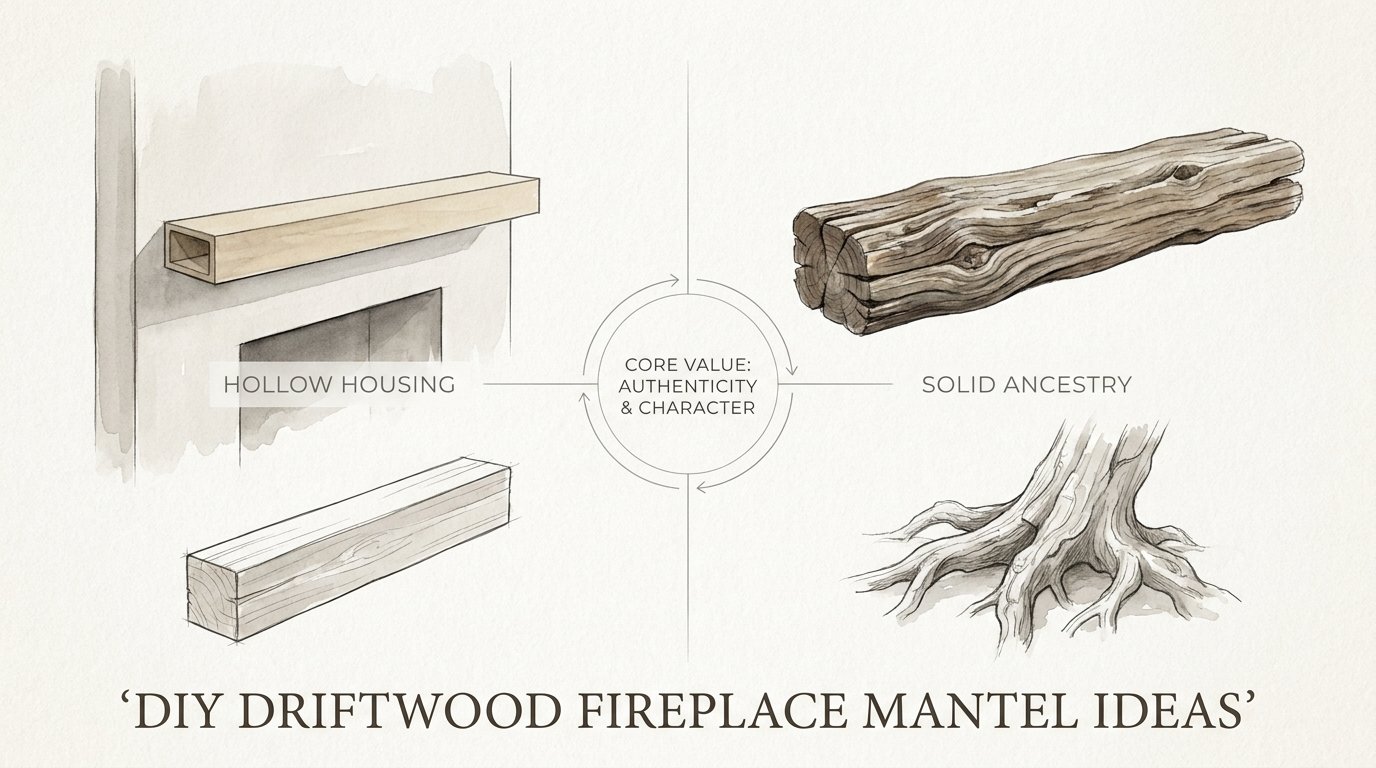
Think of a driftwood mantel as a functional piece of art. It isn’t just a shelf for photographs; it is a thermal mass that absorbs and radiates the warmth of your fire. While hollow box mantels—often referred to as “hollow housing”—mimic the look of wood, they lack the “solid ancestry” of a true timber beam. A solid driftwood beam offers a density and character that cannot be replicated in a workshop.
How to Select and Prepare Your Driftwood
The journey of a driftwood mantel begins with the search. Not every log you find on a beach is fit for the hearth. You must look for wood that is structurally sound and aesthetically compelling.
Finding the Right Timber
Search for hardwoods like oak, maple, or dense evergreens like cedar and cypress. These species hold up best against the heat of a fireplace and the weight of mantel decor. Avoid wood that feels “spongy” or light when dry, as this indicates advanced rot. The ideal piece should feel heavy for its size, suggesting a dense core that has resisted the decay of the water.
Legal and Ethical Collection
Check local regulations before you haul a log off the beach. States like Michigan and Oregon have strict rules about removing “dead and downed” wood from public lands to protect coastal ecosystems from erosion. In California, you may be limited to a specific weight per day. Always seek permission on private property. Respecting the land is part of the pioneer spirit; we take only what is truly abandoned.
The Cleaning Protocol
Once you bring your prize home, you must purge it of the “critters” and salt it collected in the wild. Start by pressure washing the beam to remove sand, loose bark, and hitchhiking insects. For a deeper clean, soak the wood in a solution of one part bleach to nine parts water for at least 24 hours. This kills mold spores and bacteria that could otherwise bloom in the warmth of your living room.
Drying and Stabilizing
Driftwood is often waterlogged. You cannot mount a wet beam; it will warp, crack, or even rot against your wall. Air-drying is the best method, though it requires patience. Place the wood in a well-ventilated, low-humidity area for several months. If you are in a rush, a kiln or a very low-heat oven can work for smaller pieces, but be careful—excessive heat can cause deep, structural “checking” or cracks.
How to Install a Heavy Driftwood Mantel
Installing a solid timber beam requires more than a few nails. You are hanging a significant weight, often between 50 and 100 pounds, above an active heat source. Safety and stability are paramount.
Standard Clearances (NFPA 211)
Before you drill a single hole, consult the National Fire Protection Association (NFPA) 211 standards. As a general rule, combustible materials like wood must be at least 12 inches above the firebox opening. If your mantel is particularly deep (over 6 inches), you may need even more clearance. This prevents the wood from “pyrolyzing”—a process where wood chemically changes due to repeated heat exposure until it can ignite at much lower temperatures.
The Lag Bolt Method
For a truly secure “floating” look on a stud wall, the lag bolt method is the gold standard. Locate the studs behind your drywall using a high-quality sensor. Drill 1/2-inch holes through the drywall and deep into the center of the studs. Insert long lag bolts, then cut off the heads, leaving 4 to 6 inches of the bolt protruding from the wall.
Match these bolt locations on the back of your driftwood beam. Drill corresponding holes into the wood. After applying a generous amount of construction adhesive to the back of the beam and the bolts, slide the mantel onto the rods. This creates a hidden, incredibly strong support system that can handle the weight of solid ancestry.
Masonry and Brick Anchors
If you are mounting to a stone or brick fireplace, you will need a hammer drill and masonry anchors. Drill into the mortar joints rather than the brick itself to prevent cracking. Use expansion bolts or lead anchors that are rated for at least twice the weight of your beam. For irregular stone surfaces, you may need to “scribe” the back of the wood so it sits flush against the uneven rock.
Benefits of a Solid Driftwood Mantel
Choosing a solid driftwood beam over a hollow alternative offers several practical and aesthetic advantages.
* Unmatched Durability: Solid timber does not dent or peel like veneer. It is a lifetime investment that grows more beautiful as it ages and reacts to the light in your home.
* Natural Thermal Mass: Unlike hollow mantels that can trap heat and potentially scorch, a solid beam acts as a heat sink, absorbing the warmth and releasing it slowly back into the room.
* One-of-a-Kind Geometry: No two pieces of driftwood are identical. The water-carved shapes provide a “organic” focal point that factory-produced items simply cannot match.
* Environmental Sustainability: Using driftwood is the ultimate form of upcycling. You are taking a piece of “waste” from the environment and giving it a second life, reducing the demand for new lumber.
Challenges and Common Mistakes
Working with raw nature isn’t always easy. Beginners often stumble on a few key areas that can ruin a project.
Mistake 1: Ignoring the Salt Content
Saltwater driftwood is saturated with minerals. If you don’t wash it thoroughly, these salts will leach out over time, ruining your paint or causing metal fasteners to corrode. Always use galvanized or stainless steel hardware to prevent “bleeding” or rust streaks on your wall.
Mistake 2: Mounting Too Early
If the wood is not completely dry to the core, it will shrink once it is installed in your climate-controlled home. This can lead to the beam pulling away from the wall or developing large, unsightly gaps. Use a moisture meter; the wood should be below 10-12% moisture before installation.
Mistake 3: Underestimating the Weight
A 6-foot solid oak driftwood beam is incredibly heavy. Using simple drywall anchors is a recipe for disaster. If you cannot find a stud or a solid masonry point, you must open the wall and install horizontal blocking between the studs to provide a sufficient mounting surface.
Limitations: When Driftwood May Not Work
While beautiful, driftwood is not the right choice for every fireplace.
If you have a modern, high-BTU gas insert with very tight clearance requirements, a thick wood beam might be prohibited by the manufacturer’s manual. Some contemporary fireplaces require non-combustible mantels (like stone or metal) because of the sheer intensity of the rising heat. Always check your fireplace’s specific manual before installing a wood mantel.
Additionally, driftwood may not be ideal in extremely humid environments where the wood can never truly stabilize. In these cases, the wood may continue to “move,” leading to cracks in the surrounding plaster or tile work.
Comparison: Solid Driftwood vs. Hollow Box Mantels
| Feature | Solid Driftwood | Hollow Box Mantel |
|---|---|---|
| Weight | High (50-150 lbs) | Low (10-30 lbs) |
| Installation | Complex (Lag bolts/studs) | Simple (Cleats/screws) |
| Authenticity | Genuine heritage timber | Mimicked appearance |
| Durability | Extremely High | Moderate to Low |
| Heat Resistance | Excellent (Solid mass) | Fair (Air pocket risk) |
Practical Tips for a Better Finish
* The “Oil and Wax” Rule: Avoid heavy, glossy polyurethanes. They make driftwood look like plastic. Instead, use a penetrating oil like Tung oil or a high-quality beeswax. This preserves the tactile, “toothy” feel of the wood while protecting it from dust.
* Sanding with Restraint: Do not sand away the character. Use a higher grit sandpaper (220+) to just take the “splinter” off the edges. You want to keep the grey patina and the water-carved ridges.
* Epoxy Reinforcement: If your beam has a beautiful crack that compromises its strength, fill it with a clear or black-tinted epoxy. This stabilizes the wood while highlighting the natural “flaw” as a design feature.
Advanced Considerations: Scribing to the Wall
For the serious practitioner, a “perfect fit” against a stone or brick wall is the hallmark of craftsmanship. This is done through a process called scribing.
Hold your mantel up to the wall (this usually requires a second set of hands). Use a compass with a pencil. Place the point of the compass against the irregular wall and the pencil against the back of the wood. Drag the compass along the wall, tracing the bumps and dips onto the wood. You then use a jigsaw or a power plane to carve away the wood along that line. The result is a mantel that looks like it grew directly out of the stone.
A Scenario in Practice: The Coastal Transformation
Imagine a home on the coast of Maine. The owners found a 7-foot piece of weather-beaten cedar after a winter storm. They spent the spring cleaning and drying it in their barn. When fall arrived, they mounted the beam above their fieldstone fireplace using hidden 3/4-inch steel rods anchored into the masonry.
The silver-grey of the cedar perfectly matched the ocean outside the window. Unlike the previous white-painted box mantel, this solid beam didn’t just sit on the wall; it anchored the room. It became the place where they set their morning coffee, the wood absorbing the heat from the hearth below and staying warm to the touch long after the fire died down.
Final Thoughts
Your fireplace deserves the weight of history. Moving away from the “plastic beat” of modern construction means embracing the imperfections and the gravity of real materials. A driftwood mantel is a commitment to quality and a nod to the ancestors who knew that a home is only as strong as its anchor.
Building your own mantel from a piece of reclaimed timber is a challenging but deeply rewarding process. It requires you to work with your hands, respect the laws of fire safety, and listen to the character of the wood. The result is a focal point that will outlast any trend.
Take the time to find the right piece. Prep it with care. Mount it with the strength it deserves. When you finally sit down in front of your first fire with that beam overhead, you will feel the difference. You won’t just be looking at a shelf; you’ll be sitting in the presence of the earth’s own history.
Sources
1 cornell.edu (https://www.law.cornell.edu/regulations/california/14-CCR-4306) | 2 99wfmk.com (https://99wfmk.com/michigan-driftwood-collection-rules/) | 3 diydriftwood.com (https://diydriftwood.com/how-to-clean-driftwood/) | 4 hawk-hill.com (https://www.hawk-hill.com/how-to-clean-driftwood/) | 5 hackrea.net (https://www.hackrea.net/stories/fireplace-mantel-height/) | 6 evermark-lnl.com (https://www.evermark-lnl.com/wp-content/uploads/2021/10/EVERMARK-MANTEL-INSTALLATION-GUIDE.pdf) | 7 mantelsdirect.com (https://www.mantelsdirect.com/blogs/news/fireplace-mantel-clearance-requirements-gas-electric-woodburning) | 8 mrtimbers.com (https://mrtimbers.com/diy-heavy-wood-mantel-install/) | 9 mantelsdirect.com (https://www.mantelsdirect.com/blogs/news/how-fireplace-mantels-are-attached-installation-methods-by-surface-type) | 10 tableandhearth.com (https://tableandhearth.com/driftwood-diy-fireplace-cover/)