Versatile Driftwood Shelving Systems
If your furniture only does one job, it’s taking more than it’s giving. I used to have a coat rack, a key bowl, a book ledge, and a plant stand cluttering my entryway. Then I found one piece of ocean-hewn architecture that did it all. Nature doesn’t design in flat planes; it designs in systems. This driftwood shelf doesn’t just hold my things; it organizes my entire morning routine through its own natural geometry.
[affiai]Working with driftwood requires a certain kind of grit. You aren’t just buying a plank from a big-box store and slapping it on a bracket. You are reclaiming a piece of history that has been cured by salt, sun, and tide. It is a material that has already survived the worst the world could throw at it. When you bring that into your home, you aren’t just adding a shelf; you are anchoring your space with a functional relic.
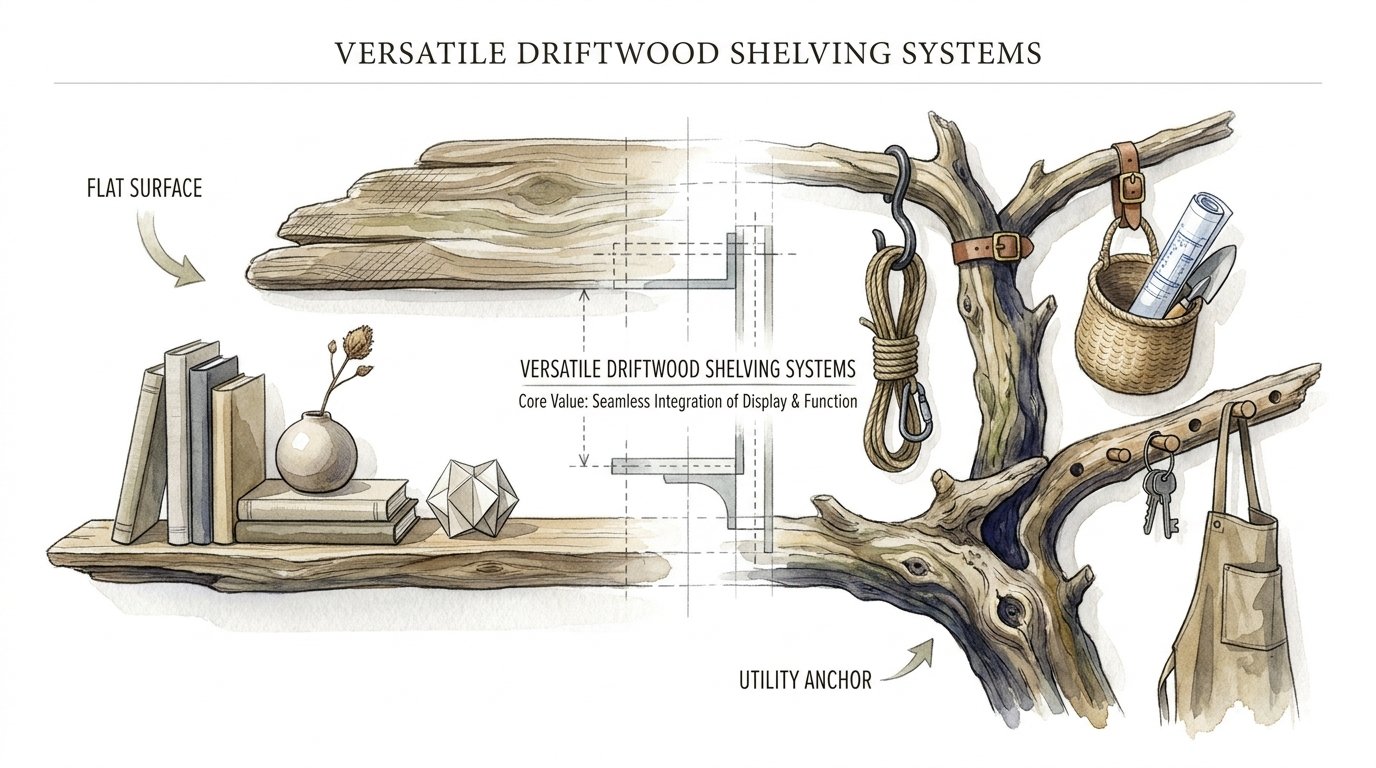
The transition from a cluttered room to a streamlined system happens when you stop looking for a flat surface and start looking for a utility anchor. A traditional shelf is passive. A driftwood system is active. Its branches become natural hooks, its hollows become bowls for your keys, and its grain tells a story that no factory-pressed MDF ever could.
Versatile Driftwood Shelving Systems
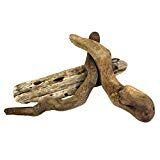
A versatile driftwood shelving system is a storage solution that utilizes naturally weathered wood—sourced from oceans, rivers, or lakes—as the primary structural and aesthetic component. Unlike standard lumber, driftwood has undergone a natural “durability assembly line,” where water exposure and UV rays have stripped away bark and soft sapwood, leaving behind a resilient, often gnarled heartwood.
These systems exist because they bridge the gap between raw nature and modern utility. In a real-world entryway, a single piece of driftwood can serve as a “Utility Anchor.” While a standard flat shelf only offers a horizontal plane, the irregular geometry of driftwood provides multiple points of interaction. A protruding knot becomes a place to hang a heavy winter coat; a deep weather-check in the grain becomes a slot for outgoing mail.
You will find these systems in coastal homes where the environment demands materials that won’t warp in the salt air, but they are equally at home in urban lofts. They provide a necessary counterpoint to the “sterile perfection” of modern interior design. In these spaces, the driftwood acts as a system of organization that feels organic rather than enforced.
Sourcing and Preparing Your Timber
The first step in building a driftwood system is the hunt. You cannot simply take any log you find on the beach. Legalities vary wildly; for instance, the UK Coast Protection Act protects certain natural materials to prevent erosion, though driftwood is often fair game if it isn’t part of a sea defense. In the United States, collecting from National Parks is generally a federal offense, whereas public BLM land or private beaches (with permission) are usually viable.
Once you have secured a piece, you must address the hidden residents. Driftwood is a sanctuary for sand gnats, borers, and salt crystals. If you bring it inside untreated, the salt will pull moisture from the air and “weep” onto your walls, and the bugs will find their way into your floorboards.
The cleaning process is non-negotiable. Start with a stiff nylon brush to remove loose sand and rot. Next, submerge the wood in a solution of one part household bleach to ten parts water. A large trough or even a temporary plastic-lined pit in the yard works best for oversized pieces. Soak the wood for at least 24 to 48 hours to ensure the solution penetrates the deep crevices. This kills bacteria and leaches out the excess salt.
After the bath, the wood must be dried. This is the hardest part for the impatient. A large log can take months to air dry, but you can speed the process in a low-heat kiln or a home oven set to its lowest possible temperature (around 110°F or 43°C) for several hours. You are looking for a moisture content below 10% to ensure the wood won’t shift or crack once it is mounted to your temperature-controlled walls.
How to Engineer the Installation
Mounting a heavy, irregular piece of wood is an exercise in physics. You aren’t dealing with a uniform weight distribution. A driftwood shelf might be six inches deep on one end and two feet deep on the other, creating a massive rotational force (torque) on your fasteners.
The most reliable method for a heavy-duty driftwood system is the French cleat. This involves cutting a 45-degree angle into a piece of sturdy 3/4-inch Baltic birch plywood. One half is secured to the wall studs using structural lag screws; the other half is recessed into the back of the driftwood. This creates a “gravity lock” that distributes the weight across multiple studs.
The Structural Checklist
- Locate Studs: Never rely on drywall anchors for driftwood. Use a magnetic stud finder to locate the center of your 2×4 or 2×6 framing.
- Choose Your Screws: Standard wood screws are too brittle. Use structural screws like Simpson SDS or GRK Rugged Structural Screws. They offer high shear strength and won’t snap under the shifting weight of the wood.
- Leveling the Irregular: Since the wood isn’t flat, you must “scribe” the back of the piece to the wall or use spacers. A shelf that looks level but isn’t flush against the wall will eventually pull its fasteners loose.
- The Cantilever Test: Once mounted, apply a downward force equal to double the intended load. If there is any “bounce” or deflection in the wall, you need additional support, such as a hidden steel bracket or a decorative rope suspension tied to a ceiling joist.
Benefits of Driftwood Systems
The primary advantage of driftwood is its unmatched durability. Having survived years of “weathering,” the wood has already done all the shrinking and expanding it is ever going to do. Once properly dried and sealed, it is incredibly stable. Unlike new pine, which might twist as your HVAC system dries out the house, driftwood stays exactly where you put it.
There is also the aesthetic of “Wabi-Sabi”—the Japanese philosophy of finding beauty in the imperfect and the transient. A driftwood shelf doesn’t show scratches or dings because its surface is already a map of scars. In a household with kids or heavy use, this is a massive practical benefit. You don’t have to worry about a coaster; the wood has already survived the Atlantic.
From a sustainability standpoint, you are utilizing “waste” material. Every piece of driftwood used is a tree that doesn’t have to be harvested from a forest. It is the ultimate form of upcycling, turning a navigational hazard into a structural asset.
Challenges and Common Mistakes
The most frequent error is underestimating the weight. A water-logged piece of oak driftwood can weigh upwards of 100 pounds. Even when dry, the density of certain species remains high. Beginners often try to use “floating shelf” rods, but unless those rods are bored deep into the heartwood with surgical precision, the shelf will sag.
Another common pitfall is the “Salt Bloom.” If you skip the fresh-water soaking phase, the salt trapped in the wood fibers will eventually migrate to the surface as white, crusty spots. This isn’t just ugly; the salt is hygroscopic, meaning it will pull moisture into the wood, potentially causing mold growth behind the shelf where air circulation is poor.
Finally, ignore the “Sanding Trap.” People often want to sand driftwood until it is as smooth as a dining table. In doing so, you strip away the “silvering”—the naturally bleached patina that gives the wood its character. Use fine-grit sandpaper (220 or higher) only on the contact surfaces where you will actually be placing items, leaving the rest of the architecture in its raw, weathered state.
Limitations: When This Isn’t the Right Choice
Driftwood shelving is not a universal solution. If your home is built with light-gauge steel studs or thin plaster-and-lath walls without a solid backing, mounting heavy driftwood can be dangerous. The weight and leverage of a deep shelf can literally pull the studs out of alignment.
Environmental constraints also play a role. In extremely humid environments, like a bathroom without a proper exhaust fan, the porous nature of driftwood can make it a magnet for mildew, especially if it hasn’t been sealed with a high-quality marine-grade finish.
Furthermore, if you require a perfectly flat, level surface for a collection of delicate glassware, driftwood might be more trouble than it’s worth. While you can plane the top of a piece of driftwood, you often lose the very aesthetic that made you choose it in the first place. In these cases, a “Live Edge” slab might be a better middle ground.
Comparison: Driftwood vs. Reclaimed Wood
Understanding the difference between these two popular “rustic” choices is essential for choosing the right system for your needs.
| Feature | Driftwood System | Reclaimed Barn Wood |
|---|---|---|
| Surface Texture | Smooth, rounded, sculptural. | Rough-hewn, splintery, linear. |
| Density | Highly variable; often lower. | High; often old-growth timber. |
| Complexity | High (irregular mounting). | Moderate (standard dimensions). |
| Cost | Free (if found) to expensive. | Consistently expensive. |
Practical Tips and Best Practices
If you want your driftwood shelf to last a century, you must treat it with respect. Apply a finish that preserves the natural look without making it look “plastic.” A simple mixture of beeswax and mineral oil is often enough to deepen the color and provide a water-resistant barrier. Avoid high-gloss polyurethanes; they fill the beautiful cracks and make the wood look like a cheap reproduction.
For maintenance, don’t use chemical cleaners. A damp cloth is usually sufficient. If the wood begins to look “thirsty” or chalky after a few years, a light application of linseed oil will bring the depth back to the grain.
Consider your lighting. Driftwood is highly textural. Using “grazing” light—where the light source is placed close to the wall, shining down across the face of the wood—will highlight the shadows and contours, turning a simple shelf into a piece of gallery art.
Advanced Considerations: The Physics of the Cantilever
For the serious practitioner, understanding the Modulus of Elasticity (MoE) is vital. Studies show that driftwood often has a mean bending strength of approximately 45 MPa, which is significantly lower than the 70 MPa found in fresh timber. This means that for a given thickness, a driftwood shelf will “fail” or crack under less weight than a standard board.
When designing a deep shelf, calculate your “Center of Gravity.” If the heaviest items (like a stack of art books) are placed at the outer edge, the leverage increases exponentially. Always try to “nestle” heavy items toward the wall-side of the shelf, using the outer, thinner branches for lighter items like air plants or photographs.
If you are building a modular system, consider using a “Cleat Wall” (a series of horizontal French cleats running the length of the room). This allows you to move your driftwood pieces around as your needs change, much like the modular systems used by 18th-century French shipbuilders to keep their tools off the damp decks.
Example Scenario: The Entryway Hub
Imagine a single, six-foot piece of cedar driftwood mounted at eye level in your foyer. The main body of the wood has been planed flat on top to hold a small tray for sunglasses and mail. To the left, a natural “Y” in the branch provides a cradle for a wide-brimmed hat.
Underneath the main shelf, two smaller, gnarled branches extend downward. These aren’t just for show; they have been reinforced with internal steel pins to act as heavy-duty hooks for a leather satchel and a wet raincoat. Because the wood is naturally water-resistant cedar, the dampness of the coat won’t damage the shelf.
This isn’t just furniture; it’s a routine. By placing your keys in the same natural hollow every day, you remove the “friction” of the morning rush. The system works with your habits because it was designed by the most efficient engineer of all: the ocean.
Final Thoughts
Versatile driftwood shelving systems offer more than just a place to put your things. They offer a connection to a world that isn’t made of right angles and plastic. When you choose to build with these materials, you are accepting the challenge of the irregular and the unpredictable.
The result is a home that feels anchored. Whether you are a beginner looking for a weekend project or an experienced builder looking to push the boundaries of structural design, driftwood provides a canvas that is as deep and varied as the waters it came from.
Start small. Find a piece of wood that speaks to you, clean it with the respect it deserves, and mount it with the strength it requires. Once you see how a single piece of nature can organize your life, you’ll never go back to flat planes again.
Sources
1 aprettyfix.com (https://aprettyfix.com/disinfect-driftwood/) | 2 tnnursery.net (https://tnnursery.net/blogs/garden-blog/10-different-driftwood-usage-visit-tn-nursery) | 3 wordpress.com (https://mikesdriftwood.wordpress.com/why-driftwood/) | 4 parklanejewelry.com (https://www2.parklanejewelry.com/how-to-clean-driftwood/) | 5 hawk-hill.com (https://www.hawk-hill.com/how-to-clean-driftwood/) | 6 youtube.com (https://www.youtube.com/watch?v=aFWLyAPowMA) | 7 furnituremargate.co.za (https://vertexaisearch.cloud.google.com/grounding-api-redirect/AUZIYQF2VxuIPDdqDFZAsASj-vIKDw_jGYVc8NaAKjy3fj2BzDBBolQj0VcnE_bCNjGGUw9zaw-0RxyjMzx2Wo_PUe1aObXvvQHBQPS9_fsFEdziDG8TZTpXanbHmMzJ-tV8A9gz0ND79z9Uh93STALp4x_kgg==) | 8 discovertheoutdoors.co.uk (https://discovertheoutdoors.co.uk/beachcombing-uk-law/) | 9 dtwooddecor.com (https://www.dtwooddecor.com/what-is-driftwood-decor/) | 10 99wfmk.com (https://99wfmk.com/michigan-driftwood-collection-rules/) | 11 quora.com (https://www.quora.com/Is-it-illegal-to-take-driftwood-from-a-beach) | 12 researchgate.net (https://www.researchgate.net/publication/388559057_Driftwood_A_mini-review_of_current_knowledge_and_research_for_furniture_industry) | 13 keelanscott.co (https://keelanscott.co/blogs/news/how-to-style-floating-shelves) | 14 youtube.com (https://www.youtube.com/watch?v=Pkznsw5bV8Q) | 15 youtube.com (https://www.youtube.com/watch?v=ME4R-TjIkcY) | 16 shelfology.com (https://shelfology.com/blogs/shelfology-u/9-tips-for-planning-your-floating-shelf-project)