How To Find Driftwood For Furniture
The best lumber in the world isn’t behind a credit card; it’s behind the next tide. The ‘coastal’ shelves in big-box stores are often just cheap pine sprayed with grey chemicals. Meanwhile, the Pacific is washing up authentic, salt-tempered hardwoods that have been curing for decades. I stopped walking past the ‘debris’ and started looking for the grain. My best furniture cost me nothing but a morning walk and a heavy carry.
[affiai]When you stand on a beach after a winter storm, you aren’t just looking at a mess of tangled branches. You are looking at a warehouse of free, high-performance building material. Nature has already done the heavy lifting for you, stripping away the sapwood, bleaching the fibers with UV rays, and tempering the heartwood in a brine solution that would make a master woodworker weep.
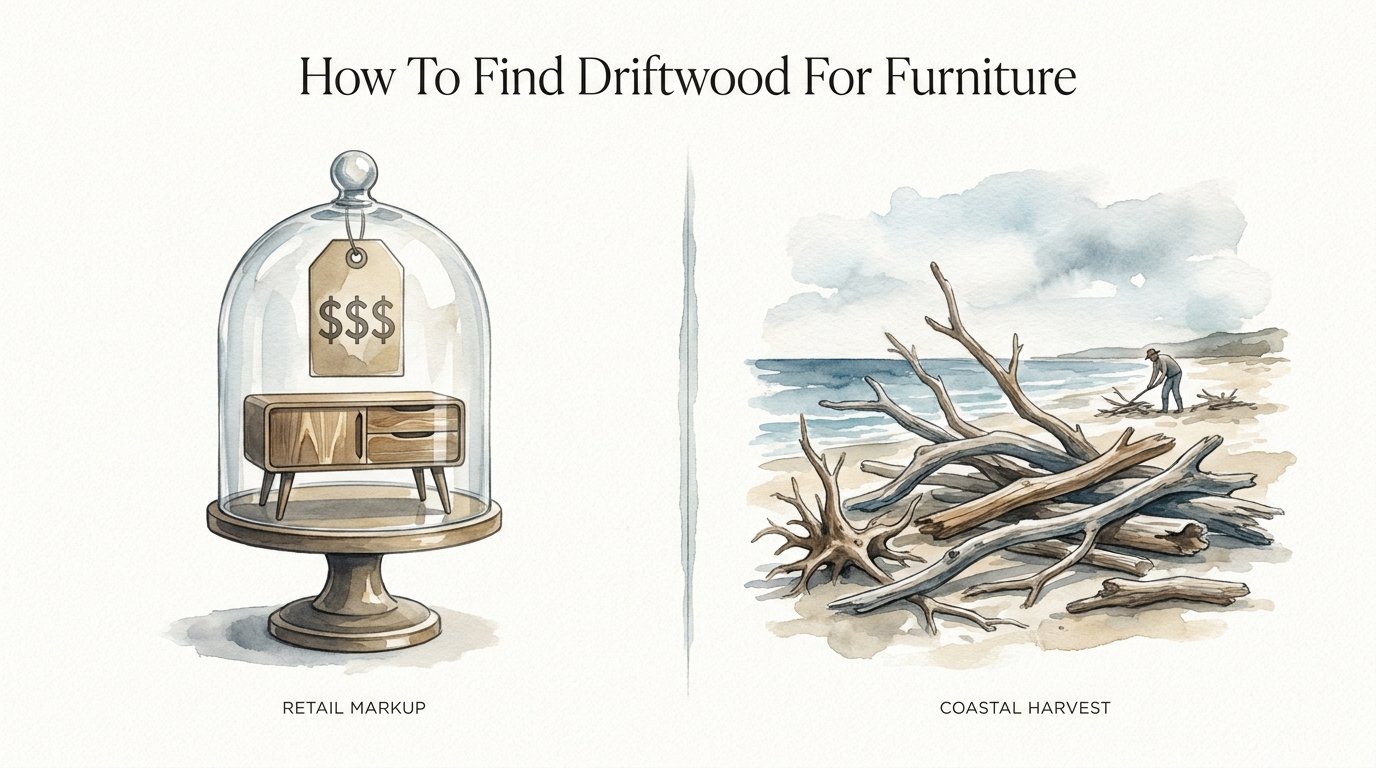
Most people see driftwood as a decorative accent—a small stick for a shelf or a bit of gnarled root for an aquarium. But if you know what to look for, you can find structural beams, table slabs, and chair legs that possess a durability and character no sawmill can replicate. This is about reclaiming the Coastal Harvest and bypassing the Retail Markup that sells you a shadow of the real thing.
How To Find Driftwood For Furniture
Finding driftwood for furniture is less about luck and more about understanding the rhythm of the water. Driftwood isn’t a specific species of tree; it is a state of being. It is wood that has been uprooted by floods, landslides, or erosion, carried downriver to the sea, and then churned by the tides until it is smoothed and stripped of its bark. The result is a material that is uniquely stable because the ocean has already forced out the most volatile moisture and replaced it with salt crystals that help preserve the internal structure.
To find the best pieces, you need to look where the energy of the water deposits its heaviest cargo. This typically happens at the mouths of major rivers, in deep coves that act as natural “driftwood traps,” or along rocky coastlines where the surf beats the wood into submission. You aren’t looking for the light, spongy wood that floats high on the sand; you are looking for the “sinkers”—heavy, dense pieces that have spent years in the brine. These are the hardwoods like Oak, Douglas Fir, and Cedar that have the structural integrity required for furniture.
The Golden Hour of Beachcombing
The best time to hunt is immediately following a King Tide or a significant winter storm. These events pull old growth out of the estuaries and toss it onto the high-tide line. Look for pieces that are partially buried in the sand. If a piece feels surprisingly heavy for its size, it’s likely a dense hardwood that hasn’t started to rot. Use a small hatchet or a knife to nick the surface. If you see bright, solid grain beneath the grey exterior, you’ve found a keeper.
How the Coastal Harvest Works: From Shore to Shop
Turning a salt-soaked log into a dining table isn’t as simple as dragging it home and hitting it with a sander. There is a biological and chemical process at play here. When wood sits in the ocean, the salt water begins to displace the sap and natural sugars within the cells. This is a form of “salt-seasoning” that was used by shipbuilders for centuries to prevent rot and warping.
The process of preparing driftwood follows a specific sequence of desalination, disinfection, and drying. Skipping any of these steps will result in a piece of furniture that either attracts pests, smells of the sea, or eventually cracks as the salt pulls moisture from the air. Here is how you manage the transition from raw beach find to workable lumber:
- Desalination: You must soak the wood in fresh water for several days, changing the water daily. This draws the concentrated salt out of the fibers so it doesn’t interfere with your future finishes or corrode your metal fasteners.
- Disinfection: Most driftwood is home to gribbles, shipworms, or sand gnats. A soak in a diluted bleach solution (1 part bleach to 10 parts water) or a thorough pressure washing is mandatory to kill these hitchhikers.
- Drying: This is the longest stage. Wood needs to reach a moisture content of 6-8% for indoor use. You can air-dry it in a covered, breezy area or use a DIY solar kiln. For smaller pieces, a low-temp oven set to 200°F for a few hours can speed up the process.
The Practical Benefits of Using Driftwood
Why go through the trouble of hauling wet logs off a beach when you can buy a pre-cut 2×4? The answer lies in the mechanical properties of salt-tempered wood. Driftwood that has survived the ocean is essentially “pre-stressed.” If it were going to warp, rot, or split, it would have done so in the surf. What you are left with is the most resilient part of the tree.
Beyond durability, there is the aesthetic value. The natural erosion creates “organic joinery”—shapes that no lathe or CNC machine can produce. When you build with driftwood, you are collaborating with the ocean. You aren’t just making a table; you are preserving a history of travel. Many pieces found on the Pacific coast may have originated in Japan or Siberia, traveling thousands of miles before reaching your workshop.
Furthermore, driftwood is ecologically responsible. You are removing “beach wrack” that can sometimes stifle dune growth if it accumulates in excessive amounts, and you are bypassing the industrial carbon footprint of commercial logging and kiln drying. It is the ultimate form of low-impact, high-character woodworking.
Challenges and Common Pitfalls
The ocean gives, but it also takes—mostly the sharpness of your tools. The single biggest challenge with driftwood is silica. As wood tumbles in the surf, fine sand gets driven deep into the grain and the cracks. If you take a standard steel saw blade to a piece of raw driftwood, you will dull it in seconds. Always use carbide-tipped tools and expect to sharpen them more frequently than usual.
Another common mistake is ignoring hidden metal. Old pier pilings or ship remnants often contain rusted nails, bolts, or wire. Use a handheld metal detector before you make a single cut. Hitting a 100-year-old wrought iron nail with a circular saw is a quick way to ruin your day and your equipment.
Lastly, beware of “punky” wood. This is wood that has started to decay from the inside out. If you can press your thumb into the wood and it leaves a permanent indent, it’s too soft for structural furniture. You can sometimes save these pieces using resin stabilization, but for your first few projects, stick to the hard, “clinking” wood that sounds like stone when you tap it.
Limitations of the Method
Driftwood isn’t a universal solution for every project. Because the pieces are irregular, you cannot use standard “square” joinery. You won’t be making many shaker-style cabinets with beach finds. This material demands scribing joinery or epoxy fills to bridge the gaps between non-linear surfaces. It requires a high level of patience and a willingness to “follow the wood” rather than forcing it into a blueprint.
There are also legal limitations. In many regions, such as parts of Washington or Oregon, you are allowed to take driftwood for personal use, but commercial harvesting requires a permit. Always check local regulations. Some beaches are protected ecosystems where the wood is vital for preventing erosion and providing habitat for shorebirds. Don’t be the person who strips a sensitive beach of its natural defenses.
Comparison: Retail Markup vs. Coastal Harvest
| Feature | Retail “Coastal” Lumber | Authentic Coastal Harvest |
|---|---|---|
| Cost | High (Premium for ‘reclaimed’ look) | Free (Cost of labor/transport) |
| Material | New-growth Pine/Fir | Old-growth Hardwoods/Tempered Cedar |
| Durability | Moderate (Prone to seasonal movement) | Superior (Pre-stressed by salt/water) |
| Chemicals | Often treated with synthetic stains/sealers | Naturally salt-cured and UV-bleached |
| Character | Uniform, manufactured weathering | Unique, erosion-carved textures |
Practical Tips for the Modern Pioneer
If you’re ready to start your first build, keep your initial projects simple. A driftwood-base coffee table is an excellent entry point. It allows you to use a large, gnarled stump as a base while keeping the top flat (using either a glass slab or a milled piece of lumber). This bypasses the need for complex structural joinery while showcasing the raw beauty of the find.
When it comes to finishing, avoid heavy film finishes like thick polyurethane. They tend to look “plastic” on the organic texture of driftwood. Instead, use a penetrating oil like Tung oil or Danish oil. These bring out the silver-grey “shimmer” of the wood without hiding the tactile quality of the grain. If the wood is particularly porous, you might need 3-4 coats as the fibers will “drink” the oil initially.
Always keep a “beach kit” in your truck. This should include a pair of heavy leather gloves, a sturdy come-along winch for larger logs, and a moisture meter. Checking the moisture content while you’re on the beach can save you from hauling a 200-pound log that is 90% water and likely to rot before it ever dries out.
Advanced Considerations: Stabilization and Resonance
For those looking to take this further, consider resin stabilization. By placing small or brittle pieces of driftwood in a vacuum chamber with a heat-cured resin (like Cactus Juice), you can turn soft, “punky” wood into a material as hard as acrylic. This is perfect for knife handles, pen blanks, or decorative inlays in larger furniture pieces.
Interestingly, some luthiers (guitar makers) have begun looking at salt-cured driftwood for its acoustic properties. The way salt water breaks down the hemicellulose in wood can actually make it more resonant, similar to the “torrefaction” process used in high-end guitar tops. If you find a straight-grained piece of Sitka Spruce or Cedar on the beach, you might be holding the top of a world-class instrument.
Examples of Driftwood Application
Imagine a entryway bench where the legs are two matching sections of a Pacific Madrone branch, sand-blasted by the ocean to a smooth, bone-white finish. The seat is a slab of Douglas Fir that fell into the Columbia River in the 1950s and spent fifty years tumbling in the surf. The joinery is simple: mortise and tenon, but the “tenons” are the natural ends of the branches themselves.
Or consider a floating shelf system where the brackets are gnarled “elbows” of Oak found in a tidal marsh. Because the Oak is so dense and salt-hardened, it can support significantly more weight than a standard pine bracket of the same size. These aren’t just furniture pieces; they are functional sculptures that bring the grit and history of the coastline into the home.
Final Thoughts
Building with driftwood is a return to a more honest form of craftsmanship. It rejects the “disposable” culture of modern retail and asks you to work with what the earth provides. It requires more sweat, more patience, and a better understanding of biology than a trip to the hardware store, but the reward is a piece of furniture that is literally one-of-a-kind.
The ocean is a master sculptor, and the tides are its delivery service. The next time a storm rolls through, don’t hunker down inside. Head to the coast with a pair of boots and a sharp eye. Your next heirloom isn’t sitting in a warehouse—it’s waiting for you on the high-tide line, cured by the salt and ready for a second life in your home.
Start small, respect the beach, and listen to what the wood tells you. The grain you find beneath that weathered grey skin will tell a story that no credit card can ever buy.
Sources
1 quora.com (https://www.quora.com/How-is-furniture-made-from-driftwood-different-from-other-wooden-furniture) | 2 kuksa.shop (https://www.kuksa.shop/en/blog/driftwood/) | 3 wikipedia.org (https://en.wikipedia.org/wiki/Driftwood) | 4 noaa.gov (https://repository.library.noaa.gov/view/noaa/41462/noaa_41462_DS1.pdf) | 5 stackexchange.com (https://woodworking.stackexchange.com/questions/159/when-is-it-best-to-use-kiln-dried-vs-air-dried-vs-green-wood-in-a-project) | 6 desch-store.com (https://desch-store.com/en/blog/our-blog-1/kilned-wood-vs-undried-wood-impact-on-furniture-manufacturing-8) | 7 aprettyfix.com (https://aprettyfix.com/disinfect-driftwood/) | 8 hawk-hill.com (https://www.hawk-hill.com/how-to-clean-driftwood/) | 9 parklanejewelry.com (https://www2.parklanejewelry.com/how-to-clean-driftwood/) | 10 instructables.com (https://www.instructables.com/Resin-Stabilizing-Wood/) | 11 thriftyfun.com (https://www.thriftyfun.com/Sterilizing-and-Desalinizing-Driftwood.html) | 12 solidsuperstore.ca (https://solidsuperstore.ca/blog/kiln-dried-wood-benefits/) | 13 firesidemotel.com (https://www.firesidemotel.com/the-allure-of-driftwood/) | 14 dksstores.com (https://dksstores.com/blog-post67) | 15 billboardlumber.net (https://www.billboardlumber.net/understanding-the-difference-green-vs-kiln-dried-lumber-for-fencing-and-construction/) | 16 quora.com (https://www.quora.com/Is-it-illegal-to-take-driftwood-from-the-beach-in-NZ) | 17 Source (https://www.google.com/search?q=time+in+Australia) | 18 Source (https://www.google.com/search?q=time+in+Canada) | 19 Source (https://www.google.com/search?q=time+in+United+Kingdom) | 20 stackexchange.com (https://woodworking.stackexchange.com/questions/2654/techniques-for-working-with-driftwood) | 21 canada.ca (https://inspection.canada.ca/en/inspect-and-protect/plant-health/travel-smart-bringing-back-wooden-and-bamboo-souvenirs) | 22 preservation-solutions.com (https://preservation-solutions.com/blogs/news/what-is-wood-stabilizer)