Natural Sound Diffuser Driftwood Shelves
The secret to a peaceful home isn’t more insulation; it’s smarter geometry. Why spend thousands on ugly acoustic foam when the ocean has already sculpted the perfect sound diffuser? While flat, modern surfaces create a chaotic echo chamber in your living room, the weathered, irregular face of sea-cured timber acts as a natural dampener. It turns your wall into a shield of silence without using a single watt of power.
[affiai]Living in a modern home often feels like living inside a drum. Glass, drywall, and polished hardwood floors are the enemies of clear conversation and relaxing music. These surfaces are “hard” in every sense of the word. They reflect sound waves with brutal efficiency, bouncing them back and forth until the air is thick with a muddy, vibrating haze. Most folks try to fix this by slapping up gray foam triangles that look like they belong in a budget 1980s recording studio. There is a better way.
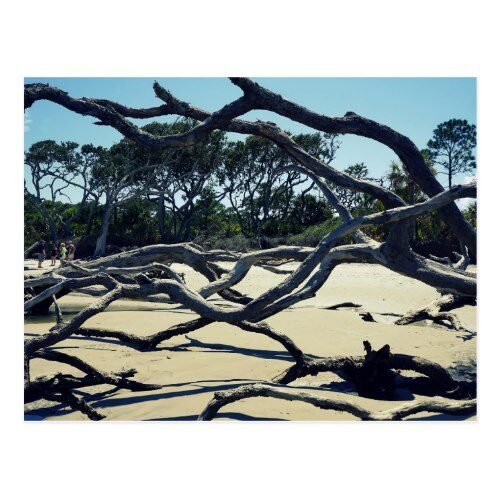
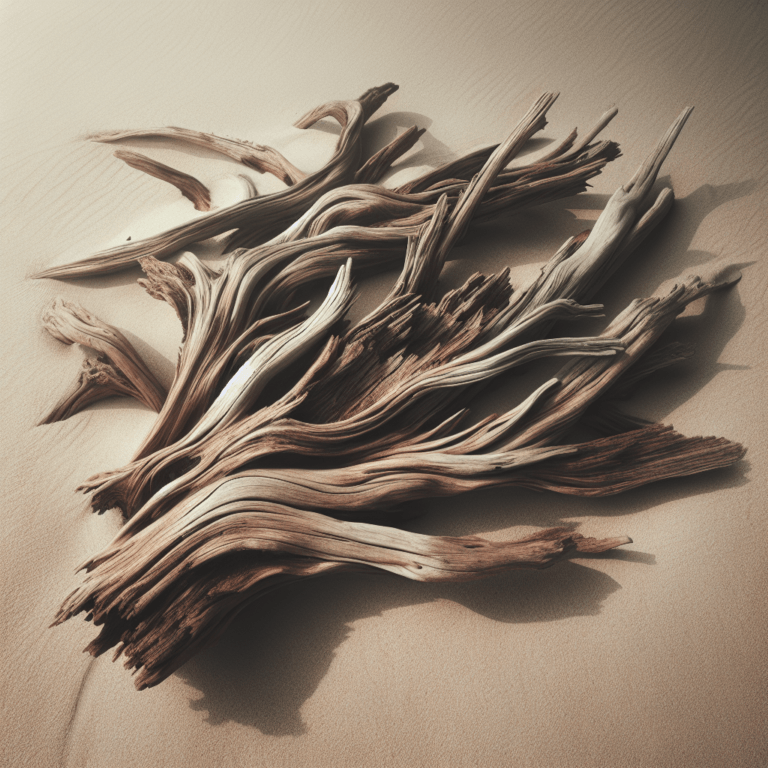
Natural driftwood, forged by years of salt and sun, possesses a chaotic surface geometry that no machine can replicate. By mounting these pieces as shelves or wall art, you are not just decorating; you are deploying a sophisticated acoustic system. This guide will show you how to harness the physics of the shoreline to bring **ORGANIC SILENCE** to your home.
Natural Sound Diffuser Driftwood Shelves
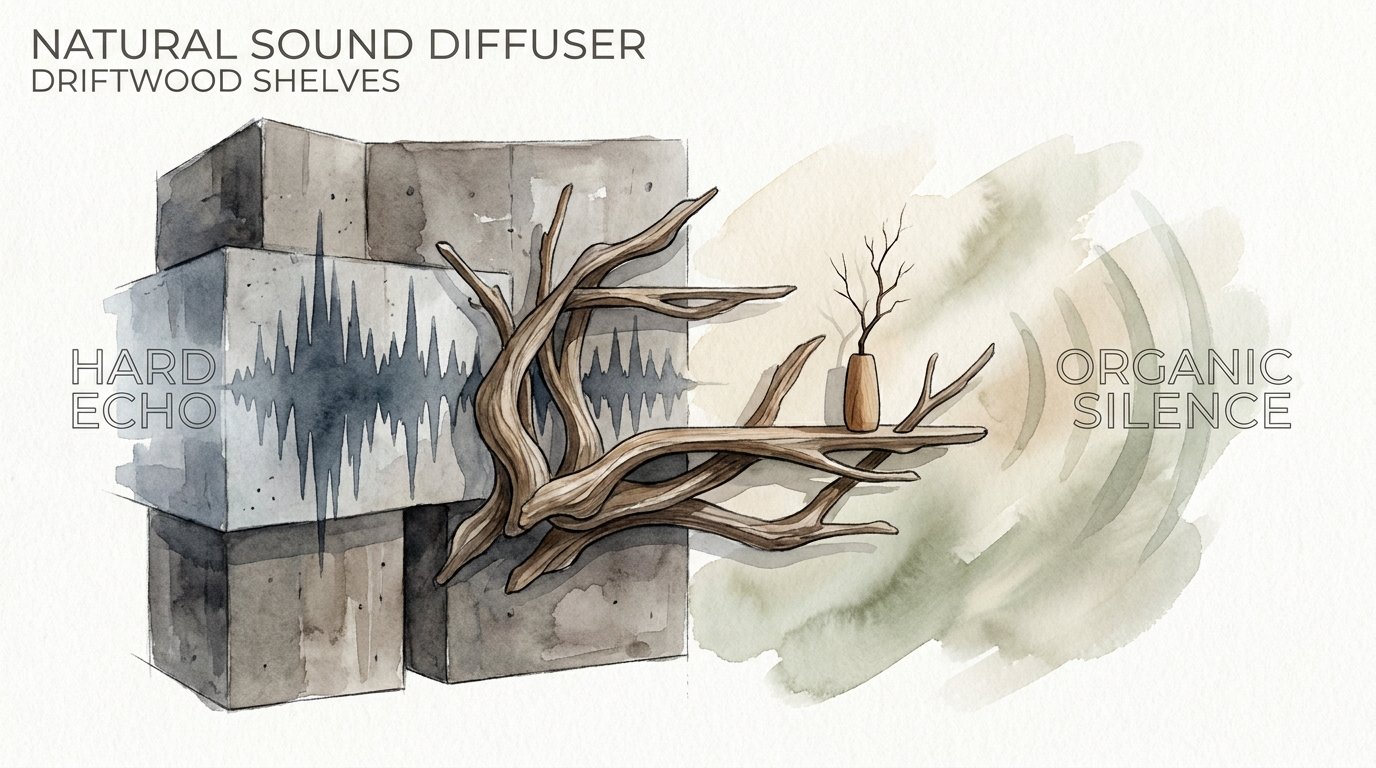
Natural sound diffuser driftwood shelves are functional storage units crafted from salvaged timber that has been weathered by water and sun. Unlike standard furniture, these pieces are designed with intentional irregularity. In the world of acoustics, a “diffuser” is a device that breaks up sound waves and scatters them in many directions. When a sound wave hits a flat drywall surface, it bounces back like a ball off a wall—this is a “specular reflection.” When that same wave hits a driftwood shelf, the varied depths, cracks, and textures catch the wave and shatter it.
This process eliminates “hot spots” of sound energy without making the room feel “dead.” If you have ever been in a room with too much foam, you know that eerie, suffocating feeling where all the life has been sucked out of the air. Driftwood provides a middle ground. It maintains the “liveliness” of a room—making it sound spacious and natural—while removing the harsh, metallic ring of an echo.
You will often see these principles applied in high-end concert halls or professional mixing rooms using expensive, mathematically-calculated wood blocks called Quadratic Residue Diffusers (QRD). Driftwood serves as nature’s version of the QRD. Because no two branches are the same thickness or shape, the shelf naturally covers a broad range of frequencies. High-pitched clinking or sharp voices are softened by the fine texture, while mid-range tones are scattered by the varying depths of the wood pieces.
How to Build and Prepare Acoustic Driftwood Shelves
Building these shelves requires more than just picking up a stick from the beach and nailing it to the wall. To make them safe for indoor use and effective for sound control, you must follow a specific process of preparation and assembly.
1. Salvaging and Selection
Finding the right timber is the first step in your acoustic journey. Look for pieces that are “sea-cured”—wood that has been in the water long enough to lose its bark and most of its soft outer fibers. Dense hardwoods like oak, cedar, or even tropical species found on southern coasts are ideal because their high density reflects sound waves more efficiently, which is necessary for effective diffusion. Avoid wood that is “punky” or rotting in the center; if it feels soft and spongy, it will absorb sound rather than scatter it, and it won’t hold the weight of your books.
2. The Sanitization Process
Bringing raw nature indoors carries risks. Driftwood is often home to salt-dwelling organisms, bacteria, or even nesting insects. You must sanitize the wood thoroughly. Start by dry-brushing the pieces with a stiff-bristled brush to remove loose sand and debris. Then, soak the wood in a large tub with a solution of water and bleach (about 1–2 cups of bleach per gallon of water) for at least 24 hours. This kills any remaining pests and neutralizes odors. If the wood is too large for a tub, you can use a spray bottle and a heavy-duty scrub, but soaking is always preferred.
3. Drying and Curing
Moisture is the enemy of stability. Once the wood is cleaned, it must dry completely to prevent mold growth once it’s mounted. Sun-drying is the traditional method, but it can take weeks. For faster results, you can “kiln-dry” smaller pieces in a home oven set to its lowest temperature (usually around 170°F to 200°F) for 2 to 4 hours. Keep a close eye on it to ensure it doesn’t scorch. For larger beams, let them sit in a dry, well-ventilated garage or workshop for at least 15 to 30 days.
4. Assembly for Maximum Diffusion
To get the best acoustic performance, you want to vary the “well depth” of your shelf. If you are mounting multiple pieces of driftwood vertically to create a shelf backboard, ensure that some pieces stick out 2 inches from the wall, while others stick out 4 or 6 inches. This variation in depth determines which sound frequencies the shelf will scatter. A deeper shelf (5–7 inches) is better at diffusing lower-mid frequencies (around 500Hz to 1000Hz), while shallower, textured surfaces handle the high-end frequencies that cause “flutter echo.”
Benefits of Driftwood Acoustic Treatment
Choosing driftwood over synthetic acoustic panels offers several measurable advantages for both the homeowner and the audio enthusiast.
- Broadband Scattering: Because driftwood is naturally irregular, it doesn’t have the “periodic” problems of manufactured diffusers. Manufactured diffusers can sometimes create “lobing” (where sound concentrates in specific spots) if the pattern repeats too much. The randomness of driftwood prevents this.
- Sustainable Sourcing: Using salvaged timber is an act of environmental stewardship. You are giving a second life to material that would otherwise rot and release carbon, and you are avoiding the petroleum-based chemicals found in most acoustic foams.
- Aesthetic Warmth: Modern soundproofing is often an eyesore. Driftwood shelves serve as a focal point in a room, bringing in a “pioneer-grit” aesthetic that pairs well with industrial, coastal, or rustic decor.
- Inherent Durability: Wood that has survived the ocean is incredibly tough. Unlike foam which crumbles over time or fabric panels that stain and tear, a driftwood shelf will likely outlast the house it is mounted in.
Common Challenges and Mistakes
Many beginners stumble when they treat acoustics as a “set it and forget it” decoration. To avoid common pitfalls, keep the following in mind:
Ignoring the Cleaning Step: The most common mistake is failing to treat the wood for tannins and salt. If you skip the soak, the wood may “bleed” brown liquid onto your walls during humid months. Salt is also hygroscopic, meaning it pulls moisture from the air, which can lead to localized dampness and mold behind the shelf.
Over-treating the Room: You do not need to cover every wall in driftwood. If you diffuse every surface, the room can lose its sense of “localization,” making it hard to tell where a sound is coming from. Focus your treatment on the “first reflection points”—the spots on the wall where sound travels directly from your speakers (or your mouth during a conversation) and hits the wall before reaching your ears.
Poor Structural Mounting: Driftwood can be deceptively heavy. Many people try to hang these shelves with simple nails or adhesive strips. You must use heavy-duty wall anchors or, preferably, screw directly into the wall studs. A falling driftwood shelf isn’t just an acoustic failure; it’s a safety hazard.
Limitations: When Driftwood Isn’t Enough
It is important to have a balanced understanding of what this method can and cannot do. Driftwood shelves are excellent **diffusers**, but they are not **absorbers** or **soundproofers**.
If your goal is to stop sound from leaving the room so your neighbors don’t hear your drums, driftwood won’t help. Soundproofing requires “mass” and “decoupling”—basically building a room within a room. Driftwood is also ineffective at managing “room modes” or low-frequency bass buildup (the “boomy” sound in corners). Bass waves are often 10 to 20 feet long; they simply roll over a 6-inch shelf as if it wasn’t there. For those issues, you still need dedicated bass traps made of high-density mineral wool.
Comparison: Driftwood vs. Traditional Treatments
To help you decide if this approach is right for your space, consider how it stacks up against the usual suspects in the acoustic world.
| Feature | Driftwood Shelves | Acoustic Foam | Machined Wood Diffusers |
|---|---|---|---|
| Primary Function | Diffusion/Scattering | Absorption | Mathematical Diffusion |
| Cost | Very Low (DIY) | Low to Moderate | High |
| Visual Impact | High/Organic | Low/Industrial | Moderate/Geometric |
| Effective Range | Mid to High Frequencies | High Frequencies only | Tuned to Specific Bands |
| Lifespan | Decades | 5–10 Years (Foam decays) | Decades |
Practical Tips and Best Practices
If you are ready to start your project, these “pro” tips will ensure you get a professional-sounding result on a pioneer budget.
- The 1:3 Ratio: For a balanced room, try to maintain a ratio of 1 part diffusion (driftwood) to 3 parts absorption (rugs, curtains, or panels). This prevents the room from becoming too “echoey” or too “dead.”
- Ear-Level Placement: Sound waves mostly travel horizontally. Mount your driftwood shelves so that the center of the wood is at “seated ear height”—usually between 36 and 48 inches from the floor.
- Back-Lighting: To enhance the aesthetic, install a small LED strip behind the driftwood. The light will catch the irregular edges, creating deep shadows that emphasize the texture and make the “geometry” of the silence visible.
- The “Clap Test”: To find where to put your shelves, stand in the middle of the room and clap your hands loudly. Listen for a “zinging” or ringing sound. Move around until you find the spot where the ring is loudest—that is where your first shelf should go.
Advanced Considerations for Serious Practitioners
For those who want to go beyond simple decoration, consider the “Phase Shift” of your diffusion. When sound hits a diffuser, it isn’t just scattered in space; it is also scattered in **time**. Because some parts of the wood are closer to the listener than others, the reflected sound waves return at slightly different times. This “smears” the reflection, making it much less noticeable to the human brain.
If you are building a dedicated listening room, you can “tune” your driftwood shelves by choosing specific wood densities. For instance, a shelf made of **Western Red Cedar** (low density) will have a slight “absorptive” quality in the high-end, while **Ipe or White Oak** (high density) will be a much more “aggressive” diffuser, reflecting almost all energy back into the room. Serious practitioners often mix these species to create a “hybrid” wall that manages multiple acoustic problems at once.
Example Scenario: The Echoing Home Office
Consider a 10′ x 12′ home office with three drywall walls and a large window. A worker in this room finds that during Zoom calls, their voice sounds hollow and distant. The “hard echo” is bouncing off the back wall and back into the microphone.
Instead of buying 24 foam squares, the worker installs three 4-foot driftwood shelves on the wall directly behind their desk.
1. The bottom shelf is made of thick, 6-inch diameter driftwood “logs.”
2. The middle shelf uses thinner, 2-inch “branches” with lots of texture.
3. The top shelf is a single, long-weathered plank with deep grooves.
The result? The thick bottom shelf scatters the lower tones of the worker’s voice. The textured middle shelf breaks up the high-pitched “sibilance” (the ‘s’ and ‘t’ sounds). The hollow, distant sound disappears, replaced by a clear, professional tone. The room feels more expensive, more peaceful, and more personal—all for the cost of a few wall anchors and a trip to the beach.
Final Thoughts
The transition from a chaotic, echoing house to a peaceful, acoustic sanctuary doesn’t require complex machinery or synthetic chemicals. It requires a return to the irregular wisdom of the natural world. Driftwood shelves offer a rare combination of utility, beauty, and scientific function, acting as a permanent shield against the noise of modern life.
By choosing to use sea-cured timber, you are rejecting the “flat-pack” culture of modern design in favor of something with history and grit. You are turning your living space into a place that doesn’t just look good, but feels right.
Start small. Find a single piece of wood that speaks to you, clean it well, and mount it where the echoes are loudest. Once you experience the difference between the harsh “hard echo” of a blank wall and the “organic silence” of a natural diffuser, you’ll never look at a piece of beach wood the same way again. Experiment with different depths and placements, and let the ocean’s geometry bring some much-needed peace to your home.
Sources
1 feltcombo.com (https://www.feltcombo.com/news/the-science-of-silence-understanding-the-acoustic-absorption-mechanism-of-wooden-panels) | 2 acousticalsurfaces.com (https://www.acousticalsurfaces.com/blog/acoustics-education/what-is-sound-diffusion-and-absorption/) | 3 youtube.com (https://www.youtube.com/watch?v=4R6ZE4hxeec) | 4 mymumthedreamer.com (https://mymumthedreamer.com/how-to-clean-driftwood-for-crafting/) | 5 wikihow.com (https://www.wikihow.com/Preserve-Driftwood) | 6 dksstores.com (https://dksstores.com/blog-post49) | 7 thepointofcreation.com (https://www.thepointofcreation.com/blog/do-it-yourself-skyline-diffuser-build/) | 8 aprettyfix.com (https://aprettyfix.com/disinfect-driftwood/) | 9 hawk-hill.com (https://www.hawk-hill.com/how-to-clean-driftwood/) | 10 illuminated-integration.com (https://illuminated-integration.com/blog/absorption-vs-diffusion/) | 11 aeco-sound.com (https://aeco-sound.com/en-us/blogs/soundproofing/material-wood)