Integrated Driftwood Shelving Permaculture Design
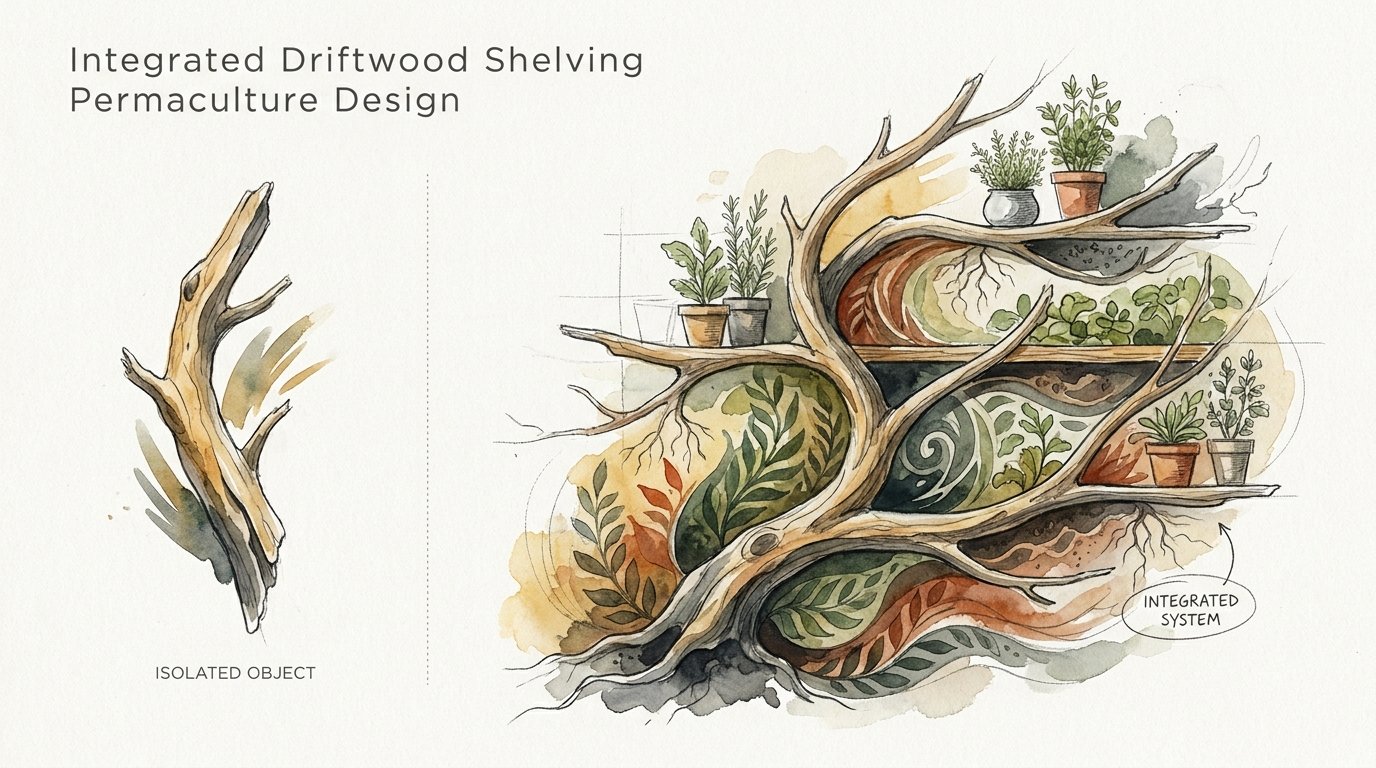
Stop treating your furniture like an island and start building a bridge to a living home. We buy furniture as ‘Isolated’ units, but your home is a system. I stopped building ‘shelves’ and started building ‘Integrated’ coastal hubs. This driftwood doesn’t just hold my books—it channels humidity to my ferns, hides my tech cables in natural grooves, and provides a root-like anchor for my vertical garden.
[affiai]Most of us view a bookshelf as a dead slab of processed timber. We screw it to a wall, stack it with static objects, and wonder why the room feels sterile. Permaculture teaches us that every element should serve multiple functions and connect to the larger whole. By merging salvaged driftwood with living plants and modern technology, we transition from mere “decorating” to true ecosystem engineering within our four walls.
This approach is about resilience and resourcefulness. It is about taking what the ocean has already weathered and turning it into a functional skeleton for a domestic jungle. In this guide, we will explore how to transition your living space from a collection of isolated objects into a thriving, integrated system.
Integrated Driftwood Shelving Permaculture Design
Integrated driftwood shelving is a design philosophy where salvaged wood serves as the structural and biological foundation for an indoor ecosystem. In a permaculture context, this means moving beyond the aesthetic of “shabby chic” to create a system where the furniture actively supports the life around it. The wood acts as a trellis, a moisture buffer, and a structural anchor for vertical gardens.
These systems are commonly used in urban apartments or homes where floor space is limited but vertical potential is high. Unlike standard MDF shelving, driftwood is an “integrated system” element because it is often porous, uniquely shaped by the elements, and contains natural cavities. These features allow it to hold air plants, support climbing vines, and even help regulate local humidity through its interaction with plant transpiration.
In a real-world setting, a driftwood hub might span a corner of a living room, reaching from floor to ceiling. Its “branches” serve as shelves for books or speakers, while its “trunk” provides a textured surface for epiphytic plants like orchids and bromeliads to cling to. It is a marriage of the coastal wild and modern functionality, ensuring that no part of the structure is “waste” or “isolated.”
How to Design and Build Your Integrated Coastal Hub
Building an integrated system requires more than a hammer and nails; it requires observation. You must look at the natural “flow” of your room—where the light falls, where the humidity pools, and where your technology needs to be powered.
Step 1: Sourcing and Preparing the Wood
True driftwood is a gift from the sea, but it comes with salt and stowaways. You must first clean the wood by dry brushing any loose sand and debris. For indoor safety, soak the wood in a solution of one part bleach to nine parts water for at least 12 to 24 hours. This kills bacteria and pests that could harm your home or other plants. After soaking, let the wood dry in the sun for a week to ensure it is fully cured.
Step 2: Structural Integration
Once the wood is prepped, determine your anchor points. In a permaculture design, we want to “stack” functions. Use the sturdiest part of the driftwood as the main vertical support. If the branch has a natural fork, this becomes a perfect resting place for a horizontal shelf made of reclaimed timber or glass. Secure the driftwood to wall studs using heavy-duty L-brackets or hidden mounting bolts to ensure it can handle the weight of both books and water-heavy plants.
Step 3: Creating the Root-Like Anchor
To turn a shelf into a vertical garden, you must provide a way for plants to attach. Epiphytic plants, such as Java ferns or staghorn ferns, do not need soil; they need a surface. Use cotton thread or monofilament fishing line to tie the roots of these plants directly into the deep grooves of the driftwood. Over several months, the roots will naturally “anchor” themselves into the wood grain, creating a living sculpture that looks as though it grew out of the sea.
Step 4: Tech and Cable Management
Stop letting plastic zip-ties ruin your aesthetic. Most driftwood has natural channels or weathered “checks” (cracks). Route your charging cables or speaker wires through these natural grooves. If the wood is thick enough, you can drill small, discreet holes to pass wires from the back of the structure to the front. This hides the “skeleton” of your technology within the “skeleton” of the wood, maintaining the illusion of a natural hub.
Benefits of the Integrated Approach
The primary advantage of this system is the creation of indoor microclimates. Plants release moisture through a process called transpiration. When you group plants together on a porous surface like driftwood, the wood absorbs excess humidity and releases it slowly as the air dries out. This creates a stable environment for moisture-loving species like ferns, which often struggle in the dry air of modern homes.
Another measurable benefit is improved air quality. By maximizing vertical space for foliage, you increase the “leaf area” in your room. A single integrated driftwood tower can hold three times as many plants as a standard floor-to-head shelf, significantly increasing the rate at which carbon dioxide is absorbed and oxygen is released.
Furthermore, this design reduces waste. By using salvaged driftwood and reclaimed materials, you are opting out of the “fast furniture” cycle. These pieces are durable and age beautifully. Instead of a shelf that ends up in a landfill after three years, you have a system that becomes more valuable and structurally interesting as the plants grow and the wood gains a natural patina.
Challenges and Common Mistakes
One of the most frequent errors is failing to account for wood movement. Wood is a “living” material that expands and contracts based on humidity. If you secure a shelf too rigidly between two pieces of driftwood without allowing for a fraction of an inch of “float,” the wood may crack as the seasons change. Always use mounting hardware that allows for slight thermal and moisture expansion.
Another pitfall is “over-cleansing.” While disinfecting is necessary, avoid using thick polyurethanes or plastic-based sealants. These “choke” the wood, preventing it from interacting with the air and making it impossible for plant roots to anchor. Stick to natural oils like tung oil or linseed oil, which preserve the wood while keeping the pores open for your vertical garden to take hold.
Finally, do not underestimate the weight of wet soil. If you are placing potted plants on the driftwood branches, ensure the structural anchors are rated for at least twice the weight you expect. Wet terra cotta and soil can be surprisingly heavy, and a collapsing system is a danger to both your home and your plants.
Limitations: When This May Not Be Ideal
Integrated driftwood systems are not universal solutions. They require active management. If you are looking for “set it and forget it” furniture, this is not for you. The plants will need misting, the wood may need occasional oiling, and you must monitor for any signs of mold if the air circulation in your room is poor.
Environmental constraints also play a role. If your home is exceptionally dark, your driftwood hub will become a “dead zone” for plants unless you integrate full-spectrum LED grow lights into the structure. Additionally, homes with very high baseline humidity (above 60%) may struggle with mold growth on the wood if there is not enough airflow. In these cases, a more “isolated” metal or plastic shelf might be a safer, albeit less soulful, choice.
Comparing Design Philosophies
Understanding the difference between an Isolated Object and an Integrated System is crucial for successful permaculture design.
| Feature | Isolated Shelf (Standard) | Integrated Coastal Hub (Permaculture) |
|---|---|---|
| Material | MDF / Processed Pine | Salvaged Driftwood / Reclaimed Timber |
| Function | Storage only | Storage, Humidity Buffer, Trellis, Cable Guide |
| Maintenance | Low (Dusting) | Moderate (Pruning, Oiling, Misting) |
| Lifespan | 3–10 Years | Decades (with care) |
| Eco-Impact | High (Waste/Chemicals) | Low (Recycled/Carbon Sink) |
Practical Tips and Best Practices
If you are just starting, begin with a “Small and Slow Solution”—one of the core 12 principles of permaculture. Find a single, interesting piece of driftwood about three feet long and mount it in a bathroom. The natural humidity from the shower will sustain air plants (Tillandsia) tucked into its crevices, and you can practice the “anchor” technique before committing to a full-wall system.
Use a Hygrometer: To keep both your wood and your plants healthy, keep a digital hygrometer nearby. Aim for a humidity range between 30% and 50%. This is the “sweet spot” where wood stays stable without cracking, and most indoor plants can thrive without excessive misting.
Group by Thirst: When designing your vertical layout, place drought-tolerant succulents on the higher, drier “limbs” and moisture-loving ferns or mosses near the base where water naturally settles and humidity is higher. This mimics a forest canopy and reduces the amount of individual care each plant requires.
Advanced Considerations for Serious Practitioners
For those looking to scale their system, consider Passive Hydroponics. You can hollow out sections of a large driftwood trunk to act as reservoirs for nutrient-rich water. By using a cotton wick, you can “channel” this water to plants located higher up the structure. This turns your shelving unit into a self-watering machine that only needs attention once every two weeks.
Another advanced technique is the Thermal Mass integration. If your driftwood hub is located near a window that gets afternoon sun, place stones or dark ceramic pots within the structure. These will absorb the heat during the day and release it slowly at night, buffering your plants against temperature drops and further stabilizing the microclimate of your living room.
Scenario: The Urban Coastal Studio
Imagine a 400-square-foot studio apartment. The tenant has no yard, but they have a ten-foot ceiling and a gnarly piece of cedar driftwood found at a local riverbed. By mounting the cedar vertically against a corner, they create a “backbone.”
They attach three glass shelves for books, but the real work happens in the wood’s deep checks. A series of trailing Pothos is planted at the top; their vines are trained to wrap around the wood, acting like living “cables.” Behind the vines, a hidden power strip is mounted to the wood, with laptop and phone chargers snaking through the Pothos leaves. The transpiration from the Pothos keeps the cedar from drying out, while the cedar provides a sturdy “cliffside” for the vines to conquer. The apartment now feels like a clearing in a forest rather than a concrete box.
Final Thoughts
Building an integrated driftwood shelving system is a rejection of the idea that furniture should be static and separate from the life of a home. It requires us to look at “waste” materials with new eyes and to understand that our tech, our plants, and our storage can exist in a single, supportive web.
By applying permaculture principles—integrating rather than segregating, and producing no waste—you create a space that is not only beautiful but functionally alive. Whether you start with a single branch or a full-room installation, the goal remains the same: stop living among objects and start living within a system.
As you experiment with these designs, remember that the wood and the plants will tell you what they need. Watch for the way the roots turn, listen for the way the wood breathes in the heat of summer, and adjust your system accordingly. Your home is not a museum; it is a habitat. Treat it with the pioneer grit it deserves.
Sources
1 youtube.com (https://www.youtube.com/watch?v=2xKJobTGcWk) | 2 youtube.com (https://www.youtube.com/watch?v=ZS3sG6fUf7g) | 3 tnnursery.net (https://tnnursery.net/blogs/garden-blog/10-different-driftwood-usage-visit-tn-nursery) | 4 uniquedriftwood.in (https://uniquedriftwood.in/blogs/driftwood-art-decor-blog/diy-driftwood-projects-home-decor) | 5 permaculturevisions.com (https://permaculturevisions.com/growing-food-indoors/) | 6 growveg.com.au (https://www.growveg.com.au/guides/6-genius-vertical-gardening-ideas/) | 7 youtube.com (https://www.youtube.com/watch?v=Y1wi3PfHGPs) | 8 freepermaculture.com (https://www.freepermaculture.com/season-extension-microclimates/)