Biological Vs Sterile Driftwood Shelf Finishes
Most people kill their driftwood with chemicals before it ever reaches the wall—here is how to keep it ‘alive’. The ‘Dead’ decor movement uses bleach and plastic to make nature look safe, but it strips away the very soul of the wood. I’m moving toward ‘Living’ shelves. Inoculating my driftwood with moss and beneficial microbes allows my shelving to actually help regulate my room’s biology and air quality. It’s not just a shelf; it’s a lung.
[affiai]Working with nature requires a shift in perspective. Instead of seeing a piece of wood as a static object to be sterilized, see it as a substrate—a foundation for life that has existed for eons before we brought it indoors. Modern interior design favors the sterile, the scrubbed, and the plastic-coated. This approach ignores the reality that our homes are ecosystems, and the materials we choose determine whether that ecosystem is healthy or stagnant.
Choosing to keep your driftwood alive means embracing the tannins, the texture, and the microscopic life that naturally calls wood home. This path leads to a home that feels less like a showroom and more like a sanctuary. This guide will walk you through the transition from sterile decor to a living habitat, ensuring your driftwood thrives as a functional part of your home’s biology.
Biological Vs Sterile Driftwood Shelf Finishes
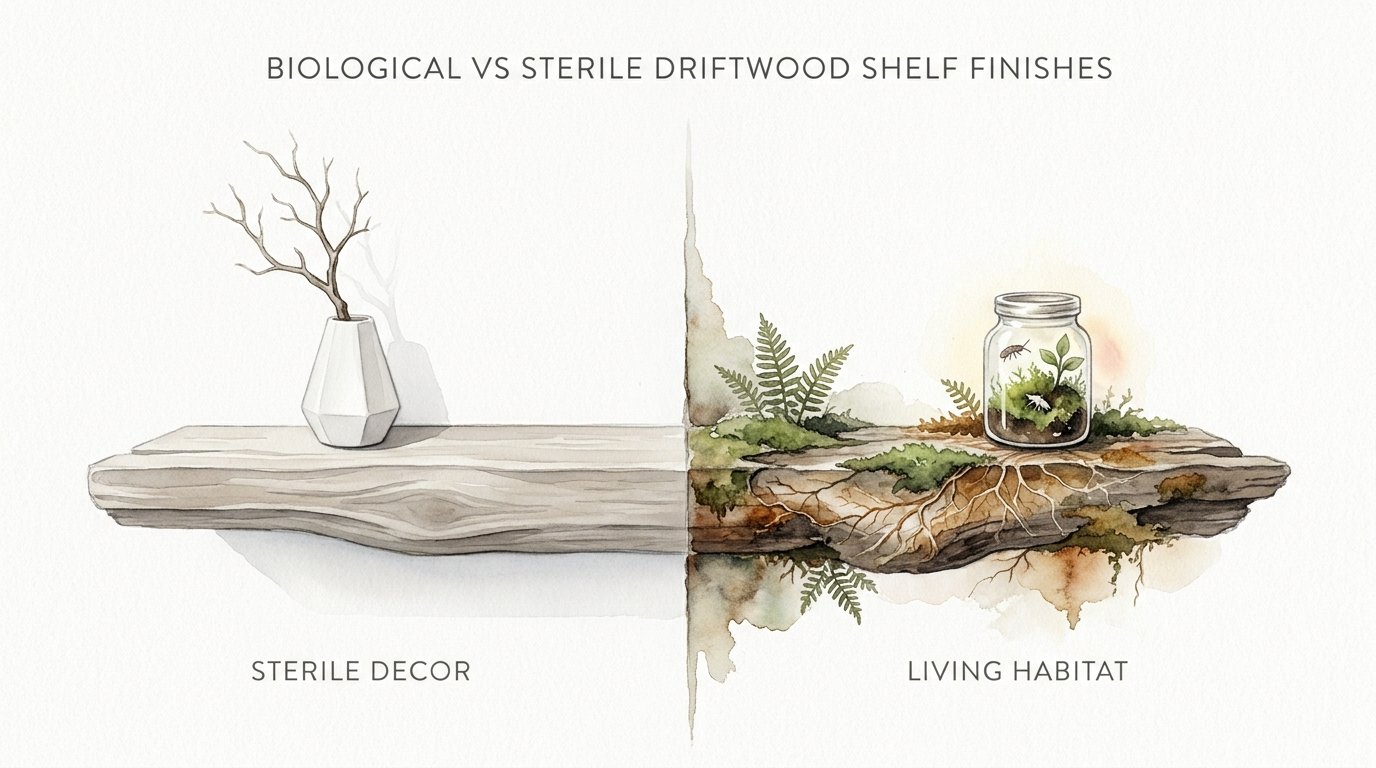
The standard approach to driftwood decor involves a harsh regimen of bleach, boiling, and plastic sealants. This process is designed to “kill” everything in the wood to prevent rot or pests. While effective at creating a static object, this method closes the pores of the wood and eliminates its natural ability to breathe. A sterile shelf is just a piece of plastic-wrapped timber that adds visual weight but contributes nothing to the air or energy of a room.
Biological finishes, on the other hand, treat the wood as a porous, active surface. Instead of sealing it with polyurethane or epoxy, you leave the grain open. This allows the wood to act as a hygroscopic buffer, absorbing excess moisture from the air when humidity is high and releasing it when the room dries out. This natural “breathing” helps stabilize the microclimate of your living space.
Retaining the wood’s natural chemistry is a vital part of this approach. Driftwood like Mopani or Bogwood is rich in tannins and terpenoids, which act as natural antimicrobial agents. These compounds don’t just sit there; they create a surface environment where beneficial microbes can outcompete harmful pathogens. Research in building biology suggests that untreated wood surfaces can actually reduce the survival time of certain harmful bacteria compared to plastic or metal.
How to Prep and Inoculate Your Living Shelf
Preparing wood for a living habitat starts with mechanical cleaning rather than chemical destruction. Use a stiff-bristled brush or an air compressor to remove loose debris, dirt, and decaying “furry” layers. If the wood was found in saltwater, soak it in distilled or dechlorinated water for two weeks, changing the water every few days to leach out the salt. Avoid bleach at all costs, as it kills the very pores you need for inoculation.
Inoculating the wood with moss is the next step in creating a “lung.” You can use the “slurry method” to establish a green carpet. Blend a handful of live moss—like Java moss or Hypnum moss—with a cup of distilled water and a tablespoon of unflavored Greek yogurt or curd. The yogurt provides the initial bacterial culture and nutrients the moss needs to take hold.
Apply this green paste to the deep crevices and rough textures of your driftwood using a paintbrush. Once applied, the wood needs a “dry start” phase. Keep the piece in a high-humidity environment, such as a large clear tote or a plastic-wrapped area, for 30 to 45 days. Mist the surface daily with distilled water. This allows the moss fragments to anchor their rhizoids into the wood fibers and the beneficial microbes to establish a colony.
The Science of Indoor Microbes and Air Quality
A living shelf acts as a probiotic surface for your home. When you inoculate wood with beneficial bacteria like Bacillus subtilis or allow the natural Staphylococcus epidermidis from your own skin to colonize the surface, you are practicing microbial competition. These “good” microbes take up the physical space on the wood, making it nearly impossible for toxic molds like Stachybotrys or Aspergillus to find a foothold.
Wood is naturally “porous” in a way that modern building materials are not. These microscopic tunnels in the wood fibers are where the magic happens. They trap dust particles and neutralize certain volatile organic compounds (VOCs) that circulate in indoor air. A moss-covered shelf adds another layer of filtration; moss is an exceptionally efficient air purifier, absorbing pollutants directly through its leaves.
This biological activity also creates a healthier ion balance in the room. Large, living wooden surfaces contribute to the production of negative ions, which are often lacking in modern, air-conditioned environments. Negative ions are associated with reduced stress and improved cognitive function. Your shelf is no longer just holding books; it is actively working to repair the atmospheric quality of your study or bedroom.
Benefits of a Living Habitat Approach
Choosing a living shelf over a sterile one offers measurable advantages for both the home and the inhabitant. The primary benefit is biophilic connection. Humans evolved in close contact with wood, soil, and plants; bringing these elements into the home in an “active” state reduces cortisol levels and lowers blood pressure. A piece of wood that changes, grows, and breathes provides a deep sense of calm that a plastic-coated alternative cannot match.
Maintenance actually becomes more intuitive over time. While a sterile shelf needs constant dusting and chemical cleaning to look “new,” a living shelf matures. The moss fills in, the wood darkens as it reacts to the light, and the ecosystem stabilizes. If you keep the humidity balanced, the shelf becomes self-cleaning to a degree, as the microbes break down the organic dust that would otherwise accumulate.
Air quality regulation is a practical, measurable gain. Homes with significant amounts of untreated, “living” wood surfaces often report more stable humidity levels throughout the seasons. This reduces the need for noisy humidifiers or dehumidifiers and protects other wooden furniture in the room from cracking.
Challenges and Common Pitfalls
The biggest hurdle for most people is the transition period. During the first few weeks of bringing untreated driftwood into a home, you might see a “white slime” or fuzzy mold appear. This is usually Cladosporium or a similar harmless fungus feeding on the remaining surface sugars in the wood. In a sterile mindset, this is a failure; in a living mindset, this is a stage of succession. Most of the time, this bloom will disappear on its own as the wood dries and the more stable microbes take over.
Managing moisture without damaging your walls is another critical challenge. Water and drywall are a bad combination. If you are misting your moss-covered shelf, you must ensure that the water doesn’t pool against the wall. Using spacers or “blocking” to keep the wood slightly off the wall surface is essential.
Over-watering is the most common cause of failure for the moss. Moss does not have roots; it absorbs moisture from the air. If the wood becomes waterlogged and stays “soggy” without airflow, it will rot. The key is to mist the surface until it is damp to the touch, then allow it to dry out slightly before the next misting. Think of it as a cycle of breath.
Limitations: When a Living Shelf May Not Work
Living shelves require a specific environmental baseline. If your room is windowless and has no airflow, the moss will die and the wood may develop unpleasant odors. Natural light or full-spectrum LED grow lights are non-negotiable for the moss to photosynthesize. Without light, the biological engine of the shelf stalls.
Environments with extreme temperature fluctuations can also be problematic. If the shelf is placed directly above a radiator or in the direct path of an air conditioning vent, the localized humidity will drop too fast for the moss to survive. These “micro-deserts” will kill the living components of the shelf, leaving you with a dry, dusty piece of wood.
Finally, consider the weight. Driftwood, especially dense hardwoods like Mopani or Malaysian wood, is incredibly heavy. When you add the weight of absorbed water and a layer of moss, a medium-sized shelf can easily exceed 40 pounds. If you aren’t prepared to drill into studs and use heavy-duty mounting hardware, a living shelf is not the right choice.
Comparison: Sterile Vs Living Driftwood Systems
| Feature | Sterile Decor | Living Habitat |
|---|---|---|
| Surface Finish | Sealed (Poly/Wax) | Open (Natural/Untreated) |
| Air Impact | VOC Outgassing (potentially) | Humidity & VOC Buffering |
| Microbiology | Inert/Dead | Probiotic/Beneficial Microbes |
| Maintenance | Low (Dusting) | Moderate (Misting/Light) |
| Longevity | Degrades visually over time | Matures and improves with age |
Practical Tips for the Living Practitioner
Mounting the wood is the first true test. Use “blind shelf supports” or 1/2-inch black pipe fittings to ensure the wood is anchored to the wall studs. Drill deep into the thickest part of the driftwood to insert the support rods. If your wood is irregularly shaped, you may need to use a level to mark the back edge and sand a flat “mating surface” so the wood sits flush against the wall.
Protecting your drywall from moisture can be handled with a simple strip of silicone or a thin piece of acrylic mounted to the back of the wood. This creates a waterproof barrier that prevents the mist from soaking into the plaster. Ensure there is at least a 1/4-inch gap between the back of the wood and the wall to allow for airflow.
Choosing the right moss species is vital for indoor success. Aquatic mosses like Java moss or Christmas moss are surprisingly resilient on land as long as humidity stays high. For a more “terrestrial” look, use Hypnum or Sheet moss. If you want to introduce beneficial microbes, spray the shelf once a week with a diluted probiotic solution designed for plants or homes.
Advanced Considerations: Automated Misting
If you plan on having multiple living shelves or a large focal piece, manual misting becomes a chore. Serious practitioners often integrate micro-misting systems into the shelf design. Small 1/4-inch tubing can be hidden behind the wood or routed through the wall, connected to a small silent pump and a reservoir hidden in a nearby cabinet.
Adding a solenoid valve and a smart timer allows you to automate the “breath” of the shelf. Setting the system to mist for 10 seconds every six hours ensures the moss stays vibrant even when you are away. This type of “probiotic architecture” transforms the shelving from a piece of furniture into an automated life-support system for your home’s air.
Lighting should also be considered an advanced variable. Moss thrives in the “blue” spectrum of light. Using a dedicated LED strip with a 6500K color temperature mounted under the shelf above will give your living shelf the energy it needs to thrive. This creates a beautiful, glowing effect that highlights the texture of the wood and the vibrancy of the green moss.
Examples and Scenarios
Consider a home office with a single, large piece of Manzanita driftwood mounted as a shelf. The branchy structure of the Manzanita provides dozens of “pockets” where moss can be tucked. In this scenario, the shelf holds a few light books and a couple of air plants (Tillandsia). The air plants thrive in the micro-humidity created by the moss, and the worker benefits from the improved focus that comes with looking at a living piece of art.
In a bathroom scenario, a dense piece of Mopani wood can be used. Mopani is naturally resistant to the high humidity and steam of a bathroom. Instead of inoculating it with a full carpet of moss, the owner allows the natural tannins to react with the moisture, creating a rich, dark patina. The untreated wood surface helps absorb odors and prevents the “stuffy” feeling common in smaller bathrooms.
For a large living room, a “Bio-Wall” integration involves three or four staggered driftwood shelves. These are connected by a single automated misting line. This setup creates a massive surface area for microbial life, acting as a powerful atmospheric regulator for the entire floor of the house.
Final Thoughts
Building a living driftwood shelf is an act of defiance against the sterile, disposable culture of modern home goods. It requires patience and a willingness to partner with nature rather than trying to dominate it. The result is a piece of furniture that feels ancient, grounded, and deeply beneficial to your physical health.
Embracing the biology of your home means accepting that things change. Moss will grow, wood will darken, and the ecosystem on your wall will find its own balance. This is not a project that you finish; it is a relationship that you maintain.
Starting with one small piece of wood is the best way to learn the rhythm of misting and the signs of a healthy microbial colony. As you gain confidence, you can expand your living habitat, eventually turning your entire home into a breathing, vibrant lung that supports you as much as you support it.
Sources
1 wetplants.com (https://www.wetplants.com/blogs/news/a-mossy-masterpiece-how-to-attach-java-moss-to-driftwood-like-a-pro) | 2 homebiotic.com (https://homebiotic.com/) | 3 re-thinkingthefuture.com (https://www.re-thinkingthefuture.com/interior-design/a9544-what-are-the-natural-finishes-for-interiors/)