Multi-use Driftwood Shelving For Small Spaces
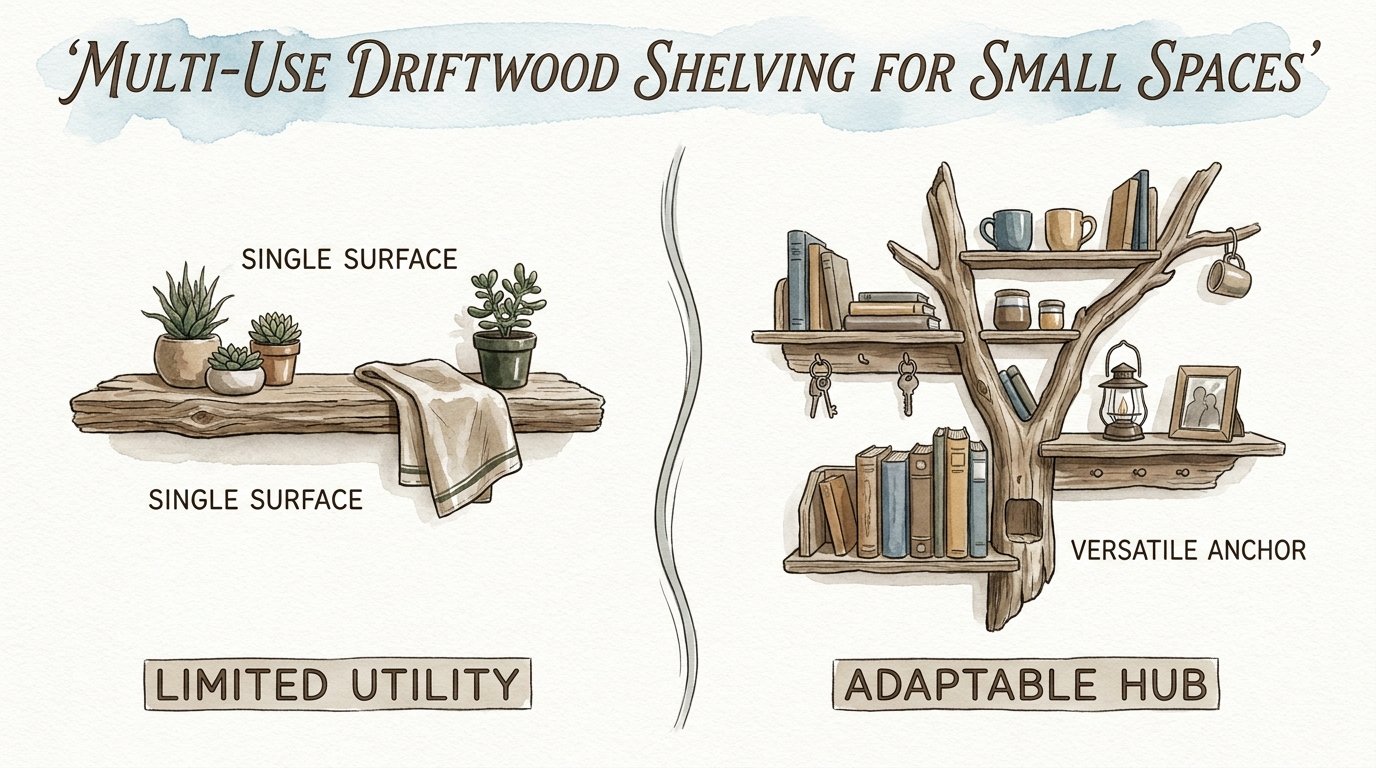
If your shelf only does one job, it’s wasting your wall space. Why buy a shelf, a coat rack, and a tool organizer separately? In nature, every structure is ‘Multi-Use’. I found one piece of storm-tossed cedar that does it all. It’s a bookshelf, a key holder, a hanging plant rack, and a vertical light mount. One anchor to rule the room.
[affiai]Living in tight quarters demands a bit of pioneer grit and a lot of ingenuity. You cannot afford to let a square foot of vertical real estate go to waste on a single-purpose plank. Most store-bought shelves are flimsy veneers that bow under the weight of a few heavy books. They offer no character and even less utility. This guide will show you how to take a raw, weathered gift from the water and turn it into the hardest-working surface in your home.
We are going to move beyond the idea of “storage” and toward the concept of an “anchor.” A good piece of driftwood isn’t just a place to put things. It is a structural tool that organizes your life and brings a piece of the wild indoors. Let’s get to work.
Multi-use Driftwood Shelving For Small Spaces
Multi-use driftwood shelving is a method of vertical organization that utilizes foraged, weathered timber to serve three or more domestic functions simultaneously. This approach treats a single piece of wood as a modular hub. You might use the top surface for books, the underside for hooks, and the natural hollows for greenery. It exists to solve the “clutter creep” that happens when you keep adding separate organizers for every new item you bring home.
In the real world, you see this logic in old maritime cabins and homesteads. Space was tight, and materials were scarce. Every peg and plank had to earn its keep. Driftwood is particularly suited for this because the water has already done the heavy lifting. It has stripped away the soft sapwood, leaving behind a dense, character-rich core that can handle significant stress if prepared correctly.
Think of it like a Swiss Army knife for your wall. Instead of a flat, sterile board, you have a three-dimensional sculpture. The irregular shapes and sturdy branches of a well-chosen piece of cedar or oak provide natural mounting points for lights or plants that a flat shelf simply cannot offer. It turns a utility item into a focal point.
How to Prepare and Build Your Multi-Use Shelf
Every project starts with the hunt. You are looking for wood that has been tumbled and cured by the elements. Cedar is the gold standard for its rot resistance and light weight. Oak and maple offer incredible strength but require more effort to mount. Once you find your piece, you must treat it like a serious building material.
The first step is a deep clean. Use a stiff nylon brush to remove loose sand, salt, and debris. Never skip the disinfection phase. A soak in a solution of one part bleach to ten parts water for at least 30 minutes will kill any lingering bacteria or hitchhiking insects. For larger pieces that won’t fit in a tub, a thorough scrub with washing soda and a high-pressure garden hose can do the trick.
Drying is the most critical stage. Wood that is damp on the inside will warp your walls or grow mold once it hits the indoor air. Allow the piece to air dry in a well-ventilated area for at least a week. If the piece is small enough, you can “kiln-dry” it in an oven at 200 degrees for two to four hours. This heat kills deep-seated pests and ensures the moisture content is stable.
Once dry, you need to flatten the mounting side. A hand plane or a belt sander works best here. You need a flush surface that will sit tight against the drywall. This is also the time to drill your holes for integrated features. Use a spade bit to create “planter pockets” for succulents or a router to cut a channel for LED strip lighting along the back edge. Finish the wood with a light coat of linseed or tung oil to bring out the grain without making it look “plastic.”
Benefits of the Multi-Use Approach
The primary advantage is the massive gain in floor space. When you combine a coat rack, a shelf, and a light fixture into one wall-mounted unit, you eliminate the need for three separate pieces of furniture. This opens up walkways and makes a small room feel significantly larger. It is the ultimate “small space” hack.
Durability is another major factor. Solid driftwood, especially species like cedar or juniper, is remarkably stable. Unlike particle board or MDF, it will not sag under its own weight over time. The “Sagulator” (a common woodworking tool) often shows that solid timber has a much higher resistance to deflection than modern composite materials. You are building something that can last decades, not seasons.
Aesthetics play a role too. There is a psychological benefit to bringing organic shapes into a rectangular room. It softens the edges of a living space. Every piece of driftwood is a one-of-a-kind artifact. You aren’t just buying organization; you are installing a piece of history that has been shaped by the tides.
Challenges and Common Mistakes
The most common error is underestimating the weight of the wood. Driftwood might look light, but a thick slab of water-cured oak can easily weigh thirty pounds before you even put a book on it. Many beginners try to use plastic drywall anchors. This is a recipe for disaster. Those anchors will eventually pull through the gypsum, leaving a massive hole and a broken shelf.
Neglecting the “clean and kill” phase is another frequent pitfall. Foraging wood from a beach or riverbank means you are inviting the outdoors in. Without proper disinfection, you may find sand gnats or wood-boring beetles emerging months later. Always soak or heat-treat your wood before it crosses your threshold.
Ignoring the center of gravity is a subtle but dangerous mistake. Because driftwood is irregular, the weight is rarely distributed evenly. If you mount it using only two points, the shelf might try to rotate or “roll” off the wall. You must find the balance point and ensure your primary fasteners are located where the bulk of the weight sits.
Limitations and When This May Not Work
This method is not ideal for rental units with paper-thin walls or strict “no-hole” policies. Because these shelves are heavy and multi-functional, they require deep penetration into the wall studs. Command strips or light-duty nails will not suffice. If you cannot find a stud, you should reconsider the project or stick to much smaller, purely decorative pieces.
Weight limits are a reality. While the wood itself is strong, the lever arm created by a deep shelf puts immense torque on the mounting screws. If you plan to store an entire encyclopedia set, you need a different engineering approach, such as a floor-supported unit. Driftwood is best for “active storage”—the items you use every day, like keys, a few books, and a lamp.
Environmental constraints also matter. High-humidity environments, like a poorly ventilated bathroom, can cause the wood to expand and contract. This might loosen the mounting hardware over time. In these areas, you must use a high-quality sealant and check the tightness of your screws every few months.
Driftwood vs. Reclaimed Barn Wood
| Feature | Driftwood | Reclaimed Barn Wood |
|---|---|---|
| Shape | Organic, irregular, 3D. | Linear, flat, predictable. |
| Preparation | High (soaking, disinfecting). | Moderate (de-nailing, sanding). |
| Mounting | Difficult (irregular surface). | Easy (flat surface). |
| Versatility | Extreme (hooks, light mounts). | Standard (surface storage). |
Practical Tips and Best Practices
Always mount into at least two wall studs. A stud finder is your best friend here. If the studs don’t line up with your desired shelf position, mount a “backboard” or a French cleat to the studs first, then attach the driftwood to that. This spreads the load and gives you a rock-solid foundation.
Use “toggle bolts” if you absolutely cannot hit a stud for the secondary mounting points. Toggle bolts provide a “wing” behind the drywall that offers much higher pull-out resistance than standard anchors. However, at least one main fastener should always be in a solid wood stud.
Integrate your lighting early. If you want a “glowing” shelf, route a small groove along the back edge before you mount it. You can tuck a low-voltage LED strip into this groove. It provides ambient light without the clutter of a lamp cord on the shelf surface. Use small brass tacks to secure the wire along the underside of the wood.
Advanced Considerations for Practitioners
For the serious builder, consider “hidden hardware” mounting. This involves drilling deep, precise holes into the back of the driftwood and using steel rods anchored into the wall studs. The shelf slides onto these rods, creating a “floating” effect. This requires a drill press and a steady hand, but the result is a shelf that looks like it is growing directly out of the wall.
Think about “live-edge” joinery if you need a longer span. You can “scarf” two pieces of driftwood together using a lap joint and waterproof epoxy. This allows you to create a shelf that wraps around a corner or spans an entire wall while maintaining the organic look. Always reinforce these joints with internal dowels for safety.
Waterproofing is essential if you are using the shelf as a plant rack. If you drill a “pocket” for a succulent, line that hole with a two-part epoxy or a small plastic insert. Even a tiny amount of standing water will rot the wood from the inside out over time. Proper drainage or a sealed barrier will keep your shelf healthy for years.
Example Scenarios
Imagine a small entryway in a city apartment. Instead of a bulky console table, you install a four-foot piece of weathered cedar. The top holds your mail and a small bowl for coins. Three antique brass hooks are screwed into the denser knots on the underside to hold your heavy winter coats. On the far right, a natural curve in the wood creates a perfect cradle for a trailing ivy plant. A single LED strip along the back provides a warm “welcome home” light. Everything you need is contained in one six-inch-deep footprint.
Consider a tiny bedroom where a nightstand is impossible. A thick piece of driftwood is mounted at bed height. It holds a book and a glass of water. A hole is drilled through the center to accommodate a pendant light cord, allowing the bulb to hang exactly where you need it for reading. The natural texture of the wood serves as a headboard substitute, adding warmth to the room without taking up an inch of floor space.
Final Thoughts
Building a multi-use driftwood shelf is more than a weekend craft project. It is an exercise in efficiency and a tribute to the resilience of natural materials. You are taking something the world discarded and turning it into the most functional part of your home. It requires patience to clean, grit to sand, and a careful eye to install.
The results speak for themselves. You gain a unique, sturdy, and versatile anchor that solves multiple problems at once. You stop being a consumer of temporary furniture and start being a curator of your own space. It is a small change that yields a massive improvement in how a room feels and functions.
Go find your piece of wood. Treat it with respect, prepare it with care, and give it a job to do. Your walls—and your floor space—will thank you for it. Experiment with different species and mounting techniques until you find the balance that works for your home. There is no one right way to do this, only the way that serves your life best.
Sources
1 youtube.com (https://www.youtube.com/watch?v=aHIK8U844wE) | 2 masterplankuk.com (https://masterplankuk.com/blogs/news/shelves-with-wood-a-comparison-guide-to-solid-timber-and-handcrafted-styles) | 3 coloradostyle.com (https://www.coloradostyle.com/blog/furniture-decorating/multifunctional-furniture-space-saving-benefits/) | 4 homedepot.com (https://www.homedepot.com/c/ah/how-to-hang-shelves/9ba683603be9fa5395fab90a500e3e8) | 5 tailorwoodhaven.com (https://tailorwoodhaven.com/blogs/tree-bookshelf/what-is-the-best-type-of-wood-for-shelves-a-complete-guide-for-every-space) | 6 youtube.com (https://www.youtube.com/watch?v=h1AimurQQnE) | 7 parklanejewelry.com (https://www2.parklanejewelry.com/how-to-wash-driftwood/)