Non Toxic Nursery Shelving Ideas
Is your ‘modern’ shelf secretly off-gassing chemicals into your home while you sleep? Modern furniture is often a cocktail of formaldehyde and synthetic resins. Driftwood is the ultimate alternative: cured by the sun, washed by the salt, and polished by the sand. It’s the only shelving that brings the scent of the ocean into your home instead of the smell of a factory.
[affiai]Choosing materials for your living space is more than an aesthetic choice; it is a health decision. In an era of flat-pack convenience, we have traded the soul of the forest for pressed sawdust and chemical binders. When you bring a new piece of mass-produced furniture into a nursery, you are often introducing a source of persistent air pollution that can last for years.
Driftwood offers a different path. It is a material that has survived the elements, stripped of its softest parts by the relentless movement of water and the bleaching power of the sun. It is a pioneer’s resource, reclaimed from the shoreline and repurposed with a bit of grit and patience. By choosing ocean-cured wood, you are opting for a history written by the tides rather than a factory manifest.
This guide will walk you through the transition from synthetic to natural. We will explore why the materials we choose for our most sensitive rooms matter and how you can harness the rugged beauty of driftwood to create a safe, breathable environment for your family.
Non Toxic Nursery Shelving Ideas
Non-toxic nursery shelving refers to storage solutions crafted from materials that do not emit harmful Volatile Organic Compounds (VOCs) or other chemical residues. In a typical modern nursery, parents often focus on the color of the paint or the softness of the rug, but the shelving units holding those organic cotton onesies are often made of Medium Density Fiberboard (MDF) or particle board. These composite woods are held together by urea-formaldehyde resins, which release gas into the air long after the “new furniture smell” has faded.
Infants are particularly vulnerable to these emissions. Their respiratory rates are higher than adults, meaning they inhale more air—and any pollutants within it—relative to their body weight. Their developing organs and immune systems are still learning how to process toxins, making the air quality of their sleeping environment a top priority for health-conscious parents.
Driftwood shelving serves as a primary example of “ocean-cured” furniture. Unlike kiln-dried lumber that may be treated with anti-fungal chemicals, driftwood has been naturally processed. The salt in the seawater acts as a natural preservative, while the sun’s ultraviolet rays provide a deep, natural sterilization. When you look for non-toxic nursery shelving ideas, you are essentially looking for ways to bring the outdoors in, using materials that have already stood the test of time and nature.
How to Source and Prepare Driftwood Shelving
Turning a piece of beach debris into a functional nursery shelf requires a systematic approach. You cannot simply pull a log from the sand and bolt it to the wall. The process involves scavenging, cleaning, sanitizing, and finishing.
The first step is scavenging. Look for “hard” driftwood—pieces that feel heavy for their size and do not crumble when you press a thumbnail into the grain. Avoid wood that smells of rot or petroleum, as these may have been contaminated by oil spills or are in the early stages of decay. You want wood that has been “polished” by the sand, leaving behind the dense heartwood.
Once you have your piece, the cleaning process begins. Rinse the wood thoroughly with fresh water to remove sand, loose bark, and salt crust. Use a stiff-bristled brush to scrub the crevices. If the wood is particularly large or has deep knots, a water flosser or a high-pressure hose can help blast out hidden debris.
Sanitization is the most critical step for a nursery environment. Even though the ocean is a harsh environment, the wood may still harbor microscopic organisms or insects. Submerge the wood in a solution of one part vinegar to four parts water for 24 hours. Vinegar is a natural disinfectant that is safe for nurseries. For a deeper clean, some pioneers use a very dilute bleach solution (1 part bleach to 10 parts water), but this must be followed by extensive freshwater rinsing and a long drying period in the sun to ensure no chlorine residue remains.
Finally, the wood must dry completely. This can take anywhere from a few days to several weeks depending on the thickness of the piece. Placing the wood in a well-ventilated area with direct sunlight is the best way to ensure the core is dry. A piece of wood that is damp on the inside will eventually mold, defeating the purpose of your non-toxic project.
Benefits of Ocean-Cured Materials
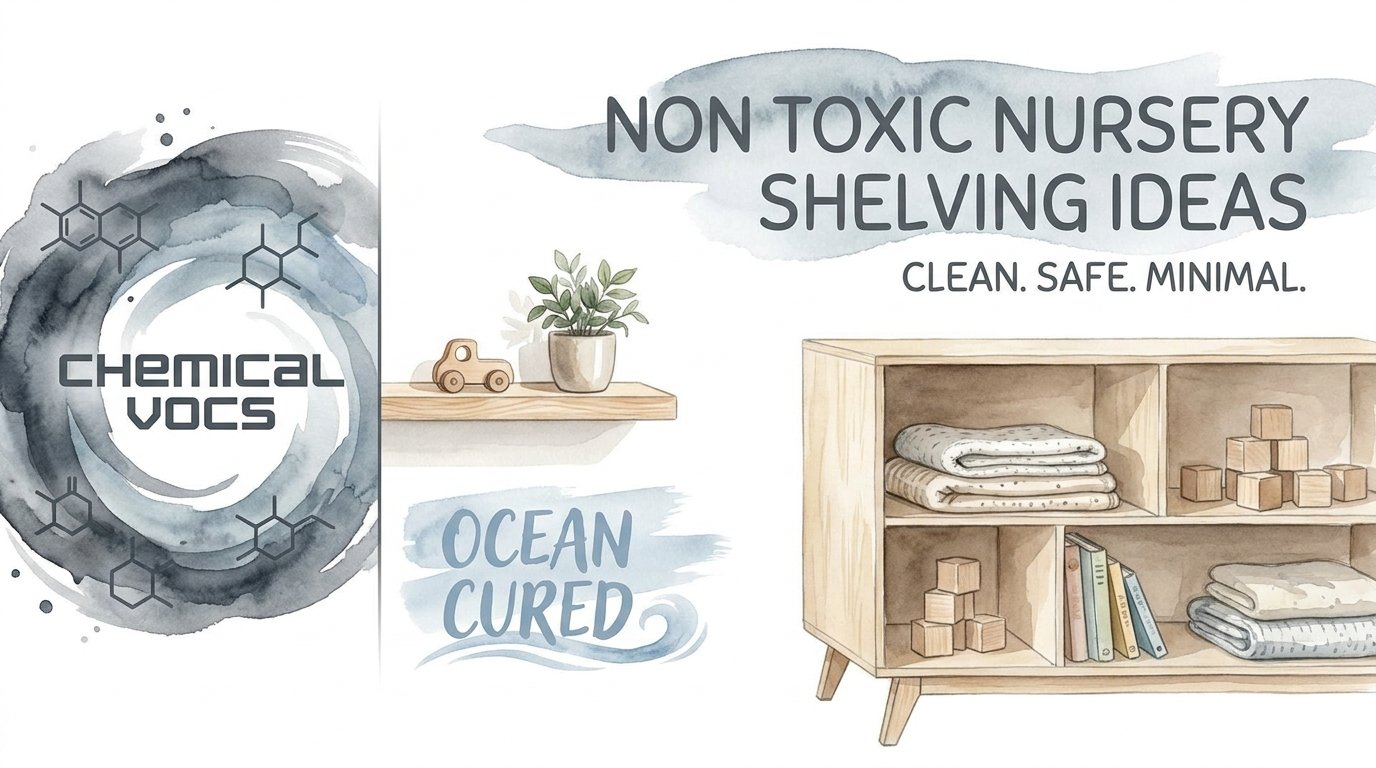
The primary advantage of driftwood is the total absence of synthetic binders. When you compare CHEMICAL VOCS vs OCEAN CURED materials, the differences are measurable. Traditional shelving often contains benzene, toluene, and formaldehyde. Driftwood contains only cellulose, lignin, and trace minerals from the sea.
Beyond the chemical profile, driftwood offers biophilic benefits. Biophilic design is the practice of incorporating natural elements into the built environment to reduce stress and improve cognitive function. Studies have shown that children in environments with natural textures and materials exhibit better concentration and lower cortisol levels. The tactile experience of touching real, weathered wood provides a sensory connection to the natural world that plastic-coated MDF simply cannot replicate.
Sustainability is another significant factor. Using driftwood is a form of radical recycling. You are not contributing to deforestation or the energy-intensive manufacturing processes required to create engineered wood. You are reclaiming a resource that nature has already discarded, giving it a second life in your home. This “pioneer-grit” approach to decorating respects the environment while providing a unique, one-of-a-kind aesthetic that no store-bought shelf can match.
Challenges and Common Mistakes
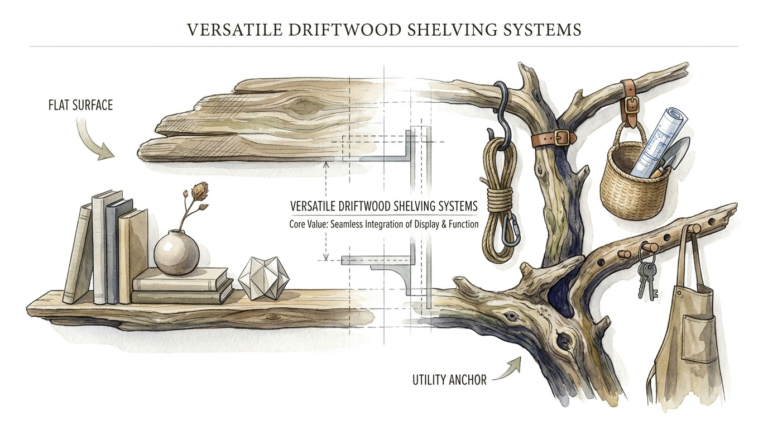
Working with driftwood is not without its hurdles. The most common mistake beginners make is failing to account for the irregularity of the wood. Unlike a standard 1×12 plank from the hardware store, driftwood is rarely flat or square. This makes mounting difficult. If you try to use standard L-brackets on a curved log, you will find the shelf wobbles or sits at an awkward angle.
Another challenge is salt residue. If the wood is not rinsed thoroughly with fresh water, it will “sweat” in humid conditions. The salt attracts moisture from the air, which can lead to a damp surface that ruins books or clutters placed on the shelf. This “hygroscopic” property of salt is why the freshwater soaking phase is non-negotiable.
Weight is also a concern. High-quality driftwood is often very dense. A three-foot shelf can weigh significantly more than a modern pine equivalent. Many DIYers make the mistake of using drywall anchors instead of finding wall studs. In a nursery, a falling shelf is a major safety hazard. You must ensure that your mounting hardware is rated for the weight and that it is anchored into the structural framing of the house.
Limitations of Driftwood Shelving
While driftwood is a superior health choice, it is not ideal for every scenario. It is generally not suitable for “heavy-duty” libraries. Because the wood has been weathered, it may have internal fissures that reduce its structural load-bearing capacity compared to fresh-cut oak or maple. It is best used for decorative items, baby monitors, or a small collection of bedtime stories.
Sourcing can also be a limitation. Depending on your geography, finding high-quality driftwood may require a trip to the coast or purchasing from a specialized dealer. If you are buying online, you lose the ability to inspect the wood for density and scent. You are also at the mercy of whatever the tide brings in, which means you cannot easily “order” a specific size or shape.
Finally, driftwood does not provide the “clean” look of a modern minimalist nursery. It is rugged, grayed, and textured. If your design goal is a perfectly symmetrical, white-gloss room, the organic chaos of driftwood may feel out of place. It requires a certain appreciation for imperfection—the “grit” that comes with choosing natural history over factory precision.
Comparison: Synthetic vs. Natural Shelving
To help visualize the trade-offs, consider the following comparison between common modern shelving materials and ocean-cured driftwood.
| Feature | MDF / Particle Board | Solid Kiln-Dried Pine | Ocean-Cured Driftwood |
|---|---|---|---|
| Chemical Profile | High VOCs (Formaldehyde) | Low VOCs (Depends on finish) | Zero VOCs (Nature-cured) |
| Durability | Low (Swells with moisture) | Medium | High (Hardened by elements) |
| Aesthetic | Uniform, Flat | Traditional Wood Grain | Unique, Weathered, Sculptural |
| Environmental Impact | High (Industrial waste) | Medium (Forestry) | Negative (Reclaimed waste) |
| Installation Ease | Very Easy (Pre-drilled) | Easy | Difficult (Requires custom fit) |
Practical Tips for Installation and Care
When you are ready to mount your non-toxic driftwood shelf, start by identifying the “flat” side. Most driftwood has a side that was protected from the elements or worn flat by dragging along the sand. This will be your top surface. If no flat surface exists, you may need to use a hand plane or a drawknife to create a level area where items can sit securely.
For mounting, consider using heavy-duty “floating” shelf brackets. These are metal rods that sit inside holes drilled into the back of the wood. This method hides the hardware and lets the natural beauty of the driftwood take center stage. Ensure the holes are drilled perfectly straight; a drill press is highly recommended for this stage. If you prefer a more rustic look, black iron pipe fittings provide a sturdy, industrial contrast to the organic wood.
To maintain the shelf, avoid synthetic furniture polishes. These often contain silicones and artificial fragrances that reintroduce VOCs into the room. Instead, use a simple mixture of beeswax and olive oil or pure walnut oil. Rub a small amount into the wood once a year to keep the fibers from becoming too brittle. This will nourish the wood without creating a toxic film.
Advanced Considerations for Serious Practitioners
For those who want to go beyond a basic shelf, consider the structural joinery of irregular shapes. If you are creating a multi-tiered driftwood unit, you cannot rely on standard butt joints. You may need to use “scribe-fitting,” a technique where you trace the profile of one piece of wood onto another and carve out a matching pocket. This creates a rock-solid connection that respects the natural curves of the material.
Another advanced consideration is the “salt-leaching” process for high-end finishes. If you intend to apply a natural resin like shellac, the salt must be almost entirely removed. Some practitioners use a “bath” of distilled water, changed daily for a week, to pull the deep-seated sodium out of the wood fibers. This prevents the shellac from clouding or peeling over time.
Think about the light in the nursery as well. Driftwood has a high silver and gray content which reflects light differently than warm-toned woods. Placing these shelves near a window can enhance the biophilic effect, as the natural UV light will continue to “bleach” the wood over time, keeping it looking fresh and clean.
Examples and Scenarios
Imagine a nursery designed with the “Ocean Breeze” theme. Instead of a plastic changing table and MDF bookshelves, the room features three staggered driftwood shelves mounted on a wall painted with zero-VOC clay paint. The shelves hold a few organic cotton plushies, a glass jar of sea glass collected on the same trip as the wood, and a small, non-toxic succulent in a terracotta pot.
In this scenario, the parent has not only created a beautiful room but has also eliminated a major source of indoor air pollution. When the sun hits the room in the afternoon, there is no chemical odor. Instead, there is the faint, clean scent of sun-dried wood. The shelves are not just furniture; they are conversation pieces that tell a story of a day spent at the shore, connecting the child to the environment before they can even walk.
Another example is the “Pioneer Study” corner. A single, thick piece of driftwood is used as a ledge for a nursing chair. It is finished with pure tung oil, which provides a water-resistant surface for a cup of tea or a bottle. The rugged texture provides a grounding element in a room that is otherwise filled with soft fabrics, creating a balanced, tactile environment.
Final Thoughts
Building a non-toxic home is a journey of small, intentional choices. By rejecting the “cocktail of chemicals” found in modern furniture and embracing the raw, ocean-cured beauty of driftwood, you are making a statement about what matters. You are prioritizing the long-term health of your family and the health of the planet.
This approach requires more effort than a trip to a big-box store. It requires the grit to scavenge, the patience to clean, and the skill to mount irregular materials. However, the result is a home that breathes, a nursery that protects, and a living space that feels truly alive.
Do not be afraid to experiment with these natural materials. Start with a single shelf and see how it changes the “feel” of the room. Once you experience the difference between factory-made and nature-cured, you may find it difficult to ever go back to synthetic alternatives. Let the ocean provide your decor, and let your home be a sanctuary of natural purity.
Sources
1 parklanejewelry.com (https://www2.parklanejewelry.com/how-to-wash-driftwood/) | 2 indoordoctor.com (https://www.indoordoctor.com/blog/furniture-off-gassing-your-health/) | 3 hawk-hill.com (https://www.hawk-hill.com/how-to-clean-driftwood/) | 4 thbd.com.au (https://www.thbd.com.au/post/toxic-nursery) | 5 molekule.com (https://molekule.com/blogs/all/vocs-the-hidden-danger-for-your-growing-child) | 6 dksstores.com (https://dksstores.com/blog-post49) | 7 wikihow.com (https://www.wikihow.com/Preserve-Driftwood) | 8 integrishealth.org (https://integrishealth.org/resources/on-your-health/2024/january/biophilic-design) | 9 biophilicproducts.org (https://biophilicproducts.org/biophilic-design-blog/biophilic-design/benefits-of-biophilic-design/) | 10 lakewedoweelife.com (https://www.lakewedoweelife.com/lake-life/driftwood-art-and-treasures-by-tammy-lovvorn) | 11 thriftydecorchick.com (https://www.thriftydecorchick.com/2021/11/how-to-build-heavy-duty-floating-shelves.html) | 12 tyfinefurniture.com (https://www.tyfinefurniture.com/blogs/blog/formaldehyde-and-other-vocs-in-furniture-explained) | 13 instructables.com (https://www.instructables.com/Food-Safe-Wood-Finish-With-Shellac-Bees-Wax-Walnut/) | 14 boulderassociates.com (https://www.boulderassociates.com/knowledge/biophilic-design-using-nature-to-nurture/) | 15 ecoparent.ca (https://www.ecoparent.ca/eco-home/how-biophilic-design-can-enrich-childrens-lives) | 16 hawk-hill.com (https://www.hawk-hill.com/diy-floating-driftwood-shelf/) | 17 famousartisan.com (https://famousartisan.com/eco-friendly-wood-finishes-a-guide-to-safer-sustainable-choices/) | 18 heritagenaturalfinishes.com (https://heritagenaturalfinishes.com/products/beesblock) | 19 rmpfinishes.com (https://www.rmpfinishes.com/blog/news/5-natural-finishes-environmentally-friendly/) | 20 believeel.com.au (https://www.believeel.com.au/biophilic-design/)