screen free evening activities
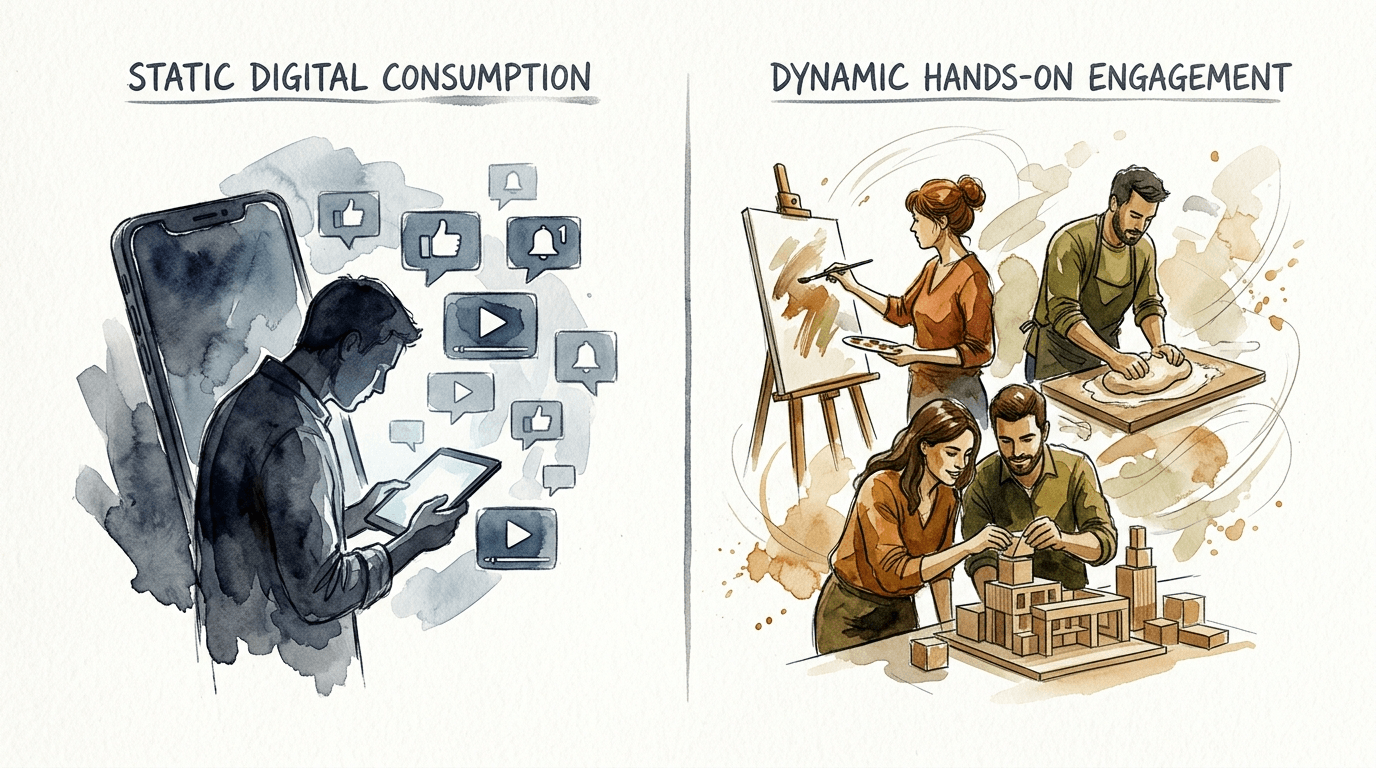
When was the last time you actually ‘did’ something after work? Static consumption drains your energy. Dynamic engagement restores it. Here are 25 ways to get your hands moving and your brain firing tonight.
[affiai]Most of us finish a long day at the office only to transition from a large screen to a medium screen, then eventually a small screen in bed. This cycle of passive consumption might feel like resting, but it often leaves us feeling more depleted than when we started. Our brains are wired for interaction, not just observation.
Breaking the “digital loop” requires more than just willpower; it requires a menu of compelling alternatives. When you engage in hands-on activities, you shift your nervous system from a state of high-alert processing to one of rhythmic, restorative flow. This isn’t just about avoiding blue light—it is about reclaiming your evening hours for genuine personal growth and relaxation.
screen free evening activities
Screen-free evening activities are intentional pursuits that do not require a digital interface. These can range from high-energy physical movements to low-energy creative hobbies. The core goal is to replace “static consumption”—like scrolling through social media or autoplaying streaming services—with “dynamic engagement.”
In a real-world context, these activities serve as a vital “buffer zone” between the high-stress demands of the workday and the restorative state of deep sleep. Digital devices are designed to keep us in a state of variable reward, constantly seeking the next hit of dopamine. In contrast, screen-free hobbies often provide “slow-burn” satisfaction. They may take longer to provide a reward, but the sense of accomplishment is deeper and more lasting.
Think of it like the difference between eating a candy bar and cooking a three-course meal. The candy bar is an instant hit that leaves you hungry later. The meal takes effort but nourishes you on a fundamental level. By integrating screen-free options into your nightly routine, you are choosing long-term vitality over short-term distraction.
The 25-Activity Master List
- Paperback Reading: Revisit the tactile sensation of turning physical pages. It reduces eye strain and helps your brain track narratives more effectively than digital text.
- Bullet Journaling: Use a physical notebook to map out your thoughts, track habits, or plan your next day without the distraction of notifications.
- Acoustic Instrument Practice: Whether it’s a guitar, piano, or even a harmonica, the vibrations of live music have a grounding effect on the nervous system.
- Gourmet Meal Prep: Focus on the sensory details of cooking—the smell of fresh herbs, the sound of a knife on a wooden board, and the heat of the stove.
- Mechanical Puzzles: Dust off a 1,000-piece jigsaw puzzle or try a Rubik’s cube. These require spatial reasoning and fine motor skills.
- Sketching or Doodling: You don’t need to be an artist. The act of moving a pencil across paper helps process the day’s emotions.
- Indoor Gardening: Repot your houseplants, prune dead leaves, or start a small herb garden on your windowsill.
- Vinyl Listening Sessions: Listen to an entire album from start to finish without skipping tracks. It turns music into an active experience rather than background noise.
- Leatherworking or Crafting: Engage in a “heavy” hobby that requires tools and physical force, which can be incredibly cathartic after a day of typing.
- Board Game Night: Invite a friend over for a classic game like Chess, Scrabble, or Catan. It fosters social connection without a digital medium.
- Stretching and Mobility: Spend 20 minutes on a yoga mat working through tight muscles. Focus entirely on the physical sensations in your body.
- Letter Writing: Write a physical letter to a friend or relative. The slow pace of handwriting encourages deeper reflection.
- Analog Photography: If you have an old film camera, spend time cleaning it or organizing physical prints into an album.
- Meditation and Breathwork: Sit in silence. Focus on the rhythm of your breath to lower your heart rate and clear mental clutter.
- Home Organization: Tackle one small area, like a junk drawer or a bookshelf. The visual order provides an immediate sense of control.
- Baking Bread: The process of kneading dough is rhythmic and meditative, and the result is a tangible, delicious reward.
- Model Building: Assemble a car, plane, or architectural set. It requires high levels of “deep focus” and patience.
- Tea Ceremony: Turn making a cup of tea into a multi-step ritual. Focus on the temperature, the steeping time, and the aroma.
- Urban Hiking: Take a 30-minute walk through your neighborhood. Leave your phone at home and simply observe your surroundings.
- Knitting or Crochet: The repetitive motion of “stitching” is a proven way to reduce anxiety and enter a flow state.
- Logic Puzzles: Solve a Sudoku or a Crossword in a physical book. It keeps your cognitive gears turning without blue light exposure.
- Deep Skincare Routine: Instead of a quick wash, spend time with a face mask or a facial massage. It’s a form of physical self-care that signals “rest” to the brain.
- Podcasting (Listening Only): While technically digital, using a dedicated audio device to listen to a story while your eyes are closed is a great middle-ground.
- Candle Making: A creative hobby that involves chemistry, scent, and a beautiful final product for your home.
- Furniture Restoration: Sanding down an old wooden chair or polishing metal hardware can be a deeply satisfying physical outlet.
How to Start Your Screen-Free Routine
Shifting your evening habits doesn’t happen by accident. It requires a systematic approach to environment design. If your phone is the easiest thing to reach, you will reach for it every time. You must create a “path of least resistance” for your screen-free activities.
Step 1: Define Your “Hard Stop.” Choose a time—perhaps 8:30 PM—when all screens go off. This is your digital curfew. Setting an alarm on your phone to signal the end of its own use can be a helpful, ironic tool for success.
Step 2: Create a Charging Station. Designate a spot outside of your bedroom—ideally in the kitchen or hallway—where all devices live for the night. Once the phone is plugged in there, it stays there. This physical distance reduces the urge to “just check one thing.”
Step 3: Stage Your Materials. If you want to read, put the book on your pillow. If you want to paint, set the easel up before you leave for work in the morning. Visual cues act as “gentle nudges” that direct your behavior toward your goals.
Step 4: Start Small. Don’t try to go four hours screen-free on your first night. Start with a 30-minute block and gradually expand it as your “analog muscles” get stronger. Consistency is more important than duration in the early stages.
Benefits of Unplugging After Work
The transition to screen-free evenings offers measurable improvements to your quality of life. Research consistently shows that reducing evening screen time directly correlates with better sleep hygiene and reduced symptoms of anxiety. When you step away from the digital world, you give your brain the space it needs to process the day’s events.
Melatonin Regulation: Exposure to blue light from screens suppresses the production of melatonin, the hormone responsible for sleep. By switching to analog activities, you allow your body’s natural circadian rhythm to take over, making it easier to fall asleep and stay asleep.
Cortisol Reduction: Social media and work emails keep your brain in a state of “threat detection.” Checking your feed can spike cortisol levels. Hands-on hobbies like gardening or knitting trigger the parasympathetic nervous system, lowering your stress hormones and inducing a state of calm.
Cognitive Restoration: Constant digital input fragments our attention. Screen-free activities often require “sustained attention,” which helps rebuild your ability to focus deeply on complex tasks. This “mental gym” makes you more productive and clear-headed during your working hours.
Common Challenges and Pitfalls
The biggest obstacle to a screen-free evening is the dopamine loop. Modern apps are engineered to provide instant, variable rewards. In contrast, reading a difficult book or learning to knit provides delayed gratification. In the first few days of your new routine, you might feel bored or restless. This is a normal “withdrawal” symptom as your brain recalibrates to a slower pace of stimulation.
Another common mistake is over-complicating the hobby. If your screen-free activity requires an hour of setup and specialized equipment you don’t yet have, you will revert to the TV. Keep your alternatives simple and accessible. The goal is to lower the barrier to entry so that doing the activity is almost as easy as picking up a remote.
Finally, watch out for “Digital Creep.” This is when you use a screen “just for a second” to look up a recipe or check a fact. Before you know it, you’ve spent twenty minutes scrolling. To avoid this, use physical tools whenever possible—printed cookbooks, paper dictionaries, and analog clocks are your best allies.
Limitations and Practical Constraints
While a 100% screen-free evening is the ideal, it isn’t always practical. Those in “on-call” professions, parents with children in extracurricular activities, or individuals managing emergencies need to remain reachable. In these cases, the goal should be “Mindful Usage” rather than total abstinence.
Environmental limitations can also play a role. If you live in a small studio apartment, you might not have space for a woodworking bench or a large puzzle table. In these scenarios, focus on “mobile” screen-free activities like journaling, stretching, or reading. The key is to adapt the principle of dynamic engagement to your specific living situation.
There are also seasonal trade-offs. Activities like urban hiking or gardening are much easier in the spring than in the dead of winter. It is helpful to have a “summer list” and a “winter list” of activities so you aren’t left without options when the weather changes.
Static Consumption vs. Dynamic Engagement
Understanding the difference between these two states is the key to choosing the right evening activity. Use the table below to see how common habits stack up against each other in terms of energy and cognitive impact.
| Factor | Static Consumption (Digital) | Dynamic Engagement (Analog) |
|---|---|---|
| Dopamine Type | Instant, short-lived spikes | Slow-burn, sustained satisfaction |
| Eye Strain | High (Blue light/PWM flicker) | Low (Natural/Reflected light) |
| Attention Span | Fragmented and reactive | Focused and proactive |
| Sleep Impact | Disruptive (Melatonin suppression) | Supportive (Natural wind-down) |
| Sense of Self | Externalized (Comparison-based) | Internalized (Skill-based) |
Practical Tips for Long-Term Success
To make screen-free evenings a permanent part of your lifestyle, you need to optimize your environment and your mindset. These best practices will help you transition from a “one-off experiment” to a lifelong habit.
- Use an Analog Alarm Clock: This allows you to leave your phone in another room entirely, preventing the “morning scroll” before you even get out of bed.
- Invest in Good Lighting: If you’re going to read or craft, make sure you have warm, high-quality task lighting. It makes the activity more physically comfortable and enjoyable.
- Find an “Accountability Buddy”: Share your screen-free goals with a partner or friend. Better yet, engage in the activities together.
- Audit Your Subscriptions: If you find you’re still drawn to the TV, consider canceling a streaming service for a month to force yourself into new habits.
- Celebrate the “Small Wins”: Take note of how much better you feel the morning after a screen-free night. That positive reinforcement is the strongest driver of habit change.
Advanced Considerations for Practitioners
For those who have mastered the basics of a screen-free evening, the next level involves skill-stacking and deep work. You can use your evening hours not just to relax, but to build complex competencies that require the kind of focus that is impossible in a digitally saturated environment.
Consider the concept of “The Flow State,” popularized by psychologist Mihaly Csikszentmihalyi. This is the state where you are so engrossed in an activity that time seems to disappear. Achieving flow is significantly easier when you remove the possibility of digital interruption. Serious practitioners often use their screen-free time for high-level creative projects, like writing a book by hand or mastering a complex piece of music.
Furthermore, you might explore biometric tracking (using a non-screen device like an Oura ring or a simple heart rate monitor) to see exactly how your screen-free routine affects your Deep Sleep and REM cycles. Seeing the data can provide the scientific “proof” your brain needs to stick with the habit during periods of high stress.
Real-World Scenario: The Professional’s Reset
Imagine “Sarah,” a software developer who spends 8-10 hours a day staring at code. By 6:00 PM, her eyes are dry, and her brain feels like it’s “buzzing.” In the past, she would go home and watch Netflix for three hours, only to wake up feeling groggy.
Now, Sarah follows a screen-free protocol. When she walks through the door, she drops her phone in a decorative bowl in the entryway. She spends 30 minutes kneading sourdough dough—the physical resistance of the flour providing a needed contrast to the abstract world of coding. She follows this with 20 minutes of foam rolling to fix her desk posture. Finally, she reads 20 pages of a historical biography under a warm lamp.
The result? Sarah’s “brain buzz” disappears by 8:00 PM. She falls asleep within ten minutes of hitting the pillow. Her morning productivity has increased because she is no longer starting the day in a “recovery” state from the night before. This isn’t a radical lifestyle overhaul; it is simply a strategic reallocation of her evening hours.
Final Thoughts
Reclaiming your evenings from the grip of digital devices is one of the most effective ways to improve your mental and physical health. By choosing active, screen-free evening activities, you are moving away from a life of passive observation and toward a life of intentional action. The 25 ideas listed here are just a starting point; the real magic happens when you find the specific pursuit that makes you forget your phone even exists.
Remember that the goal isn’t perfection—it is progress. Some nights you will fail and end up in a YouTube rabbit hole, and that’s okay. The important thing is to have the tools and the desire to try again tomorrow. Each hour you spend with your hands moving and your brain firing is a win for your long-term vitality.
Tonight, don’t just “shut down.” Instead, “fire up” your curiosity. Put the phone in the drawer, pick up a book, a brush, or a tool, and see what happens when you finally stop consuming and start creating.
Sources
1 pluria.co (https://pluria.co/blog/digital-detox) | 2 bioneurix.com (https://bioneurix.com/blogs/blog/screen-free-activities) | 3 ourtinythinks.com (https://ourtinythinks.com/insights/screen-free-evening-routine-for-kids/) | 4 camillestyles.com (https://camillestyles.com/wellness/things-to-do-at-night/) | 5 drkristinedwards.com (https://drkristinedwards.com/tpp-blog/how-screen-time-interferes-with-sleep) | 6 medium.com (https://medium.com/write-a-catalyst/a-parents-survival-guide-to-screen-free-winter-evenings-4c33a9814e70) | 7 storyofstuff.org (https://wp2018.storyofstuff.org/blog/100-things-to-do-during-screen-free-week/) | 8 lifegoalsmag.com (https://lifegoalsmag.com/tech-free-evening-routine-ideas/) | 9 techhealthyfamilies.com (https://www.techhealthyfamilies.com/blog/active-vs-passive-consumption) | 10 kwprofessionalorganizers.com (https://kwprofessionalorganizers.com/2018/11/digitaldetoxtips/) | 11 daar.com.au (https://blog.daar.com.au/blog/simple-strategies-to-restrict-screen-time-before-bed) | 12 totalwellnesshealth.com (https://info.totalwellnesshealth.com/blog/why-your-team-needs-a-digital-detox) | 13 prairie-care.com (https://prairie-care.com/resources/type/blog/digital-detox/) | 14 littledipperwellness.com (https://www.littledipperwellness.com/blog/2022/4/20/a-tired-parents-guide-to-surviving-the-end-of-the-day-without-screens-10-screen-free-activities-to-keep-your-kid-entertained) | 15 digitalmarketinginstitute.com (https://digitalmarketinginstitute.com/blog/how-to-do-a-digital-detox-at-work) | 16 thevoiceofearlychildhood.com (https://thevoiceofearlychildhood.com/active-vs-passive-screen-time/) | 17 jaimedicalsystems.com (https://jaimedicalsystems.com/health-benefits-of-reducing-your-screen-time/) | 18 sutterhealth.org (https://vertexaisearch.cloud.google.com/grounding-api-redirect/AUZIYQHhMWq_ihnOdnmwmjo0Q87uKdtendFUG9fy3aaopeUAphwHXnf5nQtZ7-kyuLE52DYSWzOQBgefKA3oV5_AYCCv6j2MHPW8urQoPbT1R2520ZHMFzIjrahFYlc8DretBGx2hh5HHrM1i2vsG2DMIOaWVT4ZXGvLikoJGCW50iehGPsIWnza1JuVwZSySQ==) | 19 jazzpsychiatry.com (https://www.jazzpsychiatry.com/blog/reclaiming-your-zzzs-tackling-screen-time-and-sleep-hygiene-for-better-mental-health) | 20 drkristinedwards.com (https://drkristinedwards.com/tpp-blog/how-screen-time-interferes-with-sleep) | 21 forbes.com (https://www.forbes.com/sites/bryanrobinson/2026/06/23/5-tips-for-a-digital-detox-without-giving-up-your-phone-or-career/) | 22 mayoclinichealthsystem.org (https://www.mayoclinichealthsystem.org/hometown-health/featured-topic/5-ways-slimming-screen-time-is-good-for-your-health) | 23 endeavorhealth.org (https://www.endeavorhealth.org/articles/digital-detox-reduce-screen-time-tips)