screen free evening activities kids
Stop fighting the screen and start steering the play. Don’t just take away the tablet—strategically replace it with high-engagement zones. Here is how to set up your home for screen-free success.
[affiai]You are likely here because the evening “witching hour” has turned into a digital standoff. You want a peaceful home, but every time you reach for the power button, a meltdown erupts. This is not a failure of your parenting. It is a predictable response to how modern technology interacts with a child’s developing brain.
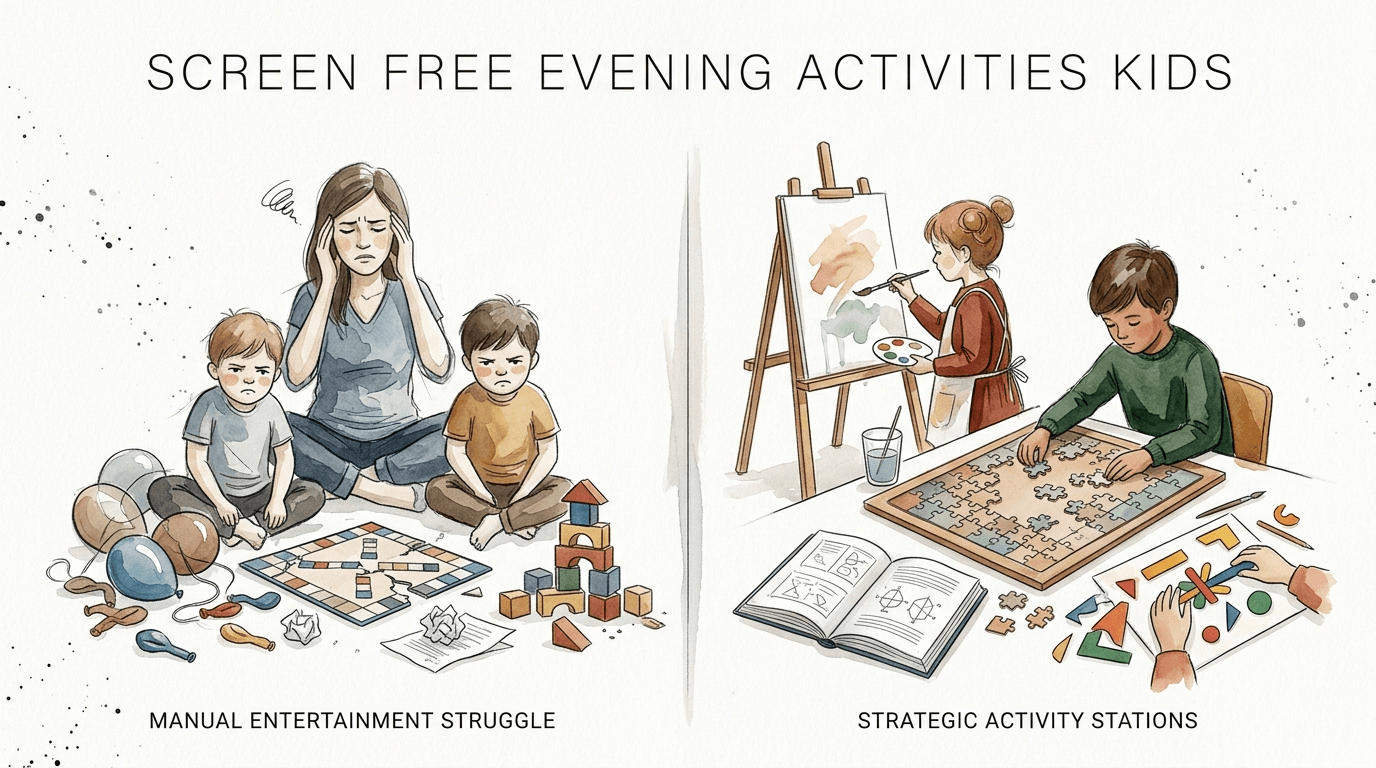
Transitioning away from digital dominance is not about deprivation. It is about a fundamental shift from the Manual Entertainment Struggle to Strategic Activity Stations. Instead of you being the constant cruise director, you are building an environment that does the work for you.
screen free evening activities kids
Screen-free evening activities for kids are intentional, low-stimulation experiences designed to settle the nervous system and encourage independent play. Unlike digital entertainment, which provides “fast dopamine” through rapid-fire visuals and instant rewards, these activities focus on “slow dopamine.” This slower release comes from effort, patience, and creative problem-solving [1.1.2].
In the real world, these activities serve as a “bridge” between the high-octane stimulation of the day and the restorative rest required at night [1.1.5]. When kids engage in hands-on tasks like building, sorting, or sensory play, they are exercising their prefrontal cortex—the part of the brain responsible for impulse control and focus [1.1.6].
Common examples of these activities include:
- Sensory Bins: Trays filled with rice, beans, or water that allow for tactile exploration.
- Open-Ended Building: Using blocks, magnetic tiles, or recycled cardboard to create original structures.
- Sorting Stations: Tasks that involve grouping items by color, size, or type to build logic and patience.
- Imaginative Roleplay: Simple props like kitchen tools or dress-up clothes that spark narrative-driven play.
These activities aren’t just “time-fillers.” They are developmental tools that help children learn to handle lower stimulation, which is essential for emotional regulation and resilience [1.1.3].
How to Build Strategic Activity Stations
The secret to a screen-free evening is preparation. You cannot expect a child to pivot from a high-intensity video game to a blank room without a struggle. You must build the “infrastructure of play” before the screen goes off.
1. Use the Toy Rotation Method
Do not dump every toy your child owns into a single bin. This leads to “decision fatigue” and eventual boredom. Instead, select 3–5 high-quality, open-ended items and place them in designated “Morning Bins” or “Evening Trays” [1.2.1]. Switch these materials weekly to keep the experience fresh and exciting.
2. Establish the “Sorting Lab”
For younger children, focus on order. Place a large bowl of mixed grains (like rajma, chana, and rice) on a mat with several smaller, empty bowls [1.2.4]. Ask them to separate the grains. This simple task requires intense focus and provides a steady sense of accomplishment as the smaller bowls fill up.
3. Create a Kitchen Creativity Zone
The kitchen is a natural creative lab. Give your child steel bowls, rolling pins, and empty containers [1.2.4]. While you prepare dinner, they can engage in “pretend cooking” or sensory exploration right next to you. This provides proximity without the need for constant direct intervention.
4. The 10-Minute Setup Rule
A station only works if it is ready to use. An activity that requires finding missing pieces or adult assembly will not get used in the heat of the moment [1.3.8]. Set up the station 10 minutes before you plan to turn off the screens. This ensures the “Bigger Yes” is visible and inviting the moment the “No” happens.
The Benefits of Low-Stimulation Play
Choosing screen-free zones over passive entertainment offers measurable advantages for both the child and the family unit. These benefits go far beyond just “less eye strain.”
Neurological Regulation
Screens trigger a dopamine loop that leaves the brain in a state of withdrawal when the device is removed [1.1.5]. Screen-free activities allow the brain to return to a baseline level of stimulation. This makes transitions to bedtime significantly smoother and reduces the frequency of “dopamine crashes” or meltdowns.
Enhanced Executive Function
Unstructured free play is a powerful brain-builder. When children grapple with how to balance a block tower or how to sort complex items, they are practicing problem-solving and self-regulation [1.5.9]. Studies show that children who engage in child-led play are often able to solve logic problems that are theoretically beyond their cognitive abilities [1.5.9].
Improved Sleep Quality
Blue light from screens suppresses melatonin, the hormone responsible for sleep [1.1.1]. By replacing devices with low-light, hands-on activities, you protect the child’s circadian rhythm. This leads to deeper REM sleep, which is essential for processing information and storing memories from the day [1.1.1].
Challenges and Common Mistakes
The transition to screen-free evenings is rarely a straight line. Many parents stumble because they approach the change with the wrong mindset or lack a structural plan.
The Convenience Trap
Many parents turn to screens because they are tired and need a moment of peace. This is understandable, but it creates a “convenience trap” [1.4.1]. The screen provides instant quiet, but it pays for that quiet with a much harder meltdown later. Recognizing that screens are a “debt” you have to pay back with interest helps you stay committed to the alternative.
The “Empty Void” Error
The biggest mistake is taking away the screen and leaving a void. If you turn off the TV and then go back to your own phone or start a chore, the child feels a sense of loss and boredom. You must “bridge” the transition by offering a high-engagement station or 10 minutes of direct connection first [1.2.5].
Treating Screens as a Reward
Using screen time as a reward for eating dinner or cleaning up makes the screen the “prized forbidden fruit” [1.4.7]. This increases its value in the child’s mind and makes them less likely to engage deeply with non-digital toys. Screens should be a neutral part of a scheduled routine rather than a high-value prize.
Limitations and Realistic Constraints
While a screen-free home is the ideal, there are practical boundaries where the method might need adjustment.
Environmental Limitations
If you live in a small apartment or a high-stress environment, setting up elaborate sensory stations may not be feasible. In these cases, focus on “micro-stations” like a single clipboard with paper and stickers, or a small bag of specialized building bricks that only comes out in the evening.
Parental Capacity
There will be days when you are sick, overwhelmed, or dealing with a crisis. On these days, screens may be a survival tool [1.2.3]. The goal is not perfection, but rather ensuring that screens do not become the *default* mode of existence. If you use a screen for survival, do so intentionally and try to “co-view” with the child to maintain connection [1.5.8].
The “Withdrawal” Period
If your child is accustomed to heavy screen use, they will likely be bored and irritable during the first week of a new routine. Their brain is literally adjusting to lower dopamine levels [1.1.6]. This is a physiological process, not a behavior problem. You must be prepared to weather the storm for 5–7 days before the new “slow dopamine” activities begin to feel rewarding to them.
Activity Comparison: Fast vs. Slow Dopamine
Understanding the difference between high-stimulation and low-stimulation play helps you choose the right stations for your home.
| Feature | Fast Dopamine (Screens) | Slow Dopamine (Activity Stations) |
|---|---|---|
| Effort Required | Minimal (Passive) | Moderate to High (Active) |
| Dopamine Release | Instant, high-intensity spikes | Steady, long-term satisfaction |
| Impact on Boredom | Masks it temporarily | Uses it to spark creativity |
| Bedtime Transition | Difficult (Melatonin suppression) | Easier (Calms the system) |
Practical Tips for Immediate Success
Implementing screen-free zones doesn’t have to be a monumental task. Start with these actionable steps to reclaim your evenings.
- Lower the Lights: Switch from overhead lights to warm lamps or “fake candles” after 6:00 PM. This signals to the body that it is time to wind down [1.3.9].
- The “I’m Putting My Phone Away” Signal: Narrate your own tech use. Say, “I am putting my phone in the charger now so I can be present with you” [1.4.3]. This models the behavior you want to see.
- Use Painters Tape: This is a “magic” tool for activity stations. Use it to tape plastic animals to a board for a “rescue mission,” or create a parade line on the floor for vehicles [1.3.2].
- Audiobooks and Podcasts: If the house feels too quiet, use audio-only entertainment. This keeps hands busy with toys while engaging the imagination through storytelling [1.3.7].
Advanced Considerations: The Maker Mindset
For families who have mastered the basics, you can begin to foster a “Maker Mindset.” This involves moving from simple play to goal-oriented, creative projects that build deep focus.
Instead of just providing blocks, provide a “challenge card” that asks the child to build a bridge that can hold a specific weight. This introduces elements of STEM (Science, Technology, Engineering, and Math) into their evening routine [1.2.7]. For older kids, this might mean a “tinker tray” filled with screws, old electronics (with batteries removed), and screwdrivers to explore how things work.
The goal is to help kids see themselves as creators rather than consumers. When a child spends an hour focused on a complex drawing or a detailed LEGO build, they are entering a “flow state.” This state is the pinnacle of slow dopamine and is the ultimate defense against the lure of easy digital hits.
A Realistic Evening Scenario
What does a successful screen-free evening actually look like? Here is a step-by-step example of the “Witching Hour” transformation.
5:00 PM – The Transition: You arrive home. Instead of the iPad, you bring out the “Special Tray”—a bin of kinetic sand that only appears on Tuesdays. This provides the “Bigger Yes” needed to skip the screen [1.4.7].
5:30 PM – Parallel Play: You begin preparing dinner. Your child is at the kitchen table with a “Sorting Station” involving different colored pasta. They are working independently, but are within your line of sight [1.2.4].
6:30 PM – Family Connection: Dinner is served screen-free. You discuss the best parts of the day. This builds language skills and social coping mechanisms that screens often displace [1.5.7].
7:15 PM – Wind Down: The “Sorting Station” is packed away. You move to a “Reading Nook” with dim lighting and soft pillows [1.2.6]. You read one chapter of a book together, further signaling to the brain that the day is ending.
8:00 PM – Bedtime: Because there was no blue light or dopamine spike in the previous two hours, the child’s body is naturally producing melatonin. They fall asleep with minimal resistance.
Final Thoughts
Reclaiming your evenings from the grip of digital devices is one of the most significant gifts you can give your child’s development. It is not about being “anti-tech,” but about being “pro-brain.” By moving from manual struggle to strategic setup, you create a home environment where creativity and calm are the default settings.
Remember that boredom is not an enemy to be defeated; it is a gateway to imagination. When you allow your child the space to be bored, you are giving them the opportunity to discover who they are outside of an algorithm.
Start small. Choose one evening this week to be entirely screen-free. Set up one station, lower the lights, and watch how the energy in your home shifts. You aren’t just taking away a tablet—you are giving back a childhood.
Sources
1 shumee.in (https://www.shumee.in/blogs/parent-guides/a-7-day-screen-free-play-plan-for-kids) | 2 ourtinythinks.com (https://ourtinythinks.com/insights/screen-free-evening-routine-for-kids/) | 3 drrupawong.com (https://www.drrupawong.com/blogs/screen-free-fun-games-activities-kids-actually-love) | 4 sf.k12.sd.us (https://www.ces.sf.k12.sd.us/o/ces/article/2758707) | 5 kidsplaymuseum.org (https://kidsplaymuseum.org/ten-screen-free-activities-to-try-at-home/) | 6 substack.com (https://technosapiens.substack.com/p/67-screen-free-activities-for-kids) | 7 notimeforflashcards.com (https://www.notimeforflashcards.com/2013/05/easy-play-stations-for-busy-days.html) | 8 alyssa-rachelle.com (https://alyssa-rachelle.com/how-to-do-a-screen-free-summer-with-your-kids/) | 9 bloomokids.com (https://bloomokids.com/screen-free-evening-for-families/) | 10 peaceathomeparenting.com (https://peaceathomeparenting.com/dopamine-loop-vs-happiness-screen-time-meltdowns-kids/) | 11 harvard.edu (https://magazine.hms.harvard.edu/articles/free-play-shapes-childs-brain-and-bestows-lifetime-benefits) | 12 littledipperwellness.com (https://www.littledipperwellness.com/blog/2022/4/20/a-tired-parents-guide-to-surviving-the-end-of-the-day-without-screens-10-screen-free-activities-to-keep-your-kid-entertained) | 13 youtube.com (https://www.youtube.com/watch?v=jLkKdtWdn4I&vl=en-US) | 14 peacefulparenthappykids.com (https://www.peacefulparenthappykids.com/read/screen-free-activities-kids)