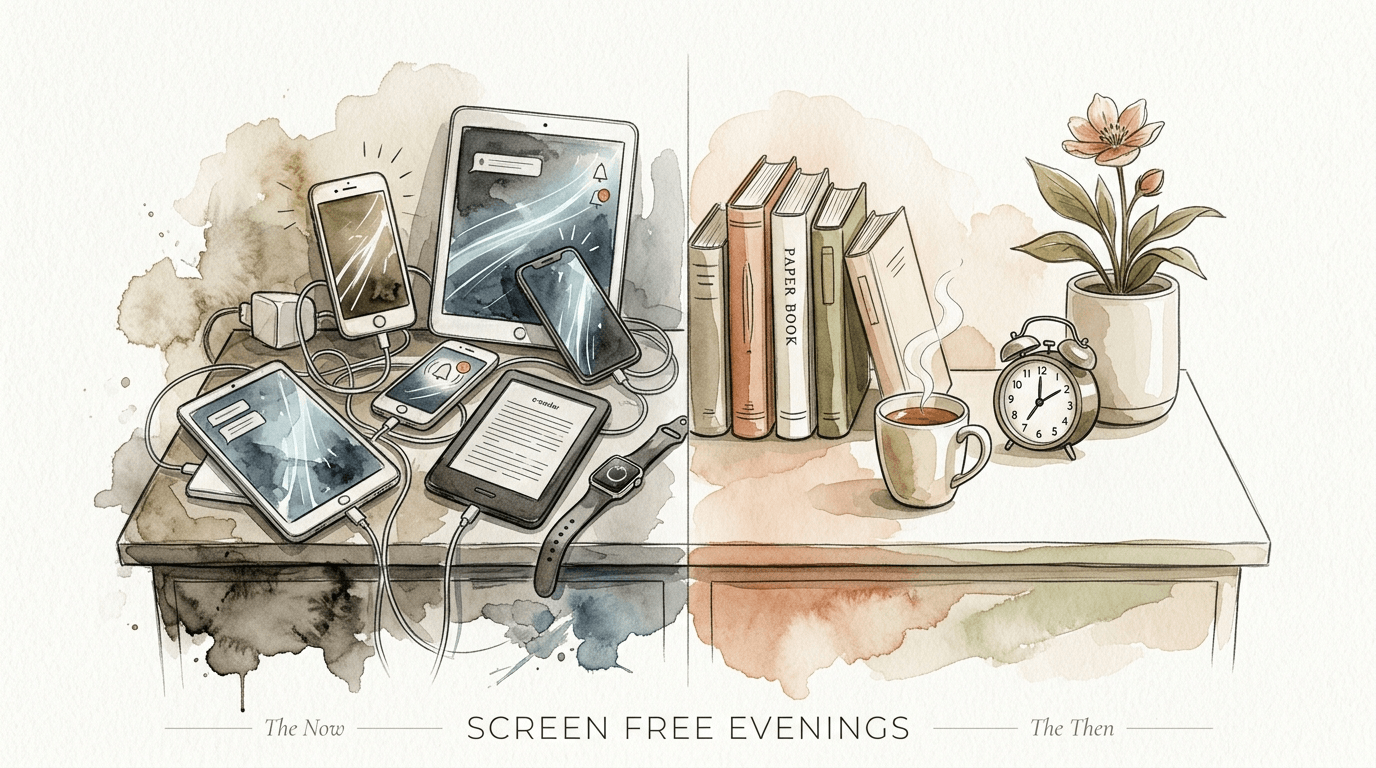
screen free evenings
Is your bedroom a sleep sanctuary or a tech hub? We have traded evening peace for constant pings. Going screen-free isn’t ‘old fashioned’—it’s a modern necessity for a rested mind.
[affiai]In the fast-paced digital era, the line between our waking productivity and our nightly recovery has blurred. Most of us end our days exactly how we start them: staring at a glowing rectangle. This constant connectivity comes at a steep price for our biology and our mental health. Creating a space dedicated solely to rest is no longer just a luxury. It is a fundamental requirement for anyone looking to reclaim their energy and focus.
This guide will walk you through the transition from a high-stimulus digital environment to a low-impact analog retreat. You will learn the science behind why screens sabotage your rest and gain practical, step-by-step strategies to reclaim your evenings. Whether you are a light sleeper or a chronic doomscroller, these shifts will help you build a relationship with sleep that actually works.
screen free evenings
A screen-free evening is a deliberate period before sleep where all electronic devices—smartphones, tablets, laptops, and televisions—are powered down or removed from your immediate environment. Typically, this “digital sunset” begins 60 to 90 minutes before you intend to be asleep. It is not about avoiding technology forever; it is about creating a biological and psychological buffer zone between the chaos of the day and the stillness of the night.
In the real world, we use screens for everything from work to social validation. This means our brains are constantly processing micro-decisions and emotional stimuli. When you continue this into the late hours, your nervous system remains in a state of high arousal. A screen-free evening acts as a signal to your body that the “hunting and gathering” phase of the day is over and the “recovery” phase has begun.
Think of it like a plane coming in for a landing. You cannot simply drop from 30,000 feet to the runway in a second without crashing. Your brain needs a gradual descent. By removing the high-energy blue light and the dopamine-heavy content of apps, you allow your internal systems to downshift naturally. This process helps regulate your circadian rhythm, which is the internal 24-hour clock that dictates when you feel alert and when you feel sleepy.
How to Transition to an Analog Evening
Transitioning away from screens requires a mix of environmental design and habit stacking. You cannot simply rely on willpower alone when your phone is designed to be addictive. You must change the “default” settings of your living space.
Step 1: Establish a Charging Station Outside the Bedroom
Place your charger in the kitchen, hallway, or living room. By the time you start your wind-down routine, your phone should already be plugged in and physically out of reach. This removes the “just one more check” temptation that often leads to hour-long scrolling sessions in bed.
Step 2: Replace Your Smartphone Alarm
One of the biggest excuses for keeping a phone on the nightstand is using it as an alarm. Purchase a dedicated analog or simple digital alarm clock. This allows you to wake up without immediately being greeted by a flood of notifications, emails, and news alerts that spike your cortisol first thing in the morning.
Step 3: Introduce “Low-Stimulus” Lighting
Standard overhead LED lights often mimic the spectrum of midday sun. Switch to warm-toned lamps or even red-spectrum bulbs in the evening. Dimming the lights in your home an hour before bed mimics the natural setting of the sun and prompts your pineal gland to start producing melatonin.
Step 4: Choose Your Analog Substitutes
Nature abhors a vacuum. If you take away your phone, you need something else to occupy your hands and mind. Keep physical books, journals, or adult coloring books on your nightstand. These activities provide the “focus” your brain craves without the hyper-stimulation of a screen.
Step 5: Define Your Digital Sunset
Set a specific time every night when the “screens off” rule applies. For many, 9:00 PM is a solid starting point if they aim to sleep by 10:30 PM. Use your phone’s built-in “Focus Mode” or “Do Not Disturb” settings to automate this transition so you aren’t manually fighting the urge to check pings.
Benefits of a Screen-Free Sleep Sanctuary
The advantages of reclaiming your bedroom from technology are both immediate and cumulative. Research consistently shows that those who avoid screens before bed report higher sleep satisfaction and better daytime functioning.
Improved Melatonin Production
Blue light specifically targets the photoreceptors in your eyes that tell your brain it is daytime. By cutting out screens, you allow melatonin—the hormone responsible for sleep—to rise naturally. This reduces “sleep latency,” which is the technical term for how long it takes you to fall asleep once your head hits the pillow.
Enhanced REM Sleep Quality
Screens don’t just keep you awake; they affect the architecture of your sleep. Studies have shown that evening screen use can delay and shorten REM (Rapid Eye Movement) cycles. REM is crucial for emotional processing and memory consolidation. When you go screen-free, you are more likely to wake up feeling emotionally balanced and mentally sharp.
Lowered Anxiety and Cortisol
The internet is a firehose of information, much of it designed to trigger an emotional response. Whether it is a work email or a stressful news headline, digital content keeps your “fight or flight” system active. An analog evening lowers your heart rate and reduces the circulating stress hormones in your body, leading to a deeper, more restorative rest.
Stronger Personal Relationships
If you share a bed with a partner, the presence of screens often creates “phubbing” (phone-snubbing). Removing devices encourages conversation, intimacy, and connection. It turns the bedroom back into a shared human space rather than two people in separate digital worlds.
Challenges and Common Pitfalls
The path to a screen-free life is rarely linear. Most people fail because they try to go “cold turkey” without preparing for the psychological withdrawal that comes with a digital detox.
The Dopamine Withdrawal
Your brain is accustomed to the constant hits of dopamine provided by social media likes and infinite scrolls. When you stop, you might feel bored, restless, or even anxious. This is a normal physiological response. Recognizing that “boredom” is actually your brain recalibrating is the first step to overcoming it.
The “Blue Light Filter” Fallacy
Many people believe that using a “night mode” or wearing blue-light-blocking glasses makes it okay to use screens until midnight. While these tools help reduce one specific type of light, they do nothing for the “cognitive arousal” caused by the content itself. A stressful video or a work task will keep you awake regardless of what color the screen is.
Using “Productive” Apps
You might tell yourself that reading a PDF for work or using a meditation app is “healthy” screen use. However, the light is still hitting your retinas, and the device still offers a gateway to other distractions. If you use a meditation app, try to start the session and then place the phone face down and out of reach.
The Morning After Loop
Some people successfully stay off screens at night but immediately grab their phone upon waking. This creates a cycle where the brain expects the digital hit, making it harder to stay disciplined the following evening. A true sanctuary approach covers both the “going to bed” and the “waking up” phases.
Limitations: When a Tech-Free Zone Is Difficult
While the ideal is a 100% screen-free environment, certain life circumstances make this challenging. It is important to find a balance that works for your specific situation rather than giving up entirely.
On-Call Professionals
Doctors, emergency responders, and IT professionals may need to be reachable at all hours. In these cases, a “sanctuary” might involve using a specialized pager or setting your phone so that only specific “Emergency Bypass” contacts can ring through, while all other apps remain locked.
Shift Workers
Those working night shifts have to fight their natural biology to sleep during the day. For them, environmental control (like blackout curtains and heavy-duty eye masks) is even more critical than the timing of the screen-free window. They may need to be more aggressive with light-blocking technology than the average person.
Medical Monitoring
Some individuals use apps to monitor glucose levels, heart conditions, or sleep apnea. For these users, the device is a medical necessity. The goal here should be to minimize “leisure” use—scrolling and entertainment—while keeping the essential medical functions active.
Safety and Communication
If you live alone or in an unsafe area, you may feel the need to have a phone nearby for emergencies. A simple solution is to keep the phone in a drawer or on the far side of the room. It remains accessible for a 911 call but is not convenient enough for mindless scrolling.
The “Now” Nightstand vs. The “Then” Simplicity
The way we set up our bedside has changed drastically over the last two decades. Understanding this shift helps us see why we are more tired than ever.
| Feature | The “Now” Tech Hub | The “Then” Sanctuary |
|---|---|---|
| Primary Light | Blue-light emitting screens/LEDs | Incandescent lamps / Candlelight |
| Alarm Type | Smartphone (Notification-heavy) | Analog clock (Single function) |
| Evening Activity | Infinite scrolling / Binge-watching | Reading / Journaling / Conversation |
| Mental State | Hyper-aroused / Overstimulated | Reflective / Calm |
| Sleep Quality | Fragmented / Delayed REM | Deep / Consistent cycles |
Practical Tips for Immediate Success
If you want to start tonight, follow these best practices to ensure your new routine sticks. Consistency is more important than perfection in the beginning.
- The 10-3-2-1-0 Rule: 10 hours before bed: no more caffeine. 3 hours before bed: no more food or alcohol. 2 hours before bed: no more work. 1 hour before bed: no more screens. 0: the number of times you hit snooze in the morning.
- Use Audio Instead of Video: If you need background noise to sleep, try a podcast or an audiobook on a timer. This provides entertainment without the disruptive light of a television or tablet.
- Prepare Your Environment: Set your thermostat between 60–67 degrees Fahrenheit (15–19 degrees Celsius). A cool room combined with an analog routine is the ultimate “sleep hack.”
- Invest in Textures: Switch to natural fibers like linen or 100% cotton sheets. When your physical environment feels like a retreat, you are less likely to look for an escape in your phone.
- Journal the “Brain Dump”: If you find yourself reaching for your phone to “check” things for tomorrow, keep a notebook by the bed. Write down the tasks so they are out of your head and on paper.
Advanced Considerations for Sleep Practitioners
For those who have mastered the basics and want to optimize their sleep environment further, consider these high-level adjustments.
Circadian Lighting Systems
Some advanced home systems can be programmed to change the color temperature of your lights automatically based on the time of day. These systems gradually shift from bright blue-white in the morning to deep amber in the evening, automating the “digital sunset” of your entire home environment.
Red Light Therapy
Exposure to red light in the evening does not suppress melatonin in the same way blue or green light does. Some practitioners use red light panels or bulbs in the evening to maintain visibility while allowing their biological clock to proceed uninterrupted.
Digital Minimumism
Go beyond just the evening hours. Evaluate which apps are actually necessary for your life. Deleting social media from your primary phone and only accessing it via a desktop computer can break the “twitch” to check your phone every five minutes, making the evening transition much smoother.
Example Scenario: The 7-Day Reset
Imagine a busy professional named Sarah who struggles with “tired-but-wired” syndrome. Here is how she implements a screen-free sanctuary over one week.
Days 1-2: Sarah moves her phone charger to the kitchen. She buys a $15 analog alarm clock. The first two nights, she feels an intense “phantom vibrate” sensation, but she reads a paperback novel for 20 minutes and falls asleep 30 minutes earlier than usual.
Days 3-4: She notices she is no longer waking up at 3:00 AM with a racing mind. By removing the evening work emails, her brain has actually processed the day’s stress before she hits the pillow. She adds a dim salt lamp to her nightstand for a warmer glow.
Days 5-7: Sarah feels a significant increase in morning alertness. She no longer needs three cups of coffee to start her day. The “bedroom sanctuary” has become her favorite place in the house, a zone where the world cannot reach her.
Final Thoughts
Reclaiming your evening from the grip of technology is one of the most effective ways to improve your long-term health. We were never meant to be “on” 24 hours a day, and our biology hasn’t caught up to the speed of our fiber-optic connections. By establishing a screen-free sanctuary, you are giving your brain the grace it needs to recover and your body the rest it requires to thrive.
The transition may feel difficult for the first few nights, but the clarity and energy you gain will far outweigh the temporary discomfort of missing a few social media updates. Start tonight by plugging your phone in another room. The digital world will still be there in the morning, but you will be much better equipped to handle it.
Experiment with different analog activities and find what truly helps you unwind. Whether it is the feel of a physical book or the quiet of a dimly lit room, embrace the simplicity. Your rested mind will thank you.
Sources
1 bdiusa.com (https://www.bdiusa.com/blog/sleep-hygiene-how-your-bedroom-furniture-can-support-healthy-sleep) | 2 theresetedit.com (https://www.theresetedit.com/digital-detox-blog/digital-detox-for-better-sleep) | 3 jersylinen.com (https://jersylinen.com/blogs/jersylinen/how-to-create-a-bedroom-sanctuary-a-quiet-guide-to-slow-living-at-home) | 4 charleston.edu (https://digital.charleston.edu/issue/summer-2025/4-key-steps-to-a-lasting-digital-detox/) | 5 kingliving.com (https://www.kingliving.com/blog/calm-bedroom-design-ideas) | 6 purespacedecore.com (https://purespacedecore.com/the-ultimate-guide-to-crafting-a-truly-serene-bedroom-sanctuary/) | 7 sleepfoundation.org (https://www.sleepfoundation.org/bedroom-environment/how-to-design-the-ideal-bedroom-for-sleep) | 8 thensf.org (https://www.thensf.org/screen-use-disrupts-precious-sleep-time/) | 9 smartgenes.co.nz (https://www.smartgenes.co.nz/blog/screen-time-and-sleep-what-research-actually-shows-2026) | 10 nih.gov (https://pmc.ncbi.nlm.nih.gov/articles/PMC12113466/) | 11 lifeline.org.au (https://www.lifeline.org.au/get-help/support-toolkit/techniques-and-guides/how-to-do-a-digital-detox) | 12 nashvilleparent.com (https://nashvilleparent.com/create-a-screen-free-room-or-zone-at-home-this-summer/) | 13 inspirahealthnetwork.org (https://www.inspirahealthnetwork.org/news/healthy-living/digital-detox-setting-screen-time-boundaries-stick) | 14 nih.gov (https://pmc.ncbi.nlm.nih.gov/articles/PMC12662671/) | 15 nih.gov (https://pmc.ncbi.nlm.nih.gov/articles/PMC12827953/) | 16 uw.edu (https://newsroom.uw.edu/news-releases/scientists-mix-skys-splendid-hues-to-reset-circadian-clocks) | 17 latimes.com (https://www.latimes.com/spaces/room/bedroom/story/clean-sleep-bedroom-design)