screen free evening routine
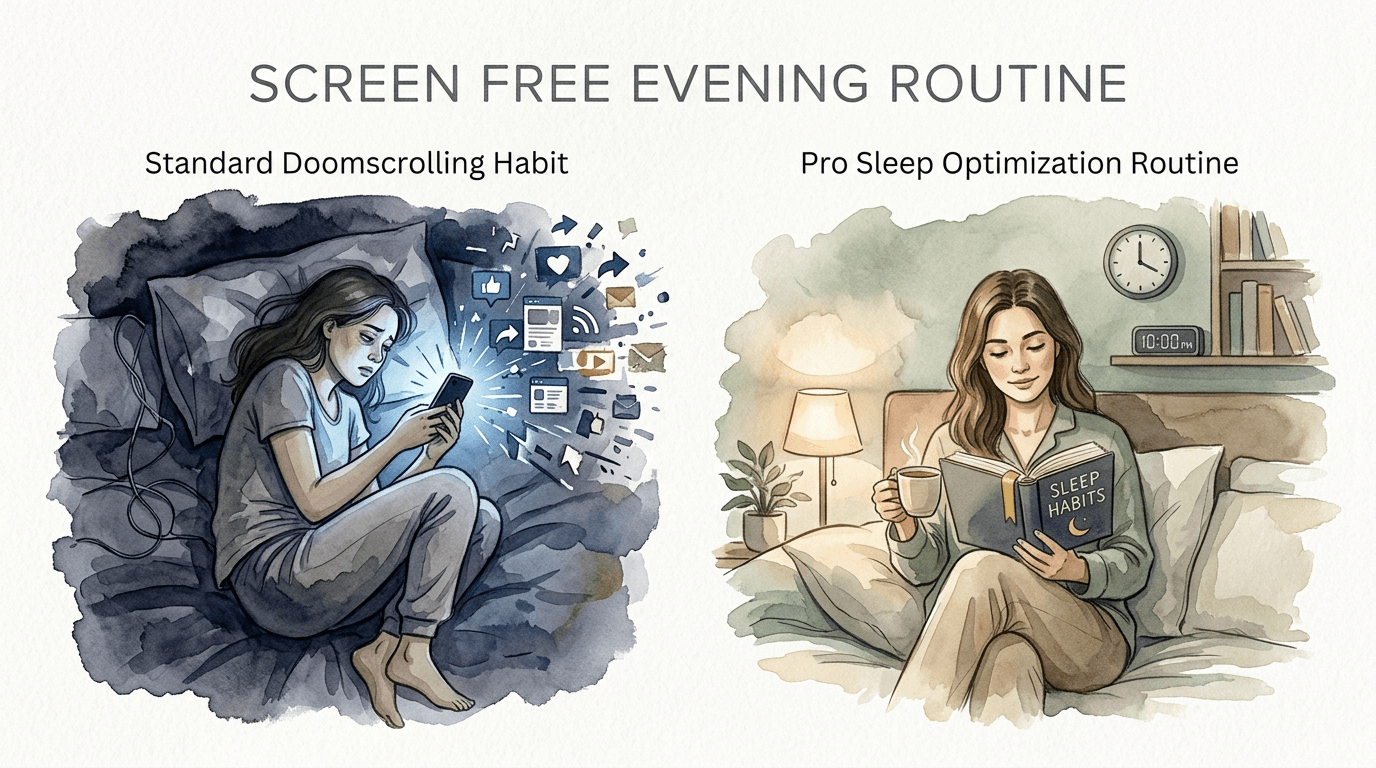
Are you scrolling your way to a bad night’s sleep? The ‘Standard’ evening is a digital drain. The ‘Pro’ evening is a calculated recovery system. Which one are you choosing tonight?
[affiai]Most people end their day in a blue-light-induced haze. They cycle between social media feeds, work emails, and streaming services until their eyes burn and their brain feels fried. This isn’t relaxation; it is a high-stimulus loop that keeps your nervous system on high alert.
Transforming your night into a high-performance recovery phase requires more than just putting your phone down. It requires a intentional screen-free evening routine that signals to your biological clock that the day is over. When you master this transition, you don’t just sleep longer—you sleep deeper and wake up with a cognitive edge that the average “doomscroller” can never achieve.
screen free evening routine
A screen-free evening routine is a strategic period of time, typically 60 to 90 minutes before sleep, where all electronic devices are powered down. This practice aims to remove the primary disruptors of human sleep: artificial blue light and emotionally stimulating digital content.
This routine exists because our internal biological clock, the circadian rhythm, is highly sensitive to environmental cues. For thousands of years, the primary cue for sleep was the setting sun. Today, smartphones, tablets, and LED televisions emit short-wavelength blue light (400–500 nm) that tricks the brain into thinking it is still noon. This light exposure suppresses the release of melatonin, the hormone responsible for feelings of sleepiness.
Think of your brain like a jet engine. You cannot simply flip a switch and expect it to go from 500 mph to a dead stop. You need a “descent” phase. A screen-free evening routine acts as that descent, allowing your heart rate to drop, your core temperature to begin its nightly dip, and your neurochemistry to shift from “alert and reactive” to “calm and restorative.”
In the real world, this routine is the difference between waking up feeling like a “zombie” and waking up feeling fully recharged. It is used by elite athletes, high-level executives, and anyone who treats their sleep as a non-negotiable pillar of health.
How to Build Your Screen-Free Recovery System
Transitioning from a digital-heavy lifestyle to a screen-free evening routine requires a step-by-step approach. You are not just removing technology; you are replacing it with rituals that promote deep rest.
Phase 1: The Digital Curfew
Set a hard “Digital Curfew” at least one hour before your target sleep time. This is the moment when all screens go dark. If you need to set an alarm for the next morning, do it now. This prevents the “just one more check” trap that often leads to another 30 minutes of unintentional scrolling.
Phase 2: Environment Optimization
Your environment dictates your behavior. As soon as the screens go off, dim the lights in your home. Use warm-toned lamps rather than bright overhead LED lights. This change in luminosity mimics the natural progression of sunset and triggers the onset of melatonin production. Consider setting your bedroom temperature to approximately 65°F (18°C), as a cooler environment is scientifically proven to facilitate faster sleep onset.
Phase 3: The “Brain Dump” and Planning
Mental stimulation is a major sleep killer. Spend five to ten minutes writing down your to-do list for the next day or journaling about any lingering worries. This “brain dump” clears your cognitive load. Instead of looping through tasks in your head while trying to sleep, you have externalized them onto paper. This signals to your brain that it no longer needs to keep those thoughts active.
Phase 4: Low-Stimulus Engagement
Fill the remaining time with activities that don’t involve a backlight. Options include:
- Reading a physical, paper book (fiction is often better for relaxation than non-fiction).
- Gentle stretching or restorative yoga to release physical tension.
- Listening to an audiobook or podcast via a smart speaker (no screen interaction).
- Engaging in a manual hobby like drawing, knitting, or light puzzles.
Benefits of a Screen-Free Evening
Committing to a screen-free evening routine offers measurable improvements to your physical and mental health. These benefits are not just subjective feelings; they are rooted in your body’s chemistry.
Maximized Melatonin Production: By removing blue light, you allow your pineal gland to release melatonin naturally. This reduces “sleep latency,” the time it takes to fall asleep, and ensures your body enters deep sleep cycles more efficiently.
Enhanced Cognitive Recovery: Deep sleep is when the brain’s glymphatic system flushes out metabolic waste. When you optimize your sleep via a screen-free routine, you wake up with better memory retention, sharper focus, and improved decision-making capabilities.
Reduced Anxiety and Stress: Doomscrolling—the habit of consuming negative news late at night—spikes cortisol and adrenaline. A screen-free routine protects your nervous system from this “stress injection” right before bed, leading to a more peaceful emotional state.
Improved Eye Health: Staring at screens for hours leads to digital eye strain, dryness, and headaches. Giving your eyes a dedicated break before sleep allows the ocular muscles to relax and recover from a day of intense near-point focus.
Challenges and Common Mistakes
Breaking the “Standard” habit of scrolling until sleep is difficult. Most people fail because they fall into common traps.
The “Just Five Minutes” Fallacy
The most frequent mistake is thinking you can check one last notification. Social media algorithms are designed to be “sticky.” A quick check of an email or a TikTok feed triggers a dopamine response that makes it nearly impossible to stop after five minutes. This creates a state of “neurophysiologic arousal” that keeps you awake long after you eventually put the phone down.
Lack of Preparation
If you don’t have a plan for what to do without your phone, you will feel bored and restless. This boredom often drives people back to their devices. You must have your “analog” options ready—a book on the nightstand, a journal nearby, or a specific stretching routine planned out.
Using Your Phone as an Alarm Clock
If your phone is the last thing you touch to set an alarm, it is likely the first thing you will use to scroll. Keeping the phone on your nightstand is a massive temptation. A pro tip is to buy a dedicated analog alarm clock and charge your phone in a different room entirely.
Limitations and Realistic Constraints
While a 90-minute screen-free window is the gold standard, it is not always feasible for everyone. Understanding these limitations helps you stay consistent without being discouraged.
On-Call Professionals: If your job requires you to be available for emergencies (doctors, IT responders, parents), a total digital blackout may be impossible. In these cases, use “Work Mode” or “Do Not Disturb” settings that only allow high-priority calls through. Use a blue light filter on the highest setting if you must look at the screen.
Family Dynamics: If you live with others who are not committed to a screen-free evening, the environment may still be bright or noisy. You cannot always control the household, but you can control your personal space. Using an eye mask or earplugs can help mitigate environmental factors you can’t change.
Travel and Environment Shifts: Staying in hotels or flying across time zones disrupts your ability to maintain a perfect routine. In these situations, focus on the “minimum viable routine”—even 15 minutes of screen-free time is better than zero.
Comparing the Standard Habit vs. Pro Routine
The differences between a standard evening and a pro-level optimization routine are stark when you look at the measurable outcomes.
| Feature | Standard Doomscrolling Habit | Pro Sleep Optimization Routine |
|---|---|---|
| Light Exposure | High blue light; suppresses melatonin. | Dim, warm light; promotes melatonin. |
| Mental State | Reactive, anxious, dopamine-seeking. | Proactive, calm, reflective. |
| Sleep Latency | 30–60+ minutes to fall asleep. | 10–20 minutes to fall asleep. |
| Morning Energy | Groggy, relies on caffeine immediately. | Alert, high cognitive clarity. |
Practical Tips for Immediate Application
Ready to reclaim your night? Start with these high-impact adjustments tonight.
- The “Out of Sight” Rule: Charge your phone in the kitchen or bathroom. If it is not within arm’s reach of your bed, you won’t use it.
- Use Grayscale Mode: If you struggle to put the phone down, turn on “Grayscale” in your accessibility settings. Removing the vibrant colors makes the screen significantly less stimulating.
- Pre-Set Your Night Shift: Automate your phone to enter “Night Shift” or “Blue Light Filter” mode at sunset. This is a “set it and forget it” way to reduce light damage throughout the evening.
- Establish a “Transition Trigger”: Choose one small action that starts your routine, like brewing a cup of herbal tea or putting on a specific pair of comfortable pajamas. This Pavlovian response tells your brain, “The screen-free time begins now.”
Advanced Considerations for Sleep Optimization
For those who have mastered the basics, you can take your recovery system even further by addressing the underlying biology of sleep.
Circadian Anchoring: Your evening routine actually begins in the morning. Getting 10 to 20 minutes of direct sunlight as soon as you wake up “sets” your internal clock. This makes your body naturally ready to wind down 14 to 16 hours later.
Temperature Regulation: Use the “Warm Bath Effect.” Taking a warm shower or bath 60 minutes before bed causes your blood vessels to dilate (vasodilation). When you step out, your core body temperature drops rapidly—a biological signal that it is time to sleep.
Cognitive Behavioral Techniques: If you suffer from “Sleep Anxiety,” try a technique called “Scheduled Worry.” During your screen-free hour, spend 15 minutes specifically thinking about and writing down everything that is bothering you. Once the 15 minutes are up, you are “done” worrying for the night. This prevents your brain from trying to process these issues while you are in bed.
Example Scenario: The Pro Evening Timeline
Let’s look at how a high-performance, screen-free evening routine looks in practice for a typical professional.
8:30 PM – The Shutdown: Finish the last work email. Plug the phone into the charger in the hallway. Switch the house lights to low, warm lamps.
8:40 PM – The Brain Dump: Spend 5 minutes writing the top 3 priorities for tomorrow and any lingering “open loops” in the mind.
8:45 PM – Physical Reset: 10 minutes of gentle, static stretching or foam rolling to release the tension of sitting at a desk all day.
9:00 PM – Deep Relaxation: Take a warm shower. The drop in body temperature afterward will trigger sleepiness.
9:15 PM – Analog Engagement: Read 20 pages of a physical book. No backlight, no notifications, just deep focus on a single narrative.
9:45 PM – Sleep Onset: Head to bed in a dark, cool room. Within 15 minutes, you are in a deep, restorative sleep.
Final Thoughts
Mastering a screen-free evening routine is one of the most effective “hacks” for improving your quality of life. It costs zero dollars, requires no special equipment, and provides immediate dividends in focus, mood, and health.
The world is designed to keep you scrolling. Every app on your phone is competing for your attention at the expense of your recovery. By choosing a “Pro” evening, you are reclaiming your time and your biology from the digital drain.
Start small tonight. Choose a 30-minute window without screens. Once you feel the difference in how you wake up tomorrow morning, you won’t want to go back to the standard habit. Your best day begins with your best night. Apply these principles and watch your performance skyrocket.
Sources
1 sip2sleep.com (https://sip2sleep.com/blogs/news/how-doomscrolling-before-bed-affects-your-sleep) | 2 theteaspot.com (https://www.theteaspot.com/blogs/steep-it-loose/evening-routine-reset) | 3 trinityhealth.com (https://trinityhealth.com/screen-free-wind-down-routines-for-better-sleep/) | 4 verizon.com (https://www.verizon.com/about/parenting/manage-screen-time-bedtime-routines) | 5 nebraskamed.com (https://www.nebraskamed.com/eye-care/how-to-avoid-anxiety-eye-strain-and-losing-sleep) | 6 zebrapen.com (https://www.zebrapen.com/blogs/blog/6-ways-effective-evening-routine) | 7 thensf.org (https://www.thensf.org/screen-use-disrupts-precious-sleep-time/) | 8 cardinalcounselingar.com (https://cardinalcounselingar.com/the-digital-dilemma-how-screen-use-before-bed-impacts-adolescent-mental-health/) | 9 sleepfoundation.org (https://www.sleepfoundation.org/how-sleep-works/how-electronics-affect-sleep) | 10 chronobiologyinmedicine.org (https://www.chronobiologyinmedicine.org/upload/pdf/cim-2024-0004.pdf) | 11 beynex.com (https://www.beynex.com/blogs/blue-light-and-sleep-how-cutting-down-evening-screen-time-affects-memory) | 12 comprehensivesleepcare.com (https://comprehensivesleepcare.com/2020/10/21/doomscrolling-affecting-sleep-health/) | 13 sleep.com (https://www.sleep.com/sleep-health/doomscrolling) | 14 mavigadget.com (https://mavigadget.com/blogs/health-fitness/the-simple-evening-routine-guide-your-blueprint-for-better-sleep-less-stress) | 15 walnuts.org (https://walnuts.org/blog/balanced-lifestyle/8-simple-ways-to-master-your-evening-routine/) | 16 brandenbodendorfer.com (https://brandenbodendorfer.com/evening-routine-tips-for-healthy-lifestyle/) | 17 littledipperwellness.com (https://www.littledipperwellness.com/blog/2022/4/20/a-tired-parents-guide-to-surviving-the-end-of-the-day-without-screens-10-screen-free-activities-to-keep-your-kid-entertained) | 18 powershealth.org (https://www.powershealth.org/about-us/newsroom/health-library/2026/02/25/doomscrolling-affecting-many-americans-sleep-poll-finds) | 19 drcolinmacleod.com (https://drcolinmacleod.com/articles/sleep-optimization-evidence-based-strategies/) | 20 nih.gov (https://pmc.ncbi.nlm.nih.gov/articles/PMC12107847/) | 21 nih.gov (https://pmc.ncbi.nlm.nih.gov/articles/PMC12022132/) | 22 nih.gov (https://pmc.ncbi.nlm.nih.gov/articles/PMC11252550/) | 23 sleepworldmagazine.com (https://sleepworldmagazine.com/2026/02/26/americans-are-doomscrolling-at-bedtime/) | 24 chicagolandneuropsychology.com (https://chicagolandneuropsychology.com/blog/what-to-do-instead-of-doomscrolling/) | 25 clevelandclinic.org (https://health.clevelandclinic.org/put-the-phone-away-3-reasons-why-looking-at-it-before-bed-is-a-bad-habit) | 26 nih.gov (https://pmc.ncbi.nlm.nih.gov/articles/PMC11417809/) | 27 youtube.com (https://www.youtube.com/watch?v=4WASgOyGjjQ)