sensory play ideas for kids playrooms
Modern toys entertain; natural sensory play engages. We’ve traded tactile exploration for flashing screens and plastic. Here is how to return to sensory-rich, natural play that actually develops a child’s brain.
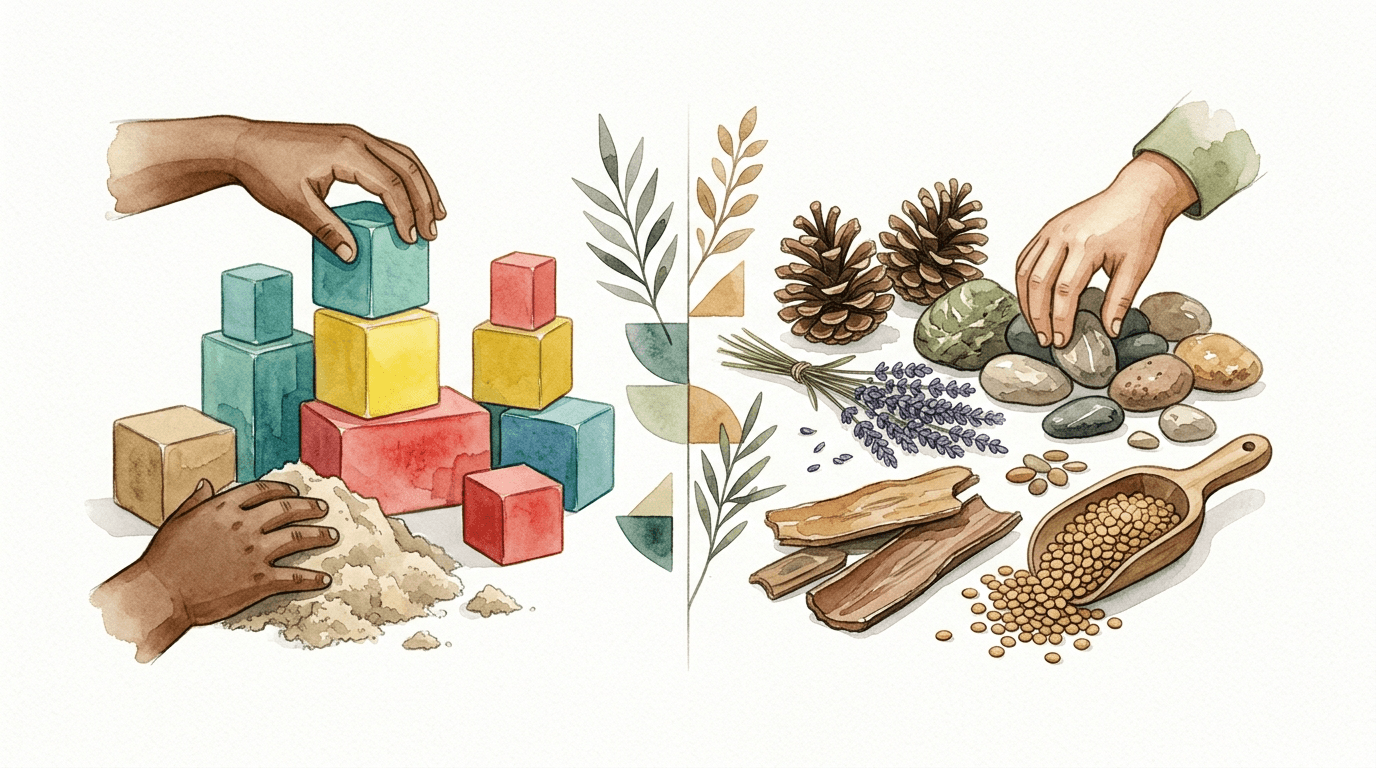
[affiai]Our children live in a world of smooth, uniform plastic. This “Synthetic Now” offers predictable textures and artificial sounds that do little to challenge a developing mind. Natural play, however, offers the “Natural Then”—a world of varied weights, temperatures, and irregular surfaces that spark curiosity.
This guide provides the framework for turning a standard playroom into a powerhouse of cognitive development. You will learn to move beyond the toy aisle and into the woods, the garden, and the kitchen. Let’s build a space where every touch builds a neural pathway.
sensory play ideas for kids playrooms
Sensory play is any activity that stimulates a child’s senses: touch, smell, taste, sight, and hearing. It also includes the often-overlooked vestibular (balance) and proprioceptive (body awareness) systems [1.1.5]. In a playroom setting, this means creating stations where children can manipulate materials that behave in unpredictable ways.
Natural sensory play specifically uses organic materials like wood, stone, sand, and water. These items provide “variable sensory feedback” that plastic cannot replicate [1.1.2]. For example, a wooden block feels cooler and heavier than a plastic one, and its texture changes as it ages. This constant stream of new information forces the brain to adapt and learn.
Effective playroom ideas include:
- The Loose Parts Buffet: A collection of pinecones, smooth river stones, corks, and silk scraps stored in low, accessible baskets [1.4.5].
- The Texture Wall: A vertical board featuring squares of different natural fabrics, corrugated cardboard, and sanded wood.
- Nature Sensory Bins: Large tubs filled with dried chickpeas, lentils, or “clean dirt” made from coffee grounds [1.2.2].
- The Indoor Mud Kitchen: A dry version of the outdoor classic, using kinetic sand or cloud dough (flour and oil) to mimic the malleable properties of mud [1.2.5].
These ideas transform a room from a storage space for objects into a laboratory for experimentation. A child isn’t just “playing” with a rock; they are measuring weight, testing hardness, and observing how light hits a jagged surface.
How to Set Up a Natural Sensory Playroom
Creating a sensory-rich environment requires a shift in perspective. You are not buying toys; you are gathering invitations. An “invitation to play” is a curated arrangement of materials designed to catch a child’s eye and prompt them to investigate [1.4.2].
Start by clearing the floor. Remove large, noisy battery-operated toys that dictate how a child should interact. Replace them with open-ended materials that have no fixed purpose. This allows the child to be the protagonist of their own learning.
Next, organize your materials by type. Use clear bins or low baskets so the child can see the options available. Labeling these bins with both words and pictures supports early literacy and teaches the child where items belong [1.5.1].
Define your zones clearly. You might have a “wet zone” for water or oobleck (cornstarch and water) and a “dry zone” for blocks and loose parts [1.2.3]. This structure reduces mess and helps the child understand the boundaries of each activity.
Finally, consider the lighting. Harsh fluorescent lights can be overstimulating and cause anxiety in some children [1.5.2]. Use warm LED bulbs or natural sunlight to create a calming, focused atmosphere. Soft lighting helps the brain settle into a “flow state” where deep learning occurs.
The Cognitive and Physical Benefits
The impact of natural play on the brain is measurable. MRI studies have shown that playing with natural materials results in 37% higher activity in the somatosensory cortex compared to playing with synthetic materials [1.1.2]. This area of the brain processes tactile information, meaning natural textures literally give the brain a better workout.
Sensory play builds the “brain’s infrastructure” through myelination [1.1.8]. This is the process where nerve fibers develop a protective coating, speeding up signals between brain cells. The more varied the sensory input, the faster and more efficient these signals become.
Practical benefits include:
- Fine Motor Development: Squeezing clay, scooping sand, and picking up tiny stones strengthens the small muscles in the hands [1.6.3]. These are the same muscles used later for writing and using scissors.
- Language Acquisition: Children gain a descriptive vocabulary they would never find in a screen-based environment. They learn words like “gritty,” “damp,” “fragrant,” and “brittle” through direct experience [1.1.8].
- Executive Function: Using open-ended materials like wooden blocks forces a child to plan, troubleshoot, and see a project through to completion [1.1.2].
- Emotional Regulation: The repetitive motion of running fingers through rice or kneading dough has a therapeutic, grounding effect [1.1.1]. It helps children manage big emotions and reduce stress.
Challenges and Common Pitfalls
The primary challenge of sensory play is the mess. Natural materials like sand, water, and flour tend to migrate outside their designated bins. Many parents avoid these activities because they fear the cleanup, but this limits the child’s developmental opportunities.
Another challenge is the “all-at-once” trap. Parents often set out every sensory tool they own, leading to overstimulation [1.5.4]. When a child is confronted with too much input, their brain may shut down or they may become hyperactive rather than focused.
The “Solo Designer” mistake is also common. Parents often design the perfect playroom as a surprise, but it may not reflect how the child actually plays [1.5.3]. If the materials are too high or the bins are too heavy, the child will lose interest or become frustrated.
Safety is always a concern with natural items. Small stones or acorns are choking hazards for toddlers, and some plants or woods can cause skin irritation. You must curate your materials carefully based on the specific age and developmental stage of your child [1.3.2].
Limitations and Environmental Constraints
Sensory play is not a one-size-fits-all solution. For children with Sensory Processing Disorder (SPD), certain textures like slimy oobleck or scratchy bark can be physically painful rather than educational [1.3.8]. These children may need a more controlled, gradual introduction to new sensations.
Space is another realistic constraint. Not every home has room for a full mud kitchen or a large sand table. In these cases, sensory play must be scaled down to “sensory bags” or small, portable trays that can be stored on a shelf [1.2.1].
The cost of high-quality natural toys can also be a barrier. Sustainably sourced wooden blocks and organic silks are often more expensive than plastic counterparts. However, many of the best sensory materials can be found for free in your own backyard or kitchen pantry [1.4.5].
Climate and seasonality also play a role. A nature bin filled with fresh moss and damp leaves may only last a few days before it needs to be replaced. Maintaining a natural playroom requires more ongoing effort and attention than a plastic one.
The Synthetic ‘Now’ vs The Natural ‘Then’
To understand the value of this approach, we must compare the two types of play environments.
| Feature | Synthetic ‘Now’ (Plastic/Digital) | Natural ‘Then’ (Organic/Tactile) |
|---|---|---|
| Texture | Uniform, smooth, predictable. | Varied, rough, smooth, cold, warm. |
| Brain Activity | Passive entertainment; lower cortical engagement. | Active exploration; 37% higher somatosensory activity [1.1.2]. |
| Purpose | Closed-ended; toy does the “work.” | Open-ended; child does the “work.” |
| Durability | Often brittle; loses value when broken. | Ages naturally; can be repurposed or composted. |
| Sensory Range | Limited to sight and sound (flashing lights). | Engages all seven sensory systems [1.3.8]. |
The complexity of natural materials provides a “high-resolution” experience for the senses. While a plastic apple always feels like plastic, a real piece of wood has grain, weight, and a distinct scent that provides a much richer data set for the brain to process.
Practical Tips for Playroom Optimization
Maximizing the value of your sensory playroom requires active management. Use these best practices to keep the space engaging and manageable:
- Implement Toy Rotation: Do not put everything out at once. Keep 75% of your materials in storage and swap them every two weeks to maintain a sense of novelty [1.2.3].
- Use Trays and Bins: Contain the mess by using deep wooden trays or plastic tubs. This defines the workspace and makes cleanup faster.
- Add Tools for Exploration: Provide magnifying glasses, tweezers, spoons, and funnels [1.2.2]. These tools encourage “scientific thinking” as children test the properties of their materials.
- Focus on Contrast: When setting up a sensory bin, pair contrasting textures. Try smooth river stones with soft sand, or cold ice with warm water [1.2.1].
- Follow the 10-Part Rule: You don’t need a hundred items. Often, the same 10 loose parts (e.g., 10 stones, 10 sticks, 10 corks) can create dozens of different “invitations to play” [1.4.2].
Storage is key. Use open shelving at the child’s height so they can choose their own activities. This fosters independence and confidence [1.4.6]. If a child has to ask for help to reach a bin, the spontaneous flow of play is broken.
Advanced Considerations for Serious Practitioners
For those looking to go beyond the basics, consider the proprioceptive and vestibular systems. Proprioception is the “heavy work” of the senses. It involves pushing, pulling, and carrying heavy objects, which helps the brain understand body boundaries and force [1.3.7].
In a playroom, you can support this by:
- Providing weighted bags filled with dried beans for the child to carry.
- Installing a low climbing wall or a sturdy wooden balance beam.
- Adding a “crash pad” of large, heavy pillows for jumping.
Scaling these activities for older children involves increasing the complexity of the “problems” they solve. A toddler might just pour rice, but a five-year-old can use a scale to measure weights or a funnel to experiment with flow rates [1.3.1].
Consider the “Reggio Emilia” approach, which views the environment as the “third teacher” [1.4.6]. The room itself should be beautiful and intentional. Use neutral colors on the walls to let the natural colors of the play materials stand out. This reduces visual noise and helps the child focus on the task at hand.
A Real-World Scenario: The Nature Tray Transformation
Imagine a standard playroom with a plastic kitchen set. The child “cooks” with plastic grapes that always look and feel the same. The play is repetitive and usually ends quickly.
Now, replace the plastic food with a “Nature Tray.” This tray contains a bowl of dried lavender, several pinecones, a small pitcher of water, and a handful of smooth stones.
The child begins to “cook.” They smell the lavender, noticing its calming scent. They try to balance a stone on top of a pinecone, practicing fine motor control. They pour water over the stones and observe how the color changes and becomes shiny. They are now engaging in “scientific inquiry”—observing, hypothesizing, and experimenting [1.3.6]. This single tray provides more cognitive stimulation in twenty minutes than a week of playing with the plastic kitchen set.
Final Thoughts
Natural sensory play is not just a trend; it is a return to the biological roots of how humans learn. By providing materials that are rich in texture, weight, and possibility, we give our children the tools to build stronger, more creative brains.
The shift from synthetic to natural play requires patience and a willingness to embrace a little bit of mess. However, the rewards—higher executive function, better emotional regulation, and a lifelong love of discovery—are well worth the effort.
Start small. Replace one plastic bin with a basket of stones today. Watch how your child’s hands move differently, how their focus deepens, and how their imagination takes flight. The “Natural Then” is waiting to be rediscovered in your playroom.
Sources
1 bunnyhopkinstoys.com (https://bunnyhopkinstoys.com/blogs/child-development/sustainable-play) | 2 drsensory.com (https://www.drsensory.com/how-sensory-experiences-can-enhance-learning-in-children/) | 3 therapypartners.com.au (https://therapypartners.com.au/blog/occupational-therapy/sensory-processing/the-impact-of-sensory-play-in-child-development) | 4 bbmacademy.com (https://bbmacademy.com/newsroom/an-age-by-age-guide-to-sensory-toys/) | 5 steppingstoneschool.com (https://www.steppingstoneschool.com/sensory-play/) | 6 eocdcs.org (https://www.eocdcs.org/sensory-play-101-engaging-little-minds-and-fingers/) | 7 artfulparent.com (https://artfulparent.com/best-kids-sensory-materials/) | 8 clevelandclinic.org (https://health.clevelandclinic.org/benefits-of-sensory-play-ideas) | 9 littlesunshine.com (https://littlesunshine.com/blog/inspiring-playroom-ideas-creating-a-reggio-emilia-inspired-space-for-your-child/) | 10 teachingautism.co.uk (https://teachingautism.co.uk/5-things-to-avoid-in-a-multi-sensory-room/) | 11 theottoolbox.com (https://www.theottoolbox.com/sensory-room-rules-protocols-and-guidelines/) | 12 plt.org (https://www.plt.org/educator-tips/nature-based-sensory-activities) | 13 theorganizedmama.com (https://www.theorganizedmama.com/mistakes-playroom/) | 14 jabaloo.com (https://jabaloo.com/blogs/education/why-natural-materials-matter-the-science-behind-montessori-toy-selection) | 15 thezoofamily.com (https://www.thezoofamily.com/fr/blogs/nouvelles/why-is-sensory-play-important-for-child-development) | 16 bushacres.com (https://bushacres.com/blogs/news/7-montessori-playroom-mistakes-parents-make-and-how-to-fix-them) | 17 myteachingcupboard.com (https://www.myteachingcupboard.com/blog/natural-loose-parts) | 18 nationalautismresources.com (https://nationalautismresources.com/school-sensory-rooms/) | 19 actionforchildren.org.uk (https://www.actionforchildren.org.uk/blog/what-is-sensory-play-and-why-is-it-important/) | 20 weespeaktlc.com (https://weespeaktlc.com/sensory-play-ideas-to-support-child-development/) | 21 lppschools.com (https://lppschools.com/the-science-of-sensory-play/) | 22 rhythmsofplay.com (https://rhythmsofplay.com/natural-materials-for-pretend-play/)