weekend reset plan for family tech use
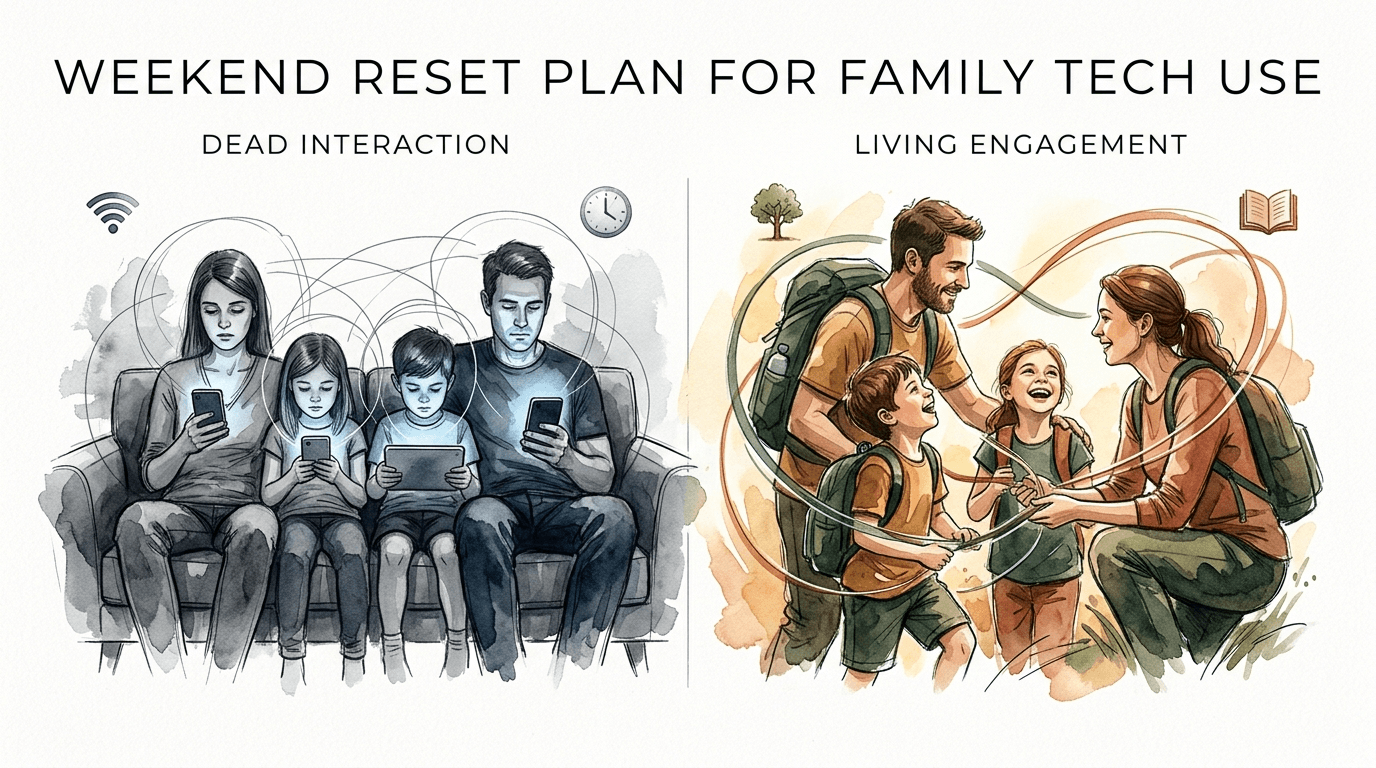
Swap the scroll for the soil. Tech isn’t the enemy, but it’s a ‘dead’ interaction. Reclaim your weekend with a reset plan that trades digital scrolling for living, breathing family engagement.
[affiai]Most of us have felt that specific Sunday evening slump where we realize we’ve spent the last 48 hours staring at a glass rectangle. We look for connection in comment sections but find only temporary hits of dopamine that leave us feeling hollow. This is the difference between dead interaction and living engagement. Dead interaction is passive, solitary even when others are in the room, and leaves no lasting memory. Living engagement is tactile, unpredictable, and builds the neural pathways that actually sustain a family unit.
Choosing to unplug isn’t about being anti-technology. It’s about being pro-presence. In a world where 81% of children under 13 now own their own mobile devices, the default setting for family life has become “separately together.” We sit on the same sofa, yet we are light-years apart in different digital universes. A weekend reset is the intentional act of pulling everyone back into the same reality.
weekend reset plan for family tech use
A weekend reset plan for family tech use is a structured period, typically from Friday evening to Sunday evening, where a household collectively agrees to minimize or eliminate non-essential digital consumption. It is a circuit breaker for the habits that have quietly taken over our domestic lives. This isn’t just about “taking away phones”; it is a strategic replacement of digital “dead space” with high-value physical and social activities.
This plan exists because modern digital interfaces are designed to be “sticky.” They use variable reward schedules to keep us scrolling long after we’ve stopped finding the content interesting. For families, this results in the “replacement effect,” where screens push out the very activities that foster development—conversation, imaginative play, and physical movement. By scheduling a reset, you create a dedicated container for the family to practice being a family again.
Think of it like a nutritional cleanse for your brain. Just as you might cut out processed sugar to reset your palate, you cut out processed “interaction” to reset your capacity for deep focus and genuine connection. It provides the “green time” necessary to offset the “screen time” that dominates the work and school week.
How to Execute Your Weekend Reset Plan
Success in a digital reset doesn’t happen by accident. If you simply hide the tablets on a Saturday morning, you will likely face a mutiny of bored children and anxious adults. You need a system that manages the transition from high-dopamine digital inputs to lower-dopamine real-world experiences.
The first step is the Friday Night “Device Hand-In.” At a designated time, perhaps 7:00 PM, all non-essential devices are placed in a central “Phone Hotel”—a basket or charging station in a common area. This ritual signals to the brain that the “always-on” mode has ended. It is helpful to have a landline or a single “emergency-only” phone designated so that parents don’t feel the need to check their personal devices “just in case.”
Saturday should focus on “The Soil.” This is the core of the reset where you engage in activities that are sensory-rich. Gardening, hiking, or even just visiting a local park allows for the biophilia effect to take hold. Research shows that children’s stress levels fall within minutes of seeing green spaces. You aren’t just killing time; you are actively lowering the cortisol levels of every family member.
Sunday is for “The Creative Production.” Instead of consuming content created by others, the family focuses on making something together. This could be a complex meal, a physical craft, or a shared project like building a birdhouse. The goal is to move from being a consumer to being a creator. This shift is vital for cognitive development and provides a sense of accomplishment that a “level up” in a video game cannot replicate.
Benefits of Choosing Living Engagement
The advantages of a weekend reset go far beyond just having “quiet” children. One of the most immediate benefits is improved sleep hygiene. Exposure to blue light from screens suppresses melatonin, making it harder for both kids and adults to fall into restorative deep sleep. By removing screens on Friday and Saturday nights, you naturally align the family’s circadian rhythms with the sun.
Focus and productivity also see a significant boost. Constant notifications fragment our attention, training our brains to expect a distraction every few minutes. A screen-free weekend acts as a “dopamine fast,” allowing the prefrontal cortex to recover. For children, this often manifests as an improved ability to engage in “deep play,” where they become so absorbed in an activity that they lose track of time—a state that is rare in the digital world.
Strengthening the family bond is perhaps the most measurable benefit. When you remove the “dead interaction” of co-viewing videos, you are forced to engage in face-to-face conversation. These interactions are where empathy is built. You begin to notice the subtleties—the tone of a child’s voice, the specific way they solve a problem, or the laughter that only happens when you’re fully present. These are the moments that build long-term emotional security.
Challenges and Common Mistakes
The most frequent error is failing to plan for boredom. When screens are removed, they leave a massive “attention void.” If you haven’t pre-stocked the house with books, board games, or project materials, that void will be filled with irritability and conflict. Boredom is actually a productive state—it’s the gateway to creativity—but in the first few hours of a reset, it feels like a crisis.
Another mistake is the “Tech Police” dynamic. If one parent becomes the enforcer while the other sneaks looks at their phone in the bathroom, the plan will fail. The reset must be a collective commitment. Children are highly sensitive to hypocrisy; if they see you “living” through your screen while telling them to “go play,” they will view the reset as a punishment rather than a lifestyle choice.
Finally, many families try to go “cold turkey” without a transition. Digital addiction is real, and the sudden removal of these stimuli can lead to actual withdrawal symptoms like headaches or intense irritability. It is better to start with “Screen-Free Saturdays” and gradually expand to the full weekend as the family’s “offline muscles” get stronger.
Limitations of the Reset Method
While a total disconnect is ideal, it isn’t always practical in a modern world. Many parents have “on-call” jobs, and many logistics—like checking the weather, using GPS for a hike, or looking up a recipe—now rely on digital tools. Acknowledge these boundaries early. The goal is to eliminate mindless scrolling, not to make your life unnecessarily difficult.
Environmental constraints also play a role. A family living in a high-rise urban apartment with limited access to “soil” or parks will face different challenges than a family with a backyard. In these cases, the “soil” might be metaphorical—visiting a library, a museum, or a community center. The principles remain the same: swap the passive for the active.
Furthermore, a weekend reset cannot fix deep-seated family issues on its own. It is a tool for connection, but it also removes the “digital buffer” that many families use to avoid conflict. When the screens go off, the hidden tensions often come to the surface. This is actually a sign of the plan’s success, but it requires parents to be ready to navigate these emotions rather than hiding back behind a screen.
Digital Consumption vs. Living Engagement
To better understand why we make this trade, it helps to compare the two types of interaction side-by-side.
| Feature | Digital Consumption (Dead) | Living Engagement (Living) |
|---|---|---|
| Pace | Rapid-fire, instant rewards. | Slower, rhythmic, delayed rewards. |
| Sensory Input | Visual and auditory only. | Five-sense immersion (touch, smell, etc.). |
| Social Value | Performative or passive. | Collaborative and authentic. |
| Long-term Effect | Attention fatigue and FOMO. | Neural growth and memory building. |
| Agency | Following an algorithm. | Self-directed choice. |
Practical Tips for a Successful Weekend
To make the transition easier, implement a “No-Tech Zone” map for your home. Designate the dining table, the bedrooms, and the backyard as permanent screen-free sanctuaries. This makes the weekend reset feel less like a temporary rule and more like a reinforcement of existing family values.
Use analog substitutes for common tech functions. Buy a physical alarm clock so your phone doesn’t have to be the first thing you touch in the morning. Use an egg timer for cooking or a paper map for your weekend drive. These small changes reduce the number of “excuses” to pick up a device. Every time you touch your phone for a “tool” purpose, you are only one swipe away from falling back into the scroll.
Prepare a “Boredom Box” filled with supplies that aren’t usually available. This could include new art supplies, a challenging puzzle, or a “mystery” ingredient for a baking challenge. Having something novel to look forward to helps bridge the gap when the digital cravings are at their highest on Saturday morning.
Advanced Considerations for Long-Term Wellness
For those who have mastered the basic weekend reset, consider the 5 M’s of Digital Wellness: Model, Mentor, Monitor, Mastery, and Meaning. Moving toward “Mastery” means teaching your children how the algorithms work. Use the end of your reset on Sunday evening to discuss why it was hard to put the phones away. This builds critical thinking skills that will help them navigate tech when they are out of your sight.
Think about the architectural changes in your home. Are your chairs pointed at a TV? If so, the environment is nudging you toward dead interaction. Try rearranging a room to focus on a central table or a window looking out at nature. When the environment supports living engagement, the “willpower” required to stay off your phone decreases significantly.
You might also look into “circadian lighting” or “analog hobbies” that require deep skill building, such as woodworking or playing an instrument. These aren’t just ways to pass the time; they are ways to reclaim your cognitive sovereignty from the attention economy.
Scenario: The Saturday Transformation
Imagine a typical Saturday morning: everyone wakes up at different times and immediately checks their notifications. By 10:00 AM, the family is in the same room, but everyone is silent, scrolling through different feeds. The energy is low, and the “Sunday Scaries” are already beginning to creep in.
Contrast that with a Reset Saturday. The family wakes up and meets in the kitchen for a phone-free breakfast. Because there is no digital distraction, a conversation starts about a bird seen in the backyard. This leads to a decision to spend the morning at a local trail. By lunch, the kids are dirty, tired, and remarkably calm. The afternoon is spent reading physical books or working on a shared puzzle. The day feels long—in the best possible way—because it wasn’t chewed up by 15-second video clips.
This isn’t a fantasy; it’s the result of a deliberate choice to prioritize living engagement over dead interaction. The physical “soil” under your fingernails and the “living” laughter of your children are the metrics of a weekend well-spent.
Final Thoughts
Trading the scroll for the soil is a powerful act of rebellion against a culture that wants your constant attention. It is a way to prove to yourself and your family that your time is your own. A weekend reset plan for family tech use provides the structure needed to reclaim the “living” moments that are so easily lost to the “dead” glow of a screen.
By focusing on preparation, replacement activities, and collective commitment, you can transform your home into a place of genuine connection. The benefits—better sleep, deeper focus, and stronger bonds—are measurable and immediate. This is the plan that allows you to stop merely “passing time” and start actually living it.
Start small if you must, but start this weekend. Put the phones in a basket, get your hands in the dirt, and see what happens when the digital noise finally stops. You might find that the real world is much more interesting than the one in your pocket.
Sources
1 childrenshospital.org (https://bchp.childrenshospital.org/news/screen-time-detox-reconnecting-family) | 2 mediaeducationlab.com (https://mediaeducationlab.com/blog/5-practical-tips-family-mental-wellbeing-digital-age) | 3 bitdefender.com (https://www.bitdefender.com/en-us/blog/hotforsecurity/digital-wellness-families-5-practical-tips-tricks) | 4 lifestance.com (https://lifestance.com/blog/how-to-do-digital-detox-advice-from-expert/) | 5 seattleschild.com (https://www.seattleschild.com/one-familys-formula-for-screen-free-days/) | 6 connecticutchildrens.org (https://www.connecticutchildrens.org/growing-healthy/10-ways-get-your-teen-and-family-try-digital-detox) | 7 connecticutchildrens.org (https://www.connecticutchildrens.org/growing-healthy/10-ways-get-your-teen-and-family-try-digital-detox) | 8 businessinsider.com (https://www.businessinsider.com/digital-detox-weekend-without-screens-helped-my-family-teen-reconnect-2025-3) | 9 nwf.org (https://www.nwf.org/Kids-and-Family/Connecting-Kids-and-Nature/Health-Benefits-and-Tips) | 10 instituteofchildpsychology.com (https://instituteofchildpsychology.com/why-getting-children-outdoors-is-essential-for-mental-health/) | 11 forbes.com (https://www.forbes.com/sites/bryanrobinson/2026/06/23/5-tips-for-a-digital-detox-without-giving-up-your-phone-or-career/) | 12 ncsu.edu (https://bertie.ces.ncsu.edu/news/digital-detox/)