Ancestral Driftwood Harvesting Vs Modern Lumber
Why did ancient coastal builders wait for the tide to ‘deliver’ their materials instead of simply cutting down the nearest forest? Modern manufacturing demands identical, fast-grown timber that lacks soul and strength. Our ancestors understood that the ocean acts as a giant kiln, curing wood with salt and pressure for decades. When you source from the tide, you aren’t just getting wood; you are harvesting a story that has been seasoned by the Pacific for half a century.
[affiai]Working with the sea requires a different kind of patience. It is a partnership between the land and the deep. While a modern sawmill can process a sapling into a 2×4 in a matter of hours, the Pacific takes years to strip away the soft, rot-prone sugars of a log, replacing them with minerals that turn the timber into something nearly geological. This article guides you through the grit and wisdom of tide-harvested timber, from the ancestral roots of the practice to the practicalities of modern coastal scavenging.
The shift toward industrial timber has made us forget the value of “Pacific seasoning.” We trade longevity for speed, choosing wood that is often unstable and chemically treated to mimic what the ocean does naturally. Understanding how to harvest and use driftwood isn’t just a survival skill; it is a way to build structures that outlast their makers.
Ancestral Driftwood Harvesting Vs Modern Lumber
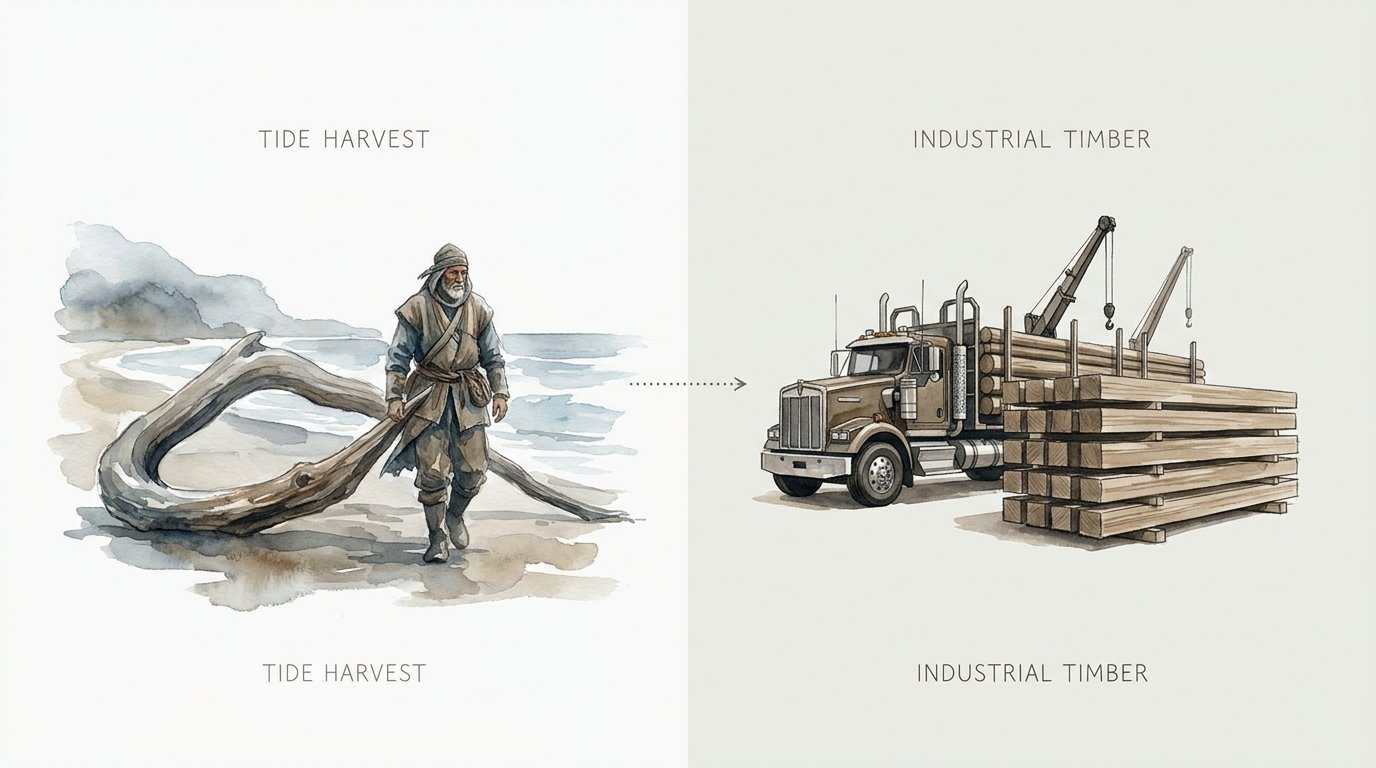
Ancestral driftwood harvesting is the practice of collecting and preparing timber that has been naturally processed by river or ocean currents. For millennia, coastal cultures from the Norse shipwrights to the Haida and Coast Salish peoples viewed the beach as a renewable warehouse of high-grade construction material. These builders recognized that logs floating in the ocean underwent a chemical transformation that standing timber could not match.
The primary difference lies in the curing process. Modern lumber is typically kiln-dried, a process that uses heat to rapidly pull moisture from the fibers. While efficient, this often leaves the wood with internal stresses that lead to warping or “checking” once it enters a humid environment. In contrast, driftwood has been submerged in a high-pressure brine solution. Salt water flushes out the biological sugars and starches—the “food” for rot and insects—and replaces them with sodium chloride and trace minerals.
This “salt-cured” timber possesses a density and resistance to decay that makes it a superior choice for certain structural and aesthetic uses. Historically, the Inuit used driftwood for kayak frames and tools because it was lighter and stronger than anything they could trade for. On the Pacific coast, large cedar and spruce logs were often preferred as “tide-harvested” because the sea had already done the hard work of stripping the bark and leaching the sap.
Modern industrial lumber is a product of speed. It is grown in plantations, harvested young, and treated with copper-based chemicals to prevent decay. While this works for suburban framing, it lacks the character and natural resilience of wood that has survived the North Pacific. Choosing tide-harvested wood is about rejecting the disposable nature of modern construction in favor of a material that has already proven its strength against the elements.
The Mechanics of Pacific Seasoning: How It Works
Harvesting from the tide is not a random act of beachcombing. It is a systematic process of selection, recovery, and secondary curing. Successful harvesters follow a rhythm dictated by the moon and the seasons, looking for specific characteristics in the wood that indicate it is ready for use.
Selection and Identification
Identifying the right logs is the first step. You are looking for timber that has been in the water long enough to be “cleansed” but not so long that it has become home to gribbles or shipworms. Look for logs with “silvered” surfaces and no remaining bark. This indicates the ocean has successfully leached the sapwood.
Check the ends of the log for rot. If the core is solid and the wood feels heavier than it looks, it is likely waterlogged but structurally sound. Species like Western Red Cedar and Sitka Spruce are the prizes of the Pacific Northwest, valued for their natural oils and straight grain.
Recovery Techniques
Recovering heavy timber from a remote beach requires more than just a strong back. Ancestral builders used the tide itself to move logs, tying them to small boats at low tide so they would float and be towable when the water rose. Today, many harvesters use portable winches or “log arches” to move material to a loading point without damaging the shoreline.
Mechanical assistance should be used sparingly and often requires specific permits. In many jurisdictions, you are restricted to what can be moved by hand. This limitation forces a level of selectivity that preserves the ecosystem. You aren’t just taking wood; you are “tending” the beach.
The Desalination and Drying Process
Once the wood is off the beach, the real work begins. The salt that preserves the wood also attracts moisture from the air, a phenomenon known as being “hygroscopic.” To make driftwood suitable for indoor furniture or fine joinery, it must be properly dried.
Start by scrubbing the wood with a stiff brush and fresh water to remove surface sand and loose salt. For smaller pieces, some practitioners advocate for a “reverse soak” in fresh water to pull some of the salt out of the surface layers, which helps tools stay sharp longer. The wood is then stacked with “stickers”—thin strips of wood—to allow airflow on all sides. Drying can take anywhere from six months to two years depending on the thickness of the timber.
The Practical Benefits of Tide-Harvested Wood
The advantages of salt-cured timber extend beyond mere aesthetics. This wood has undergone a natural version of the pressure-treatment process, making it uniquely suited for certain environments.
Superior Rot Resistance: The sodium chloride embedded in the wood fibers creates a hostile environment for the fungi that cause rot. While modern pressure-treated wood relies on chemicals like ACQ, driftwood uses the same mineral balance that has preserved maritime artifacts for centuries.
Dimensional Stability: Because the salt crystals help regulate how moisture enters and leaves the cells, driftwood is less prone to the “seasonal movement” that plagues fresh-cut timber. Once properly dried, a driftwood plank is incredibly stable, making it ideal for large-scale carvings or structural posts.
Pest Immunity: Most wood-boring insects are deterred by high salt content. Termites and carpenter ants prefer the sweet, starchy fibers of “green” or kiln-dried wood. Driftwood, having had those sugars leached out by years in the Pacific, is far less attractive to these pests.
Unique Aesthetic Value: No machine can replicate the “driftwood silver” patina or the smooth, sculpted texture created by sand and surf. This wood carries the visual weight of its journey, featuring unique knots and grain patterns that serve as a focal point in any architectural design.
Challenges and Common Pitfalls
The sea does not give up its treasures without a price. Working with driftwood presents several technical hurdles that can ruin a project if not managed correctly.
The most common mistake is failing to account for the “tool-tax.” Salt is an abrasive, and the minerals embedded in driftwood will dull saw blades and chisels significantly faster than standard lumber. High-carbon steel tools are a necessity, and you should expect to sharpen them twice as often. Furthermore, the salt can cause metal fasteners to corrode. Using standard zinc-plated screws in driftwood is a recipe for “bleeding” and eventual structural failure; only high-grade stainless steel or silicon bronze fasteners should be used.
Another pitfall is internal rot. A log may look silver and solid on the outside but can be “punky” or hollow at the core. Always drill a pilot hole or use an increment borer to check the density of the heartwood before committing to a large recovery effort. If the wood feels soft or crumbles when drilled, it has been reclaimed by the ocean and is better left as habitat.
Limitations and Environmental Constraints
Tide-harvesting is not a universal solution for all construction needs. There are realistic boundaries to where and how this wood can be used.
Building Codes and Engineering: In many regions, structural lumber must be “grade-stamped” by a certified agency. Since driftwood is salvaged, it lacks these stamps. This means you generally cannot use it for the primary load-bearing frame of a permitted residential home without an engineer’s sign-off. It is best used for non-structural elements, outbuildings, or decorative accents.
Salt Migration: If the wood is used indoors without a proper seal, the salt can “weep” during periods of high humidity. This can damage drywall or finish paint. Always ensure that driftwood used in interior spaces is fully dried and sealed with a high-quality oil or polyurethane to lock in the minerals.
Ecological Impact: Driftwood is not just “debris”; it is a vital part of the coastal ecosystem. It provides habitat for birds, stabilizes sand dunes, and provides nutrients to the tidepool communities. Over-harvesting can lead to beach erosion. It is essential to follow local regulations, which often limit the amount of wood you can take and prohibit the removal of “embedded” logs that are already serving as a foundation for the landscape.
Comparison: Industrial Lumber vs. Tide-Harvested Timber
| Feature | Industrial Kiln-Dried | Tide-Harvested (Driftwood) |
|---|---|---|
| Curing Speed | 4–7 Days | 5–50 Years (Natural) |
| Rot Resistance | Chemical (Coppers/Arsenic) | Natural Mineral Impregnation |
| Tool Wear | Low | High (Abrasive minerals) |
| Stability | Prone to warping/checking | High dimensional stability |
| Cost | Market price per board foot | “Free” (Labor and Permit costs) |
Best Practices for the Modern Scavenger
If you intend to source your own materials from the Pacific, you must adopt the mindset of a pioneer rather than a consumer.
- Know Your Local Laws: In Washington State, the Shoreline Management Act heavily regulates driftwood removal. In Oregon, you are generally limited to one cubic yard per day for personal use, and mechanized equipment is often prohibited. Always carry the necessary permits and know exactly where the property lines of “public” beaches end.
- Safety First: Never turn your back on the ocean. “Sleeper” or “rogue” waves can move massive logs with terrifying speed. Only harvest during receding tides and stay clear of logs that are actively being moved by the surf.
- Invest in the Right Fasteners: As mentioned, salt and common steel don’t mix. Use 316-grade stainless steel for any project involving tide-harvested wood. It is an added expense, but it prevents the “black streaks” that occur when salt reacts with iron.
- Seal the Grain: For exterior projects, a simple coat of linseed oil or tung oil can enhance the silver patina while providing an extra layer of moisture protection. For interior use, a matte polyurethane will prevent salt from leaching out during humid months.
Advanced Considerations: The Chemistry of the Cell Wall
For the serious practitioner, understanding the microscopic changes in the wood is key. When wood stays in salt water, the process of “osmosis” occurs. The saltwater solution is more concentrated than the sap inside the tree’s cells. This draws the sap out of the wood through the cell walls. Once the sap is gone, the void is filled with water containing dissolved minerals.
As the wood dries, these minerals—primarily sodium chloride—crystallize inside the cell lumen and within the cell walls themselves. These crystals act as mechanical spacers, preventing the cells from collapsing as they lose water. This is why salt-cured wood “dries flatter” than green wood. Additionally, the salt crystals are “deliquescent,” meaning they can absorb small amounts of atmospheric moisture, which keeps the wood from becoming too brittle in dry climates.
However, this same chemistry means you must be careful about glues. Many modern wood glues (like PVA) do not bond well to high-salt surfaces. If you are doing complex joinery, consider using a high-quality epoxy or traditional hide glue, and always “fresh-cut” the joint surface immediately before glue-up to expose wood that hasn’t been heavily oxidized by the salt.
Examples of Tide-Harvested Construction
Consider the case of a coastal shelter built on the rugged West Coast of Vancouver Island. Instead of trucking in pressure-treated 6×6 posts, the builder used salvaged cedar logs that had been seasoning in a nearby cove for a decade. These logs were already “silvered” and stripped of their sapwood by the ocean. By using a simple post-and-pier foundation and securing the logs with silicon bronze drift pins, the builder created a structure that is naturally resistant to the salt spray and high humidity of the rainforest.
Another scenario involves using driftwood as “live-edge” cladding for an interior feature wall. The harvester selected smaller, sun-bleached spruce planks, scrubbed them with fresh water, and kiln-dried them in a small homemade solar kiln for three months. The result was a wall that featured the sculptural textures of the sea, providing a level of “pioneer-grit” character that no high-end lumber yard could supply.
Final Thoughts
Ancestral driftwood harvesting is a testament to the wisdom of working with natural cycles rather than trying to outpace them. By allowing the ocean to act as a primary processor, we gain access to timber that is physically superior in its stability and resistance to decay. This practice encourages a deeper connection to the local environment and a rejection of the “fast-timber” culture that dominates modern construction.
Whether you are building a small garden structure or a piece of heirloom furniture, sourcing from the tide requires you to respect the power of the Pacific. It demands patience, hard labor, and a keen eye for quality. In return, the sea provides a material that is not only functional but carries the weight and history of the deep.
Take the time to walk your local beaches and observe the logs that the tide has delivered. Look for the silver grain and the solid heartwood. Apply the techniques of the ancestors to your modern projects, and you will find that the wood seasoned by the ocean builds a story as strong as the timber itself.
Sources
1 wikipedia.org (https://en.wikipedia.org/wiki/Driftwood) | 2 youtube.com (https://www.youtube.com/watch?v=9u-lrUTm9-4) | 3 homefire.co.uk (https://www.homefire.co.uk/blogs/blog/kiln-dried-vs-seasoned-wood-whats-the-better-choice) | 4 campfirewoodfuel.com (https://www.campfirewoodfuel.com/resources/blog/kiln-dried-vs-seasoned-firewood-whats-the-difference-and-why-it-matters/) | 5 charltonandjenrick.co.uk (https://www.charltonandjenrick.co.uk/news/2024/11/seasoned-or-kiln-dried-wood-whats-the-best/) | 6 conwyvalleylogs.com (https://www.conwyvalleylogs.com/the-pros-and-cons-of-kiln-dried-firewood-and-seasoned-logs/) | 7 mkm.com (https://mkm.com/blog/advice-and-reviews/marine-grade-timber-explained-sourcing-wood-for-coastal-conditions) | 8 wonderfulmuseums.com (https://www.wonderfulmuseums.com/museum/beachcomber-museum/) | 9 buildingproductsplus.com (https://buildingproductsplus.com/ultimate-guide-to-choosing-the-right-lumber-for-your-marine-construction/) | 10 beachcombingmagazine.com (https://www.beachcombingmagazine.com/blogs/news/swimming-trunks-about-driftwood) | 11 reddit.com (https://www.reddit.com/r/Washington/comments/t0hpgt/is_it_legal_to_harvest_driftwood_for_firewood/) | 12 sos.state.or.us (https://vertexaisearch.cloud.google.com/grounding-api-redirect/AUZIYQHl5tcnlqb6ZedJQPhImKSeRMtRmrUjN8yCWVbKnBWOfJwjrYd6BUDgZ-pwmfoBSPDuijpDFwL71yi50SopOvR00JmR1fHdsy0zhRyhqS0kvzZZdD5W4ZNKlpO12MxZ_4WzKooEvWrk16p8ln8L_ja5dddiOiOvq-iZFR5BhMl9H_QrQ4lqjik=)