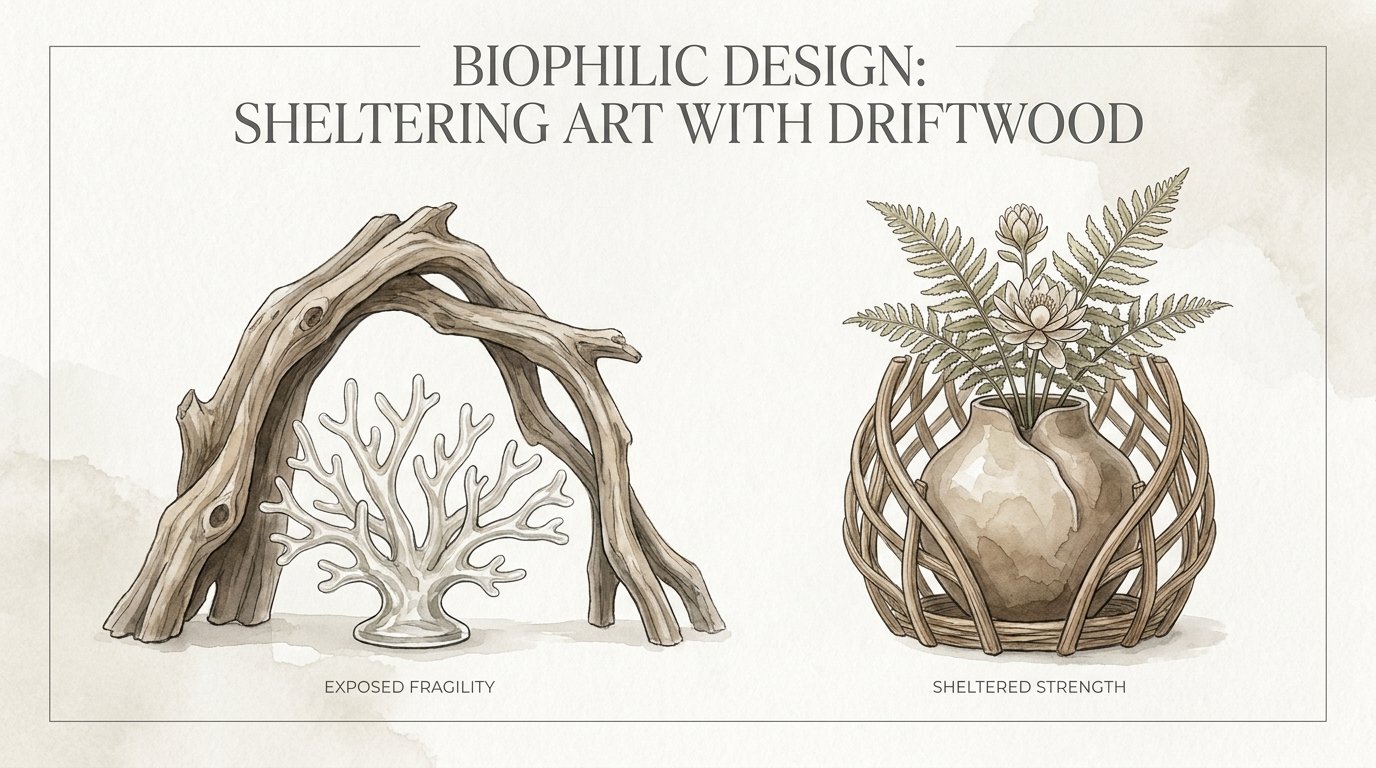
Biophilic Design: Sheltering Art With Driftwood
Does your home decor feel like a sterile museum exhibit or a protective, organic sanctuary? We spend thousands on fragile treasures only to leave them ‘exposed’ on flat, hard surfaces. The coastal strategist uses the gnarled, protective geometry of the ocean’s bones to create a ‘shelter’ within the home. This isn’t just about display; it’s about using the wood’s ancient strength to armor your modern life.
[affiai]Stepping into a room should feel like entering a clearing in a forest or a sheltered cove on a storm-lashed coast. Most modern interiors fail this test because they rely on the “exposed fragility” of glass, steel, and MDF. These materials offer no narrative and provide no sense of safety. Driftwood, however, carries the grit of the tides and the stoic endurance of the forest. When you use it to frame your art or support your keepsakes, you are not just decorating; you are building a bastion.
This guide explores how to integrate the raw, weathered power of driftwood into your living space through the principles of biophilic design. You will learn how to identify the right species, prepare the wood for a lifetime of indoor use, and engineer structures that look as if they grew directly from your walls.
Biophilic Design: Sheltering Art With Driftwood
Biophilic design is the intentional process of integrating natural systems and materials into the built environment to satisfy the human craving for nature. It is rooted in the “biophilia hypothesis,” popularized by biologist Edward O. Wilson in the 1980s, which suggests that humans possess an innate tendency to seek connections with nature and other forms of life. In practical terms, this means that a room filled with organic textures—like the silvered grain of sun-bleached timber—actually lowers cortisol levels and improves cognitive function.
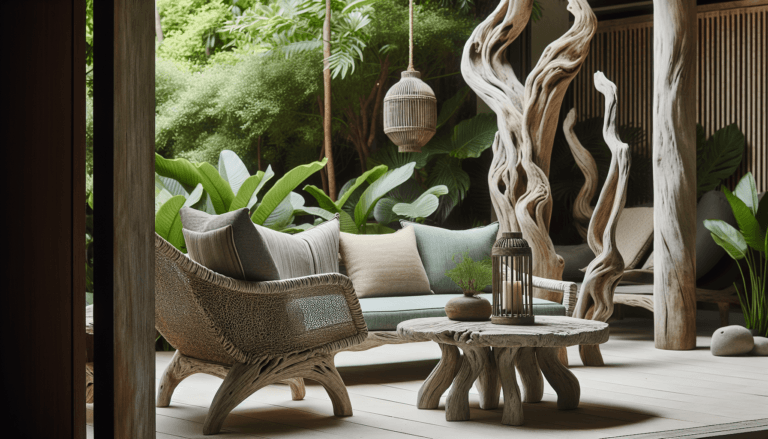
Driftwood serves as a primary tool for the coastal strategist because it embodies the concept of “refuge.” In the wild, large logs provide shelter for nesting birds and act as the foundational anchors for sand dunes. When brought indoors, that same gnarled geometry can be used to “cradle” fragile art, glasswork, or lighting. Instead of a vase sitting precariously on a flat table, it can be nestled within the hollow of a weathered root system, creating a visual sense of “sheltered strength.”
Real-world applications of this design philosophy range from massive architectural installations in coastal retreats to subtle, functional accents in urban apartments. Whether it is a full-scale “geologic wall” or a simple branch acting as a floating bough, the presence of wood that has survived the ocean’s salt and sun provides a psychological anchor for the room’s occupants.
The Anatomy of Driftwood: Choosing Your Armor
Not every piece of wood found on the beach is suitable for your home. To build a lasting sanctuary, you must understand the density, tannin content, and history of the timber you find. Softwoods and hardwoods react differently to the drying process and offer varying levels of structural integrity.
Hardwoods vs. Softwoods
Most driftwood found on coastlines consists of local species that have fallen into river systems or been swept away during storms. In the Pacific Northwest, you are likely to find Red Cedar and Sequoia. These are prized for their high tannin content, which makes them naturally resistant to decay and rot. Cedar, in particular, maintains its structural strength for decades even in humid environments.
On the other hand, species like Poplar or Sycamore are common in river-fed driftwood collections. Research indicates that clear poplar driftwood can maintain a compressive strength of nearly 39 MPa, making it surprisingly viable for furniture construction. However, these lighter woods are more prone to “wood-boring insects” and partial rot if they haven’t been properly seasoned by the sea.
Identifying Quality Specimens
Look for pieces that feel heavy for their size. High density often indicates that the wood has been compressed by the water or was a hardwood to begin with. Avoid “spongy” wood that yields under thumb pressure; this is a sign of internal rot that no amount of bleach can fix. The best pieces for “sheltering art” are those with deep crevices, hollows, or “gnarled joints” where the tree’s original root system met the trunk. These geometric complexities are what provide the protective nesting areas for your decor.
Preparation: From Tides to Timber
Bringing a piece of the coast into your home requires more than just picking it up off the sand. Raw driftwood can harbor sand gnats, woodworms, salt crystals, and microscopic organisms that will degrade the wood—and your home’s hygiene—over time.
The Sanitization Process
A thorough cleaning process typically takes three to five days. Start by scrubbing the wood with a stiff nylon brush to remove loose sand and “beach wrack” (seaweed and debris). For deep crevices, use an air compressor or a water flossing tool to blast out hidden grit.
Soak the wood in a solution of one part household bleach to nine parts fresh water. Submerge the piece completely for at least 24 to 48 hours. This kills any remaining parasites and lightens the wood to that sought-after “silver-gray” patina. If you prefer a more natural look, use a heavy concentration of white vinegar instead of bleach, though this is slightly less effective against deep-seated larvae.
The Drying Phase
Once sanitized, the wood must be dried slowly. Rapid drying near a heater or in direct, intense sunlight can cause the wood to check (crack) as the outer layers contract faster than the core. Place the wood in a well-ventilated, shaded area. Depending on the thickness, this can take anywhere from a few days to two weeks. The wood is ready when it feels room-temperature to the touch and rings with a hollow, “wooden” sound when tapped.
The Art of Sheltering: Design Techniques
The “Coastal Strategist” approach focuses on the interaction between the wood and the items it protects. This is the transition from “Exposed Fragility” to “Sheltered Strength.” Instead of seeing the driftwood as a standalone sculpture, see it as a framework.
Nesting and Cradling
Identify the “negative space” within a gnarled piece of wood. A deep U-shaped bend in a branch is the perfect “nest” for a hand-blown glass bowl or a collection of smooth river stones. By placing the fragile item inside the wood’s curve, you create a visual metaphor for protection. The wood acts as the “armor,” while the art remains the “precious core.”
Horizontal vs. Vertical Integration
Horizontal pieces work best as mantels or coffee table centerpieces. A long, weathered branch can be hollowed out to hold tea lights or small succulents, creating a “biophilic gradient” across a room. Vertical pieces, such as root systems, can be mounted as wall art that doubles as a shelving unit. The unpredictable angles of the branches provide “natural levels” for displaying small treasures without the rigid, artificial lines of standard shelving.
Structural Integrity: Engineering the Display
When using driftwood for functional purposes, such as shelving or lighting, you cannot rely on hot glue or light adhesives. Driftwood is often heavier than it looks, and its irregular shape makes load-bearing difficult to calculate.
Mounting Solutions
For wall-mounted driftwood, always seek out the structural studs behind your drywall. Heavy pieces should be secured using long-lag screws or invisible floating shelf brackets. If you cannot find a stud, use heavy-duty toggle bolts. Avoid plastic drywall anchors, as the torque from an irregularly shaped branch will eventually pull them through the wall.
Hidden Hardware
Professional designers often use a “back-mount” technique. This involves screwing the driftwood from behind a mounting board or through the wall itself. By countersinking the screws and filling the holes with a mixture of sawdust and wood glue, you can create the illusion that the wood is floating or growing directly out of the architecture.
Aesthetics: Weathered Patinas and Modern Finishes
While many prefer the raw, sun-bleached look of driftwood, applying a finish can highlight the grain and protect the wood from the low humidity found in most climate-controlled homes.
Oiling for Depth
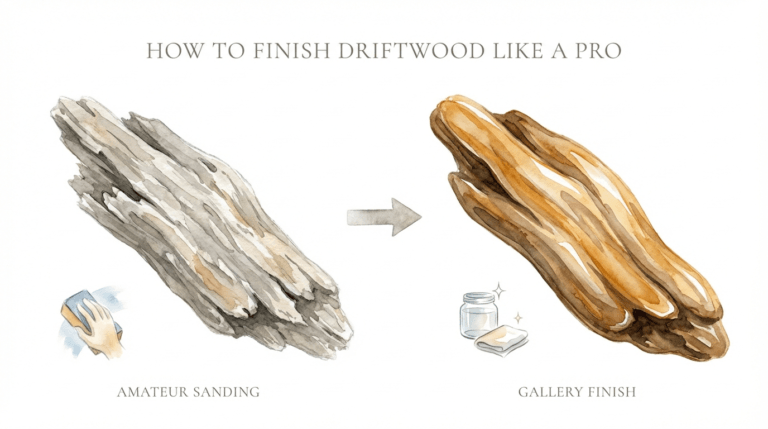
Raw driftwood can become brittle and “splintery” over time. Applying boiled linseed oil or a high-quality tung oil restores the wood’s moisture and brings out hidden colors—deep ambers, rich browns, and charcoal grays. Three coats are typically recommended, allowing the oil to soak in completely between applications.
Modern Contrast
For a more contemporary look, consider “dipping” the ends of the wood in matte black or gold paint. This creates a sharp, intentional contrast between the wild, weathered wood and the precision of modern design. It signals that the driftwood is not a piece of debris, but a curated artifact.
Psychological Impact: The Power of Organic Geometry
Why does driftwood feel different than a standard piece of lumber? It is the “fractal complexity.” Nature rarely works in straight lines. The curves, knots, and eroded surfaces of driftwood provide the eye with a “soft” place to land.
Research into biophilic design shows that environments with organic materials reduce heart rates and blood pressure. In one Japanese study, participants in a room with wood wall panels reported lower instances of depression and stress compared to those in a steel-clad room. The “sheltering” aspect of driftwood art taps into our primal need for a “safe harbor.” It reminds the subconscious of a place where the storm has already passed, and only the strong remain.
Challenges and Common Mistakes
The most frequent error in driftwood design is improper scale. A tiny piece of wood on a large, empty wall looks like an afterthought. Conversely, a massive root system in a small hallway can feel claustrophobic rather than protective.
- Skipping the Soak: Failure to sanitize wood often leads to an infestation of “powderpost beetles” or other wood-boring insects months after the piece has been brought inside.
- Forcing the Form: Trying to sand a piece of driftwood into a perfectly straight shelf ruins its character. If you want straight lines, buy a 2×4. Let the wood’s natural bends dictate the design.
- Over-Decorating: The wood is the star. Cluttering a driftwood shelf with too many plastic or mass-produced items dilutes the biophilic effect. Use the “rule of three” and leave plenty of negative space.
Limitations: When Driftwood May Not Work
Driftwood is a living material, even when it is “dead.” It reacts to environmental changes. In extremely dry climates, it can continue to crack and pop as it loses internal moisture. In very humid bathrooms, unprotected driftwood can develop mold if it isn’t sealed with a marine-grade varnish or polyurethane.
Additionally, there are legal constraints. In many regions, removing driftwood from public beaches is restricted or requires a permit to protect the local ecosystem. Always check local regulations before harvesting. In some areas, driftwood is vital for beach stabilization and bird nesting; removing it can be an act of environmental “grit” that goes against the very biophilic principles you are trying to honor.
Comparison: Hand-Found Driftwood vs. Commercial Reclaimed Wood
| Feature | Hand-Found Driftwood | Commercial Reclaimed Wood |
|---|---|---|
| Texture | Highly irregular, eroded, gnarled. | Often planed, uniform, or rustic-sawn. |
| Cost | Free (plus labor for cleaning). | Moderate to High ($10-$50 per sq/ft). |
| Durability | Variable; requires careful selection. | High; usually pre-treated and kiln-dried. |
| Installation | Complex; requires custom mounting. | Standard; works with traditional joinery. |
Practical Tips for the Coastal Strategist
To implement this style successfully, start small. Find a single, high-quality branch and use it to frame a specific area of your home, such as a reading nook or an entryway.
- Use Marine Varnish for “Wet” Areas: If placing driftwood in a bathroom or kitchen, a matte-finish marine varnish will protect it from steam without making it look “plastic.”
- Incorporate Lighting: Use LED “fairy lights” or recessed puck lights to illuminate the wood from within. The shadows cast by gnarled branches create a dramatic, organic effect at night.
- Sanding for Safety: While you want to keep the texture, use 220-grit sandpaper on the specific areas where the wood will touch your art or where hands might brush against it to prevent splinters.
Advanced Considerations: Integrating Technology
Serious practitioners of biophilic design are now integrating smart home technology directly into driftwood structures. This can include:
– **Hidden Charging Ports:** Carving out a small recess in a thick driftwood bedside table to house a wireless charging pad.
– **Integrated Sound:** Using the hollow core of a large log as a natural acoustic resonator for a hidden Bluetooth speaker.
– **Bio-Lighting:** Mounting air plants (Tillandsia) directly into the wood crevices and using specialized UV-spectrum grow lights to keep them thriving indoors.
These techniques ensure that the “shelter” you are building is not a step backward into the primitive, but a sophisticated merger of ancient materials and modern convenience.
Examples and Scenarios
The Living Room Mantel: A 6-foot piece of Western Red Cedar, found after a winter storm, is cleaned and mounted above a fireplace. Instead of sitting *on* the mantel, three fragile, hand-turned ceramic vases are nestled *into* the natural curves of the wood. The silver patina of the wood complements the earthy tones of the clay, making the vases look like they are part of a mountain ridge.
The Office “Refuge”: In a high-stress home office, a vertical driftwood root system is mounted to a side wall. It holds no books, only a single “prospect” view of a landscape painting and a small air plant. When the worker feels overwhelmed, their eyes rest on the complex, fractal patterns of the roots, triggering a biological “reset” that a flat white wall cannot provide.
Final Thoughts
Building a sanctuary is an act of defiance against the sterile, the fragile, and the temporary. By choosing to shelter your art with the gnarled bones of the ocean, you are acknowledging that beauty is most powerful when it is protected by strength. Driftwood is the ultimate pioneer material—it has been tested by the waves, bleached by the sun, and refined by time.
Do not be afraid of the grit. Embrace the knots, the cracks, and the irregular paths the wood has taken. When you bring these elements into your home, you aren’t just adding a decoration; you are inviting a story of survival into your daily life. Experiment with different placements, learn the “feel” of different timbers, and let your home become the “sheltered strength” you need in a modern world.
As you continue your journey into biophilic design, consider how other natural elements—stone, raw wool, and living greenery—can further armor your space. The coastal strategist knows that a home is more than a building; it is a landscape where we choose to thrive.
Sources
1 rmcad.edu (https://www.rmcad.edu/blog/biophilic-design-integrating-nature-into-modern-interiors/) | 2 thefurnitureshows.com (https://thefurnitureshows.com/news/embracing-biophilic-design-2024-guide-natural-living-spaces) | 3 clementstudio.com.au (https://clementstudio.com.au/blogs/latest-articles/the-rise-of-biophilic-interior-design-in-2024) | 4 biophilicproducts.org (https://biophilicproducts.org/biophilic-design-blog/biophilic-design/benefits-of-biophilic-design/) | 5 oceanhomemag.com (https://www.oceanhomemag.com/uncategorized/luxurious-driftwood-furniture-from-the-worlds-beaches/) | 6 oceanhomemag.com (https://www.oceanhomemag.com/home-design/driftwood-decor/) | 7 researchgate.net (https://www.researchgate.net/publication/399045870_Driftwood_as_a_Material_for_Making_Unique_Furniture) | 8 coastalcottagebyceleste.com (https://www.coastalcottagebyceleste.com/diy/lr0iwt1wrtsiz0a4dzvpbq3m5awhyk) | 9 hawk-hill.com (https://www.hawk-hill.com/how-to-clean-driftwood/) | 10 naturallywood.com (https://www.naturallywood.com/wood-performance/health-biophilia/) | 11 thermoryusa.com (https://thermoryusa.com/2021/02/01/the-benefits-of-biophilic-design/) | 12 walkerwarner.com (https://walkerwarner.com/work/view/driftwood/) | 13 architecturalsupplements.com (https://architecturalsupplements.com/news/the-top-biophilic-design-trends-shaping-2024/)