Best Uv Protective Finish For Driftwood
The sun can turn your ocean treasure into a pile of gray splinters faster than you think. We love the sun-bleached look, but there is a fine line between ‘coastal’ and ‘crumbling.’ Without the right UV-blocking shield, your driftwood shelf will lose its structural integrity and its soul. Here is how to lock in the color while keeping that raw, natural feel.
[affiai]Driftwood is more than just dead wood. It is a record of a journey, cured by salt and sculpted by the relentless rhythm of the tides. When you pull a piece from the shoreline, it has already been through a gauntlet. However, the moment you bring it into a garden or a sunlit room, a new battle begins. Ultraviolet radiation acts like a microscopic sandpaper, grinding down the lignin that holds wood fibers together.
Choosing a finish for these weathered relics requires a different mindset than finishing a piece of fresh oak from the lumberyard. You are working with a material that is exceptionally porous and often chemically altered by salt. A standard interior polyurethane will fail here. You need something that can flex, breathe, and—most importantly—thwart the sun’s attempts to turn your find into silver dust.
Best Uv Protective Finish For Driftwood
The gold standard for protecting wood exposed to harsh environments is marine-grade spar varnish or spar urethane. These products were originally engineered for the wooden masts (spars) of sailing ships, which faced constant sun, salt spray, and physical racking. Unlike standard finishes, a spar finish is high in oil content and contains specialized UV inhibitors.
These inhibitors work like a high-SPF sunscreen for your wood. They absorb or reflect the ultraviolet rays before they can reach the wood fibers and break down the “glue” that keeps the wood strong. In the real world, this means your driftwood won’t just look better; it will actually stay solid. Without this protection, the surface of the wood becomes “friable,” meaning it starts to flake off in tiny, gray scales.
Marine finishes are used by boat builders, outdoor furniture makers, and coastal homeowners who understand that the elements never stop attacking. For a piece of driftwood, these finishes provide a flexible “skin” that can expand and contract with temperature changes without cracking or peeling. This flexibility is the secret to longevity.
Why Spar Varnish Beats Standard Polyurethane
Interior polyurethanes are designed to be hard and scratch-resistant. While that sounds good, a hard finish is brittle. When wood sits in the sun, it heats up and expands. When it cools down, it shrinks. A brittle finish cannot keep up with this movement, so it develops microscopic cracks. Moisture gets into those cracks, gets trapped under the finish, and causes the whole layer to peel off in ugly sheets. Spar varnish stays slightly soft even when cured, allowing it to move with the wood.
How to Apply UV Protection to Driftwood
Applying a finish to driftwood is not a “slap it on” affair. Because the wood is so thirsty, your technique determines whether the piece looks like a natural treasure or a piece of plastic.
Step 1: Desalination and Cleaning
Salt is the enemy of adhesion. If you apply a finish over salt-crusted wood, the finish will eventually bubble and fail. Submerge your driftwood in a tub of fresh water for several days, changing the water daily. This leaches out the salt. Once soaked, scrub the surface with a stiff nylon brush to remove loose sand, dried algae, and crumbling wood fibers.
Step 2: The Drying Phase
Never finish wet wood. Driftwood must be bone-dry all the way through. Depending on the thickness of the piece, this could take a week in a dry garage or a few days in a low-humidity environment. Moisture trapped inside will cloud the finish or cause it to rot from the inside out.
Step 3: The Wiping Varnish Technique
To avoid a thick, “plastic” look, do not apply the varnish straight from the can with a heavy brush. Instead, create a “wiping varnish.” Mix your marine spar urethane with an equal part of mineral spirits. This thins the finish, allowing it to soak deep into the porous wood rather than just sitting on top.
- Use a lint-free cotton cloth to wipe the thinned mixture onto the wood.
- Wait ten minutes for the wood to drink it in, then wipe away any excess that hasn’t absorbed.
- Allow it to dry for 24 hours.
- Repeat this process for 3 to 5 coats. This builds protection from within the wood fibers.
Step 4: Managing the Sheen
Most UV-blocking finishes are naturally glossy because gloss provides the best reflection of UV rays. If you want a raw, matte look, apply your first three coats in gloss for the best protection. For the final coat, use a satin or matte version of the same product. This gives you the strength of the gloss with the aesthetic of a natural find.
Benefits of UV Shielding
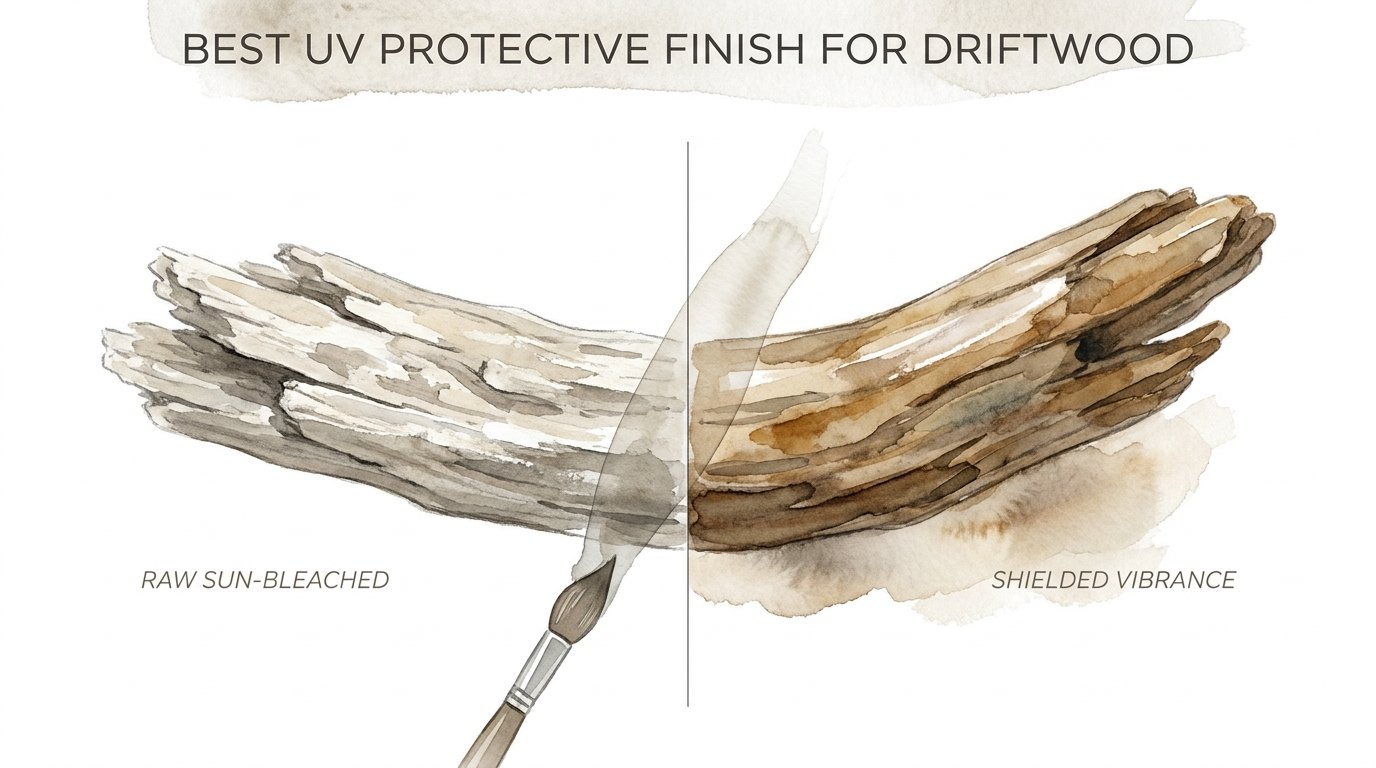
The most immediate benefit is color retention. UV rays act as a bleach, stripping away the deep ambers, rich browns, and subtle grays of the wood. A shielded finish preserves the “vibrance” of the grain, making the wood look “wet” and alive even when dry.
Beyond looks, you are preserving the structural integrity. Lignin degradation doesn’t just change the color; it turns the wood into a sponge that absorbs water. This leads to rot, fungal growth, and insect infestation. A good UV finish seals these pathways, ensuring your driftwood sculpture or furniture piece remains a legacy item rather than a temporary decoration.
Furthermore, a properly finished piece is much easier to clean. Raw driftwood is a magnet for dust and cobwebs, which get caught in the rough texture. A sealed surface allows you to wipe away grime with a damp cloth without the wood absorbing the dirt.
Challenges and Common Mistakes
The biggest mistake is over-application. It is tempting to put on one thick, heavy coat to “get it over with.” This is a recipe for disaster. Thick coats trap bubbles, take forever to dry, and are prone to sagging and running. On a complex, craggy piece of driftwood, those drips will dry into hard, ugly “icicles” that are nearly impossible to sand out.
Another common pitfall is ignoring the “bottom” or hidden sides of the wood. Even if a side isn’t facing the sun, it needs to be sealed. If one side is sealed and the other is raw, the wood will absorb moisture unevenly, leading to warping or “cupping.” You must treat the piece as a whole unit, sealing every nook, cranny, and crevice.
Finally, many people forget to sand lightly between coats. The first coat of any finish will “raise the grain,” making the wood feel fuzzy or rough. A quick pass with 220-grit sandpaper or a fine scuff pad will knock down those fibers, ensuring the subsequent coats lay flat and bond properly.
Limitations of UV Protection
No finish is permanent. Even the highest-grade marine varnish will eventually succumb to the sun if left outdoors year-round. You should expect to perform a “maintenance coat” every 12 to 24 months for outdoor pieces. This involves a light sanding and a fresh wipe-on layer of finish.
Environmental trade-offs are also a reality. Oil-based spar finishes often have a slight amber tint. While this looks beautiful on many woods, it can slightly change the “silver-ghost” look of certain types of bleached driftwood. If you absolutely must have zero color change, you will need a water-based spar urethane, which dries crystal clear but generally offers slightly less flexibility and depth than its oil-based counterparts.
RAW SUN-BLEACHED vs SHIELDED VIBRANCE
Deciding between a raw look and a shielded finish often comes down to the intended use and the environment.
| Feature | Raw Sun-Bleached | Shielded Vibrance |
|---|---|---|
| UV Resistance | Zero (accelerated graying) | High (preserves color) |
| Maintenance | None (until it rots) | Annual/Bi-annual recoating |
| Texture | Rough and “dusty” | Smooth and sealed |
| Structural Life | Short (3-5 years outdoors) | Long (10+ years with care) |
Practical Tips and Best Practices
Always test your finish on a small, inconspicuous area first. Every piece of driftwood is a unique chemical cocktail of minerals, tannins, and salt residues. You don’t want to find out that your finish turns your prize find a strange shade of orange after you’ve coated the whole thing.
For pieces with deep holes or cracks, use a disposable foam brush to “dab” the finish into the recesses. Gravity will pull the finish deep into the wood, sealing areas that a cloth or standard brush might miss. Ensure you wipe away any pooling liquid, as thick puddles of varnish will never cure correctly and will remain tacky for weeks.
If you are working in a humid environment, wait for a dry day. High humidity can “blush” a finish, turning it a milky white as moisture gets trapped in the drying film. A clear, sunny day with low humidity is your best ally.
Advanced Considerations
For those looking for the absolute peak of protection, consider products containing nano-particle UV absorbers. These are the cutting edge of wood science. These particles are so small they don’t scatter light (meaning they don’t cloud the finish), but they are incredibly effective at neutralizing UV radiation.
Serious practitioners often use a “sealing” layer of penetrating epoxy before the spar varnish. The epoxy soaks into the soft, punky areas of the driftwood and hardens them into something akin to stone. You then apply the UV-blocking spar varnish over the epoxy. The epoxy provides the strength, and the varnish provides the sun protection. This “belt and suspenders” approach is how world-class marine woodwork is maintained.
Examples and Scenarios
Consider a large cedar stump found on a Pacific Northwest beach. If you turn this into an outdoor coffee table for a sun-drenched patio, you are facing maximum exposure. In this scenario, you would want to use a high-build marine varnish like Epifanes or System Three. You would apply at least six coats, with the first two thinned significantly for penetration. This creates a thick, resilient barrier that can withstand the intense solar load.
Contrast this with a delicate piece of “ghost wood” used as a wall hanging in a bedroom. The UV exposure is lower, and you likely want to maintain that ethereal, dry look. For this, a water-based, matte-finish spar urethane applied in two thin “wiping” coats is sufficient. It provides enough protection to keep the wood from getting brittle without changing the visual “temperature” of the piece.
Final Thoughts
Preserving driftwood is an act of respect for the time it spent in the wild. By applying a high-quality UV-blocking finish, you are not just painting on a layer of chemicals; you are providing a shield that allows the wood’s natural story to remain visible for decades.
Whether you choose a traditional oil-based spar varnish or a modern water-based urethane, the key lies in the preparation and the patience of the application. Short, thin coats will always outperform a single thick one, and a clean, salt-free surface is the only foundation worth building on.
Do not be afraid to experiment with different sheens and thinning ratios. Each piece of driftwood has its own personality, and finding the right “shielded vibrance” is part of the craft. Take the time to do it right, and your ocean treasure will remain a centerpiece instead of becoming a memory.
Sources
1 awiqcp.org (https://awiqcp.org/news-and-blog/the-best-outdoor-wood-finish-how-to-protect-your-wood-like-a-pro/) | 2 youtube.com (https://www.youtube.com/watch?v=DhZSKixKdIo) | 3 thewoodwhisperer.com (https://thewoodwhisperer.com/articles/a-better-way-to-apply-spar-urethane/) | 4 aquariumcoop.com (https://forum.aquariumcoop.com/topic/8554-how-do-i-stop-driftwood-from-leaching-tanins/) | 5 wood-source.com (https://wood-source.com/articles/what-is-the-best-finish-for-your-project/) | 6 youtube.com (https://www.youtube.com/shorts/xiIEMmTPiU0) | 7 reddit.com (https://www.reddit.com/r/woodworking/comments/po8wl8/how_to_get_a_smooth_finish_with_spar_urethane/) | 8 monsterfishkeepers.com (https://www.monsterfishkeepers.com/forums/threads/how-do-i-ensure-a-driftwood-does-not-leach-tanins-and-stain-my-water.360015/) | 9 jamesfurnituredeals.com (https://www.jamesfurnituredeals.com/best-marine-varnish-for-outdoor-furniture/) | 10 pbo.co.uk (https://www.pbo.co.uk/gear/best-boat-varnish-choose-the-right-varnish-for-your-woodwork-66781)