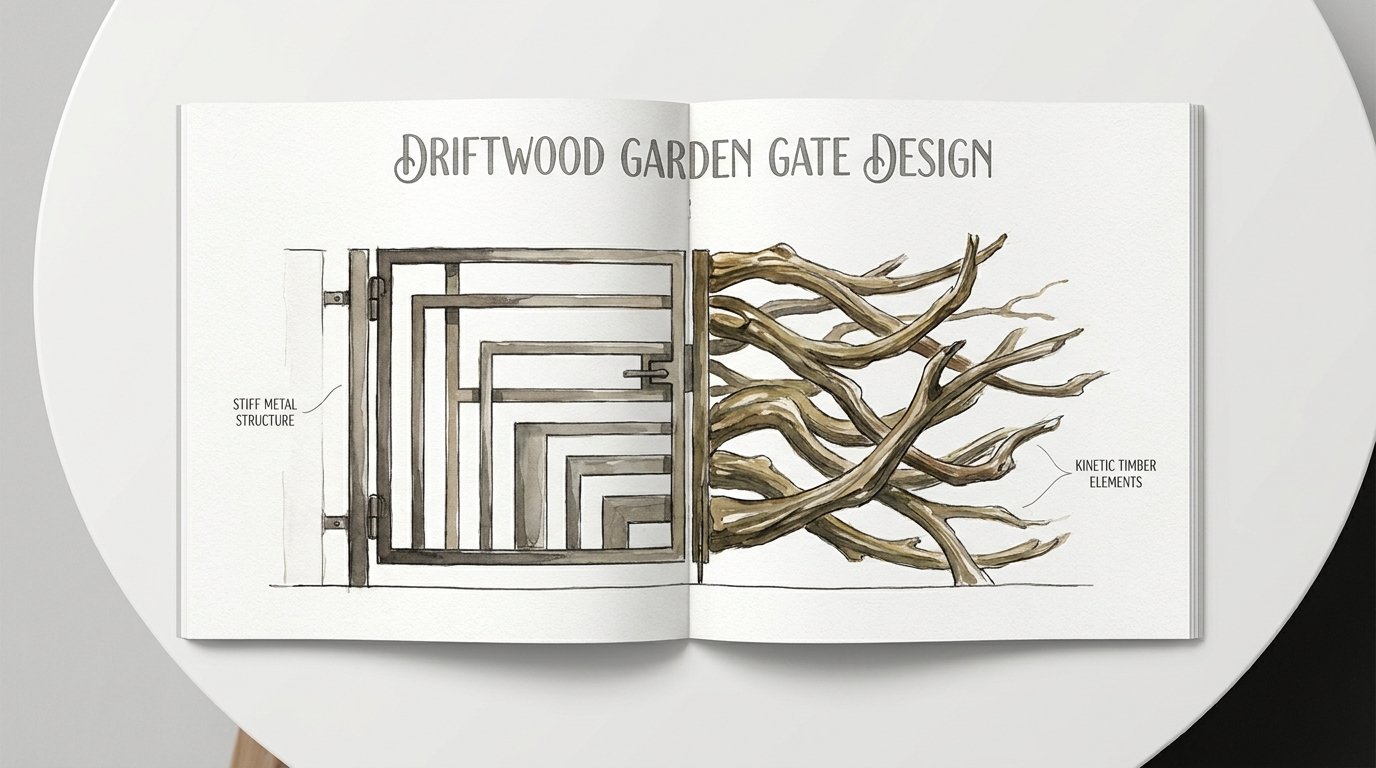
Driftwood Garden Gate Design
When you align your home with the physics of the sea, even the heaviest gate feels as light as a feather. Metal hinges rust and seize in the salt air. A weight-balanced driftwood pivot gate uses the wood’s own unique geometry to create a kinetic masterpiece. Learn how to find the natural center of gravity in ocean-hewn timber to build a gateway that responds to a single finger’s touch.
[affiai]Coastal living demands a respect for entropy. The salt spray, a relentless mist of corrosive ions, views your high-end stainless steel hardware as a temporary challenge. Eventually, the salt wins. Traditional hinges, which hang the weight of a gate from the side of a post, rely on shear strength and leverage. This design forces the wood to fight a losing battle against torque and gravity. But when you move the axis of rotation to the center of the timber, you change the fundamental physics of the entrance.
Building with driftwood is a lesson in patience and observation. You are not just building a barrier; you are harnessing a piece of history. These logs have been tumbled by the Pacific or the Atlantic, scoured by sand, and cured by brine. They are dense, resilient, and often “fossilized” by their journey. Using a pivot mechanism allows you to celebrate the irregular beauty of these timbers without forcing them into the rigid, failing structures of standard carpentry.
Driftwood Garden Gate Design
Driftwood garden gate design is the art of integrating found objects into functional architecture without stripping them of their character. Unlike a standard gate made of dimensional lumber, a driftwood gate relies on the organic curves and structural density of wood that has already survived the harshest environment on earth. In the coastal context, these gates serve as more than just boundaries; they are sculptural landmarks that signal a transition from the wild shoreline to the cultivated sanctuary of a garden.
The core of this design philosophy is “kinetic timber.” This refers to heavy, structural wood that moves with the fluidity of a much lighter material because its mass is perfectly aligned with its pivot point. While a traditional gate is a rectangle of wood hanging off a vertical post, a driftwood pivot gate is often a single, massive log or a collection of joined branches that rotate around a central vertical axis. This design mimics the way a compass needle floats or a ship’s rudder turns.
In real-world applications, driftwood gates are found in rugged coastal estates, Mediterranean villas, and eco-conscious garden retreats. They are used where standard hardware would fail within seasons or where the aesthetic goal is to blend the man-made environment with the natural horizon. Designers choose driftwood because it has a high lignin content—the natural polymer that makes wood “hydrophobic” and resistant to rot. Because the sea has already washed away the softer cellulose fibers, what remains is the bone of the tree: tough, dense, and naturally beautiful.
Finding the Ghost: The Physics of the Center of Gravity
Before you bore a single hole, you must find the “ghost” inside the log—its center of gravity. Most driftwood is asymmetrical. One end might be a heavy root ball, while the other is a tapered trunk. If you try to mount this like a normal gate, the heavy end will drag the latch into the dirt until the hinges snap.
Finding the balance point is a tactile process. You can use a simple pipe or a smaller log as a fulcrum on the ground. Lay your driftwood piece across the fulcrum and slide it back and forth until the log balances perfectly level. This point is your vertical axis. When you drill your pivot hole here, the weight on the left side of the gate exactly cancels out the weight on the right.
This balance is what allows a 300-pound cedar log to swing open at the touch of a child’s hand. Because the weight is distributed vertically through the pivot into the earth, there is zero lateral torque on the gate post. The post doesn’t need to resist being pulled over; it only needs to keep the gate upright. This shift from tension to compression is the secret to a gate that lasts a century.
How to Construct a Weighted Pivot Gate
Construction begins with the foundation. Because a pivot gate transfers all its weight straight down, the bottom pivot point must be incredibly stable. In traditional coastal builds, this was often a “pivot stone”—a hard granite or basalt rock with a natural or carved depression. Modern builders might use a stainless steel pin and a ball-bearing socket, but the principle remains the same.
The Socket and the Pin
First, excavate a hole at least 3 feet deep for your main support post. This post doesn’t hold the gate’s weight, but it provides the upper limit of the pivot. For the bottom pivot, you want a heavy, flat stone or a concrete footing with a 316-grade stainless steel rod embedded in it. This rod should be roughly 1 inch in diameter and extend 6 inches above the ground level.
Next, you must bore a matching hole into the bottom of your driftwood log. This is the most critical step. The hole must be perfectly vertical. If the hole is tilted even a few degrees, the gate will “climb” as it opens and try to swing shut or open on its own. Using a long auger bit and a spirit level, drill into the heartwood of the log.
The Upper Guide
The top of the gate needs a guide to keep it from tipping. This is not a load-bearing hinge; it is a simple collar or pin that allows the log to rotate while staying vertical. A common technique is to use a heavy-duty stainless steel eye bolt on the post and a pin on the top of the log. Because this point sees very little stress, you can often hide the hardware within the wood for a “floating” appearance.
Bracing for Longevity
If your gate is a single massive log, no bracing is needed. However, if you are building a frame from multiple pieces of driftwood, use “V-bracing” instead of the traditional “Z-brace.” Since the pivot is in the center, the weight travels from the outer edges back toward the middle. A V-shape, with the point at the bottom pivot, ensures that gravity compresses the joints together rather than pulling them apart.
Benefits of the Balanced Pivot System
The primary advantage of a weight-balanced driftwood gate is its mechanical efficiency. By eliminating the leverage that plagues side-hinged gates, you remove the most common cause of failure: sagging. Even the best-built traditional gates will eventually pull their top hinges out of the post or cause the post itself to lean.
* Zero Sagging: Since the weight is supported from below, there is no downward leverage on the side of the post.
* Rust Immunity: By using a stone socket or minimal, heavy-duty stainless steel at the pivot points, you eliminate the complex moving parts of metal hinges that seize in salt air.
* Wind Resistance: A center-pivoted gate can be designed to be “wind neutral.” If the surface area is balanced on both sides of the axis, the wind will not force the gate open or closed.
* Hand-Touch Operation: The lack of friction and perfectly balanced mass means the gate moves with incredible smoothness, regardless of its weight.
* Natural Aesthetic: Driftwood has a silver-gray patina that looks better with age, unlike painted or treated lumber that peels and rots.
Challenges and Common Mistakes
Working with driftwood is not like working with kiln-dried pine. The wood is irregular, and its internal moisture content can vary wildly. One of the most frequent errors is failing to account for “green” weight versus “dry” weight. If you find a log on the beach that is waterlogged, it will be significantly heavier than it will be after six months in your garden. If you balance the gate while it is wet, it may become unbalanced as it dries unevenly.
Another common pitfall is improper soil stabilization. Because all the weight is concentrated on a single point (the bottom pivot), the ground must not be allowed to settle. If the pivot stone sinks even an inch, the top guide will bind, and the gate will seize. Always use a deep, compacted gravel base or a concrete pier under your pivot stone.
Vertical alignment is the third major challenge. In a standard gate, you can shim the hinges to fix a slight lean. In a pivot gate, the axis is fixed. If your bottom pin and top guide are not perfectly “plumb” with each other, the gate will have a “preferred” position—it will always want to swing to the lowest point of its arc. This can be used intentionally to create a self-closing gate, but if unintentional, it is a frustrating flaw.
Limitations: When This Approach Fails
A weight-balanced driftwood pivot gate is not a universal solution. It requires a specific set of conditions to be successful. First, it requires space. Because the gate rotates around its center, it needs clearance on both sides of the fence line. You cannot install a center-pivot gate flush against a wall or in a narrow alleyway where one side of the gate would hit an obstruction.
Security is another limitation. Pivot gates are often “double-acting,” meaning they swing both ways. This makes them difficult to lock with standard deadbolts or latches. While you can engineer a stop and a latch, the natural movement of the wood and the pivot mechanism makes them better suited as garden entrances or property markers rather than high-security barriers.
Finally, the availability of materials can be a constraint. To build a truly impressive pivot gate, you need a substantial, structural piece of driftwood. Small branches or brittle, rot-filled logs will not survive the stress of being bored for a pivot pin. You must source high-quality, dense hardwoods or rot-resistant softwoods like cedar or redwood.
Comparison: Stiff Metal vs. Kinetic Timber
Choosing between traditional metal hardware and a kinetic timber system depends on your environment and your maintenance tolerance.
| Feature | Stiff Metal (Traditional) | Kinetic Timber (Pivot) |
|---|---|---|
| Primary Force | Tension / Shear | Compression |
| Longevity (Coastal) | 5–10 years (Rust) | 30–50+ years |
| Maintenance | Greasing, shimming, painting | Clearance checks, minimal oiling |
| Ease of Opening | Heavy (Leverage based) | Weightless (Balanced) |
| Installation Difficulty | Moderate | High (Requires precision) |
Practical Tips for the Modern Pioneer
If you are ready to build, start by scouting your wood after a big storm. Look for “cured” wood—pieces that have no bark and a smooth, bone-like finish. These have already lost their volatile oils and are less likely to warp once installed.
Seal the end grain. Even though driftwood is resilient, the holes you drill for your pivot pins expose the interior fibers. Use a clear, marine-grade epoxy or a deep-penetrating oil to seal the inside of the bored holes. This prevents moisture from sitting at the pivot point and causing internal rot.
Use a bearing. For a truly “feather-light” feel, place a single large stainless steel ball bearing in the bottom of your pivot socket. The gate pin will rest on this sphere, reducing the contact surface area to a single point. This eliminates the “grinding” feel of wood-on-stone or metal-on-metal.
Leave a gap. Coastal wood breathes. In the humid winter, your gate will swell; in the dry summer, it will shrink. Ensure you have at least an inch of clearance between the gate and the support posts. A tight fit is the enemy of a pivot gate.
Advanced Considerations: Counterweighting
Serious practitioners often take balance a step further by using external counterweights. If you have a particularly beautiful piece of driftwood that is wildly asymmetrical—perhaps a long, thin branch with a massive root ball—you can use “physics as ornament.”
By attaching a heavy stone or a smaller, denser piece of wood to the shorter, lighter end, you can move the center of gravity to exactly where you want the pivot to be. This is how ancient “shadoof” systems worked for irrigation. In a garden gate, a hanging stone on a rusted iron chain can serve as a counterweight that balances the long arm of a sweeping driftwood log.
This creates a “floating” effect where the gate seems to defy gravity. When executed correctly, the gate doesn’t just open; it drifts. You can even tune the counterweight so that the gate gently returns to a closed position after it is released, acting as a natural self-closing mechanism without the need for springs.
Scenario: The Ghost Log Gate
Imagine a property line on the edge of a salt marsh. The owner found a 12-foot cedar log that had been bleached white by three years in the sun. It weighed nearly 250 pounds and was shaped like a lightning bolt. Using traditional hinges was impossible; the torque would have snapped a 4×4 post in weeks.
The builder identified the center of gravity about 4 feet from the heavier root end. They embedded a 1-inch stainless steel pin into a granite boulder buried 4 feet deep. They bored a 1.25-inch hole into the cedar log and dropped it onto the pin, resting it on a marine-grade thrust bearing.
The result was a gate that spanned an 8-foot opening. Despite its massive size and rugged appearance, a three-year-old could push it open. Because the weight was balanced, the wind didn’t catch it like a sail; it simply stood its ground. Ten years later, while the neighbor’s iron gate is a mass of orange rust, the “Ghost Log” remains perfectly plumb and silent.
Final Thoughts
Building a weight-balanced driftwood pivot gate is an exercise in working with nature rather than attempting to conquer it. It requires you to look at a piece of wood not as a plank, but as a distribution of mass. By shifting your perspective from the stiff, failing mechanics of metal hinges to the fluid physics of a balanced pivot, you create something that feels like it has always belonged to the landscape.
This approach offers more than just durability; it offers a daily interaction with the laws of gravity and the history of the sea. Each time you touch the wood and feel it glide open, you are reminded that the most complex problems are often solved by the simplest alignments.
Whether you are a seasoned woodworker or a curious beginner, the pivot gate is a project that rewards precision and patience. Start by finding your wood, then find its center, and finally, find the peace that comes with a gate that never sags and never seizes.
Sources
1 automatedgatesupply.net (https://automatedgatesupply.net/preventing-rust-gate-hardware-coastal-california/) | 2 abesco.com.au (https://www.abesco.com.au/blog/pivot-vs-traditional-hinges/) | 3 ariumology.com (https://ariumology.com/2025/12/18/paludarium-driftwood-guide-how-to-choose-wood-by-color-shape-plant-compatibility/) | 4 youtube.com (https://www.youtube.com/watch?v=p5hQUL8M-Q4) | 5 youtube.com (https://www.youtube.com/watch?v=S6O4T0QM-vE) | 6 maxavegroup.com (https://www.maxavegroup.com/types-of-hinges/)