Biophilic Driftwood Art For Apartments
Your brain wasn’t built for right angles; it was built for the curves of the wild. Living in a city shouldn’t mean living in a cage of straight lines. Biophilic design uses ‘wild’ geometry to lower stress and improve focus. See how one piece of driftwood can soften the harshest urban environment.
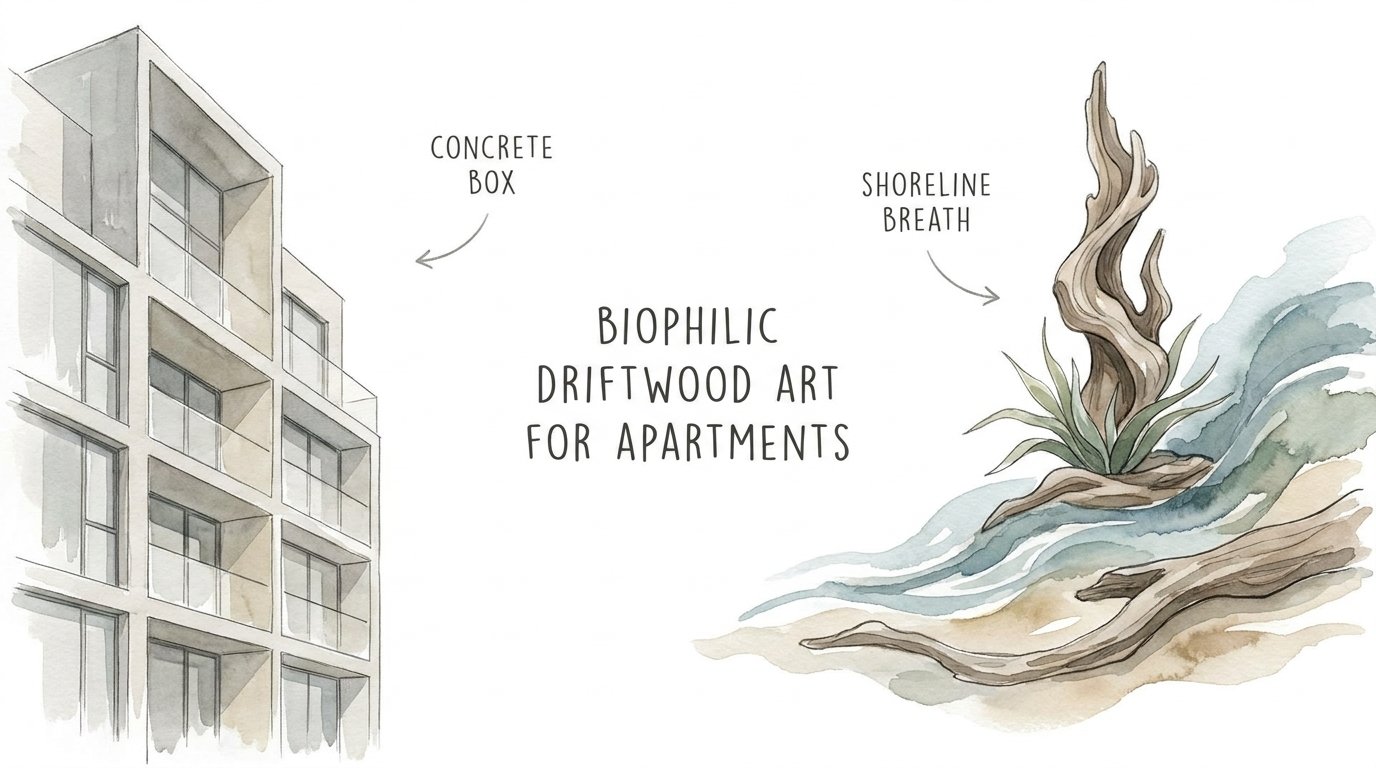
[affiai]Step inside any modern apartment and you are likely met with a grid. The walls are flat. The corners are sharp. Even the windows are rigid rectangles cut into a concrete box. This is efficient for builders, but it is a silent tax on the human spirit. Our ancestors spent millennia navigating the irregular, fractal patterns of forests and riverbeds. When we strip those away, we lose a vital tether to the world that forged us.
Bringing a weathered piece of driftwood into a high-rise isn’t just about decoration. It is about a tactical reintroduction of nature. This isn’t store-bought plastic made to look like wood; it is a remnant of a tree that fought the elements, was tumbled by the sea, and bleached by the sun. It brings a story of survival into a space that often feels sterile and temporary.
Biophilic Driftwood Art For Apartments
Biophilic driftwood art is the practice of using water-worn wood as a primary design element to bridge the gap between urban living and the natural world. In the world of design, “biophilia” refers to our innate, biological need to connect with life and lifelike processes. While a houseplant provides a living connection, driftwood provides a structural and historical one.
This art form exists because humans do not thrive in environments devoid of organic complexity. In an apartment, where you cannot easily plant a garden or build a cabin, driftwood serves as a portable piece of the wilderness. It acts as a “natural analogue,” meaning it mimics the shapes and patterns we find in nature. These “biomorphic” forms—curves, twists, and irregular grains—are proven to trigger a relaxation response in the brain.
You will find these pieces used as massive wall-mounted sculptures, delicate tabletop accents, or even functional items like curtain rods and jewelry hangers. In a real-world urban setting, a single, six-foot piece of bleached cedar mounted above a sofa can transform a room. It breaks the “concrete box” feel by introducing a focal point that the eye can rest on without being jarred by a sharp edge.
How to Source and Prepare Your Driftwood
Creating your own biophilic art starts with the hunt. If you live near a coastline or a river, beachcombing is the traditional path. Look for wood that is “silvered” or gray, which indicates it has been bleached by UV rays and salt. This wood is typically more stable and less likely to rot. Avoid any pieces that feel heavy and waterlogged or show signs of active fungal growth, as these will be a nightmare to dry.
Once you bring a piece home, you cannot simply hang it on the wall. It carries the history of the water, which often includes salt, sand, and tiny hitchhikers. Preparation is a slow process that requires patience and a bit of pioneer grit.
Step 1: The Initial Clean
Start by dry-brushing the wood with a stiff nylon brush. You want to knock off loose bark, dried mud, and any crumbling sections. Do this outside if possible. If the piece has deep crevices, use a canister of compressed air to blow out hidden sand or debris. This ensures that your cleaning solutions can reach every nook.
Step 2: The Disinfecting Soak
To make the wood safe for an apartment, you must sanitize it. Prepare a large tub with a solution of one part bleach to nine parts water. Submerge the wood completely. If it floats, use heavy stones to weigh it down. Let it soak for at least 24 to 48 hours. This kills bacteria, mold spores, and any insects that might be living deep in the grain.
Step 3: The Desalination and Drying
After the bleach soak, rinse the wood thoroughly with fresh water. If the wood came from the ocean, you may want to soak it in fresh water for another 24 hours to draw out the salt. Salt can attract moisture from the air, which may cause the wood to “weep” or rot over time. Once rinsed, place the wood in a dry, well-ventilated area. Do not rush this. Depending on the thickness, it may take two weeks to a month to dry completely.
Step 4: The Finishing Touch
Once bone-dry, use a fine-grit sandpaper (220 grit) to smooth out any “hairy” fibers or sharp splinters. You aren’t trying to make it look like a furniture store piece; you are just softening the touch. For a finish, most biophilic practitioners prefer a matte sealer. A spray-on matte lacquer or a simple rub of beeswax will preserve the color without adding an artificial shine. Avoid high-gloss finishes, as they shatter the illusion of a natural object.
Benefits of Driftwood in Urban Design
The most immediate benefit of driftwood art is psychological. Research in environmental psychology suggests that looking at natural patterns—especially those with a fractal dimension—can lower heart rates and reduce cortisol levels. In a high-stress city environment, these visual cues act as a “soft fascination” that allows the brain to recover from the “directed attention” required for work and navigation.
Practical benefits for apartment dwellers include:
- Acoustic Softening: Unlike glass or metal art, the porous and irregular surface of wood helps break up sound waves, slightly reducing the echo in rooms with hard floors.
- Weight Efficiency: Many types of driftwood, particularly those that have been sun-bleached for years, are surprisingly lightweight. This makes them easier to hang on drywall without heavy-duty anchors.
- Sustainability: Using foraged driftwood is the ultimate form of upcycling. You are taking a waste product of the natural world and giving it a second life without any manufacturing footprint.
- Timeless Aesthetic: Natural wood doesn’t go out of style. While “trendy” decor fades, the silvered texture of a weathered branch remains a classic element of the human-nature connection.
Challenges and Common Mistakes
The biggest mistake beginners make is failing to account for the weight and leverage of the wood. A piece of driftwood may be light, but if it is long and mounted at a single point, it acts as a lever that can pull a screw right out of the wall. Always use at least two points of contact for any piece longer than two feet.
Another common pitfall is the “Beach Theme Trap.” People often think that adding driftwood means they must add seashells, blue anchors, and rope. This turns a sophisticated biophilic element into a kitschy theme. To keep it professional and grounded, treat the wood as a sculpture. Pair it with neutral tones, industrial metals, or lush green plants. Let the wood speak for itself without the maritime cliches.
Finally, do not ignore the smell. If you skip the disinfecting soak, the wood may eventually emit a musty or “marshy” odor as it reacts to the humidity in your apartment. This is why the bleach soak and thorough drying are non-negotiable steps.
Limitations of Driftwood Decor
While beautiful, driftwood has its boundaries. It is not an ideal material for high-moisture areas like a small, poorly ventilated bathroom. Even sealed wood can absorb steam, leading to warping or the return of mold. If you must use it in a bathroom, ensure it is treated with a marine-grade sealer and that the room has a powerful exhaust fan.
Environmental limitations also apply. In many regions, it is illegal to remove driftwood from certain beaches or national parks. Driftwood provides essential habitat for coastal organisms and helps prevent erosion. Always check local regulations before you go foraging. If you cannot find it yourself, buy from reputable sellers who source their wood legally and sustainably.
Natural Driftwood vs. Synthetic Alternatives
When deciding how to bring the “wild” into your home, you might be tempted by synthetic versions or mass-produced “driftwood-style” items from big-box retailers.
| Feature | Natural Foraged Driftwood | Synthetic/Store-Bought Decor |
|---|---|---|
| Visual Complexity | High (unique grain, irregular curves) | Low (repeated patterns, uniform) |
| Tactile Experience | Warm, varied texture | Cold, plasticky or overly smooth |
| Biophilic Impact | Strong (authentic natural connection) | Weak (brain recognizes the imitation) |
| Cost | Free (if foraged) to High (artisan) | Moderate to High |
| Maintenance | Requires initial prep and sealing | Ready to hang, easy to wipe |
The measurable factor here is the “fractal dimension.” Natural wood has a level of detail that looks the same whether you are looking from five feet away or five inches. Synthetic versions often fail this test upon close inspection, which reduces the “soft fascination” effect that lowers stress.
Practical Tips for Apartment Mounting
If you are a renter, you likely cannot drill massive holes into your walls. This doesn’t mean you can’t enjoy driftwood art. Use a “picture rail” system if your apartment has one, or look into heavy-duty adhesive hooks for smaller pieces.
For larger, sculptural pieces, consider the “D-Ring” method. Attach two D-rings to the flattest part of the wood (the side that will face the wall). This allows the wood to sit flush. If the wood is very irregular, you can use “stand-offs”—small spacers—that hold the wood an inch away from the wall. This creates a dramatic shadow line that emphasizes the curves and makes the piece look like it is floating.
Lighting is your secret weapon. A piece of driftwood looks okay in flat light, but it looks magnificent under a spotlight. Use a clip-on light or a floor lamp to cast shadows through the branches. This mimics the dappled light of a forest and increases the biophilic depth of the room.
Advanced Considerations for Serious Practitioners
For those looking to go beyond a single branch, consider an installation that spans the entire height of a wall. You can “sew” smaller pieces of driftwood together using copper wire or heavy jute twine to create a textured screen. This is an excellent way to divide a studio apartment without building a permanent wall.
You might also consider the “Mixed Media” approach. Integrating live air plants (Tillandsia) into the crevices of the driftwood adds a layer of literal life. Since air plants do not need soil, they thrive in the nooks of the wood. Just remember to mist the plants away from the wood periodically to prevent the driftwood from staying damp for too long.
Scaling up also means thinking about structural integrity. If you are mounting a 30-pound cedar root, you must find the wall studs. A toggle bolt into drywall might hold for a month, but seasonal humidity changes cause the wood to expand and contract, which can loosen the anchor over time.
Real-World Example: The Studio “Nature Nook”
Imagine a 400-square-foot studio in a dense city center. The walls are white, the floor is laminate, and the window looks out at another brick building. The resident feels “boxed in.”
To fix this, they find a four-foot piece of driftwood with a deep, “V” shaped curve. They mount it horizontally about 12 inches below the ceiling on the far wall. They then hang three small, pendant-style grow lights that shine directly onto the wood. Below the wood, they place a simple wooden bench and two large leafy plants.
The result? The eye is no longer trapped by the white wall. It is drawn upward to the complex, silvered grain of the wood. The shadows cast by the driftwood make the ceiling feel higher and the room feel less like a box. This is biophilic design in action—using a dead piece of wood to bring a living feeling to a dead space.
Final Thoughts
Biophilic driftwood art is more than just a trend; it is a return to a sensory language that we all speak fluently. It is the language of the shoreline and the forest floor. By bringing these elements into our apartments, we refuse to let the city strip away our connection to the wild. We trade the sterile for the storied.
The beauty of this approach is its accessibility. You do not need an expensive degree or a massive budget to start. You need a keen eye, a bit of patience for the cleaning process, and the willingness to let a “wild” object break the rules of your straight-edged home.
Start small. Find a single piece that speaks to you. Clean it, seal it, and find a place for it where it can catch the light. You will find that the air in your apartment feels a little lighter, and the walls feel a little further away. That is the power of the curve in a world of right angles. Experiment with different textures and see how your space—and your mind—responds to the presence of the wild.
Sources
1 thedesignbasics.com.au (https://thedesignbasics.com.au/how-to-do-biophillic-design-for-apartments/) | 2 cottage-fever.ca (https://cottage-fever.ca/biophilic-design-and-its-impact-on-your-mental-health/) | 3 gardenonthewall.com (https://www.gardenonthewall.com/blog/designing-for-human-well-being-and-the-biophilia-approach) | 4 momiji-home.com (https://journal.momiji-home.com/biophilic-design-in-small-apartments/) | 5 architizer.com (https://architizer.com/blog/inspiration/stories/psychology-curves-and-lines-architecture/) | 6 arktek3d.com (https://arktek3d.com/blog/biophilic-architecture-seven-principles/) | 7 suiteminded.com (https://www.suiteminded.com/blog/curves-in-interior-design-a-trend-we-absolutely-love) | 8 feelgoodathome.co.uk (https://feelgoodathome.co.uk/2024/06/19/the-psychology-of-using-curved-design-shapes-in-interiors/) | 9 diydriftwood.com (https://diydriftwood.com/driftwood-refinishing-techniques/) | 10 theroomsart.com (https://theroomsart.com/driftwood-wall-decor-guide/) | 11 hawk-hill.com (https://www.hawk-hill.com/how-to-clean-driftwood/) | 12 coco-papaya.com (https://www.coco-papaya.com/en/blog/ethnic-decoration-handicrafts-from-around-the-world/driftwood-decoration-a-unique-and-natural-choice-to-beautify-your-interior) | 13 uca.edu (https://uca.edu/art/2021/03/30/ways-biophilic-design-promotes-human-health-and-well-being/) | 14 danslelakehouse.com (https://danslelakehouse.com/2020/12/diy-driftwood-wall-hanging.html) | 15 biophilicproducts.org (https://biophilicproducts.org/biophilic-design-blog/biophilic-design/benefits-of-biophilic-design/)