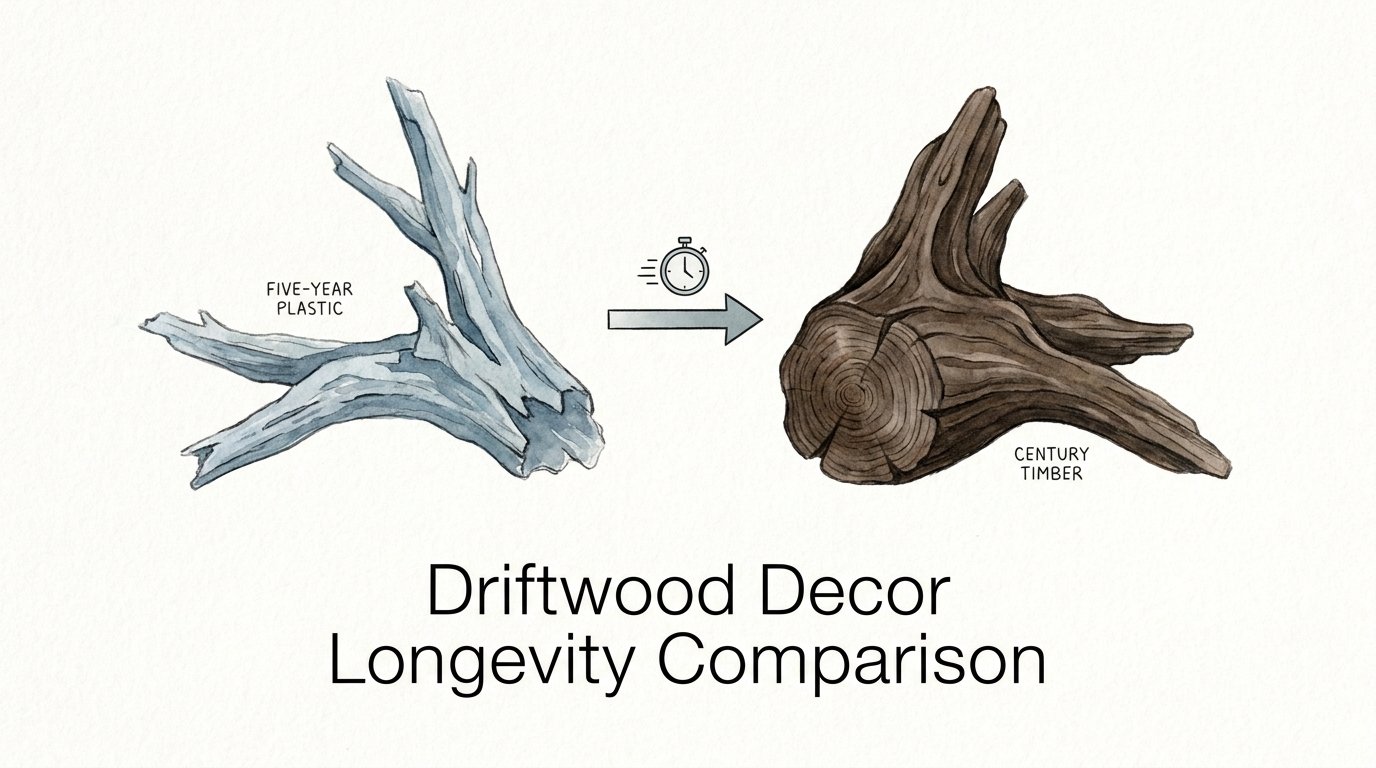
Driftwood Decor Longevity Comparison
Will your decor be in a landfill in five years, or will it be an heirloom? Big-box stores want you to buy a new ‘vibe’ every season. But the ocean has already manufactured something that never goes out of style and won’t fall apart in five years. Choose the legacy of the tide over the plastic of the factory.
[affiai]There is a quiet strength in a piece of wood that has survived the churning of the Atlantic or the steady pulse of a river for a decade before reaching your hands. This is not just a branch; it is a survivor. When you bring driftwood into your home, you are not just decorating a room. You are installing a witness to time itself.
Modern consumers are caught in a cycle of disposable aesthetics. We buy furniture made of compressed sawdust and chemical glues, only to watch the edges peel and the joints wobble before the decade is out. Driftwood offers a different path. It represents a return to materials that have already been “tested” by the harshest elements on earth.
In this guide, we will explore why driftwood is the ultimate sustainable material. You will learn how to source it, how to treat it so it lasts for generations, and how to spot the difference between a temporary trend and a piece of century timber. We are looking for the grit and the grain that outlasts the warehouse sale.
Driftwood Decor Longevity Comparison
Driftwood is essentially wood that has undergone a natural “pressure treatment” by water and sun. While most store-bought lumber is kiln-dried and chemically treated, driftwood has had its softest fibers worn away by the current. What remains is the dense, resilient heartwood that can withstand almost anything if properly maintained.
In the real world, “fast furniture” is often built with a lifespan of 5 to 15 years. These pieces use Medium Density Fiberboard (MDF) or particleboard covered in a thin plastic laminate. Once moisture hits the core of these materials, they swell and disintegrate. In contrast, a solid piece of driftwood—especially from a hardwood species—has a structural integrity that can span 50 to 100 years or more.
Consider the environment. Millions of tons of “five-year plastic” furniture end up in landfills every year. This is because these items are designed for the dump. Driftwood, however, is a reclaimed resource. It requires no new logging, no factory emissions, and no toxic glues to exist. It is nature’s own upcycling project, ready to be transitioned from the shoreline to your mantle.
The longevity of driftwood isn’t just about its physical toughness. It’s about its aesthetic immunity to the “trend cycle.” A piece of gnarled oak found on a beach doesn’t look “dated” when the next color palette becomes popular. Its beauty is rooted in organic geometry, which remains timeless as long as the wood stays dry and free from pests.
How to Process and Preserve Your Finds
Turning a raw find into a finished heirloom requires patience and a specific sequence of care. You cannot simply pull a log from the mud and put it on your rug. The wood must be cleaned, disinfected, and stabilized to ensure it doesn’t bring the outdoors—or its inhabitants—into your living space.
First, give the piece a deep scrubbing with a stiff-bristled brush. You need to remove the “soft wood” layer, which is the partially decayed outer surface. This is often where dirt and salt deposits hide. If the wood is particularly grimy, a power washer on a low setting can work wonders, but be careful not to gouge the unique character of the grain.
Second, you must disinfect. Submerge the wood in a solution of one part bleach to nine parts water. Let it soak for 24 to 48 hours. This kills mold spores, bacteria, and any boring insects that might be nesting deep within the fibers. For very large pieces that cannot be submerged, you can apply the solution with a spray bottle, but multiple applications and a longer “cure time” in the sun will be necessary.
Third, the drying process is critical. Wood must be bone-dry before you apply any finish. Leave your piece in a well-ventilated area or under direct sunlight for several weeks. If you seal moisture inside the wood, it will eventually rot from the inside out. You will know it is ready when it feels lighter and sounds hollow when tapped.
Finally, choose your sealant. If you want to keep the “ghostly” silver-grey look, use a clear matte lacquer or a water-based polyurethane. For a richer, deeper tone that highlights the grain, use a natural oil like tung oil or beeswax. Avoid thick, glossy varnishes that make the wood look like plastic; you want to enhance the texture, not hide it.
Benefits of Driftwood in Modern Design
The most immediate benefit of driftwood is its unique architectural character. No two pieces are identical. In a world of mass-produced, identical units, a driftwood lamp or mirror frame provides a focal point that cannot be replicated. It brings a sense of the wild into a sterile environment.
Sustainability is the second major advantage. Because you are salvaging a material that has already “finished” its life cycle in the wild, your carbon footprint for the piece is virtually zero. You aren’t contributing to deforestation. Instead, you are preventing that wood from eventually decaying and releasing its carbon back into the atmosphere immediately.
From a psychological standpoint, driftwood contributes to “biophilic design.” This is the practice of incorporating natural elements into built environments to reduce stress and improve well-being. Looking at the complex, fractal patterns of natural wood is proven to be more soothing to the human brain than looking at flat, synthetic surfaces.
Driftwood is also remarkably versatile. While it is a staple of “coastal” or “nautical” styles, it works equally well in minimalist, industrial, or rustic interiors. A gnarled, dark piece of river wood can add warmth to a cold, modern loft, while a sun-bleached branch can brighten a dark, traditional study.
Challenges and Common Mistakes
The biggest mistake newcomers make is rushing the drying phase. Moisture is the enemy of longevity. If you build a table base from wood that isn’t fully cured, it will warp, crack, or develop a musty odor over time. This ruins the structural integrity of the piece and can damage other furniture nearby.
Another common pitfall is ignoring the salt content in ocean-sourced driftwood. Salt is hygroscopic, meaning it pulls moisture from the air. If you don’t soak your ocean finds in fresh water multiple times before drying, the wood may “sweat” or feel damp on humid days. This can lead to white salt stains on your upholstery or flooring.
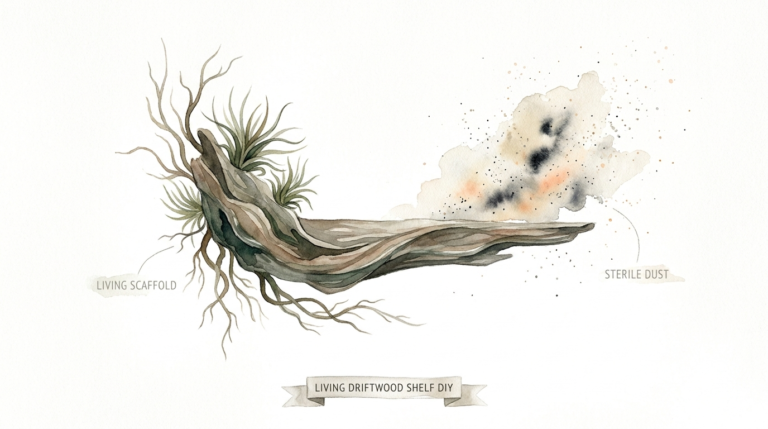
Insects are a real threat. Some beetles and termites thrive in damp wood. A superficial cleaning isn’t enough to kill larvae deep inside. Skipping the bleach soak or a heat-treatment phase is an invitation for pests to move into your home’s actual structure. Always treat your finds as if they are “guilty until proven clean.”
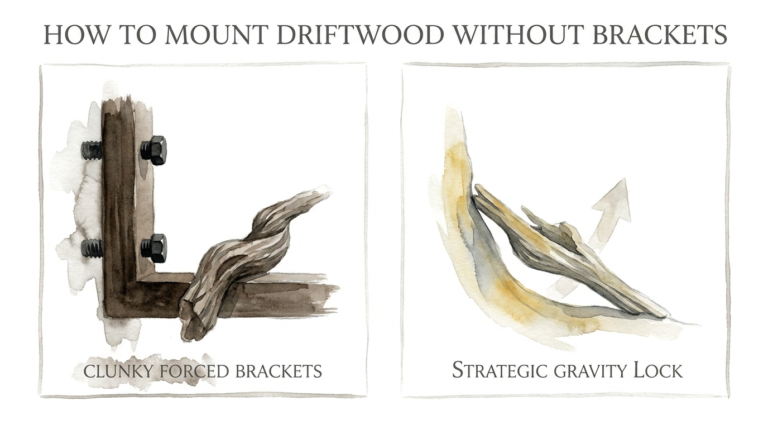
Lastly, people often choose pieces based solely on looks without considering weight and balance. A beautiful branch might look great on a wall, but if it is heavy and lacks flat mounting points, it becomes a safety hazard. Always plan how a piece will be anchored before you fall in love with it.
Limitations and Environmental Constraints
Driftwood is not ideal for every application. Because the wood has been weathered, it is often more brittle than fresh-cut timber. This means it is generally not suitable for heavy-load-bearing structures like the main legs of a dining table unless the piece is exceptionally thick and dense, such as a large root ball.
Environmentally, it is important to check local regulations. In some protected coastal areas or national parks, removing driftwood is illegal because it provides a vital habitat for small organisms and helps prevent beach erosion. Always ensure you have the right to collect from a specific location to maintain the “eco-friendly” status of your project.
Maintenance is also a factor. Unlike a laminate desk that you can scrub with harsh chemicals, driftwood requires a gentler touch. It is porous and will absorb spills instantly. This makes it a poor choice for kitchen countertops or high-traffic surfaces where food and grease are present unless it is heavily sealed in resin.
Finally, there is the “species gamble.” When you find wood on a beach, you don’t always know what tree it came from. Some softwoods, like pine or cedar, will naturally degrade faster than hardwoods like oak or mahogany. If you are building something intended to last a century, you must develop the skill to identify denser, more durable species.
Heirloom Quality vs. Disposable Decor
When we talk about “Century Timber,” we are describing wood that has the density and treatment to outlive its owners. “Five-Year Plastic” describes the vast majority of modern home goods. The following table illustrates why the investment in natural wood pays off in the long run.
| Feature | Century Timber (Driftwood) | Five-Year Plastic (Big Box) |
|---|---|---|
| Primary Material | Solid heartwood, naturally weathered | MDF, particleboard, plastic laminate |
| Average Lifespan | 50 – 100+ Years | 5 – 15 Years |
| Repairability | High (Can be sanded and re-oiled) | Low (Laminate cannot be repaired) |
| Sustainability | Reclaimed/Carbon-neutral | High manufacturing/Landfill waste |
| Aesthetic Value | Grows more beautiful with age | Degrades and looks “cheap” quickly |
Practical Tips for Success
Start small. Don’t try to build a ten-foot headboard as your first project. Begin with a centerpiece for a table or a simple wall hanging. This allows you to practice the cleaning and sealing process without a massive investment of time or space.
Invest in a good set of tools. A Dremel with various sanding attachments is perfect for getting into the tight crevices and knots of driftwood. A quality moisture meter (around $30) is also a life-saver; it will tell you exactly when your wood is dry enough to seal, removing the guesswork.
Think about lighting. Driftwood has incredible shadows. If you are displaying a piece of wall art, use a directional spotlight to highlight the ridges and whorls of the grain. This transforms a “stick” into a dramatic sculpture. Similarly, incorporating LED strips behind a large piece of wood can create a stunning “halo” effect.
When joining pieces together, avoid visible screws. Wood glue and dowels are much more effective and maintain the organic look. If you must use screws, pre-drill your holes to prevent the weathered wood from splitting. Always hide the hardware on the backside of the piece whenever possible.
Advanced Considerations for the Serious Practitioner
For those looking to move beyond simple decor into furniture making, you must understand the “Janka Hardness” of your finds. This is the measure of how much force is required to embed a steel ball into the wood. Denser hardwoods like Oak (1360 lbf) or Hickory (1820 lbf) are far better for tables than softwoods like Pine (roughly 400 lbf).
Consider the “Tannin Factor.” Many types of driftwood, particularly those found in rivers, are rich in tannins. These can leach out over time if the wood gets damp, staining your walls or carpets. Advanced practitioners use “tannin blockers” or specific shellac-based primers before applying a final topcoat to ensure no “bleeding” occurs.
Stabilization with resin is another high-level technique. If you find a piece of wood that is beautiful but slightly soft or crumbly in spots, you can use a vacuum chamber and stabilizing resin (like Cactus Juice) to turn it into a rock-hard composite. This allows you to use “punky” wood that would otherwise be discarded.
Scaling up to large installations requires architectural planning. If you are mounting a 50-pound root system to a drywall surface, you must locate the studs and use heavy-duty French cleats. Never rely on simple anchors for heavy natural wood; the vibration and weight will eventually pull them out, potentially damaging your home.
Examples and Realistic Scenarios
Imagine you find a three-foot section of silvered cedar on a beach in Oregon. After the cleaning and bleaching process, you realize the wood has a natural “curve” that fits the human back. Instead of making a simple wall hanging, you mount it to a heavy steel base to create a minimalist sculptural bench.
By spending $40 on a steel base and $20 on oil, you have created a piece of furniture that would retail for $800 in a high-end boutique. More importantly, because you used cedar—a naturally rot-resistant wood—and sealed it properly, that bench can sit in your entryway for forty years. It will look better in year forty than it did on day one.
Another scenario: you are decorating a nursery. Instead of buying a plastic mobile made in a factory, you use a light, spindly branch of sun-bleached manzanita. You sand it smooth so there are no splinters and hang it with organic cotton twine. You have created a safe, non-toxic focal point that tells a story of the earth rather than the assembly line.
Final Thoughts
The choice between the factory and the forest is a choice between the temporary and the timeless. When you choose driftwood, you are opting out of the “throwaway culture” that has dominated home design for decades. You are choosing a material that has already survived the worst and is ready to provide beauty for the best years of your life.
Remember that every knot and crack in a piece of driftwood is a scar of survival. Those “imperfections” are what make the wood an heirloom. While a big-box store table tries to hide its flaws under a layer of paint, driftwood wears its history proudly. It invites you to do the same in your own home.
Take your time with the process. The ocean didn’t make that wood in a day, and you shouldn’t try to finish it in one either. Respect the grain, dry it thoroughly, and seal it with care. You aren’t just making a piece of decor; you are preserving a legacy of the tide that will stand firm long after the plastic trends of today have crumbled.
Sources
1 coco-papaya.com (https://www.coco-papaya.com/en/blog/ethnic-decoration-handicrafts-from-around-the-world/driftwood-decoration-a-unique-and-natural-choice-to-beautify-your-interior) | 2 theroomsart.com (https://theroomsart.com/driftwood-wall-decor-guide/) | 3 oceanhomemag.com (https://www.oceanhomemag.com/home-design/driftwood-decor/) | 4 dtwooddecor.com (https://www.dtwooddecor.com/driftwood-coffee-table-care-and-maintenance/) | 5 homestyler.com (https://www.homestyler.com/article/driftwood-decor-redefined?lang=ar_SA) | 6 loopdeco.com (https://vertexaisearch.cloud.google.com/grounding-api-redirect/AUZIYQFtmu4Tv86PRVy34DhYg1ZA2kiOmDcdW2dzbGU9l82MxzVT6XEokBHcZD0rwaO4V3pJm0jVHvSB6z7AMamAU_a6PrIBspJeB-Q3iTfMxn5L9N6EO2eLnoFDXIdOv4IDqwYHOWewUTBauzmXX5OkvDTwuLGlGKFNjDgyvDmwDA==) | 7 nippyfish.net (https://nippyfish.net/2018/11/16/different-types-of-aquarium-driftwood/) | 8 petramadalena.com (https://petramadalena.com/blog-post/sustainable-bespoke-furniture-guide-2026-eco-friendly-materials-custom-design-trends-responsible-manufacturing/) | 9 earth.org (https://earth.org/antique-vs-fast-furniture-study-shows-millennials-take-a-sustainable-stance/) | 10 wikihow.com (https://www.wikihow.com/Preserve-Driftwood) | 11 jamesandjamesfurniture.com (https://jamesandjamesfurniture.com/blogs/news/fast-furniture) | 12 lumber2love.com (https://www.lumber2love.com/the-benefits-of-handmade-furniture-vs-mass-produced-pieces/) | 13 youtube.com (https://www.youtube.com/watch?v=aFWLyAPowMA)