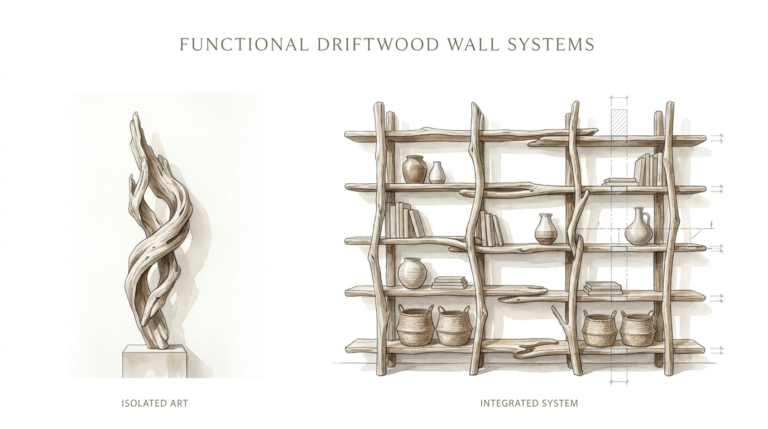
Driftwood Wall Art Arrangement Ideas
Your decor shouldn’t just be ‘there’; it should have a rhythm. One branch is an accident; five branches in a geometric sequence is a statement. Most coastal homes feel cluttered because they lack intent. Learn how to turn chaos into a curated rhythm that calms the mind.
[affiai]Coastal living isn’t about throwing a few shells on a mantel and calling it a day. It is about understanding the raw, weathered history of the materials you bring into your space. Driftwood is the ultimate storyteller, having been scoured by salt and tumbled by tides until only the strongest fibers remain. To use it correctly, you must treat it with the same respect the ocean did.
Driftwood Wall Art Arrangement Ideas
Driftwood wall art is the intentional placement of water-sculpted timber to create a focal point that bridges the gap between the wild outdoors and a structured interior. It is not just a “rustic” choice; it is a study in texture, silvered patinas, and organic geometry. In a modern home, these arrangements serve as a counterbalance to the hard, sharp lines of glass and steel.
In a traditional or pioneer-style home, driftwood acts as a bridge to the past, reminding us of a time when every piece of wood in a house had a purpose and a history. You might see a single, massive “specimen” branch acting as a sculptural headboard, or a collection of smaller “lathed” pieces arranged in a sunburst pattern over a fireplace. These ideas work because they respect the scale of the room and the character of the wood.
Real-world application often involves taking a dead wall—like a long hallway or the space above a sofa—and giving it a pulse. Designers use driftwood in repetitive “modular” layouts where multiple similar pieces are spaced exactly four inches apart to create a sense of mechanical rhythm. Others prefer the “cascade” where wood flows downward like a frozen waterfall.
How to Design with Intent: The System of Geometric Flow
Arranging driftwood requires a plan before the first nail ever touches the wall. You cannot simply hold a branch up and hope for the best. A systematic approach ensures that the “random” look of nature is actually a highly controlled visual experience.
Start by sourcing your wood responsibly. Check your local regulations, as many public beaches and national parks prohibit the removal of natural features to prevent erosion. Once you have your materials, you must clear a large floor space that mimics the dimensions of your wall. This is where the work begins.
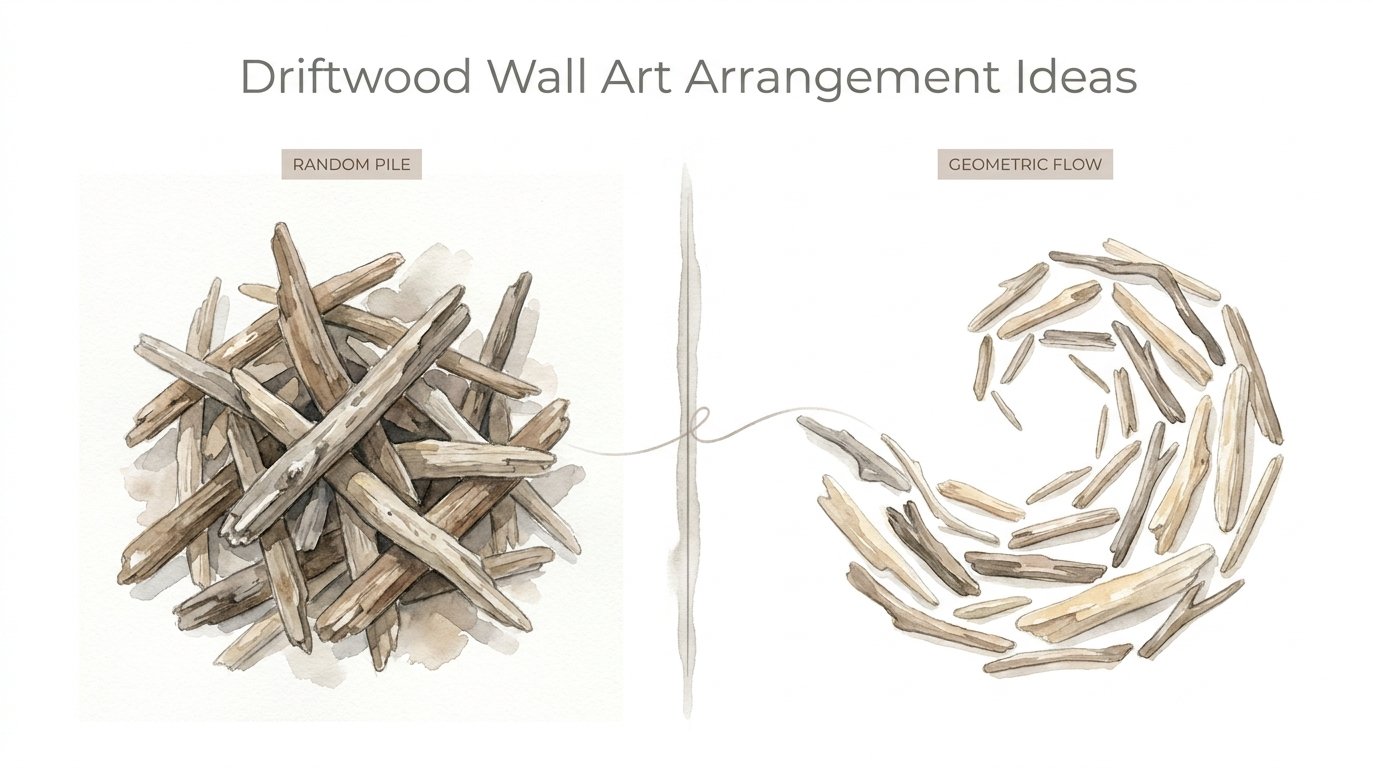
Lay out your pieces and look for the dominant “grain” or “curve” of each. In a GEOMETRIC FLOW arrangement, you are looking for repeating angles. If one branch curves to the left, find another that echoes that movement. You are building a visual sentence where each piece of wood is a word that leads to the next.
Measure the negative space between the branches. If you want a modern, rhythmic look, keep the gaps consistent. If you want a more organic, pioneer-grit aesthetic, vary the gaps but maintain a central axis. This central axis is an invisible line that anchors the entire piece, preventing it from looking like a pile of debris.
How to Prepare Your Wood: The Ritual of Salt and Sun
The biggest mistake beginners make is bringing “raw” driftwood directly from the beach into their living room. This is a recipe for pests, mold, and salt damage. You must cure the wood with the same patience a shipwright uses to season timber.
First, scrub the wood with a stiff-bristle brush and fresh water to remove loose sand, salt, and decaying bark. For a deep clean, soak the pieces in a solution of one part bleach to nine parts water for at least 24 hours. This kills any lingering organisms or insect larvae hiding in the crevices.
After the soak, the wood must dry completely. This is not a process that can be rushed. Place the wood in a well-ventilated area, preferably in direct sunlight, for several days or even weeks depending on the thickness of the branch. Moisture trapped inside the wood will eventually lead to rot or mold behind your wall art.
Once dry, decide on your finish. A “pioneer-grit” approach often leaves the wood raw and silvered. However, if the wood feels brittle or “dusty,” a light coat of Linseed oil or Tung oil can stabilize the fibers without adding a fake, glossy sheen. Sand the sharpest edges with 120-grit sandpaper just enough to prevent splinters, but not enough to erase the character lines etched by the sea.
Benefits of Strategic Driftwood Arrangements
Using driftwood as a primary design element offers practical and aesthetic advantages that mass-produced decor cannot match. The most obvious benefit is the unique nature of the material. No two pieces of driftwood are identical, meaning your wall art is a one-of-a-kind installation that cannot be replicated.
From a psychological perspective, these arrangements introduce “biophilic” elements into the home. Humans have a natural affinity for organic shapes. The sight of weathered wood can lower heart rates and reduce stress levels, creating a sanctuary-like atmosphere in a busy household.
Environmentally, driftwood is a sustainable choice. You are upcycling a discarded natural resource rather than purchasing plastic or virgin timber products. It is decor that carries no carbon footprint, only the weight of its own history.
Challenges and Common Mistakes
Working with driftwood is not without its hardships. The most frequent error is a failure of scale. A small, spindly branch on a massive white wall will look like a mistake. Conversely, a heavy, thick log in a tiny bathroom can feel oppressive and claustrophobic. You must match the “visual weight” of the wood to the volume of the room.
Another pitfall is poor mounting. Driftwood is often heavy and oddly shaped. Standard picture hangers are rarely sufficient. If you do not find the wall studs or use high-quality toggle bolts, you risk the art falling and damaging your floors—or worse, injuring someone.
Over-arranging is also a danger. If you try to force the wood into a shape it doesn’t want to go—like bending it or cutting it into perfect squares—you lose the “honesty” of the material. The goal is to highlight what the ocean did, not to hide it under layers of paint or glue.
Limitations: When Nature Stays Outside
There are times when driftwood wall art may not be the best fit for a space. In high-humidity environments like a poorly ventilated bathroom, the wood can re-absorb moisture, leading to warping or a musty odor. If your home has a recurring termite or carpenter ant problem, introducing untreated wood is a significant risk.
Weight is a structural limitation. In older homes with plaster-and-lath walls, mounting a 40-pound root system requires significant reinforcement that may involve opening the wall. Furthermore, if you are a renter, the heavy-duty anchors required for large driftwood pieces may violate your lease agreement.
Finally, consider the “dust factor.” The deep crevices and knots in driftwood are magnets for dust and cobwebs. If you are not prepared to use a soft brush or compressed air to clean the piece regularly, it will quickly lose its silvered luster and look neglected.
Comparison: RANDOM PILE vs. GEOMETRIC FLOW
Understanding the difference between an accidental arrangement and an intentional one is the key to a professional look.
| Factor | Random Pile | Geometric Flow |
|---|---|---|
| Visual Intent | Accidental, cluttered, “found” look. | Deliberate, rhythmic, gallery-style. |
| Symmetry | Low; pieces are thrown together. | High; balanced weight and spacing. |
| Space Requirement | Works in small, “nook” areas. | Requires large, open wall planes. |
| Maintenance | Difficult; many hidden pockets for dust. | Easier; clean lines are easy to brush. |
Practical Tips for a Solid Installation
Hanging a three-dimensional object on a two-dimensional wall requires some clever engineering. Use a “French Cleat” system for oversized, heavy pieces. This involves a metal or wood bracket where one half is attached to the wall studs and the other to the driftwood. It provides the most stable support and allows for slight horizontal adjustments.
For lighter, spindly branches, use heavy-duty fishing line or aircraft cable. This creates a “floating” effect where the hardware disappears, leaving only the wood to catch the eye. Ensure you use “eye-screws” drilled directly into the densest part of the branch for the most secure attachment point.
Always use a level. Even if the wood is crooked, the overall arrangement must be level to the floor. A tilted arrangement creates a sense of “visual vertigo” that ruins the calming effect you are trying to achieve.
Advanced Considerations: Lighting and Shadow
The true professional knows that driftwood is only half of the art; the other half is the shadow it casts. By using “grazing light”—lighting positioned at a sharp angle to the wall—you can exaggerate the textures of the wood and create a dramatic, three-dimensional effect.
Consider recessed LED strips hidden behind the wood. This “backlighting” makes the driftwood look like it is floating in a glow of light, highlighting the silhouette of the branches. In a dark hallway or bedroom, this provides a soft, ambient light that is far more interesting than a standard lamp.
Scaling your arrangement to follow architectural lines can also elevate the work. If you have a vaulted ceiling, arrange the wood in a vertical “climb” that draws the eye upward. If you have a long, low console table, keep the wood horizontal and wide to ground the furniture in the room.
Real-World Scenarios
Imagine a modern loft in the city. The walls are cold, grey concrete. By installing a seven-foot horizontal driftwood branch with five smaller vertical “rungs” attached in a geometric grid, you instantly warm the space. The contrast between the industrial concrete and the sun-bleached wood creates a sophisticated, “coastal modern” vibe.
In a quiet beach cottage, the owner might choose a “radial sunburst” arrangement over the bed. Twenty small, similarly sized sticks are arranged in a circle, pointing outward from a central hub. This creates a sense of energy and movement, mimicking the sun rising over the water. It turns a simple bedroom into a sanctuary.
For a narrow entryway, three thick pieces of driftwood can be mounted vertically at varying heights. This mimics a stand of trees or old pier pilings. It provides a rugged, “pioneer-grit” welcome that tells every guest that this home values the raw beauty of the natural world.
Final Thoughts
Driftwood wall art is about more than just filling an empty space. It is a commitment to seeing the beauty in the weathered and the value in the worn. When you arrange wood with intent, you are not just decorating; you are creating a rhythm that resonates through the entire home.
Whether you choose a massive, singular statement piece or a complex, geometric modular flow, remember that the wood has already done the hard work of surviving the sea. Your job is simply to give it a place to rest where its story can be told. Be patient with the cleaning, be precise with the mounting, and be bold with the scale.
The goal is a curated calm. By following these steps, you move away from the chaos of a cluttered home and toward a space that feels as vast and balanced as the ocean itself. Start small, experiment with the floor layout, and soon you will have a wall that doesn’t just sit there—it speaks.
Sources
1 planner5d.com (https://planner5d.com/blog/coastal-interior-design-guide/) | 2 youtube.com (https://www.youtube.com/watch?v=Pkznsw5bV8Q) | 3 specialeditionart.com (https://specialeditionart.com/blogs/theoracle/how-to-hang-driftwood-on-your-wall-a-comprehensive-guide) | 4 homify.com.my (https://www.homify.com.my/diy/52765/preserve-driftwood-with-5-things-and-make-a-decorative-object-out-of-it) | 5 lakewedoweelife.com (https://www.lakewedoweelife.com/lake-life/driftwood-art-and-treasures-by-tammy-lovvorn) | 6 mykachhi.com (https://mykachhi.com/8-driftwood-wall-art-for-living-room-ideas/) | 7 driftwoodacademy.com (https://driftwoodacademy.com/is-it-legal-to-collect-driftwood/) | 8 hawk-hill.com (https://www.hawk-hill.com/how-to-clean-driftwood/) | 9 thisoldhouse.com (https://www.thisoldhouse.com/walls/how-to-hang-something-heavy) | 10 etwoodcrafts.com (https://etwoodcrafts.com/blogs/news/how-to-hang-heavy-wooden-art) | 11 frenchcreekfarmhouse.com (https://www.frenchcreekfarmhouse.com/2020/01/how-to-safely-hang-heavy-stuff-on-wall.html) | 12 hackrea.net (https://www.hackrea.net/stories/driftwood-wall-art-ideas/) | 13 wonderfuldiy.com (https://wonderfuldiy.com/diy-driftwood-wall-hanging-ideas/)