How To Value Driftwood For Art
The ‘rubbish’ you stepped over this morning is currently being sold for three figures in urban galleries. What most people see as a tripping hazard on the beach, a minimalist designer sees as a structural masterpiece. Stop looking for ‘wood’ and start looking for ‘lines.’ Here is how to spot the asset in the chaos.
[affiai]Most people walk the shoreline with their eyes on the horizon, missing the literal wealth at their feet. They see a tangled mess of gray salt-bleached branches and call it debris. To the trained eye, that “debris” is a high-value raw material forged by years of hydraulic pressure, salt-water saturation, and UV exposure. It is a material that cannot be manufactured in a factory or replicated in a woodshop.
Every twist in a piece of driftwood tells a story of a tree that lost its battle with an eroding bank and won its second life in the current. Whether you are a weekend hobbyist or a serious practitioner looking to scale a boutique art business, understanding the difference between a soggy stick and a gallery asset is the first step toward reclaiming value from the wild.
How To Value Driftwood For Art
Valuing driftwood requires a shift in perspective. You are not looking for lumber; you are looking for sculpture. In the professional art market, the value of a piece is determined by its species, its structural integrity, and its “gesture”—the natural movement of the wood’s shape.
Driftwood exists because wood is resilient. While the softer cellulose in a fallen branch rots away quickly, the dense lignin remains. Over months or years at sea, the water “sculptures” the wood, stripping away bark and soft tissue until only the hardest core remains. This leaves behind a smooth, silver-gray patina that designers pay a premium for in modern, minimalist, and Scandinavian-style interiors.
Real-world value is often dictated by the “negative space” within a piece. A solid, straight log is worth very little. However, a root system from a Red Cedar or a Manzanita branch that has been sand-blasted into an intricate “S-curve”—often called a Hogarth curve in art circles—can fetch hundreds of dollars before it even touches a gallery floor.
Weight is the most immediate indicator of value. When you pick up a piece, it should feel surprisingly heavy for its size. High weight indicates a dense, rot-free core. If the wood feels “corky” or light, the internal structure has likely succumbed to wet rot, making it worthless for long-term preservation.
The Preparation Process: From Shoreline to Showroom
Turning a raw find into a finished asset is a multi-day operation that demands patience. You cannot simply drag a log home and put it on a mantle. Raw wood from the beach is often a sanctuary for sand gnats, termites, and microscopic bacteria.
First, the wood must be dry-brushed to remove loose sand and salt crust. Use a stiff nylon brush or a wire brush for particularly gnarled pieces. Avoid using metal brushes on softer woods like Pine or Cedar, as you will leave unnatural scratch marks that ruin the “water-worn” aesthetic.
Submerging the wood in a sanitizing solution is a mandatory step for any piece intended for indoor use. A standard mixture of 1-part bleach to 9-parts water is effective for killing pests and bacteria. For pieces that will be used in sensitive environments like aquariums, a longer soak in plain, dechlorinated water—changed daily for two weeks—is required to leach out tannins.
The drying phase is where most beginners fail. Wood that is dried too quickly in direct, high heat will “check” or crack. The ideal method is to let the wood air-dry in a shaded, well-ventilated area for at least three to five days. If you are working on a deadline, some practitioners use low-temperature oven baking (below 200°F), but this carries a risk of warping the wood’s natural lines.
Benefits of Driftwood Art
The most obvious advantage is sustainability. Every piece of driftwood collected is a form of upcycling. You are taking a natural waste product and preventing it from becoming a navigational hazard or a clogging agent in river mouths.
From a design standpoint, driftwood provides a unique “organic-modern” contrast. In a world of mass-produced furniture made from MDF and plastic, a raw, weathered piece of Juniper or Oak provides an irreproducible focal point. No two pieces are identical, which gives the artist an automatic monopoly on that specific design.
Furthermore, the material cost is essentially zero. While the time investment in scouting and cleaning is significant, the lack of an upfront “lumber bill” makes this one of the most accessible forms of high-end art for those willing to do the manual labor.
Challenges and Common Mistakes
The most frequent error is misjudging the state of decay. Just because a piece looks silver and beautiful on the outside doesn’t mean the core is sound. Use the “thumb test”: if you can press your thumbnail into the wood and it feels spongy, the piece is already too far gone for anything other than a campfire.
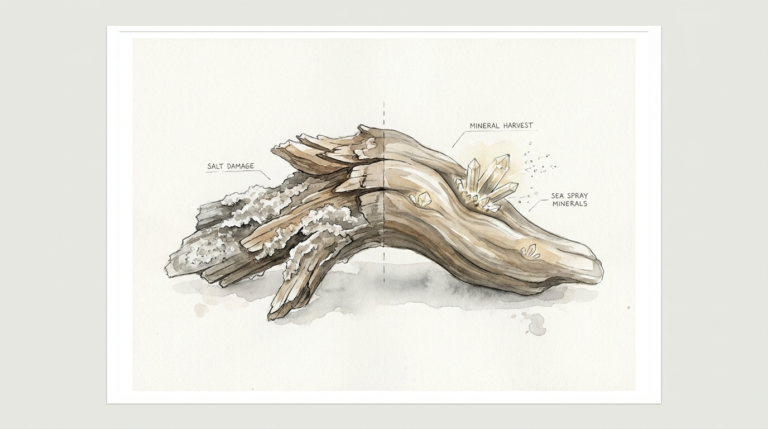
Identifying pests is another hurdle. Coastal wood is frequently home to “shipworms” or wood-boring beetles. Small, perfectly round holes are a red flag. While some artists value the aesthetic of “wormy” wood, you must ensure the piece is thoroughly treated with a borate solution or heat-sterilized to prevent an infestation in your home or gallery.
Legal pitfalls are equally dangerous. Many people assume the beach is a “free for all,” but federal and state laws vary wildly. In many National Parks, it is a felony to remove even a small stick. Always check local Department of Natural Resources (DNR) guidelines. For example, in some coastal regions, you are legally allowed to take “driftwood” but not “logs,” with the distinction often based on whether the piece has been sawn by a human or naturally broken.
Limitations and Realistic Constraints
Driftwood is not a structural material. You should never use a piece of found wood as a load-bearing leg for a heavy dining table unless it has been thoroughly tested for internal voids. Saltwater environment creates hidden pockets of weakness that may not be visible on the surface.
The “smell factor” is another limitation. Wood found in brackish or stagnant water can retain a sulfurous odor even after cleaning. If a piece still smells like mud after a week of drying, it likely has deep-seated anaerobic bacteria that will be nearly impossible to neutralize without vacuum-sealing it in resin.
Environmental trade-offs must also be considered. Driftwood plays a vital role in coastal ecosystems, providing shelter for small organisms and stabilizing dunes. Stripping a beach of all its wood is not only illegal in many jurisdictions—it’s ecologically irresponsible. Professional collectors follow the “one-piece-per-visit” rule to ensure they aren’t depleting the local habitat.
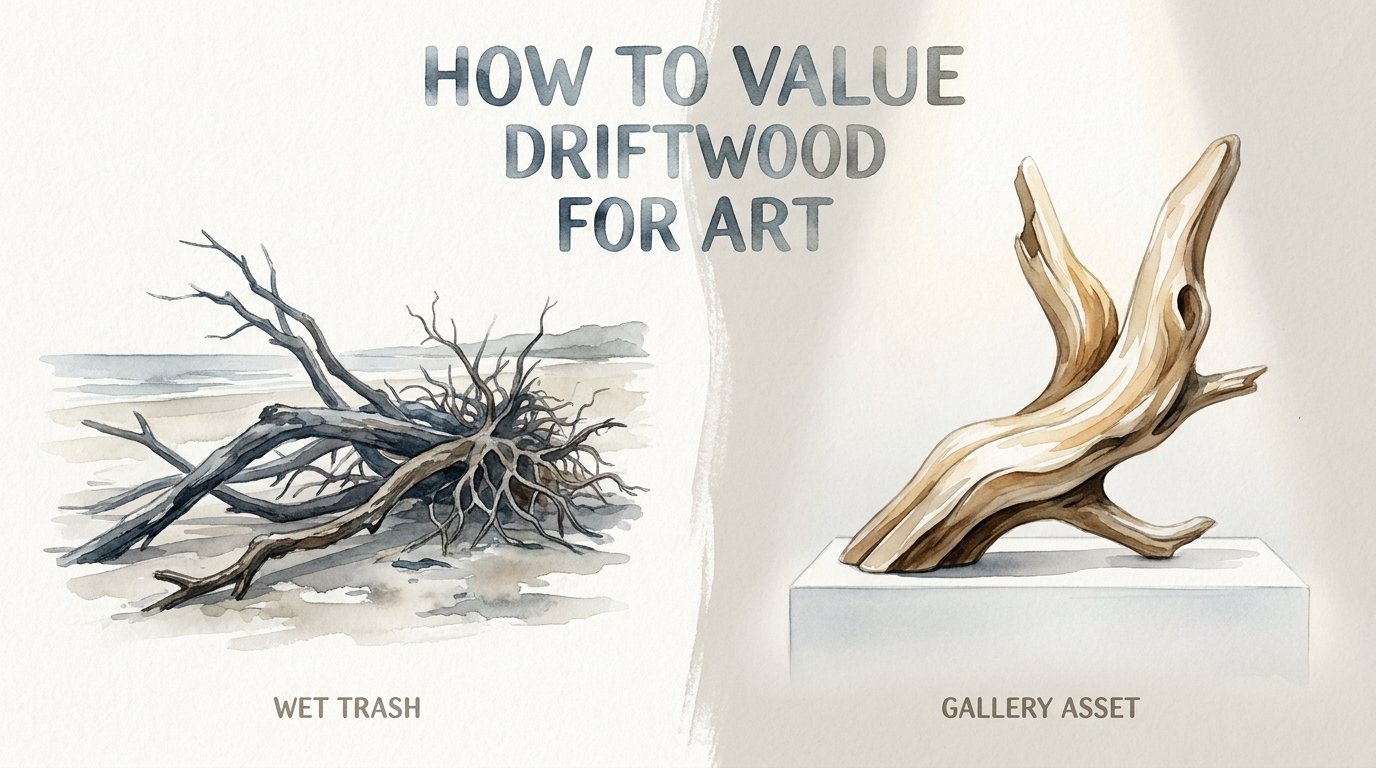
Comparison: Wet Trash vs. Gallery Asset
Understanding which category your find falls into will save you hours of wasted labor. Use the table below to evaluate your next haul.
| Feature | Wet Trash (Discard) | Gallery Asset (Keep) |
|---|---|---|
| Density | Spongy, light, “corky” feel | Heavy, solid, rings “hard” when tapped |
| Surface | Slimy, peeling bark, slimy film | Bleached, smooth, sand-blasted texture |
| Color | Dark brown, black streaks of rot | Silver-gray, pale tan, or deep red (Redwood) |
| Shape | Straight, blocky, featureless | S-curves, knots, voids, “root flare” |
| Scent | Strong sulfur or moldy odor | Neutral or faint “ocean” scent |
Practical Tips for the Modern Pioneer
Invest in a high-quality pressure washer. While hand-scrubbing works for small twigs, a pressure washer is the only way to effectively clean the deep crevices of a large root system without destroying the wood’s patina. Set the PSI low—around 1,500—to avoid “fuzzing” the wood fibers.
Keep a “scouting kit” in your vehicle. This should include a pair of heavy-duty gloves, a small hand saw for removing unusable side-branches on site, and a mesh bag to allow the wood to begin air-drying on the trip home.
When it comes to finishing, less is more. Most high-end buyers want the raw, matte look of the wood. If you must seal it, use a clear, matte polyurethane or a light coat of beeswax. Avoid high-gloss finishes, which tend to make the wood look like cheap plastic and hide the natural grain details that make it valuable.
Advanced Considerations: Scaling and Staging
For the practitioner looking to move from hobby to business, staging is everything. A piece of wood on a garage floor is a stick; the same piece of wood mounted on a minimalist steel base with professional lighting is a $500 sculpture.
Consider the “Basing” of your art early in the process. Many professional driftwood artists use heavy black granite or reclaimed steel as bases. The contrast between the organic, chaotic lines of the wood and the rigid, industrial nature of the base creates the “tension” that gallery owners look for.
If you find a particularly large or complex piece, consider “photogrammetry”—using your phone to create a 3D scan of the wood. This allows you to show the piece to potential interior design clients or gallery curators before you spend the time and money on a full restoration.
Example Scenario: The Coffee Table Centerpiece
Imagine you find a 4-foot section of a Western Red Cedar root system on a beach after a winter storm. It is silver-bleached, heavy, and has several “windows” or natural holes through the center.
Your process begins with a 24-hour soak in a 10% bleach solution in a large plastic trough. After rinsing, you spend two hours with a Dremel tool and a fine sanding attachment, removing only the sharpest splinters while preserving the “water-carved” ridges. You let it dry for a week in a climate-controlled shop.
By mounting this piece on two simple, hidden acrylic risers, you create the illusion that the wood is “floating” as a center element for a glass-topped coffee table. While the raw root cost you nothing but a few hours of labor and $20 in cleaning supplies, the finished, staged assembly can be marketed to high-end furniture boutiques for $1,200 or more.
Final Thoughts
The transition from beachcomber to driftwood artist is less about what you find and more about what you see. The shoreline is a chaotic environment, but within that chaos are structures that have been refined by the most powerful forces on the planet.
Taking the time to understand the species, the chemistry of preservation, and the aesthetics of line will transform your “rubbish” into a legitimate asset. It is a slow, methodical craft that rewards those who have the grit to hunt in the cold and the patience to wait for the wood to reveal its final form.
Start small. Find one piece that has a line you can’t stop looking at. Clean it, dry it, and place it in a room with good light. You’ll soon realize that the most valuable things in your home don’t always come from a store—sometimes they just wash up at high tide.
Sources
1 wikihow.com (https://www.wikihow.com/Preserve-Driftwood) | 2 coco-papaya.com (https://www.coco-papaya.com/en/blog/ethnic-decoration-handicrafts-from-around-the-world/driftwood-decoration-a-unique-and-natural-choice-to-beautify-your-interior) | 3 thecoolist.com (https://www.thecoolist.com/driftwood-decor-ideas-for-home/) | 4 cornell.edu (https://www.law.cornell.edu/regulations/california/14-CCR-4306) | 5 darhlene.com (https://darhlene.com/2017/02/20/harvesting-driftwood-101/) | 6 atlaswoodcompany.com (https://atlaswoodcompany.com/blogs/news/how-to-choose-the-right-wood-species-for-your-photograph-or-art) | 7 beavercrafttools.com (https://beavercrafttools.com/blogs/wood-for-carving/best-wood-for-wood-carving) | 8 hawk-hill.com (https://www.hawk-hill.com/how-to-clean-driftwood/) | 9 beavercrafttools.com (https://beavercrafttools.com/blogs/wood-for-carving/driftwood-carving-a-completed-guide) | 10 dksstores.com (https://dksstores.com/blog-post67) | 11 kraycustomrefinish.com (https://kraycustomrefinish.com/identifying-wood-types-furniture/) | 12 quora.com (https://www.quora.com/How-can-you-find-out-if-a-piece-of-artwork-has-a-market-value) | 13 moneypantry.com (https://moneypantry.com/how-to-sell-driftwood/) | 14 quora.com (https://www.quora.com/Is-it-illegal-to-take-driftwood-from-a-beach) | 15 northwestdriftwoodartists.org (https://www.northwestdriftwoodartists.org/lesson-center/about-the-art/art-and-driftwood/) | 16 youtube.com (https://www.youtube.com/watch?v=SkCTLcabA4w)