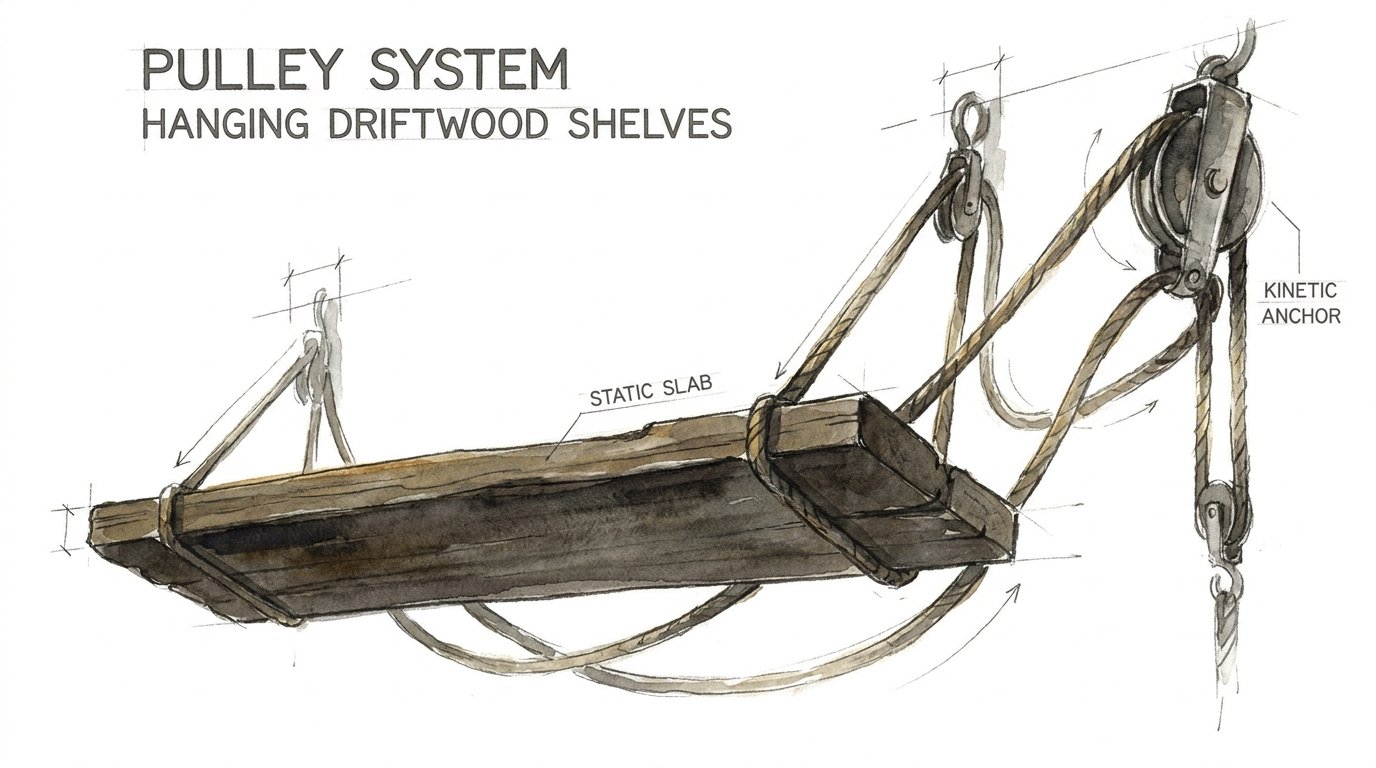
Pulley System Hanging Driftwood Shelves
Stop letting your furniture dictate your floor space—make your shelves move for you. Most shelving is a ‘static’ obstacle that kills the energy of a room. Kinetic pulley systems transform this driftwood shelf into a living part of your home’s workflow. Lower it when you’re creating, and hoist it away to open up the room when you’re done. It’s coastal aesthetics meets industrial efficiency.
[affiai]Modern living often feels like a battle against the very objects we buy to make life easier. We stack, we cram, and we walk around heavy, immovable blocks of wood and MDF. There is a certain pioneer grit in reclaiming that space. Instead of accepting the floor as the only boundary for storage, we look to the rafters. This project is about more than just a shelf; it is about the intersection of raw, found nature and the clean mechanical advantage of the pulley.
Driftwood carries a history of the sea, shaped by current and salt until only the strongest heartwood remains. When you pair that weathered timber with the iron and hemp of a rigging system, you aren’t just decorating a room. You are installing a machine. This guide will walk you through the physics, the craftsmanship, and the safety required to hang a piece of the coast from your ceiling.
Pulley System Hanging Driftwood Shelves
Pulley system hanging driftwood shelves are a form of kinetic furniture that utilizes basic mechanical advantage to create adjustable storage. Unlike a standard floating shelf that is anchored permanently to a wall stud, these shelves suspended from the ceiling. They rely on a network of ropes and pulleys to move vertically. This concept originates from maritime traditions and industrial warehouses where vertical space was the only luxury available.
In the real world, you see these systems in high-ceilinged lofts, artist studios, and compact coastal cottages. They serve as “living” storage. An artist might lower a shelf full of brushes and paints to desk height during a session, then hoist it out of sight to clear the floor for a gallery showing. In a kitchen, a driftwood herb rack might sit at eye level for harvesting and then retreat toward the skylight to catch the best sun.
Visualizing this setup requires thinking of the shelf as an anchor. It is a heavy, organic mass tethered by tension. The driftwood provides the “Static Slab” foundation—the physical place where items rest—while the pulley rigging acts as the “Kinetic Anchor,” the mechanical heart that allows for movement. This duality allows the piece to be both a rugged focal point and a highly functional tool.
How to Build Your Kinetic Driftwood System
Building a reliable hanging system requires a disciplined approach to both woodworking and rigging. You cannot simply throw a rope over a hook and expect it to hold. You must account for the structural integrity of your ceiling and the balance of the wood itself.
1. Sourcing and Curing the Driftwood
Your first task is finding a piece of wood that has the “grit” to handle the tension. Look for hardwoods like oak or maple that have been naturally seasoned by the water. Softwoods like pine or cedar can work, but they are more prone to splitting under the pressure of eye-bolts. Once you find your piece, you must treat it.
Scrub the wood with a stiff brush to remove salt and sand. Boiling the wood for one to two hours is the best way to kill deep-seated pests and remove excess tannins. If the piece is too large to boil, soak it in a saltwater solution for at least a week, followed by a thorough drying period. You want the wood to be “bone dry” before you apply any finish or drill into it.
2. Calculating the Mechanical Advantage
Physics determines how easy it will be to lift your shelf. A single fixed pulley has a mechanical advantage (MA) of 1. This means if the shelf weighs 40 pounds, you must pull with 40 pounds of force. To make the shelf feel lighter, you need a compound system.
A 2:1 system uses one moving pulley attached to the shelf itself. In this setup, you only pull 20 pounds of force to lift that 40-pound slab, though you have to pull twice as much rope. For heavy driftwood “Static Slabs,” a 2:1 or even a 3:1 “Z-rig” is often the best choice. It provides smooth, controlled movement without requiring the strength of a deckhand.
3. Installing the Ceiling Support
Never anchor a pulley system into drywall alone. You must locate the ceiling joists. A common technique is to mount a secondary support piece—often a thick birch plywood plank—across two or more joists. This spreads the load and prevents the eye-bolts from pulling through the timber. Use 4-inch wood screws to secure this support piece. Once the support is in place, you can screw your eye-bolts into it with confidence.
4. Rigging the Lines
Thread your rope through the pulleys. Manila rope is the traditional choice for its “pioneer-grit” aesthetic and natural grip. Synthetic ropes like nylon move more smoothly through the sheaves, but they can be “stretchy,” leading to a shelf that bounces.
Ensure your holes in the driftwood are slightly larger than the rope diameter to prevent binding. Pass the rope through the corners of the shelf and secure them with a “Stopper Knot” or a “Figure Eight” knot. This ensures the wood cannot slip down the line even if the system loses tension.
Benefits of Kinetic Driftwood Shelves
The most immediate benefit is the reclamation of floor space. In small dwellings, every square foot of floor is precious. By moving your storage to the “Z-axis,” you free up room for movement, furniture, or simply a clearer mind.
Beyond space, these shelves offer unparalleled versatility. You can adjust the height to suit the task at hand. If you are working on a detailed project, the shelf comes to you. If you need a clean background for a photo or a gathering, the shelf disappears. This is the essence of making the furniture move for you, rather than you moving around the furniture.
From a design perspective, the contrast between the weathered, silver-grey of the driftwood and the industrial gleam of the pulleys creates a “coastal industrial” look. It tells a story of survival and utility. It looks like something you would find in the cabin of a 19th-century schooner, yet it functions perfectly in a modern smart home.
Challenges and Common Mistakes
One of the most frequent errors is failing to balance the center of gravity. Driftwood is rarely a perfect rectangle. If one end is heavier than the other, the shelf will tilt, causing your items to slide off. You must find the balance point before drilling your holes. Sometimes, you may need to add a small lead weight or a “counter-weight” to the lighter side of the wood to keep it level.
Rope stretch is another silent enemy. New manila or sisal rope will stretch over the first few weeks of use. If you level your shelf perfectly on day one, it might be crooked by day fourteen. Plan for this by using adjustable hitches, such as a Taut-Line Hitch, which allows you to take up the slack without re-tying the entire system.
Inadequate anchoring is the most dangerous mistake. A 50-pound driftwood shelf, once loaded with books or plants, can easily weigh 100 pounds. Under the dynamic force of being pulled up and down, that weight can double. If those eye-bolts aren’t buried deep into solid ceiling joists, the entire system becomes a falling hazard. Always over-engineer your anchors.
Limitations: When This System May Not Work
This is not a “set it and forget it” storage solution for fragile items. Because the shelf is suspended by rope, it will have a slight sway. If you live in an earthquake zone or have high-energy pets, storing fine crystal or top-heavy vases on a kinetic shelf is a recipe for disaster.
Environmental factors also play a role. Driftwood and natural fibers are sensitive to humidity. In a very damp basement or a bathroom with poor ventilation, the rope can rot and the wood can warp or grow mold. You must ensure the space has adequate airflow to keep the organic materials healthy.
Finally, there is a “rope tax” on your ceiling height. The pulleys and knots take up space. If you have low 7-foot ceilings, a hanging shelf will likely be in the way regardless of whether it is raised or lowered. These systems thrive in rooms with at least 9 to 10 feet of vertical clearance.
Comparison: Static Slab vs. Kinetic Anchor
When deciding between a traditional fixed shelf and a pulley system, consider the following factors:
| Feature | Static Slab (Fixed) | Kinetic Anchor (Pulley) |
|---|---|---|
| Installation Difficulty | Low to Medium | High |
| Floor Space Impact | None (Wall-mounted) | Variable (Retractable) |
| Weight Capacity | Very High (Stud-based) | Medium (Joist-based) |
| Flexibility | None | High (Adjustable heights) |
| Maintenance | Zero | Annual inspection required |
Practical Tips and Best Practices
If you want your system to last a lifetime, follow these rules of thumb:
- Use the Bowline Knot: This is the king of knots for a reason. It creates a secure loop that will not slip under load but is easy to untie even after it has been tightened by heavy weight.
- Install a Wall Cleat: You need a place to tie off the rope once the shelf is hoisted. A heavy-duty brass or iron boat cleat mounted at chest height is the safest way to “lock” the shelf in position.
- Chamfer the Holes: Use sandpaper to smooth the edges of the holes you drill in the driftwood. Sharp edges will saw through your rope over time through friction.
- Dust Management: Ceiling-mounted items catch dust on the top surface. Since you can lower the shelf, cleaning becomes much easier than with traditional high shelves. Use a damp cloth once a month to keep the grain of the wood visible.
Advanced Considerations for Serious Practitioners
For those looking to go beyond the basics, consider a counterweight system. By attaching a weight—similar to an old window sash weight—to the opposite end of your pulling line, you can create a shelf that stays in place wherever you leave it. The weight of the counterweight should perfectly match the weight of the shelf and its average load. This “neutral buoyancy” makes the shelf feel nearly weightless.
Another advanced technique involves Shou Sugi Ban. This Japanese method of charring the wood surface creates a carbonized layer that protects the driftwood from rot and insects while giving it a deep, obsidian sheen. Pairing charred driftwood with stainless steel pulleys creates a strikingly modern aesthetic that still feels rooted in ancient tradition.
Scaling the system is also an option. You can rig multiple “Static Slabs” onto a single “Kinetic Anchor” system. This creates a tiered shelving unit that moves as one. This requires precise calculations of the rope tension to ensure each tier stays level as it rises, but it maximizes the storage capacity of a single ceiling anchor point.
Example Scenarios
Consider a 12-foot driftwood log found on a Pacific Northwest beach. A woodworker cleans and dries the piece, then rigs it with a 3:1 pulley system in their garage. They use it to store long rolls of canvas and blueprints. During the day, the log sits 3 feet above their workbench for easy access. At night, they hoist it to the 10-foot ceiling, allowing them to park their vehicle underneath without interference.
In a different scenario, a coastal cafe uses a series of small driftwood slabs suspended over the counter to hold daily menus and specials. The staff lowers the boards every morning to write the new offerings, then hoists them up so they are visible from the back of the room. The movement of the shelves becomes a part of the morning ritual, a tactile “kinetic” start to the workday.
Final Thoughts
Kinetic driftwood shelving is more than a weekend DIY project; it is an exercise in intentional living. By taking the time to source a piece of wood from the wild and rigging it with a functional machine, you are rejecting the “static” nature of modern furniture. You are choosing a path that values both the beauty of the natural world and the efficiency of classical mechanics.
Success with this system comes down to respect for the materials. Respect the weight of the wood, the strength of the joists, and the integrity of the knots. When these elements come together, you gain a storage solution that doesn’t just hold your things—it moves with you. It changes the way you interact with your room, proving that even a heavy slab of timber can be made to dance with the right leverage.
Experiment with different wood textures and rope types. Start with a small, single-pulley setup to get a feel for the tension before moving on to larger, more complex compound rigs. The goal is to build something that feels as sturdy as a pioneer’s cabin yet as fluid as the tide that brought the driftwood to shore. Over time, you may find that internalizing these principles of mechanical advantage and space optimization changes how you look at every corner of your home.
Sources
1 dycoventures.com (https://dycoventures.com/blogs/articles/are-garage-ceiling-storage-racks-safe) | 2 instructables.com (https://www.instructables.com/Hanging-Moving-Book-Shelves/) | 3 arackabove.com (https://arackabove.com/pages/a-garage-ceiling-storage-guide) | 4 marcusfishtanks.com (https://marcusfishtanks.com/blogs/news/diy-aquarium-driftwood-preparing-and-using-it-safely) | 5 microaquaticshop.com.au (https://microaquaticshop.com.au/blogs/bonsai-driftwood/27-best-driftwoods-for-aquarium-types) | 6 aqua-fish.net (https://en.aqua-fish.net/articles/aquarium-driftwood-faq-guide) | 7 firgelliauto.com (https://www.firgelliauto.com/blogs/engineering-calculators/pulley-mechanical-advantage-calculator) | 8 ucsc.edu (https://ucscphysicsdemo.sites.ucsc.edu/physics-5a6a/pulley-mechanical-advantage/) | 9 rigginglabacademy.com (https://rigginglabacademy.com/pulley-systems-for-mechanical-advantage/) | 10 petzl.com (https://www.petzl.com/US/en/Professional/How-to-calculate-mechanical-advantage?ActivityName=Technical-rescue)