Sea-cured Driftwood Vs Kiln-dried Lumber
Why does a piece of wood that spent 40 years underwater hold more weight than the shelf you bought yesterday? Modern furniture is rushed through a kiln to make it ‘shelf-ready’ in days, leaving it brittle and prone to cracking. Real driftwood has been ‘slow-cured’ by the ocean’s salt and pressure for decades. It’s not just a shelf; it’s a piece of ancient architecture that has already survived the hardest conditions on Earth.
[affiai]You might think that soaking wood in salt water for half a century would rot it to the core. In reality, the exact opposite happens. This slow, rhythmic process of submersion and pressure creates a material that modern industrial methods simply cannot replicate.
Understanding the difference between mass-produced lumber and sea-cured driftwood is more than just a lesson in carpentry. It is a study in how time and nature can outwork any machine. If you are looking for strength that lasts generations, you have to look where the tide goes out.
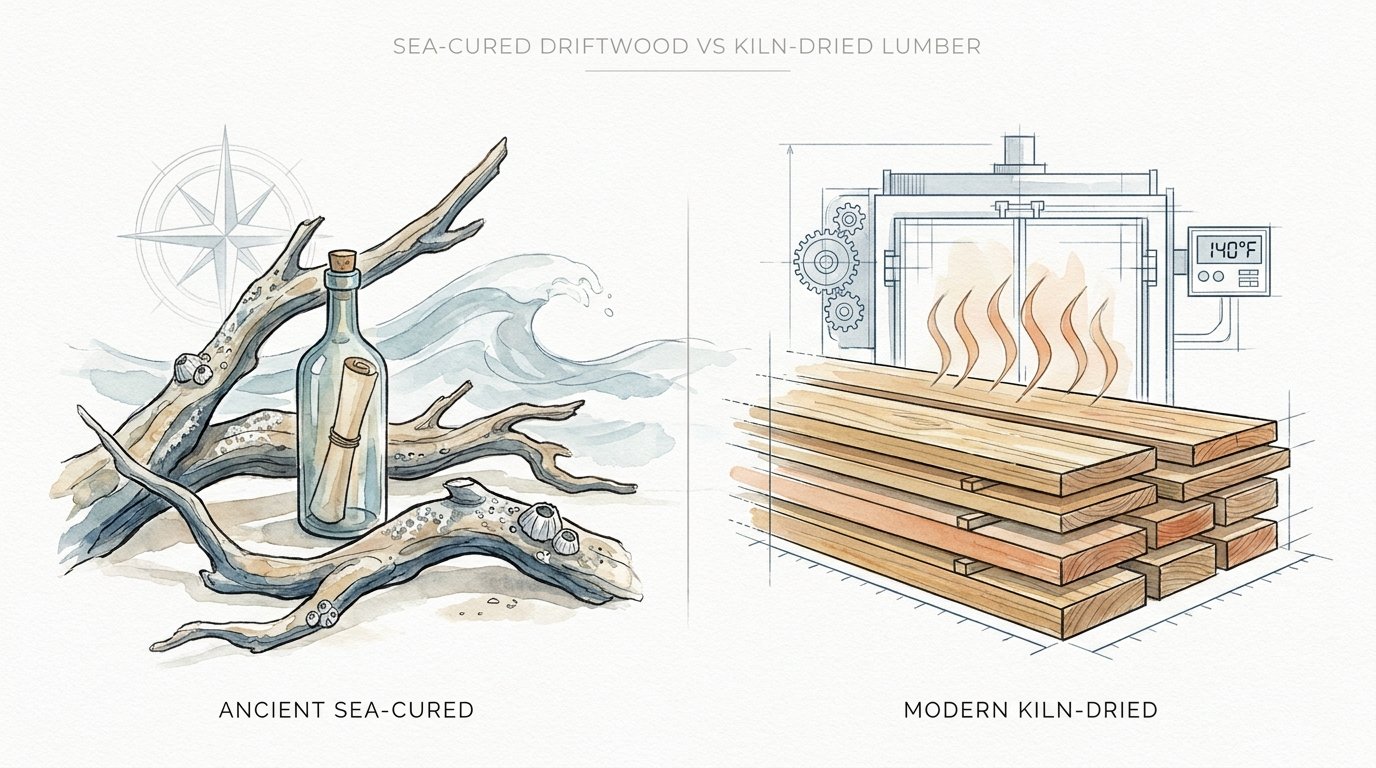
Sea-cured Driftwood Vs Kiln-dried Lumber
Modern lumber is a product of speed. Trees are harvested, sliced into boards, and shoved into high-temperature ovens called kilns to bake out the moisture in a matter of hours or days. This process is efficient for the market, but it is violent for the wood’s cellular structure. Rapid heat causes the wood fibers to shrink unevenly, often creating internal stresses that lead to warping or “case-hardening.”
Sea-cured driftwood exists on a completely different timeline. This wood has spent decades at the mercy of the tides, undergoing a process known as water seasoning. While submerged, the ocean’s salt and pressure work in tandem to purge the wood of its most volatile components.
Soluble sugars, starches, and hemicellulose are slowly leached out of the wood fibers. These are the very substances that fungi and insects love to eat. When these “soft” components are replaced by salt crystals and minerals from the water, the wood becomes less like a plant and more like a stone.
Think of kiln-dried lumber as a piece of toast; it’s dry and functional, but it’s brittle. Sea-cured driftwood is more like a piece of cured leather. It has been tempered by its environment until only the most resilient parts of the cellular structure remain.
How the Ocean “Cures” Wood on a Cellular Level
The transformation of a fallen tree into a structural masterpiece happens through osmotic exchange. When wood is submerged in salt water, the high concentration of salt in the ocean pulls moisture out of the wood cells while simultaneously forcing salt minerals in.
This process is remarkably gentle compared to the blistering heat of a kiln. Because the exchange happens over years, the wood cells don’t collapse or “honeycomb.” Instead, the salt crystals act as a stabilizing agent. They occupy the spaces where water used to sit, preventing the wood from shrinking or expanding as the humidity changes.
Pressure also plays a critical role. At the bottom of a river or ocean, the weight of the water compresses the wood fibers. This is why “sinker logs”—trees that have sat at the bottom of waterways for a century—are often significantly denser and heavier than green wood of the same species.
Benefits of Sea-Cured Wood for Heavy-Load Projects
If you are building a shelf meant to hold a library of heavy books, sea-cured wood offers several mechanical advantages. Its dimensional stability is perhaps its greatest asset. Unlike the pine boards from a big-box store, sea-cured wood has already done all the warping it will ever do.
Increased Hardness: The absorption of minerals like silica and calcium from the water can actually petrify the wood over long periods. This makes the surface much more resistant to dents and scratches than standard kiln-dried lumber.
Natural Pest Resistance: The high salt content makes the wood an inhospitable environment for termites and wood-boring beetles. You aren’t just buying a shelf; you are buying a piece of timber that has a built-in, non-toxic preservative.
Tension Strength: Studies on saltwater-incubated pine have shown that several weeks of salt exposure can actually increase the wood’s tensile strength. Imagine what forty years of that same process can do for a thick slab of oak or cedar.
Challenges and Common Mistakes When Working with Driftwood
Working with wood that has been “sea-tempered” requires a specific set of skills and tools. The biggest mistake beginners make is treating it like ordinary lumber. You have to respect the history that is literally baked into the grain.
Corrosion Issues: The same salt that preserves the wood will eat through standard zinc or steel screws. Always use 316-grade stainless steel fasteners. If you use cheap hardware, the salt in the wood will cause the screws to rust and snap within a year.
Tool Wear: Driftwood often contains fine particles of sand and grit embedded deep within the fibers. This will dull your saw blades and planer knives faster than anything else. Plan to sharpen your tools twice as often when working with sea-recovered material.
The “Drying Out” Phase: If you find a fresh piece of waterlogged wood, you cannot just bring it home and start building. It must be “dewatered” slowly. If it dries too fast in a heated home, the cells will collapse, and the wood will shatter.
Limitations: When Sea-Cured Wood May Not Be Ideal
Despite its incredible strength, sea-cured driftwood isn’t the right choice for every situation. You have to consider the environment where the final piece will live.
For instance, driftwood is not suitable for structural framing in modern homes where building codes require standardized, grade-stamped lumber. You cannot easily calculate the load-bearing capacity of a random piece of ocean-found timber to satisfy a building inspector.
There is also the issue of finish adhesion. Many oils and varnishes do not bond well with salt-laden wood. You may need to “desalt” the surface by wiping it down with fresh water and allowing it to dry multiple times before applying a topcoat.
Finally, availability is a major constraint. You cannot simply order 500 board feet of 40-year sea-cured oak. Each piece is a unique find, which makes it perfect for a statement shelf but difficult for a full-scale flooring project.
Practical Tips for Sourcing and Prepping Your Own Wood
If you want to move away from the “brittle shelf” syndrome, you need to know how to spot high-quality reclaimed wood. Look for pieces that feel unusually heavy for their size. This is a sign of high mineral content and density.
The Float Test: If a piece of wood is truly “sea-cured” and dense, it will often sit lower in the water than a fresh piece of wood. “Sinker” quality wood is the gold standard for strength.
Cleaning the Grain: Use a stiff nylon brush and fresh water to scrub away loose sand and salt from the surface. Avoid using a power washer, as the high pressure can “fuzz” the delicate fibers of the wood and ruin the natural patina.
Testing for Rot: Take a small awl or a screwdriver and poke the wood. If it sinks in like butter, the wood has rotted. If it bounces off or barely makes a mark, the ocean has done its job and cured the timber.
Advanced Considerations: The Sinker Log Phenomenon
For those looking to go beyond beach-found driftwood, sinker logs represent the pinnacle of water-cured timber. These are logs that fell off rafts during transport in the 1800s and have sat in the anaerobic (oxygen-free) silt of river bottoms ever since.
Because there is no oxygen, the wood does not rot. Instead, it undergoes a century of slow mineralization. Sinker cypress and sinker redwood are prized by luthiers and high-end furniture makers because the wood is incredibly resonant and structurally “dead”—meaning it will never move, twist, or shrink.
The colors found in these logs are also impossible to replicate. The minerals in the river water turn the wood deep shades of olive, chocolate, and even purple. This is nature’s way of staining the wood all the way through the core.
A Realistic Example: The Library Shelf Test
Imagine you have two shelves. One is a 1-inch thick piece of kiln-dried pine from a local hardware store. The other is a 1-inch thick slab of 40-year sea-cured cedar.
You load both with 100 pounds of encyclopedias. Within six months, the kiln-dried pine will likely show a visible “sag” or deflection. The rapid drying in the kiln has left the lignin (the glue of the wood) brittle and less able to handle long-term tension.
The sea-cured cedar, however, remains perfectly flat. The salt crystals in its fibers act like millions of tiny internal struts, resisting the compression of the heavy books. It has already spent four decades under the weight of the Atlantic; a hundred pounds of books is nothing to a piece of wood that has survived the deep.
Final Thoughts
Choosing sea-cured driftwood over modern kiln-dried lumber is a choice to value time over convenience. It is a recognition that the best things in life—and in carpentry—cannot be rushed. When wood is allowed to cure in the salt and the cold, it develops a character and a strength that modern industry can only dream of.
Building with this material connects you to a tradition of “pioneer-grit” craftsmanship. You are working with a material that has already been tested by the ultimate auditor: the ocean. It requires more patience, better tools, and a bit of a hunter’s eye to find, but the result is a piece of furniture that is structurally superior to anything you can buy in a box.
If you are tired of furniture that feels temporary, start looking to the water. The best materials for your next project might be sitting at the bottom of a river or washing up on a rocky shore, waiting for someone with the patience to use them. Experiment with a small piece of driftwood first, and you will quickly see why the “slow-cured” path is the only one worth taking.
Sources
1 youtube.com (https://www.youtube.com/watch?v=gRA92B93tCQ) | 2 youtube.com (https://www.youtube.com/watch?v=lz_-cZCmv18) | 3 nih.gov (https://pmc.ncbi.nlm.nih.gov/articles/PMC10144292/)