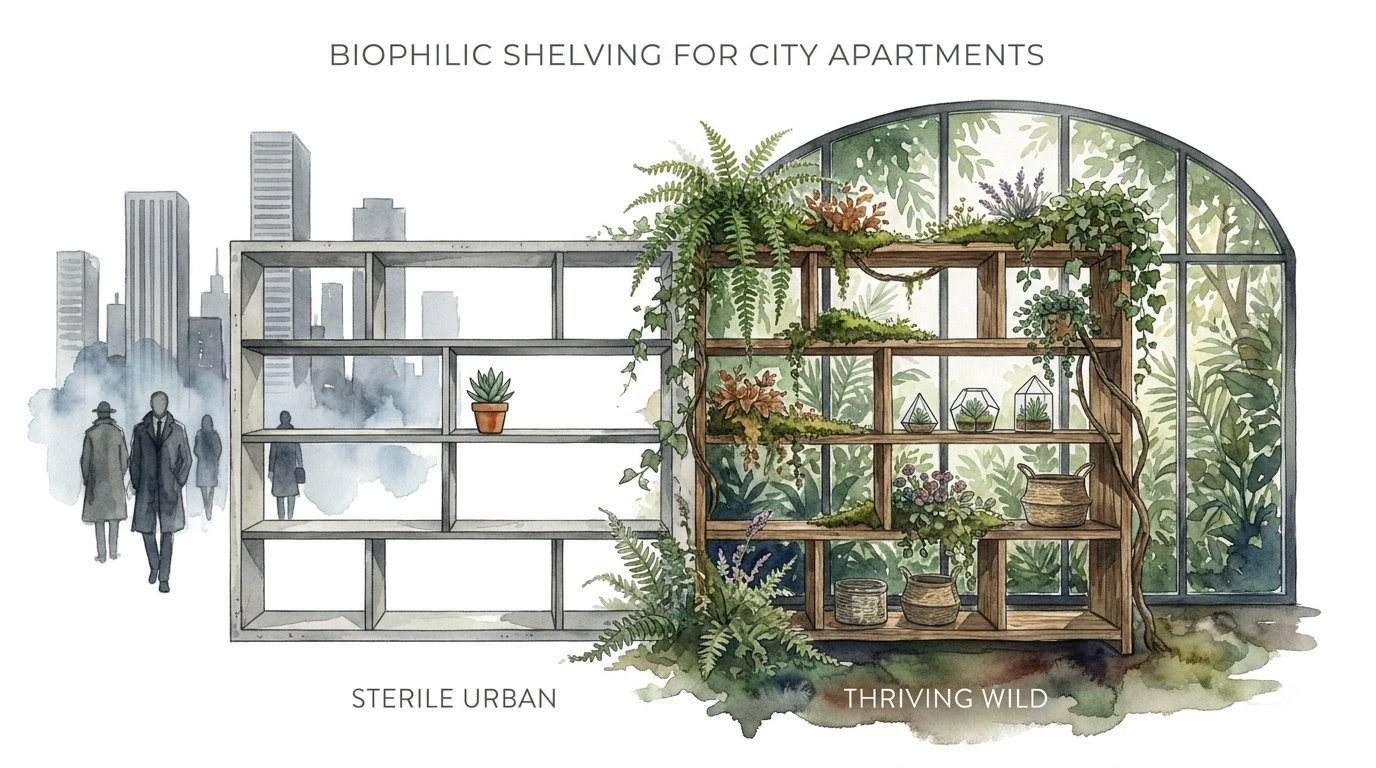
Biophilic Shelving For City Apartments
Your apartment is a box of straight lines; it’s time to break the cycle with the chaotic geometry of the sea. Urban design prioritizes efficiency over biology. Bringing wild, sea-sculpted architecture into your living space restores the connection between your modern life and the ancient earth. Most city dwellers exist in a state of sensory deprivation, surrounded by the right angles of mass-produced drywall and particle-board furniture. This environment signals a subtle, constant threat to the primitive brain, which evolved to seek safety in the soft curves and predictable complexity of the natural world.
[affiai]Transforming a cramped studio or a high-rise flat into a sanctuary requires more than a few scattered houseplants. It demands a fundamental shift in how you perceive the surfaces that hold your life. Biophilic shelving offers a way to reclaim the vertical space of your home, replacing the rigid sterility of the “urban box” with the grit and texture of the wild. These shelves do not just hold books; they act as anchors for the soul, grounding you in a history that predates the city itself.
Biophilic Shelving For City Apartments
Biophilic shelving is the intentional integration of natural, organic forms—specifically raw wood, driftwood, or live-edge timber—into the storage systems of a home. Unlike standard floating shelves that use perfectly planed, kiln-dried boards, biophilic shelves preserve the history of the tree or the journey of the wood through the tides. They are functional sculptures that bring the “Material Connection with Nature,” a core principle of the 14 Patterns of Biophilic Design, into the domestic sphere.
In the context of a city apartment, where square footage is a luxury and views of nature are often blocked by concrete, these shelves serve as a bridge. They exist to satisfy our innate biological need for “Biomorphic Forms and Patterns.” Research in environmental psychology suggests that humans have a strong preference for curved shapes over sharp angles. This is not merely a matter of taste; neuroscientists have observed that sharp edges can trigger the amygdala, the brain’s threat-processing center, whereas organic contours promote relaxation and a sense of safety.
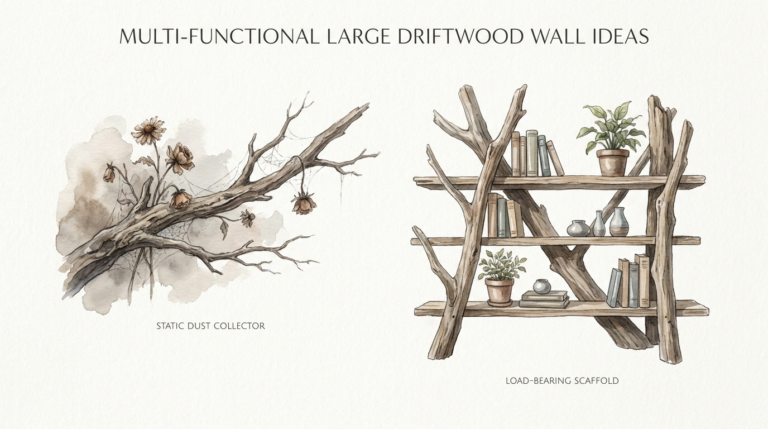
Real-world applications of this concept range from minimalist driftwood ledges in Scandinavian-style lofts to massive, floor-to-ceiling live-edge installations in eco-luxury residences. In smaller apartments, a single piece of sea-weathered timber mounted as a shelf can change the entire frequency of a room. It breaks the visual monotony of the “sterile urban” environment and replaces it with a “thriving wild” aesthetic that feels earned rather than bought.
The Anatomy of an Organic Shelf: Sourcing and Selection
Creating a biophilic shelf starts with the hunt. You are looking for wood that has been finished by the elements, not a factory. Driftwood is the ultimate prize for this project because the ocean has already done the heavy lifting, stripping away the bark and softening the grain through years of salt-water immersion and sun-bleaching.
Sourcing must be done with respect for the ecosystem. Many public beaches and national parks have strict regulations against removing driftwood, as these pieces provide vital habitats for coastal organisms and help prevent erosion. Always check local laws or purchase from reputable suppliers who harvest wood ethically from private lands or through sustainable salvage operations.
When selecting a piece of wood for shelving, look for structural integrity first. A piece of driftwood may look beautiful, but if it feels light as cork or shows signs of significant “punky” decay, it will not hold weight. Aim for hardwoods like oak, maple, or cedar that have retained their density. The wood should be at least one inch thick at its thinnest point to prevent sagging under the load of books or decor.
How to Prepare and Install Natural Wood Shelving
Preparing wild wood for a city apartment requires a blend of old-world patience and modern precision. You cannot simply pull a log from a riverbank and bolt it to your wall. The wood must be cleaned, sanitized, and stabilized to ensure it does not bring the “outside” in in the form of pests or mold.
Step 1: Sanitization and Drying
Thoroughly scrub the wood with a stiff brush and a mild bleach solution to kill any lingering bacteria or insect larvae. Once cleaned, the wood must dry completely. This process can take weeks if the wood was waterlogged. Avoid the temptation to rush this by placing it near a radiator, as rapid heat can cause the wood to crack or warp. Use a moisture meter to ensure the internal moisture content is below 12% before proceeding.
Step 2: Surface Refinement
Sand the wood to reveal its hidden character. Start with a coarse 80-grit paper to remove any jagged splinters or rough patches, then move to 120 and finally 220-grit for a finish that is smooth to the touch but still retains its natural contours. The goal is to make the shelf safe for your hands and your belongings without erasing the “pioneer-grit” texture that defines the piece.
Step 3: Mounting for Irregular Loads
Installing an irregular shelf is more complex than mounting a flat board. You must find the balance point. Heavy-duty black pipe fittings or custom-forged steel brackets are ideal because they provide a rugged, industrial contrast to the organic wood. Always secure your brackets directly into wall studs. If a stud is not available, use high-capacity toggle bolts rather than plastic drywall anchors.
Because the back of a piece of driftwood is rarely flat, you may need to scribe the wood to the wall or use spacers. A more advanced technique involves using a router to create a recessed channel in the back of the wood so it can slide onto a hidden mounting plate, creating a “floating” effect that lets the wood’s shape speak for itself.
The Biological Edge: Why It Matters
Choosing organic geometry over industrial efficiency provides measurable benefits for the apartment dweller. The “Biophilia Hypothesis” suggests that our physical and mental health is intrinsically tied to our connection with nature. In a high-stress urban environment, these connections are often severed.
Practical, observable benefits include:
- Reduced Cortisol Levels: Visual contact with natural textures and “fractal” patterns—the repeating, complex shapes found in wood grain—has been shown to lower heart rates and reduce stress hormones.
- Enhanced Cognitive Focus: A study by the University of Melbourne found that even brief interactions with natural elements can increase productivity by up to 15%. A biophilic shelf in a home office acts as a “micro-restorative” element, allowing the brain to recharge during tasks.
- Improved Air Quality: While the wood itself is inert, biophilic shelving often serves as the foundation for indoor gardens. Vertical greenery helps filter urban pollutants and increases humidity in dry, climate-controlled apartments.
Common Pitfalls and How to Avoid Them
The most frequent error in DIY biophilic design is the failure to prioritize structure. A beautiful piece of wood is useless if it collapses. Never underestimate the weight of the wood itself plus the objects you intend to place on it. Wood that has been in the water for a long time can be deceptive; it may look solid but have a hollow or rotted core. Always perform a “tap test” with a hammer; a solid piece should ring, while a decayed piece will produce a dull thud.
Another common mistake is using the wrong finish. Thick, high-gloss varnishes can make natural wood look like plastic, destroying the “Material Connection with Nature.” Instead, use breathable finishes like linseed oil, tung oil, or a matte-finish water-based polyurethane. These protect the wood while allowing the tactile, matte quality of the grain to remain prominent.
Limitations and Environmental Constraints
Biophilic shelving is not a universal solution for every storage need. Because the surfaces are often uneven, they are poor choices for holding unstable items like narrow-based glassware or tall, thin vases. These shelves are best suited for books, potted plants, or sturdy ceramics.
Environmental limitations also play a role. Natural wood is sensitive to extreme fluctuations in humidity. In an apartment with inconsistent heating or high moisture levels (like a bathroom without proper ventilation), the wood can expand and contract, potentially loosening the mounting hardware or developing cracks. If you are installing these in a damp area, a marine-grade sealer is mandatory to prevent rot.
Comparison: Mass-Produced vs. Biophilic Shelving
| Factor | Standard Factory Shelving | Biophilic/Organic Shelving |
|---|---|---|
| Visual Impact | Linear, predictable, background. | Dynamic, unique, focal point. |
| Psychological Effect | Neutral or “Threat-Perception” (sharp angles). | Restorative, calming (organic curves). |
| Maintenance | Low; wipe clean. | Moderate; periodic oiling may be needed. |
| Durability | High (if steel/solid wood); Low (if MDF). | Extreme (solid timber can last decades). |
| Skill Level Required | Beginner (assembly required). | Intermediate to Advanced (craftsmanship). |
Practical Tips for Immediate Application
If you are ready to bring the wild into your apartment, start small. You do not need a whole library of driftwood. A single, well-placed ledge in the entryway can transform the transition from the “sterile urban” street into your “thriving wild” home.
- Mix the Old with the New: Pair a rough-hewn driftwood shelf with sleek, modern items like a brass lamp or a minimalist clock. This contrast highlights the organic beauty of the wood.
- Use Lighting to Enhance Texture: Install a small LED strip or a directional spotlight above the shelf. The raking light will cast shadows that emphasize the deep grooves and “sea-sculpted” architecture of the wood.
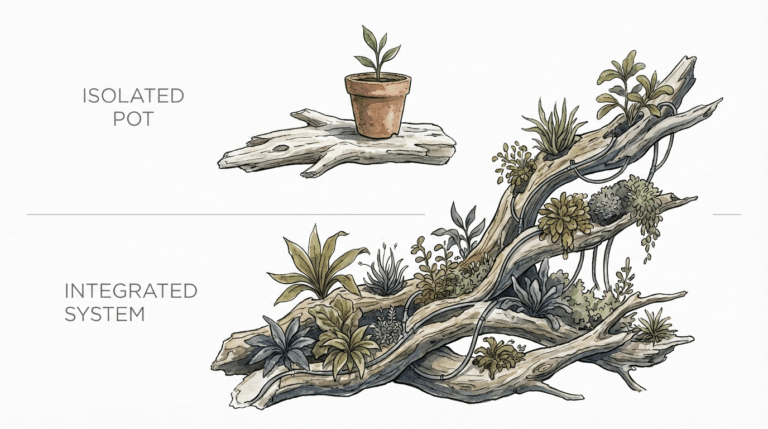
- Incorporate Living Elements: Treat the shelf as an ecosystem. Place trailing plants like Pothos or Philodendron on the highest points so the vines can mimic the natural flow of water over the wood.
Advanced Considerations: Integrating Technology and Life
For the serious practitioner, biophilic shelving can be more than just a surface; it can be an integrated system. Advanced designs incorporate “hidden” features like routed-out channels for wireless charging pads or integrated irrigation lines for a series of small, built-in planters.
Scaling these considerations means thinking about the “Nature of the Space.” In a large apartment, you can use biophilic shelving to create “Refuge” or “Mystery”—two more of the 14 Patterns. For example, a series of staggered organic shelves can act as a room divider, partially obscuring the view and enticing a person to explore the space further, mimicking the way one might navigate a forest.
Example Scenario: The Workspace Transformation
Consider a 600-square-foot apartment in a dense city like London or New York. The inhabitant works from a desk tucked into a corner, facing a white wall. By replacing a standard IKEA shelf with a 4-foot piece of reclaimed pier timber, the entire atmosphere shifts.
The inhabitant mounts the timber using heavy-duty hidden steel rods. They sand the top surface flat to hold a laptop riser but leave the “live edge” facing out. To finish, they apply three coats of hand-rubbed tung oil. They add a few clay pots with ferns and a small stone tray for pens. The result is a workspace that no longer feels like a cubicle. It feels like a workstation on the edge of the world, where the “chaotic geometry” of the wood provides a visual anchor that keeps the mind from wandering into urban anxiety.
Final Thoughts
Your living space should be a reflection of the earth you walk upon, not just the city you work in. Biophilic shelving is a practical, powerful tool for breaking the cycle of straight lines and reclaiming the biological heritage that urban design so often ignores. It requires a bit of grit to source and install, but the rewards are measured in a deeper sense of peace and a more resilient state of mind.
Bringing the wild indoors is an act of restoration. It is about more than just furniture; it is about creating a habitat that supports the human animal. Start with one piece of wood, one shelf, and one connection to the ancient earth. You will find that once you break the box, the city outside feels a little less imposing and the world inside feels infinitely more alive.
Sources
1 rentcafe.com (https://www.rentcafe.com/blog/daily-living/2024-biophilic-interior-design-ideas-for-apartments/) | 2 silphiumdesign.com (https://silphiumdesign.com/curves-influence-emotional-design-psychology/) | 3 bmdesigngroup.com.au (https://bmdesigngroup.com.au/blog/psychology-of-curved-architecture-organic-forms-architecture/) | 4 vietaquaticwoods.com (https://vietaquaticwoods.com/natural-aquarium-driftwood-supplier/) | 5 vermontwoodsstudios.com (https://vermontwoodsstudios.com/blogs/recent-articles/wood-sourcing-certifications) | 6 coastalcottagebyceleste.com (https://www.coastalcottagebyceleste.com/diy/lr0iwt1wrtsiz0a4dzvpbq3m5awhyk) | 7 youtube.com (https://www.youtube.com/watch?v=ggDsw1nQDQ8) | 8 artisanfurniture.in (https://www.artisanfurniture.in/discover-the-top-7-tips-for-ethical-wood-sourcing-in-furniture/) | 9 biophilic-innovations.co.uk (https://biophilic-innovations.co.uk/the-14-patterns-of-biophilic-design-explained/) | 10 plantsolutions.com (https://plantsolutions.com/biophilic-design-cure-for-urban-isolation) | 11 gardenonthewall.com (https://www.gardenonthewall.com/blog/the-psychology-of-shapes-in-nature-inspired-interior-design) | 12 decoratingden.com (https://arose.decoratingden.com/embracing-nature-biophilic-interior-design-tops-the-2024-trend-list/) | 13 clementstudio.com.au (https://clementstudio.com.au/blogs/latest-articles/the-rise-of-biophilic-interior-design-in-2024) | 14 terrapinbrightgreen.com (https://www.terrapinbrightgreen.com/wp-content/uploads/2014/09/14-Patterns-of-Biophilic-Design-Terrapin-2014p.pdf) | 15 urbandesignlab.in (https://urbandesignlab.in/building-healthier-cities-the-power-of-biophilic-design/) | 16 rayon.design (https://www.rayon.design/blog/5-interior-designs-trends-to-watch-in-2024) | 17 utoronto.ca (https://www.artsci.utoronto.ca/news/new-psychology-research-why-do-we-prefer-curves-over-straight-edges) | 18 architizer.com (https://architizer.com/blog/inspiration/stories/psychology-curves-and-lines-architecture/) | 19 chalkstudio.design (https://www.chalkstudio.design/blog-most-popular-biophilic-interior-design-styles-in-2024-ft-chalk-studio) | 20 integrishealth.org (https://integrishealth.org/resources/on-your-health/2024/january/biophilic-design) | 21 terrapinbrightgreen.com (https://www.terrapinbrightgreen.com/reports/14-patterns/) | 22 biophilicproducts.org (https://biophilicproducts.org/biophilic-design-blog/14-patterns-of-biophilic-design/)