Custom Driftwood Shelf Engineering
Stop buying solutions designed to break and start producing the infrastructure your life actually requires. The consumer waits for a sale; the producer waits for a storm. Learn to engineer your own heavy-duty shelving using the ocean’s free resources and a few basic tools.
[affiai]Building your own furniture is a rite of passage for the master producer. Most modern shelving is little more than compressed dust and plastic glue, destined to sag under the weight of a few hardback books. When you source material from the coastline, you are working with wood that has already been tempered by the most brutal forces on Earth.
The saltwater, the sun, and the relentless mechanical action of the tides act as a natural kiln. This process strips away the soft, vulnerable sapwood and leaves behind a dense, resilient core. Understanding how to harness this raw power requires more than just a hammer and nails; it requires an engineering mindset.
You must learn to see the structural potential in a weathered log. Every piece of driftwood tells a story of survival, and your job is to give that story a permanent place on your wall. This guide will walk you through the grit and the geometry of turning ocean-washed timber into heavy-duty infrastructure.
Custom Driftwood Shelf Engineering
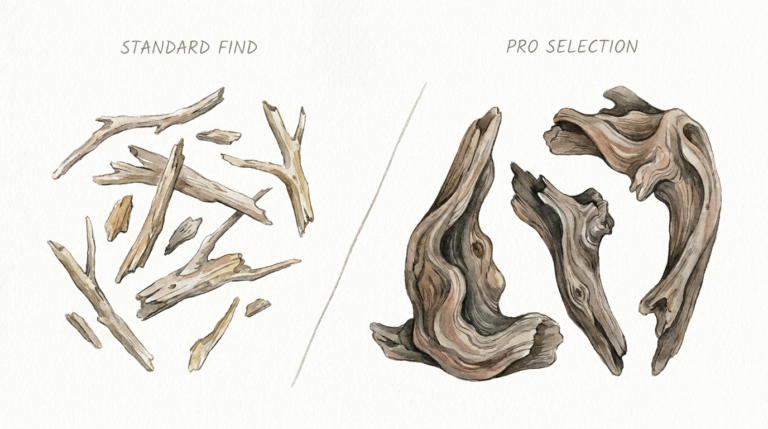
Custom driftwood shelf engineering is the process of selecting, stabilizing, and mounting naturally weathered timber for structural use. Unlike dimensional lumber found at a hardware store, driftwood is irregular, non-linear, and biologically complex. Engineering these pieces into shelves requires a deep understanding of wood density and load-bearing physics.
True driftwood has undergone a unique seasoning process. Years of immersion in saltwater often “pickle” the wood, while the sun’s UV rays bleach and harden the exterior fibers. This creates a material that is often more stable than green wood, provided you know how to handle its eccentricities. In the real world, these shelves are used in coastal homes, rustic workshops, and high-end architectural projects where standard shelving fails to provide the necessary character or strength.
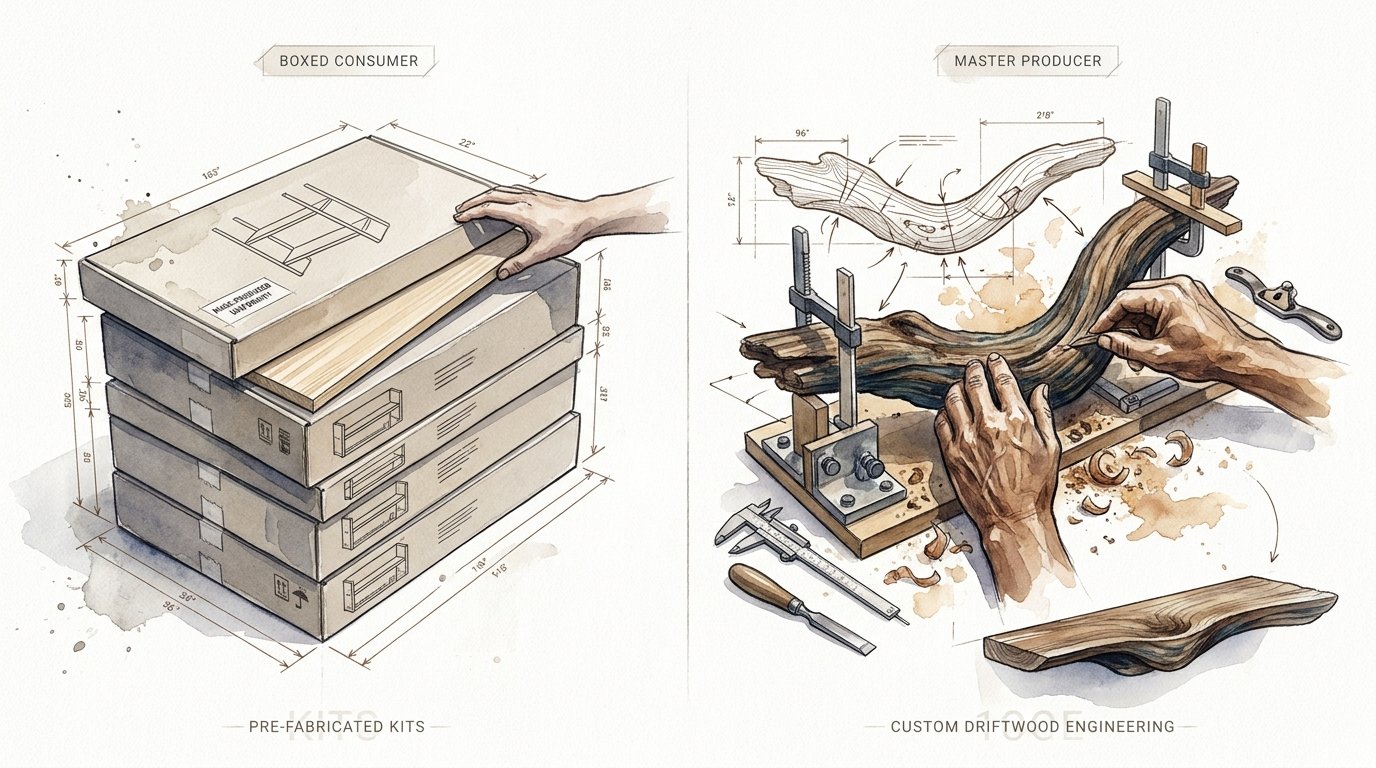
Think of driftwood as the “reclaimed” timber of the natural world. While a “Boxed Consumer” buys a shelf made of MDF, a “Master Producer” engineers a shelf from a piece of oak or cedar that has survived a decade at sea. This approach treats the wood as a structural beam rather than a decorative accessory. It involves assessing the grain direction, checking for internal rot, and calculating the lever-arm force that will be applied to your wall studs.
The Master Producer’s Workflow: From Shore to Wall
Engineering a heavy-duty shelf begins long before you pick up a drill. You must follow a rigorous process to ensure the timber is safe, stable, and strong enough for the task.
Sourcing and Legal Ethics
Collecting driftwood is not a free-for-all. Many regions have strict regulations to protect coastal ecosystems. In places like Oregon, you are generally permitted to take “small amounts” for personal use, often defined as what one person can carry by hand. However, removing logs embedded in dunes or using mechanized equipment is typically prohibited. Always check local wildlife or park service rules to ensure your harvest is legal and ethical.
The Desalination Process
Salt is the enemy of metal hardware and long-term wood stability. If you ignore the salt content, your shelf will “sweat” in humid weather and corrode your mounting brackets. You must soak your timber in fresh water for several days to draw out the salt. Change the water daily until it remains clear. For smaller pieces, boiling the wood for two hours can accelerate this process and kill any dormant pests.
Sterilization and Pest Control
Beach-combed wood is often a haven for sand gnats, beetles, and bacteria. After the fresh water soak, you must sterilize the wood. A solution of one part bleach to ten parts water is standard for killing surface mold and microbes. For deep-seated pests, heating the wood in an oven at 200°F (93°C) for two to four hours is the gold standard. This temperature is high enough to kill insects without reaching the ignition point of the wood.
Milling and Scribing
The greatest challenge in driftwood engineering is the lack of flat surfaces. To create a functional shelf, you must create at least one flat plane for the items to sit on and one flat plane to meet the wall. Using a drawknife or a portable sawmill is common for larger logs. For the wall-facing edge, use a technique called “scribing.” This involves holding the wood against the wall and using a compass to trace the wall’s irregularities onto the timber, ensuring a gap-free fit.
Advantages of Coastal Timber Engineering
The benefits of using driftwood for shelving extend beyond simple aesthetics. When you engineer your own solutions, you gain measurable advantages in durability and cost.
- Structural Resilience: Driftwood has already been “stress-tested” by the ocean. Pieces that haven’t cracked or shattered under the pressure of the tides are likely to hold up under significant static loads indoors.
- Zero Material Cost: The raw material is free. While the “Boxed Consumer” spends hundreds on mass-produced kits, the producer invests only time and sweat equity.
- Natural Seasoning: Saltwater immersion can sometimes act as a preservative, making the wood more resistant to future rot if properly finished.
- Unique Geometry: No two pieces are the same. This allows for bespoke designs that fit perfectly into specific alcoves or corners where standard shelving would look out of place.
Common Pitfalls and How to Avoid Them
Beginners often underestimate the complexity of working with weathered wood. Avoiding these common mistakes will save your walls and your sanity.
Ignoring the Moisture Content: Just because wood feels dry to the touch doesn’t mean it is. Using a moisture meter is essential. If the internal moisture is above 12%, the wood will warp or crack once it enters a climate-controlled home. Allow the timber to acclimate to your indoor environment for at least two weeks before final mounting.
Underestimating Leverage: A heavy driftwood shelf acts as a long lever. The deeper the shelf, the more rotational force it exerts on the wall mounting. Many DIYers use simple drywall anchors, which will eventually pull out. You must secure your brackets directly into the center of wall studs using heavy-duty lag bolts.
Skipping the Grain Inspection: Driftwood can have “hidden” rot. Use a small awl or screwdriver to poke the wood. If it sinks in easily, that section is compromised. You must cut back to solid, sound timber before proceeding with the build.
Realistic Constraints and Limitations
While driftwood is a powerful resource, it is not a universal solution. Understanding its boundaries is a mark of a true practitioner.
Environmental limitations are the primary concern. Driftwood from heavily polluted industrial harbors may contain heavy metals or chemical runoff. Avoid pieces that smell like oil or chemicals, as these can off-gas in your home. Furthermore, very soft woods like rotted pine or hemlock may never achieve the structural rigidity required for a heavy-duty book shelf, regardless of how much epoxy you use.
The irregular shape also limits the “useful” surface area. A log that looks massive on the beach might only yield a 4-inch deep shelf once it is squared off and scribed. You must manage your expectations regarding the ratio of raw material to finished product.
Heritage Timber vs. Disposable Fiberboard
Understanding the difference between engineered driftwood and commercial options is critical for long-term planning.
| Feature | Master Producer (Driftwood) | Boxed Consumer (MDF/Particleboard) |
|---|---|---|
| Material Lifespan | 50+ Years (Increases character with age) | 5-10 Years (Degrades/Peels) |
| Weight Capacity | High (Limited only by bracket/stud) | Low (Prone to “creep” and sagging) |
| Moisture Resistance | High (Natural seasoning + sealant) | Extremely Low (Swells and disintegrates) |
| Repairability | Full (Can be sanded and refinished) | None (Disposable if damaged) |
Practical Tips for Success
Follow these best practices to ensure your shelving stands the test of time.
- Use Hidden Floating Brackets: For a clean “floating” look, drill deep, straight holes into the back of the driftwood and use steel rods or specialized floating shelf brackets. This transfers the load directly into the wall studs without visible hardware.
- Stabilize with Epoxy: If you find a piece with beautiful cracks or “checks,” don’t discard it. Use a two-part clear epoxy to fill the voids. This bonds the wood together and prevents the cracks from spreading.
- Finish with Penetrating Oils: Avoid thick, plastic-like polyurethane. Use tung oil or boiled linseed oil. These soak into the wood and highlight the natural weathering while providing a breathable barrier.
- The “Tap” Test: When sourcing, hit the wood with a stone. A solid piece will produce a high-pitched “clack,” while a rotted piece will produce a dull thud. Only take the “clack” wood.
Advanced Considerations for Practitioners
For those looking to push the boundaries of driftwood engineering, consider the physics of “Live Edge” mounting. When working with extremely heavy timber—such as a 100-pound cedar log—the mounting system must be over-engineered.
Consider using a **French Cleat** system. A French cleat involves cutting a 45-degree angle along the back of your shelf and a matching angle on a piece of hardwood secured to the wall. This distributes the weight across the entire length of the shelf rather than focusing it on two or three points.
Furthermore, advanced builders often “bookmatch” driftwood. This involves slicing a large log down the center and unfolding it like a book to create two symmetrical shelves. This requires a bandsaw and a steady hand, but the resulting visual impact is unparalleled in commercial furniture.
Scenario: The Heavy-Duty Kitchen Spice Beam
Imagine you have found a dense, four-foot piece of weathered oak. It is 5 inches thick and incredibly heavy. To turn this into a kitchen shelf capable of holding cast iron pans and heavy jars, you cannot rely on standard brackets.
First, you mill the top surface flat using a hand plane. You leave the front edge raw and “live” to show the ocean’s erosion. On the back, you scribe the wood to match the slightly bowed kitchen wall. You then drill three 3/4-inch holes, 6 inches deep into the back of the beam.
In the wall, you locate three studs and drive 8-inch steel lag bolts into them, then cut the heads off the bolts to create “rebar pins” protruding from the wall. You slide the oak beam onto these pins. The result is a shelf that looks like it is naturally emerging from the wall, yet it can easily support over 100 pounds without a millimeter of deflection.
Final Thoughts
Engineering your own infrastructure is about more than just saving money; it is about reclaiming the role of the producer. Driftwood shelving is a perfect entry point into this mindset because it forces you to collaborate with nature rather than trying to dominate it. You must listen to what the wood tells you about its strength and its limits.
The transition from a consumer to a master producer happens the moment you realize that the world is full of high-quality raw materials waiting to be discovered. The ocean provides the timber, and your grit provides the engineering.
Take the time to source your material correctly, treat it with respect, and mount it with precision. When you look at a shelf you hewed from a storm-washed log, you won’t just see a place to put your keys. You will see a testament to your own capability and a permanent upgrade to your environment.
Sources
1 youtube.com (https://www.youtube.com/watch?v=c3j9o7yTMss) | 2 shelfology.com (https://shelfology.com/blogs/shelfology-u/ask-the-shelf-experts-what-are-the-best-woods-for-floating-shelves) | 3 dksstores.com (https://dksstores.com/blog-post6) | 4 hawk-hill.com (https://www.hawk-hill.com/how-to-clean-driftwood/) | 5 sos.state.or.us (https://vertexaisearch.cloud.google.com/grounding-api-redirect/AUZIYQESMO5mr_hZUqPTysXRIOE569MhBx3MyANWhCTmsVLn8dYQVoF_S0A-h8SG6Rs4HhblB8bznc2OJu_4KiE-FMa9MkbwH-w7P9iz6I4o4z6QLH1iX-4hzINtQYKa9Do8f8w-S3mNwzuNRjfKngzEsYuCVgCGLEPHN_P89KcxIB74VsMsX-Nmyg==) | 6 public.law (https://oregon.public.law/rules/oar_736-026-0010) | 7 thriftyfun.com (https://www.thriftyfun.com/Sterilizing-and-Desalinizing-Driftwood.html) | 8 parklanejewelry.com (https://www2.parklanejewelry.com/how-to-clean-driftwood/) | 9 youtube.com (https://www.youtube.com/watch?v=OVrOk5Ly_eI) | 10 masterplankuk.com (https://masterplankuk.com/blogs/news/shelves-with-wood-a-comparison-guide-to-solid-timber-and-handcrafted-styles) | 11 shelfexpression.net (https://shelfexpression.net/blogs/topshelf/not-all-wood-is-created-equal)