Real Driftwood Shelf Vs Resin Imitation
Is your home decor secretly off-gassing chemicals, or was it cured by the Pacific Ocean for twenty years? Retailers sell the ‘look’ of the ocean using factory molds and toxic resins. Real driftwood offers a salt-hardened density that no factory can replicate and no chemical can match.
[affiai]When you bring a piece of the coast into your home, you aren’t just adding a shelf; you are bringing in a story of survival. For decades, that wood has been tossed against barnacle-encrusted rocks, bleached by relentless UV rays, and saturated with sea salt until its very cellular structure changed. Most modern furniture is built for a season, but driftwood was forged for a lifetime at sea.
Choosing between a natural salt-cured specimen and a synthetic resin imitation is more than a style choice. It is a decision between the authentic grit of the shoreline and a hollow, plastic-poured replica. If you are ready to stop settleing for factory-made “coastal vibes” and want the real thing, let’s look at what actually makes driftwood the superior choice for your walls.
Real Driftwood Shelf Vs Resin Imitation
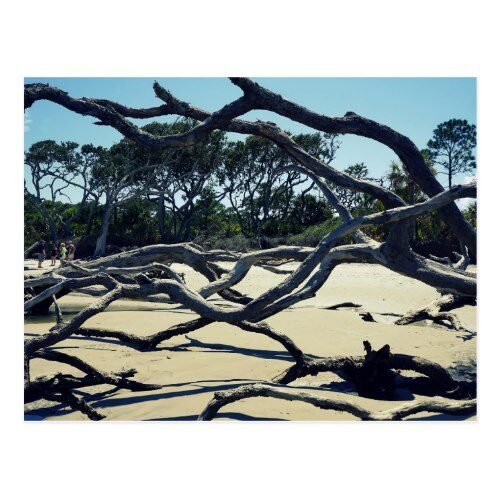
Real driftwood is wood that has been washed onto a shore or beach of a sea, lake, or river by the action of winds, tides, or waves. In the context of the Pacific Northwest, this wood is often the remnants of ancient forests, fallen giants that have spent years or even decades in the water. Over time, the saltwater acts as a natural preservative, leaching out the soft sapwood and leaving behind the dense, rot-resistant heartwood.
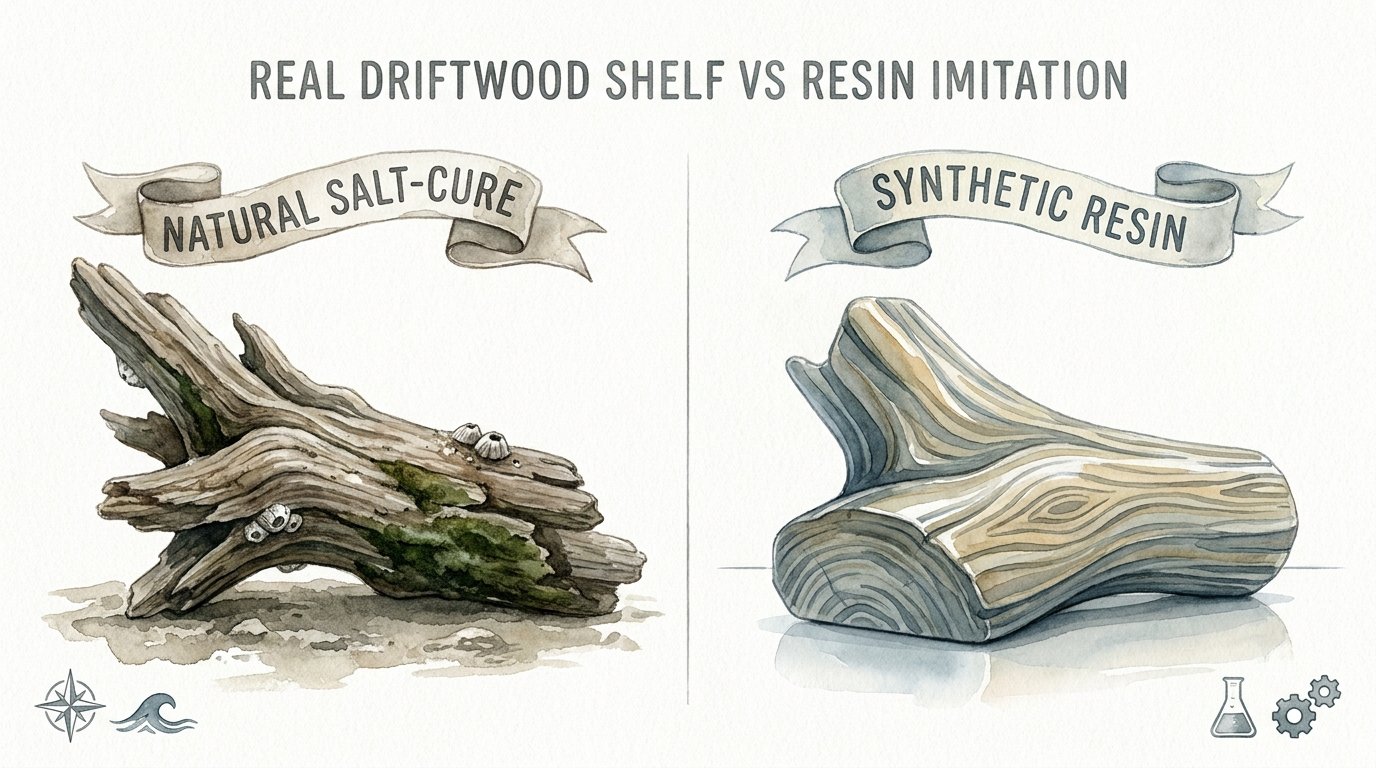
Resin imitations, on the other hand, are mass-produced in industrial facilities. These “faux wood” pieces are created by pouring liquid polyurethane or polyester resin into a silicone mold taken from a real piece of wood. While they can look convincing from a distance, they lack the soul and the physical properties of the original.
In a real-world home environment, the difference becomes apparent the moment you touch the surface. Real driftwood feels cold, heavy, and textured, with a grain that tells the history of its erosion. Resin feels like plastic because it is plastic. It is a static object that doesn’t breathe, doesn’t age gracefully, and—most importantly—doesn’t offer the structural integrity of salt-hardened timber.
How the Natural Salt-Cure Process Works
The “Pacific cure” isn’t something you can buy in a bottle. It is a slow, chemical transformation that occurs when timber is submerged in high-salinity environments. Understanding this process helps you appreciate why a real driftwood shelf is so much tougher than a standard piece of pine from the local lumber yard.
Salt Permeation and Mineralization
When wood floats in the ocean, the high osmotic pressure of the saltwater forces sodium chloride (NaCl) and other minerals deep into the wood’s pores. As the wood dries out on the beach, these salt crystals remain trapped within the fibers. This process, known as mineral absorption, significantly increases the mechanical strength of the wood. Studies have shown that coniferous woods like pine and larch actually see an increase in tensile strength after being saturated in seawater.
The Erosion of Soft Tissues
The ocean is a brutal sandblaster. As a log is tossed in the surf, the softer, less dense parts of the wood—the sapwood and bark—are stripped away. What remains is the gnarled, dense core. This is why driftwood often has those beautiful, smooth, sculptural shapes. The “fluff” has been removed by nature, leaving only the most durable parts of the tree.
Natural Sanitization
While the ocean is full of life, the combination of high salinity and intense UV exposure from the sun acts as a primary sanitizing agent. The salt inhibits the growth of many common land-based fungi and wood-boring insects. By the time a piece of driftwood is sun-bleached to that iconic silver-gray, it has been naturally “kiln-dried” by the environment, making it remarkably stable for indoor use.
Benefits of Choosing Real Driftwood
The most immediate benefit of real driftwood is its uniqueness. No two pieces of wood are eroded by the ocean in the same way. When you install a floating driftwood shelf, you are guaranteed to have a one-of-a-kind piece that cannot be found in a big-box catalog.
Health and Air Quality
Unlike resin imitations, real driftwood does not off-gas volatile organic compounds (VOCs). Many synthetic resins and the adhesives used in composite “wood-look” furniture release formaldehyde and other chemicals into your home for years after purchase. Real wood, especially when finished with natural oils like Tung or Linseed, provides a clean, non-toxic alternative that improves your indoor air quality rather than compromising it.
Durability and Density
Salt-cured wood is incredibly dense. Because the sea has already removed the parts of the wood prone to rotting or shrinking, the final product is highly stable. It won’t warp or twist like “green” lumber often does when introduced to the dry air of a climate-controlled home. This makes it an ideal material for heavy-duty shelving that needs to hold weight without sagging.
Challenges and Common Mistakes
The biggest challenge with real driftwood is sourcing it legally and ethically. Many people assume they can just back a truck up to any beach and start loading, but regulations vary wildly. In many National Parks, it is strictly illegal to remove any natural material, including driftwood. In states like California, there are often daily weight limits (such as 50 pounds per day) for personal use.
Pests and Microorganisms
While salt-curing helps, it isn’t a 100% guarantee against pests. A common mistake is bringing “fresh” driftwood directly into the house without a secondary treatment. If the wood has been sitting in a damp area of the beach or near a river mouth, it may have picked up hitchhikers like termites or carpenter ants. Always inspect the wood for small “pinholes” or “frass” (wood dust) which indicates active insect activity.
Structural Mounting
Driftwood is rarely straight. This makes mounting it as a shelf a bit of a puzzle. Beginners often try to use standard L-brackets, which can look clunky and ruin the aesthetic. The challenge lies in finding the “level” line on a gnarled piece of timber and drilling precise holes for hidden floating shelf anchors.
Limitations of Driftwood Decor
Driftwood has its boundaries. Because it is a natural product, it is susceptible to leaching. If you use a salt-cured shelf in a high-moisture environment like a bathroom without a proper seal, the salt within the wood can actually draw moisture from the air. Over time, this can lead to “salt damp” or cause the wood to feel slightly sticky.
Additionally, driftwood can be brittle. The same process that makes it dense and hard can also make it prone to splintering if you try to drive screws directly into it without pre-drilling. It doesn’t have the same “flex” as freshly milled lumber.
Comparison: Real Driftwood vs. Resin Imitation
| Feature | Real Driftwood | Resin Imitation |
|---|---|---|
| Chemical Off-gassing | None (100% Natural) | High VOCs / Formaldehyde |
| Texture & Feel | Deep grain, cold to touch | Smooth, plastic-like feel |
| Density & Strength | Salt-hardened, very high | Medium (brittle) |
| Longevity | Decades to centuries | 5-10 years (sun-sensitive) |
| Authenticity | Unique story/history | Mass-produced clone |
Practical Tips for Preparing Driftwood Shelves
If you’ve found the perfect piece of timber on a legal beach, your work is only beginning. To ensure it is safe for your home, follow these steps:
- Scrub and Blast: Use a stiff nylon brush and a high-pressure hose to remove sand, salt crust, and loose organic matter from every crevice.
- The Bleach Soak: Submerge the wood in a solution of 1 part bleach to 9 parts water for 24 hours. This kills bacteria, mold spores, and any remaining insects deep in the grain.
- Slow Drying: Do not put wet driftwood in direct sunlight or near a heater immediately, as this can cause it to crack. Let it air dry in a shaded, well-ventilated area for at least two weeks.
- The Hot Needle Test: If you aren’t sure if a piece of decor is real wood or resin, heat a needle until it is red-hot and press it into an inconspicuous spot. If it sinks in and smells like burning plastic, it’s resin. If it resists and smells like a campfire, it’s real wood.
For finishing, stay away from shiny polyurethanes. They make real driftwood look like cheap resin. Instead, use a matte wax or a natural oil. These finishes penetrate the wood and highlight the grain without creating an artificial “plastic” shell.
Advanced Considerations: Stabilization
For serious practitioners, “raw” driftwood may sometimes be too soft if it has suffered from internal rot before it was salt-cured. In these cases, you can use a wood stabilizer. This is a thin, liquid resin (ironically) that is pulled into the wood fibers under a vacuum.
However, unlike cheap resin furniture, this process uses the resin to reinforce the natural wood structure rather than replace it. This is particularly useful for “spalted” driftwood—wood with beautiful black lines caused by ancient fungal activity—which is visually stunning but often structurally weak.
Example Scenario: The Great Room Focal Point
Imagine a wide, open-concept living room with a stone fireplace. Instead of a standard mahogany mantel, the homeowner installs a six-foot slab of Pacific Western Red Cedar driftwood.
The wood was found on a rugged stretch of the Oregon coast, showing the deep, silver-gray grooves of twenty years of salt exposure. Using heavy-duty 3/4-inch steel rods drilled directly into the wall studs, the shelf “floats” against the stone. It holds a collection of vintage books and a few pieces of sea glass. Because it is salt-cured, it handles the heat from the fireplace without cracking, and its natural scent—a mix of cedar and salt—faintly perfumes the room whenever the sun hits it.
Final Thoughts
The difference between real driftwood and resin imitation is the difference between a memory and a photograph. One has been through the fire—or in this case, the water—and has the scars to prove it. The other is a sterilized, chemical-laden copy designed for convenience over character.
By choosing real, salt-cured driftwood, you are investing in a piece of the natural world that is chemically safe, structurally superior, and visually incomparable. It takes more work to clean, cure, and mount, but the result is a home that feels grounded in the power of the Pacific.
Next time you are browsing a home decor aisle and see a “driftwood-style” shelf, remember the Pacific cure. Look for the weight, the smell of the grain, and the cold touch of mineral-hardened timber. Your home deserves the grit of the real ocean.
Sources
1 diydriftwood.com (https://diydriftwood.com/driftwood-refinishing-techniques/) | 2 oceanhomemag.com (https://www.oceanhomemag.com/home-design/driftwood-decor/) | 3 aliexpress.com (https://www.aliexpress.com/s/wiki-ssr/article/resin-driftwood-aquarium) | 4 cornell.edu (https://www.law.cornell.edu/regulations/california/14-CCR-4306) | 5 hawk-hill.com (https://www.hawk-hill.com/how-to-clean-driftwood/)